Someone did. With Rosecrans gone and half the army streaming north, command of everything still left on the field fell to Maj. Gen. George H. Thomas (North), and what Thomas did over the next several hours saved the Union army from destruction.
Thomas was a Virginian and a former slaveholder, born in Southampton County into a planter family that owned enslaved people, born into the very world the Confederacy was fighting to preserve, and he had chosen the Union over his native South. His own sisters disowned him for it and turned his portrait to the wall. The man who now stood between Bragg’s army and the annihilation of a Union force was a son of the slaveholding South who had turned his back on it to fight against it.
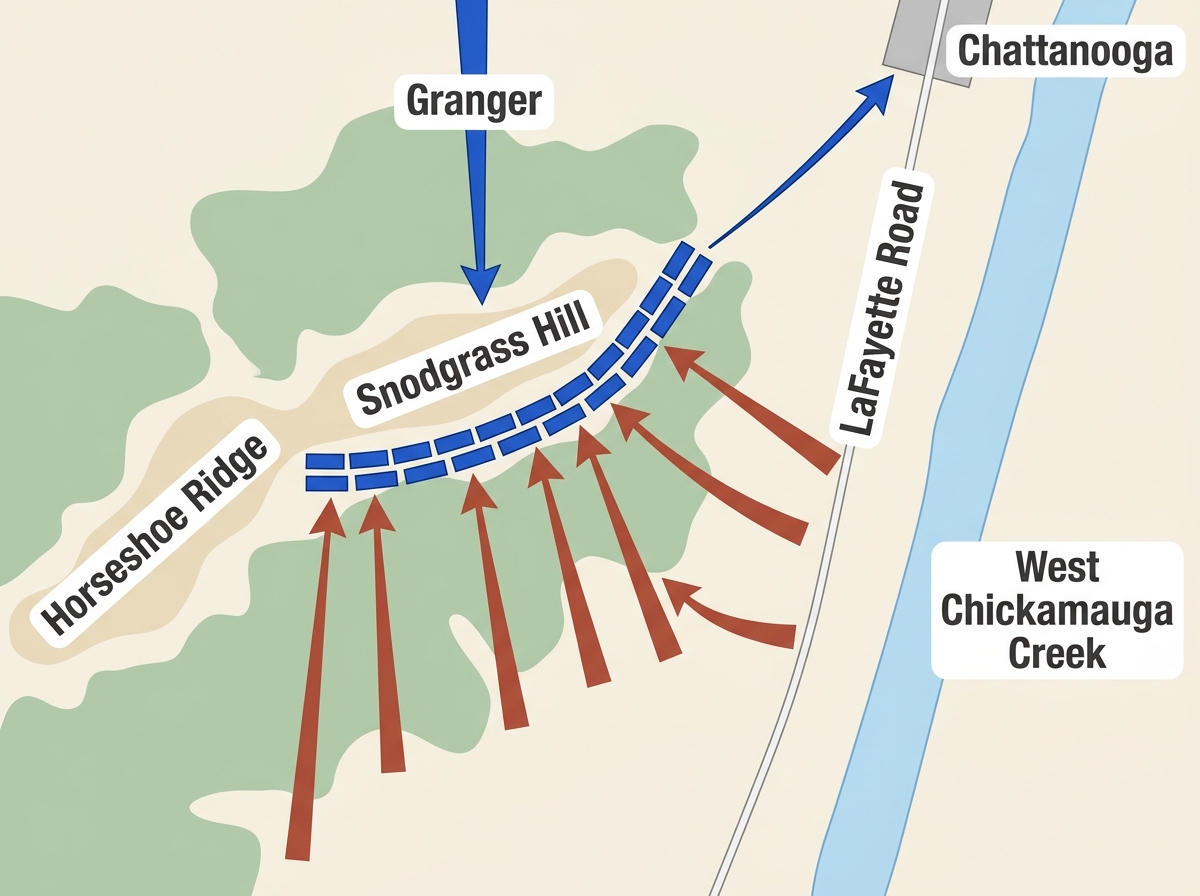
Thomas pulled what was left of the army back onto high ground at the rear of the field: Snodgrass Hill and Horseshoe Ridge, a series of steep, wooded knolls at the northwest of the battlefield. There he gathered the wreckage in person: broken regiments, orphaned units cut off from commanders who had already fled, men with no orders and nowhere to go. He rode the line under fire, set the survivors along the crest by hand, and told them to hold. And from around one in the afternoon until dark, they held. Wave after wave of Confederate assault came up the wooded slopes; each time the improvised line beat it back, and each time the ammunition ran lower, until men were stripping cartridge boxes off the dead and wounded to keep firing. Thomas stayed on the ridge through all of it, calm, immovable, the still point the broken army formed back around. Late in the afternoon the help arrived: Maj. Gen. Gordon Granger (North), commanding the Union Reserve Corps (a fresh body of troops Rosecrans had held back from the fighting and posted to the north to guard the roads), marched his men toward the sound of the guns without waiting for orders, reached Thomas at the breaking point, and threw his fresh brigades into the line as their cartridges gave out.
The Rock of Chickamauga
The story of how Thomas earned his nickname is woven into this stand, though the cleanest version of it is too tidy to fully trust. Garfield, Rosecrans’s chief of staff, made his way back toward the firing, the one staff officer who turned around, and reported that Thomas was holding, "standing like a rock." From that grew the name that stuck to him for the rest of history: the Rock of Chickamauga.
The honest version is that the name was earned on this ridge and attached to it afterward; the tidy story that Garfield coined it on the spot and it instantly caught on is folklore-tinged. No one used "Rock of Chickamauga" in print before 1869, and Garfield’s famous 1870 memorial line already presumes the phrase is familiar. Whatever the exact words and whoever first spoke them, the stand was real and the name was earned.
By holding Snodgrass Hill into the twilight, Thomas bought the time the rest of the army needed to fall back in order rather than be hunted down piecemeal. When darkness finally let him disengage, what could have been the annihilation of the Army of the Cumberland had been turned into a hard, costly, but organized withdrawal toward Chattanooga.
Thomas turned a rout into a retreat. His stand on Snodgrass Hill and Horseshoe Ridge, reinforced by Granger marching to the guns, held the field until nightfall and let the broken army escape into Chattanooga as an army, not a mob. The battle was lost. The army was not, and that distinction is the whole reason there was still a Union force in the West to fight the next round.