The attack went in late in the day. In the early afternoon of April 9, regiments of the United States Colored Troops began probing the Confederate skirmish line on the Union right, feeling for the strength of the defense and drawing fire. Then, near 5:30 in the evening, the whole Union line rose out of its trenches at once, along nearly the entire front, and charged across the open ground toward the earthwork.
On the far Union right, closest to the river, came the division of Black soldiers under Brigadier General John P. Hawkins (North), three brigades of United States Colored Troops thrown straight at the part of the line held by Thomas’s young Alabama reserves. They went in over the worst of the ground, into the cleared field thick with felled trees and sharpened stakes and buried shells. Men were hit by rifle and cannon fire the instant they stood up, and others were blown apart stepping on the subterra shells hidden in the grass. They kept going. They drove the Confederate skirmishers back into the main works, hacked their way through the rows of abatis, and reached the wall.
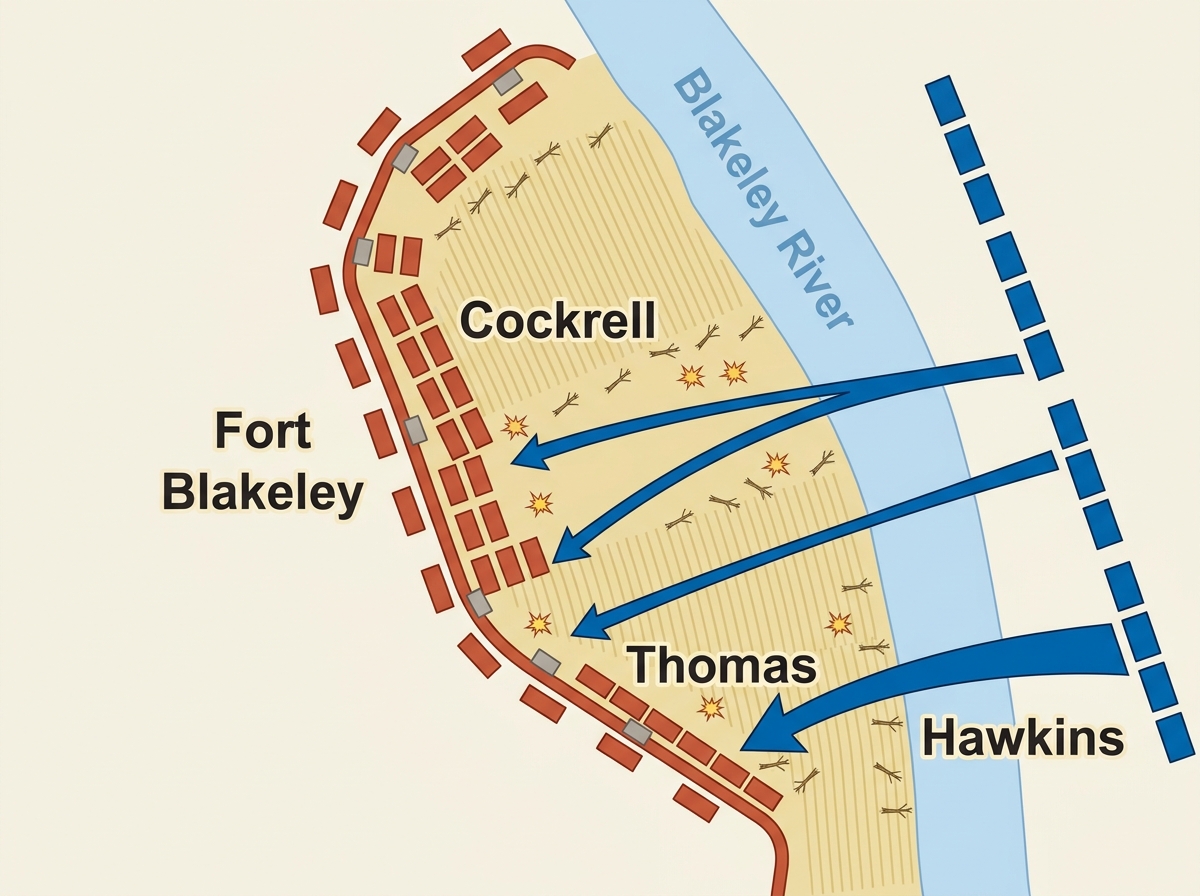
It was over almost as fast as it began. The line was simply too long and too thinly held to stop a rush on that scale. Once the attackers were through the obstacles and over the parapet at several points, the defense came apart. The fighting at the wall was close and savage where it happened at all, but it lasted only about thirty minutes from the charge to the collapse. Most of the garrison threw down their arms. A few dozen men got away across the river by boat; everyone else was killed, wounded, or, overwhelmingly, captured.
After the wall
Something ugly may have happened in the last minutes. Almost as soon as the fort fell, accounts surfaced that some Confederates were shot after they had surrendered, in the stretch of the line stormed by the Black regiments. It is not hard to see where the rage came from. The Confederate government had treated captured Black soldiers not as prisoners of war but as escaped property to be enslaved or killed, and the men of the United States Colored Troops knew it; they had crossed a minefield to reach a wall held by an army that did not recognize their right to surrender. The careful conclusion of historians who have studied it is that some Federal soldiers probably did fire on men who had given up, but that there was no large-scale massacre. The full truth of those chaotic thirty minutes is still argued over.
When the smoke cleared, the count told the story of a one-sided fight. The Union lost on the order of 150 killed and around 650 wounded across the whole siege and storm. The Confederates lost perhaps 75 killed, but more than 2,800 men were marched off as prisoners. Liddell’s garrison, the last army defending the last earthwork above Mobile, had effectively ceased to exist in half an hour.