On the afternoon of February 14, the gunboats came up the Cumberland to do to Fort Donelson exactly what they had done to Fort Henry, and the river fort was ready for them. The same weapon that had won the first fort almost by itself was beaten back from the second one, and beaten back hard. Grant was not even there to see it. He was downriver in a meeting.
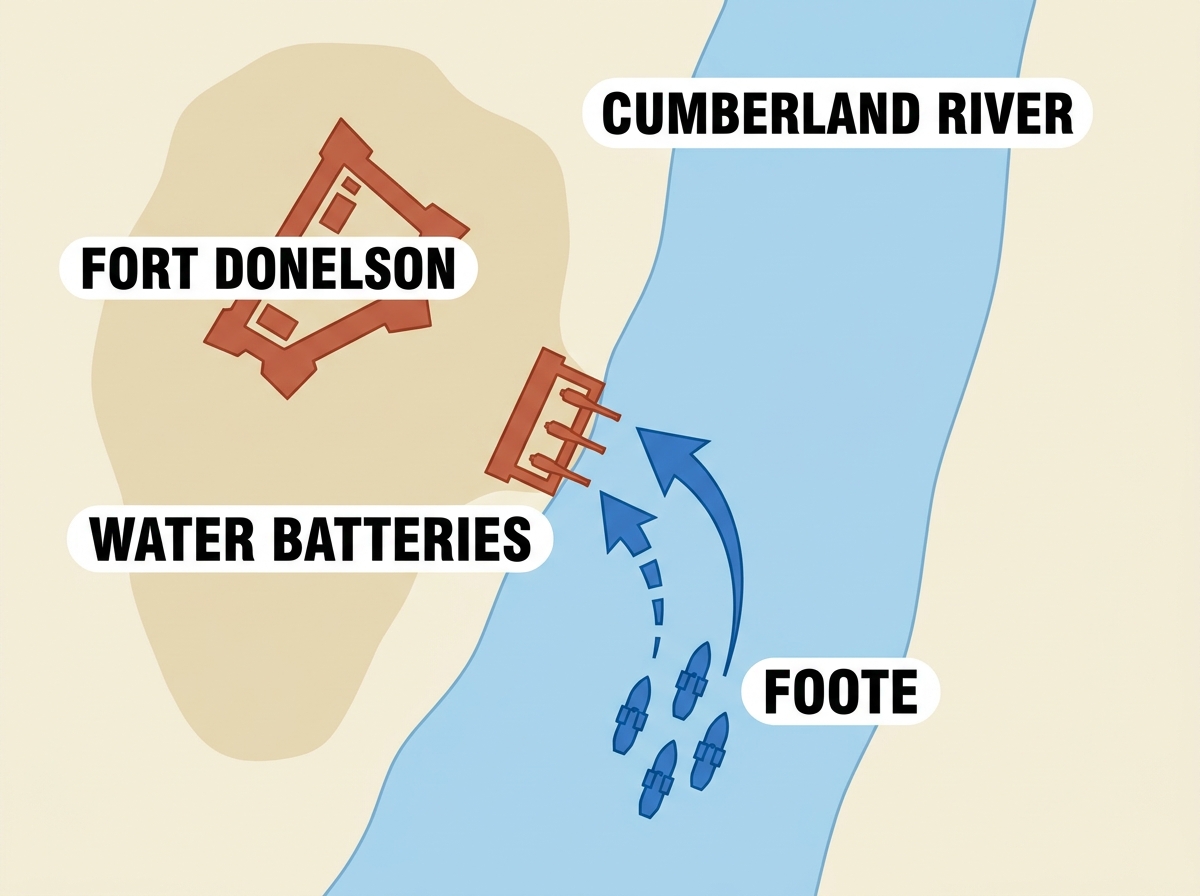
The thing the gunboats had to get past was the fort's water batteries, gun positions dug into the river bluff specifically to shoot at ships. Fort Donelson had two tiers of them stacked on the high west bank of the Cumberland, a lower battery down near the waterline and an upper battery above it, the heaviest gun among them a 10-inch Columbiad (a big smoothbore cannon) in the lower battery, with a rifled 64-pounder (a gun with a spiral-grooved barrel that spins the shot for more range and accuracy than a smoothbore) and a pair of 32-pounders up top. Sitting up on that bluff gave the Confederate gunners a brutal advantage. They could fire down onto the boats, plunging shot through the decks, while the river's strong downstream current and some flooding made it hard for the gunboats to hold position and aim back.
Closing to four hundred yards
Foote brought his whole flotilla up: four ironclads (the St. Louis, Carondelet, Louisville, and Pittsburg) and three timberclads behind them (older gunboats armored with thick wood instead of iron, the Tyler, Conestoga, and Lexington). The attack opened around 3:00 in the afternoon and lasted only about an hour and a half. Foote ran the same play that had worked at Fort Henry, closing right in to within about 400 yards (370 m) of the guns so his fire would tell.
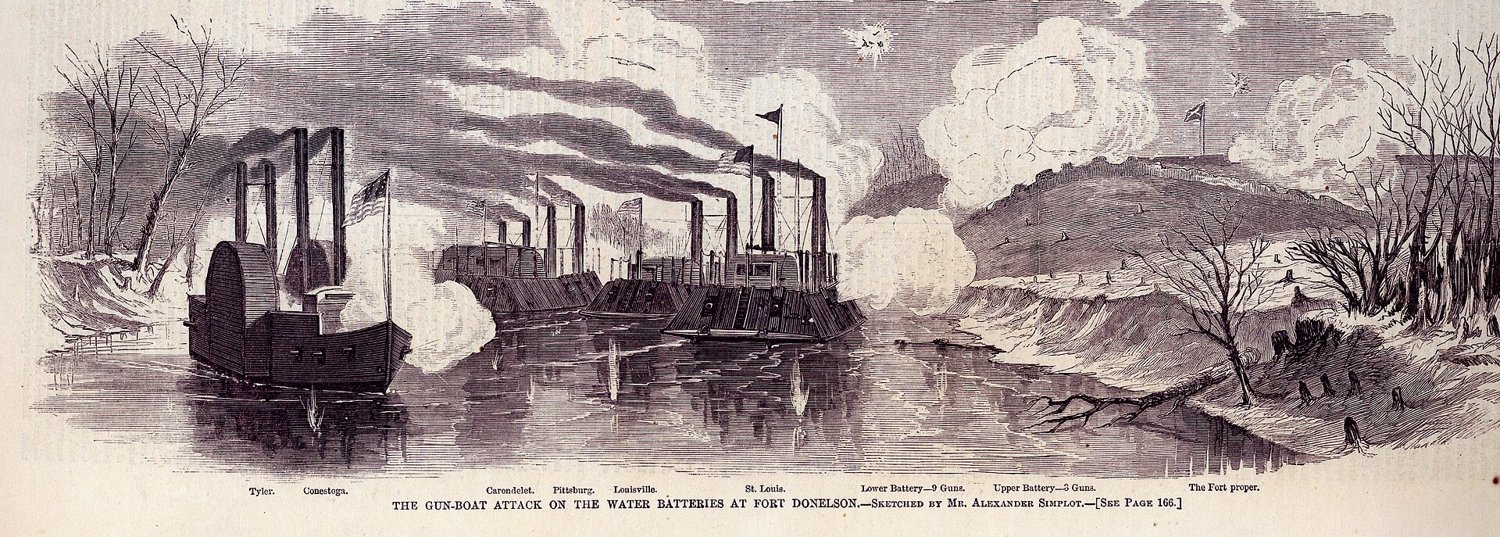
This time it was a fatal mistake. Up close and below the batteries, his boats took the plunging fire full in the face. The St. Louis was hit 59 times, the Carondelet 54 times, the Louisville 36 times, the Pittsburg 20 times. Two of the ironclads had their steering shot away, went unmanageable, and drifted helplessly downriver, and the rest of the flotilla pulled back after them. Foote himself was wounded, struck in the foot by wood splinters when a Confederate shot tore through the pilot house of his flagship St. Louis, a hurt he never fully recovered from. On the Union side, 8 sailors were killed and 44 wounded in that hour and a half. In the Confederate water batteries up on the bluff, not a single man was hit.
That lopsided afternoon rewrote Grant's whole plan. Fort Henry had fallen to gunboats alone; Fort Donelson had just thrown the gunboats off the river. There would be no naval shortcut here. If the fort was coming down, the army was going to have to take it the slow, bloody way, on foot, from the land side.