Where the Army of Tennessee bled to death
For a few minutes it looked like it might work, by one of the cruelest accidents of the day.
Out in front of the main Union line, south of the works, sat two brigades belonging to Brigadier General George D. Wagner (North), posted in an exposed advanced position. When the Confederate wave reached them, they were overwhelmed and fled back north toward the safety of the works, running, in effect, straight up the same ground the attackers needed to cross. The defenders on the main line held their fire to avoid shooting their own retreating men, so the last half-mile of the Confederate advance went largely uncontested. Wagner’s broken brigades partly masked the Union guns at the worst possible moment, and the attackers rode that lull right up to the wall. At the center, troops under Major General Patrick R. Cleburne (South) and Major General John C. Brown (South) drove through the deliberate gap at the Columbia Pike and into the Carter House yard. For one moment the Confederates were inside the Union line.
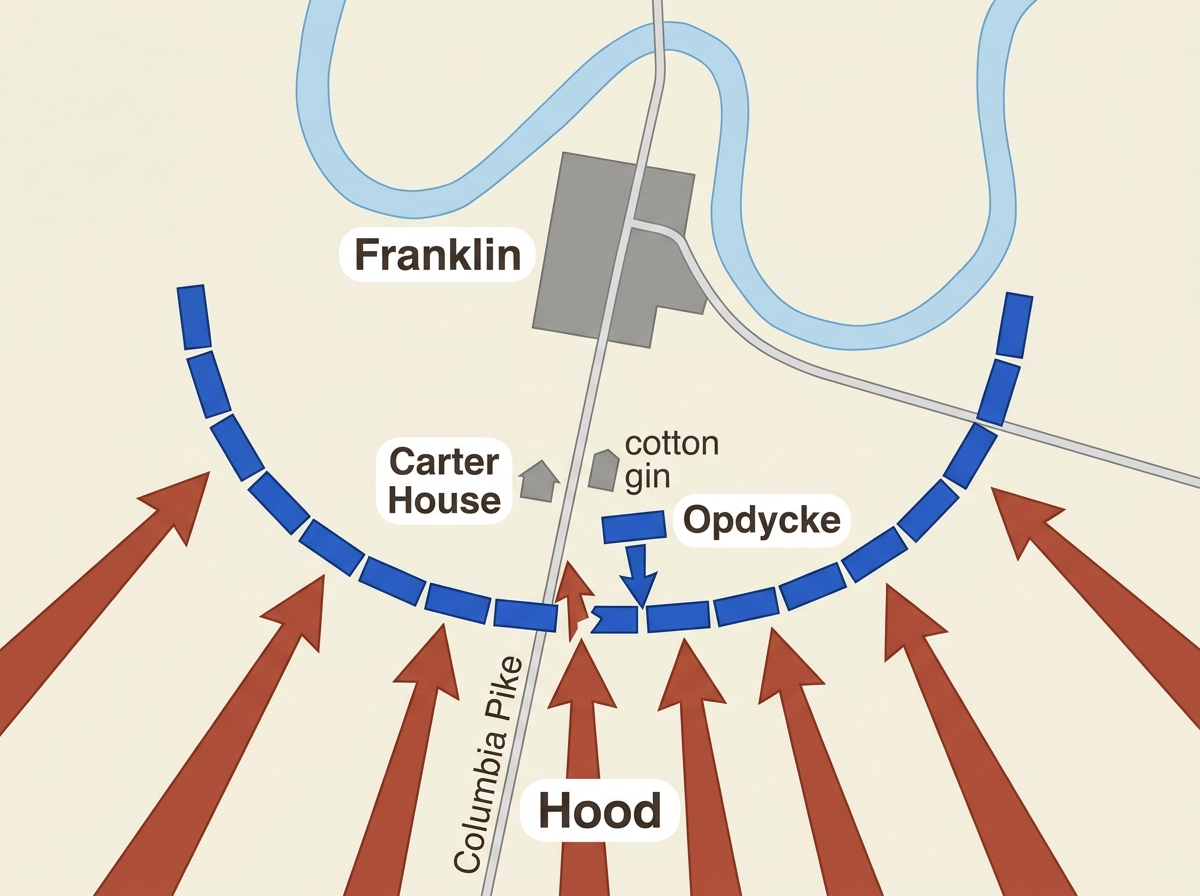
It did not hold, and the reason was a single colonel’s stubbornness, and behind him a wall of men who had spent the day getting ready to do exactly this. Colonel Emerson Opdycke (North), a brigade commander, had flatly refused to put his men out on the exposed forward line earlier in the day; he posted his brigade instead about two hundred yards behind the Carter House, in reserve. When the Confederates burst through the gap, Opdycke’s reserve was exactly where it needed to be. He counterattacked straight into the breach, gathered up rallied troops from Wagner’s broken brigades and the men holding the line at the house, and drove the Confederates back out of the works. The one Confederate penetration of the line was sealed shut almost as fast as it had opened. Major General David S. Stanley (North) was wounded helping rally the broken center near the Carter House.
With the breach closed, the battle did not become a breakthrough. It became a grinding, point-blank slaughter at the parapet, and the Union soldiers behind that earthen wall were the ones doing the killing. Rank after rank of Confederates came up out of the dark against the ditch and the wall, and the men in the works shot them to pieces, in some places firing into a mass so close they could not miss, for something like five hours. Thousands of dug-in Federals, secure behind dirt, emptied their rifles into men who had nowhere to go but forward into the muzzles or back across the open ground they had just crossed. The worst of it was at the cotton gin and the Columbia Pike, where the fighting went hand-to-hand, muzzle to muzzle. This is the stretch of dirt where the Army of Tennessee lost its leadership. Six Confederate generals were killed or mortally wounded here in a single afternoon, more general officers than fell at Gettysburg, Antietam, Chickamauga, or Spotsylvania, along with some fifty-five regimental commanders. It is where Cleburne fell, on foot after his horse was shot, somewhere in front of the cotton gin he had been driving toward.
When it was over, Schofield (North) did the thing that makes Franklin such a strange victory. Holding the town had never been his goal; getting his army and his wagons safely across the Harpeth and on to Nashville was. Once the trains were over the river, he carried out the plan he had had all along: after dark, his army quietly withdrew across the Harpeth and marched north, leaving the battlefield to Hood. Lieutenant General John Bell Hood (South) held the field at dawn, which let him call it a win. It was a hollow one. His army was wrecked, and it limped north in Schofield’s wake toward Nashville, where, two weeks later, it would be destroyed outright.
Western TheatreNashville: where Hood’s wrecked army was destroyed two weeks later