While the fight crawled across the slope, an army watched it from below and could not quite see it. Down in the valley around Chattanooga, tens of thousands of Union soldiers and officers stood looking up at Lookout Mountain all afternoon. But the cloud-band that had thickened across the slope hid the combat itself. They could see the bare summit standing clear above the cloud; they could hear the rattle and boom of the unseen battle muffled inside it; they simply could not see the men. A whole army stood riveted, watching a mountain smoke and rumble with a fight it could not lay eyes on.
The legend got its name in real time. Watching from the captured hill at Orchard Knob, the Union quartermaster general, Brigadier General Montgomery C. Meigs (North), the officer who ran the whole army’s supply, reached for a phrase to describe the thing in the cloud and called it “the Battle Above the Clouds,” and the name stuck before the gun smoke had cleared. The name was fastened onto a fight the namer could only half see, and it would outlive almost every hard fact about the day.
The hard facts are stubbornly modest. The Union lost on the order of 671 men, by the most-cited reckoning 89 killed, 471 wounded, and 111 captured or missing, though some accounts put the killed nearer 81 and the total nearer 629. The Confederates lost something over 1,250, of whom the great majority, around 1,064, were prisoners rather than dead. Fewer than two thousand men, all told, became casualties on that mountain. For comparison, the Battle of Chickamauga two months earlier, on the ground these same armies had just left, had cost something like 34,000. The Battle Above the Clouds, measured in blood, was one of the cheaper days of the war.
Western TheatreChickamauga: the 34,000-casualty fight these armies had just leftGeary himself, who had led the climb, wrote home to his wife in the full flush of pride that he had “stormed what was considered the … inaccessible heights of Lookout Mountain,” a feat he was sure would “be celebrated until time shall be no more.” The heights were considered inaccessible, and his men had gone up them. But the largest figure in the campaign saw the day very differently, and said so without mercy.
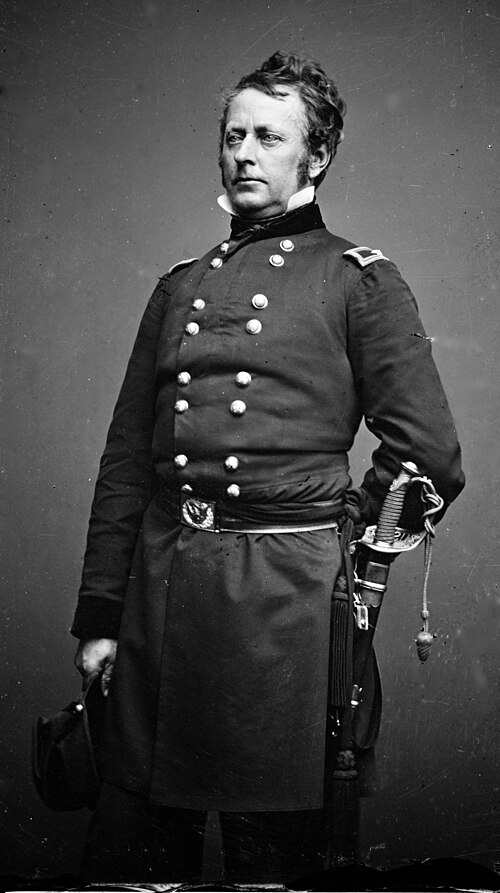
Grant thought the whole thing was overrated. He had not even wanted it fought as a battle, and when he came to write his memoirs years later he flattened the legend in a single famous passage:
“The battle of Lookout Mountain is one of the romances of the war. There was no such battle and no action even worthy to be called the battle on Lookout Mountain. It is all poetry.”
Grant, Personal Memoirs
Both things are true at once. The romance is real: the cloud, the unseen battle, the watching army, the name coined on the spot, the flag at dawn still to come. And the deflation is real too: a hard climb, a modest fight, an outnumbered enemy who mostly surrendered, a summit walked up to rather than fought for. It was a genuine Union victory on a genuinely brutal piece of ground, wearing a name several sizes too big for it.