While Overton Hill held in the east and drained Confederate strength toward it, the real break came in the west, at Shy’s Hill, on Lieutenant General Alexander P. Stewart’s (South) front.
Shy’s Hill (the old Compton’s Hill) had a fatal defect built into the way its trenches were dug. The defenders’ works sat on the geographical crest, the literal highest point of the ground, rather than the military crest, the slightly lower line from which you can actually see and shoot the whole slope below you. The difference is everything. Because the trenches were placed too high, there was dead ground beneath them where attackers were sheltered from fire almost until the moment they reached the top. Worse, the position formed a salient (a bulge sticking out from the line) so it could be fired into from nearly every direction at once. It was a trap waiting for the right shove.
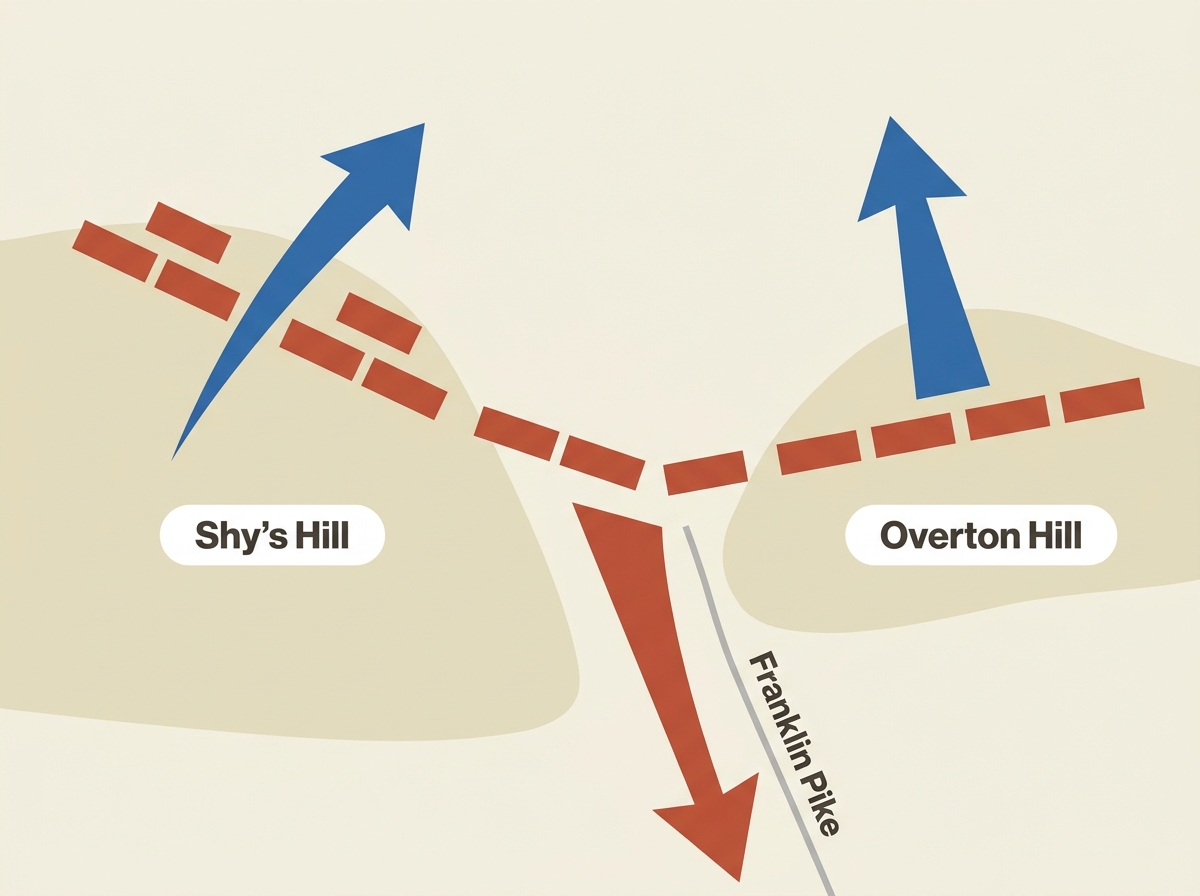
Late in the afternoon, with the daylight going, Brigadier General John McArthur (North) decided to give it that shove. He sent word up that he would attack within five minutes unless he was ordered not to, and then he sent three brigades straight at the salient. The flaw did its work: the attackers crossed the sheltered ground, reached the crest before the defenders could stop them, and carried the hill. Colonel William M. Shy (South) of the 20th Tennessee was killed there defending it, and the height has carried his name ever since. Compton’s Hill became Shy’s Hill in his honor.
And then the whole Army of Tennessee came apart. With Shy’s Hill gone, Stewart’s left flank suddenly disintegrated and the line was rolled up from west to east, the collapse running down the army like a zipper pulled open, each unit’s flank exposed the instant the one beside it broke. This was not an orderly retreat. It was a rout: the last major Confederate field army in the West dissolving into a flood of men streaming south down the Granny White and Franklin Pikes, the two roads out of the trap. One of the most complete routs of any field army in the entire war.
Add up the two days and the numbers tell the story in their shape more than their size. Union losses came to about 3,000. Confederate losses came to about 6,000, twice as many, but the telling part is how: only around 1,500 of those were killed or wounded. The rest, something like 4,500, were captured, swept up as prisoners along with many guns. That ratio is the fingerprint of an army that did not get ground down but broke, that stopped fighting and dissolved. You do not take 4,500 prisoners from an army that is retreating in good order. You take them from one that no longer exists.
Nashville did not merely defeat the Army of Tennessee; it ended it as a fighting force. Within weeks Hood had fewer than 18,000 effectives (able-bodied soldiers still fit to fight) and General P.G.T. Beauregard (South), surveying the wreck, judged it had fewer than 15,000 men. Hood retreated all the way to Tupelo, Mississippi, and on January 13, 1865, resigned his command. He was never given another army to lead. The force that had marched into Tennessee a real, if battered, army marched out as a rabble, and the West was decided.
If there was one reason any organized remnant survived at all, it was the man Hood had sent away. Major General Nathan Bedford Forrest (South) rejoined the broken army and took command of the rearguard, the thankless job of standing between a routed army and the cavalry trying to finish it. Brigadier General James H. Wilson’s (North) horsemen pressed the pursuit hard. Forrest fought them off in a string of vicious holding actions, a nighttime melee in the rain on the Granny White Pike, then more rearguard fights at Richland Creek, Anthony’s Hill, and Sugar Creek, buying time with blood until the survivors could get across the Tennessee River and south to Tupelo. His rearguard is widely credited as the only thing that kept any organized piece of the army together during the retreat. It is the bitter irony of the campaign: the unit that might have prevented the disaster, kept away from the battle, was the only thing that saved anyone from it.
Atlanta had fallen, Mobile Bay was sealed, Lincoln was re-elected, Sherman was marching to the sea, and now, at Nashville, the Confederacy’s last offensive army in the West was simply erased. It was one of the few times in the entire war that a whole field army was not just beaten but destroyed, and it was done, at the strongest point on the field, with the help of the very men the enemy army had gone to war to keep enslaved. It vindicated the slowest, most deliberate general in the army, the one his own superiors had a replacement riding toward; the soldiers who had called him “Old Slow Trot” came out of it calling him the Sledge of Nashville. The slow man had been right, and the army of the slaveholders’ republic in the West was gone.