December 15 opened in fog, and it opened with the lie.
On the Union left, Major General James B. Steedman (North) drove his men against Major General Benjamin F. Cheatham’s (South) corps on Hood’s right (the eastern end of the line) across the Nashville & Chattanooga Railroad, hard and loud: the feint, the false punch meant to grab Hood’s attention and pin his reserves in the wrong place. It did not actually fool Lieutenant General John Bell Hood (South); he was not deceived about where the main weight was coming. But it did something nearly as good. It seized works on that flank that made the eastern end of Hood’s line untenable, and it kept Confederate troops busy at the very end of the army where Thomas least wanted them free to move.
Then, on the far Union right (the western end of the field, opposite Lieutenant General Alexander P. Stewart’s (South) corps on Hood’s left) the door began to swing. Brigadier General James H. Wilson’s cavalry (North), much of it fighting dismounted, on foot like infantry the way Civil War cavalry usually fought a stand-up battle, moved out to the west and then wheeled south as the outer edge of the great right wheel. Behind and inside the horsemen came Major General Andrew J. Smith’s (North) infantry, the heavy mass of the blow, with Major General John M. Schofield’s (North) corps in reserve. Schofield was the man who had fought the brutal delaying actions at Spring Hill and Franklin two weeks earlier, the rear-guard fighting that had bought Thomas the time to gather this whole force in the first place. The shape is the thing: cavalry on the outer edge, infantry massed behind it, the whole Union line rotating down onto Stewart’s left like a slow, enormous hammer.
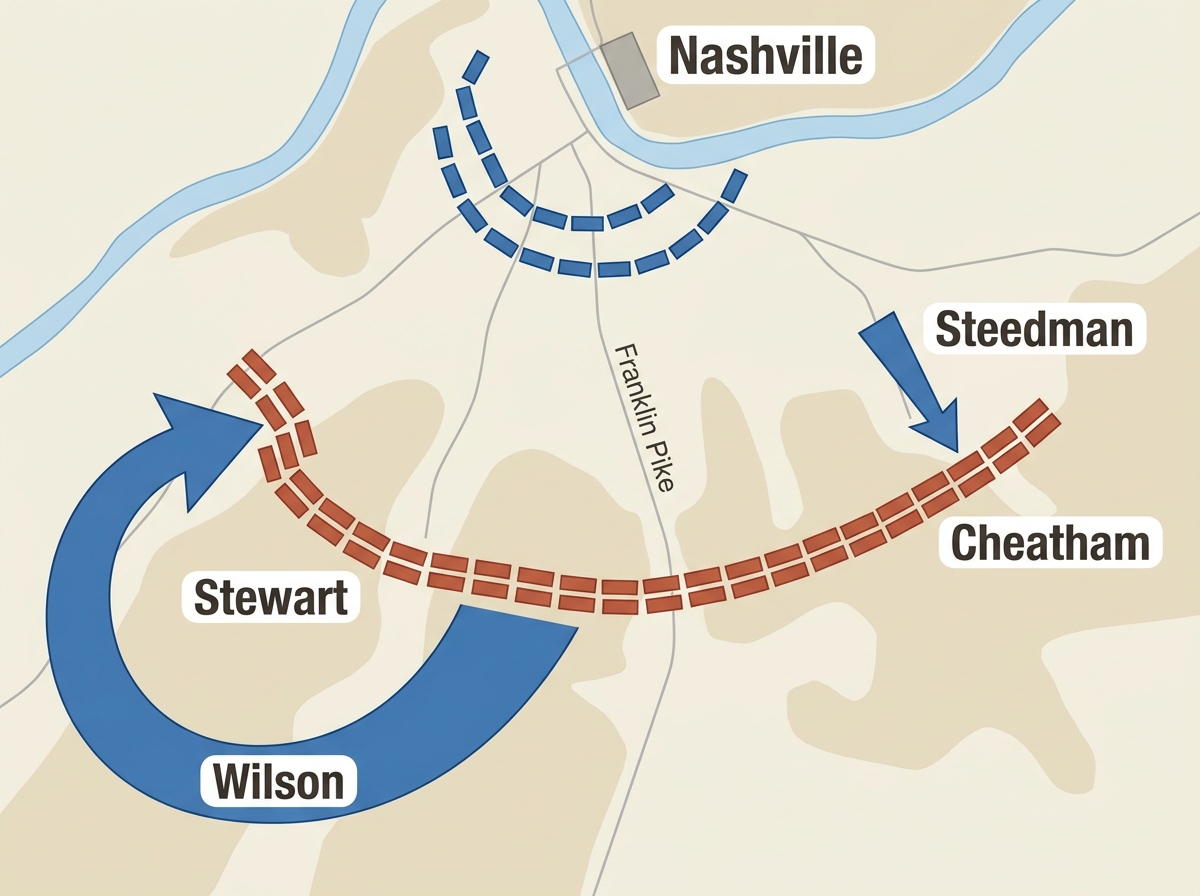
Stewart’s left was anchored on a chain of five detached redoubts, small standalone earthwork forts, each mounting two to four cannon and held by roughly 150 men, strung out to guard the flank like a row of locks on a gate. Around 2:30 in the afternoon the Union right hit them, and they fell one after another in sequence, Redoubt 4, then 5, then 3, then 2, then 1, the wheel rolling them up like a line of dominoes. The dismounted cavalry on the outer edge did much of the actual flank work, getting around and behind the forts as Smith’s infantry came on from the front. The attackers came on with such momentum that eyewitnesses remembered whole regiments competing with one another to be the first into a redoubt, racing each other up to the guns. A flank meant to be a barrier became a stepping path.
By nightfall Hood’s left had simply collapsed. The damage forced his whole army to fall back about 2 miles (3 km) to a new, shorter, desperate line, a tighter arc anchored on two heights: Shy’s Hill (then called Compton’s Hill) on the west, in front of Stewart’s broken corps, and Overton Hill (sometimes called Peach Orchard Hill) on the east, on Cheatham’s front. Hood had survived the first day, but only by giving up ground and crowding what was left of his army onto two hills. Both would have to hold the next day. Neither was a fortress.