By December of 1864 the Confederacy was a building already on fire, and most people on both sides could see it. Atlanta had fallen that September. Mobile Bay had been sealed shut in August, closing one of the last working ports. Abraham Lincoln had been re-elected in November, which killed any Confederate hope that the North would simply get tired and quit. And William T. Sherman was at that very moment cutting a path of destruction across Georgia toward the sea. The war in the East was grinding toward its end around Richmond. The war in the West, for all practical purposes, came down to one last Confederate field army and what it would do.
That army was the Army of Tennessee, the Confederacy’s main fighting force in the western half of the war, a force that had been beaten and rebuilt and beaten again across two years of campaigning. Its commander, Lieutenant General John Bell Hood (South), was a fighter to the point of self-destruction. Rather than sit still while Sherman burned Georgia, Hood had gambled on the boldest move left to him: swing north, invade Tennessee, threaten to drive all the way to the Ohio River, and force the Union to come unglue its plans to deal with him. It was the Confederacy’s last offensive gamble in the West.
It had already gone catastrophically wrong before this story even begins. Two weeks earlier, on November 30, 1864, Hood had hurled that army head-on into entrenched Union troops at the Battle of Franklin, a frontal assault across open ground against dug-in defenders, the kind of attack that gets men killed by the thousand for nothing. It did exactly that. Hood lost around 6,250 men, including six generals killed, among them the gifted division commander Major General Patrick Cleburne (South). The historian David Eicher later put the whole campaign in one sentence that has stuck: “If Hood mortally wounded his army at Franklin, he would kill it two weeks later at Nashville.” That is a modern historian talking, not a soldier of the time, but it is the truest one-line summary of what was coming.
Western TheatreFranklin: the frontal assault that wrecked Hood’s army two weeks beforeIn mid-December, Hood marched the wreckage of his army up to the southern edge of Nashville, and there he stopped, because there was nothing good to do next. Nashville had been in Union hands since February 1862, and the Union had spent nearly three years turning it into a fortress: a 7-mile semicircular ring of fortifications (heavy field works, meaning dug-in defensive lines and earth-walled forts a charging man has to cross) wrapped around the south and west of the city, with the Cumberland River guarding the north and east. Hood was far too weak to storm works like that. But he was also unwilling to retreat. He believed, probably correctly, that if he turned the army around and marched it south, it would simply melt away, men slipping off into the dark by the hundred until there was no army left.
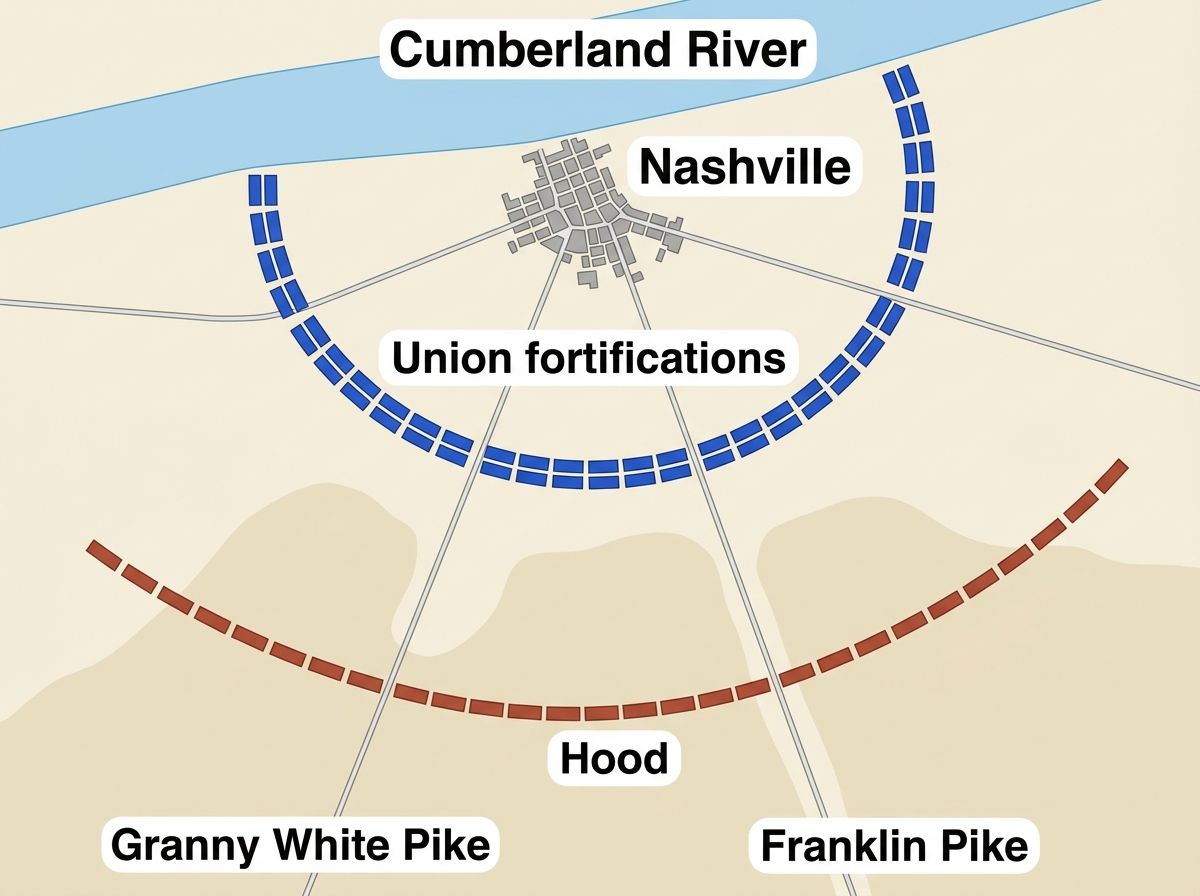
So he did the only thing his logic allowed and the worst thing tactically: he dug a thin defensive line in an arc about 4 miles long across the hills south of the city, and he waited. From the Confederate right to left, three corps (large wings of the army, tens of thousands of men apiece) held that arc: Major General Benjamin F. Cheatham (South) on the right (the eastern end), Lieutenant General Stephen D. Lee (South) in the center, and Lieutenant General Alexander P. Stewart (South) on the left (the western end). Too weak to attack, too proud to run. An army parked in front of a fortress, daring the fortress to come out.
Inside the fortress was the man who would oblige him.