While the battle raged for hours, while thousands of men were being shot and shelled on the ridges a couple of miles away, the general commanding the larger army sat at his headquarters and never heard a sound of it.
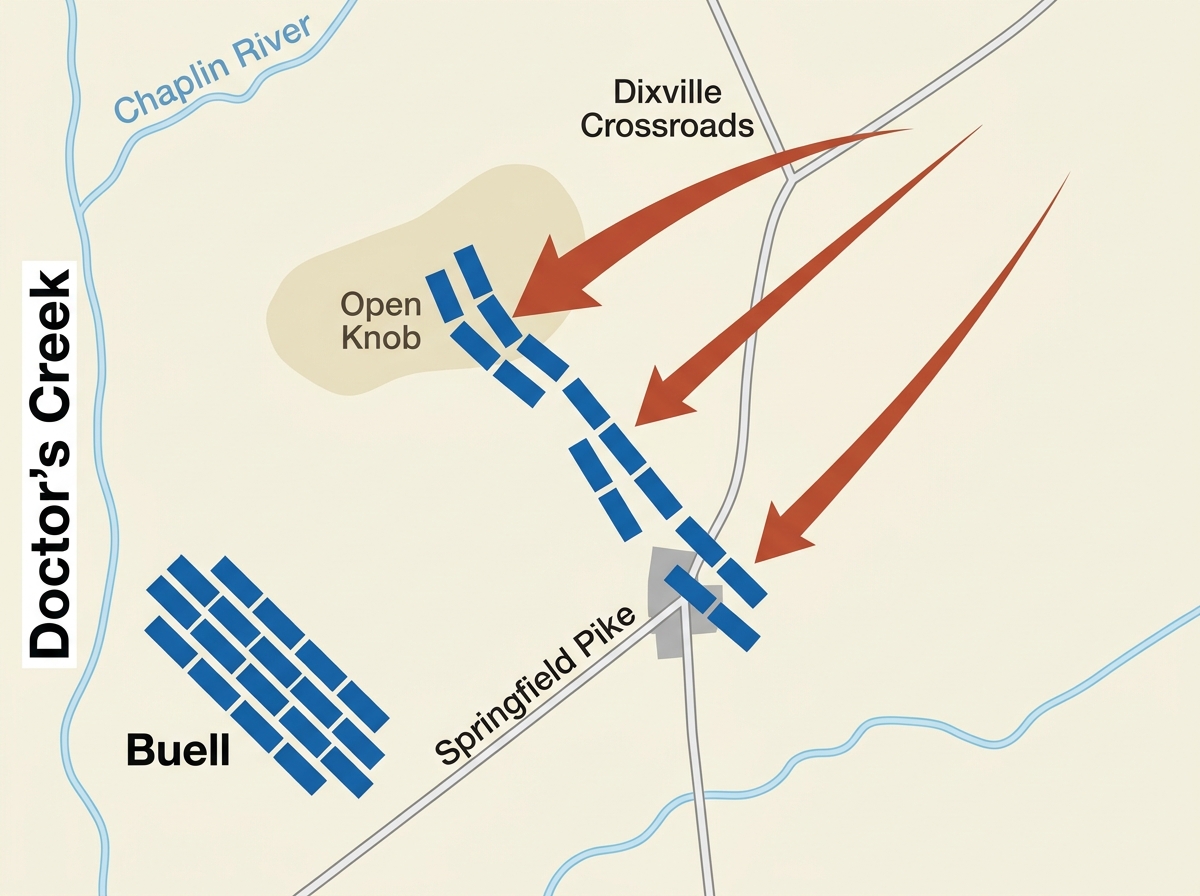
It is called an acoustic shadow. A trick of weather and terrain, an inversion in the air over the rolling Chaplin Hills, can bend and muffle sound so that a battle deafening up close becomes silence a short distance off. That is what happened to Buell. At his headquarters to the rear, only about two miles from the fighting, he and the men around him agreed they heard nothing of a fight that had been roaring for hours. The little gunfire that did reach him, the story goes, he took for distant artillery drill rather than a battle. The consequence was catastrophic for the men actually fighting: believing nothing serious was happening, Buell fed in no reserves until late afternoon. The bulk of his army, tens of thousands of men, stood idle while one of its corps was torn apart over the next rise.
It helps to know how an army was built. A Civil War army broke into a few corps, each tens of thousands of men under one general; a corps broke into divisions of several thousand; a division into brigades of a couple of thousand; and the cannon traveled in batteries (clusters of guns and the men who worked them). So when only “one corps plus parts of another” did the fighting at Perryville, that means a single big chunk of the army carried the whole battle while the rest stood by. Buell had a very large army in the area: the Army of the Ohio nearby numbered somewhere around fifty-five to sixty-one thousand, with some accounts running higher still. But only about twenty-two thousand Union soldiers actually fought. Against them, Bragg committed only about sixteen thousand men, a fraction of what he could have massed, since the rest of his army was off facing Frankfort, chasing a feint. A smaller Confederate force was about to bloody a Union army several times its size, and the reason was not Southern brilliance: most of the North’s numbers never got into the fight, and their commander, two miles off, did not even know there was a fight to get into.
The Attack Rolls Down the Line
Around half past noon, the guns of Major General Benjamin F. Cheatham’s (South) division opened the bombardment, and the Confederate attack came on in a rolling, staggered sequence soldiers called en echelon (brigades striking one after another from north to south rather than all at once, like a row of dominoes tipping down the line). The plan, directed on this wing by Major General Leonidas Polk (South), aimed to crush the Union left, the northern end of the line, and then roll the whole army up from there: to attack down the line from its undefended end, folding it back on itself the way you’d flatten a tin lid.
The Killing Ground at Open Knob
The hammer fell hardest on a hill called Open Knob, also remembered as Parsons’ Ridge, on the Union far left. Around two o’clock, Brigadier General Daniel Donelson’s (South) brigade crossed the Chaplin River expecting to find an open, undefended flank (the exposed end of the enemy line, where there is no one to shoot back) and instead slammed into a strong Union position on the knob. The attack was thrown back with losses of around a fifth of the brigade. And still, two miles to the rear, Buell heard nothing. Then, an hour later, came the blow that would decide the sector: Brigadier General George Maney’s (South) brigade went straight at Open Knob.
Open Knob was the bloodiest, most crucial action of the battle. Maney’s men charged the ridge and the Union cannon of Parsons’ battery posted on it. You could have walked the ground from there to Buell’s tent in less than an hour, and his army never came. The Confederates were thrown back, charged again, were thrown back again, and on the third assault they broke through and overran the guns. The cost to the Union command was brutal: Brigadier General James S. Jackson (North), the division commander on that part of the field, was killed outright near the guns, and Brigadier General William R. Terrill (North), holding the knob, was mortally wounded by an artillery shell, carried off the field and dead by two o’clock the next morning. For the green Union regiments on that hill, some of them weeks old and barely drilled, it was their first battle and their last stand at once. The breakthrough was finally stopped only when it crashed into another Union line on a ridge just behind, held by Colonel John C. Starkweather (North), a brigade commander whose stand on the rear ridge, around half past five, kept the broken left from coming apart entirely. One historian of the battle has called Maney’s repulse there the high-water mark of the Confederacy in the western theater, the farthest north the Southern tide ever reached in this part of the war before it began to recede, ranking it with the most famous spot of the war’s most famous battle, the Angle at Gettysburg.
Eastern TheatreGettysburg: the Angle, the war’s most famous high-water markThat comparison to Gettysburg’s Angle comes from the historian Kenneth W. Noe; it’s a paraphrase of his judgment, not his exact words.
Almost none of the rest of the army shared in it. Around twenty to four, Brigadier General Patrick Cleburne (South) came into the fight on the Confederate left; his horse was killed and he was wounded in the ankle, and he kept going. But on the Union side, the held-back men stayed held back. Sheridan, though he sat only a few hundred yards from the corps being torn apart, threw back a Confederate lunge on the Springfield Pike around four and otherwise stayed out of it, still under Gilbert’s restraining orders. So the whole reason a smaller army could maul a larger one was right there on the field: between the acoustic shadow keeping Buell ignorant and Gilbert holding back the men in the center, the Union never brought its real weight to bear, and the killing stayed packed onto one ridge while a whole army listened to silence.