The hill across the river was the problem. From the high ground the Union had seized on January 1, Federal guns could rake the right of Bragg’s line. So on the afternoon of January 2, Bragg (South) decided it had to be taken back, and he handed the job to the division of Major General John C. Breckinridge (South), a former Vice President of the United States, now a Confederate general, and a man who had spent the previous day feuding with Bragg over the army’s handling. Bragg ordered him to cross the open ground and storm the Union division on the hill east of the river.
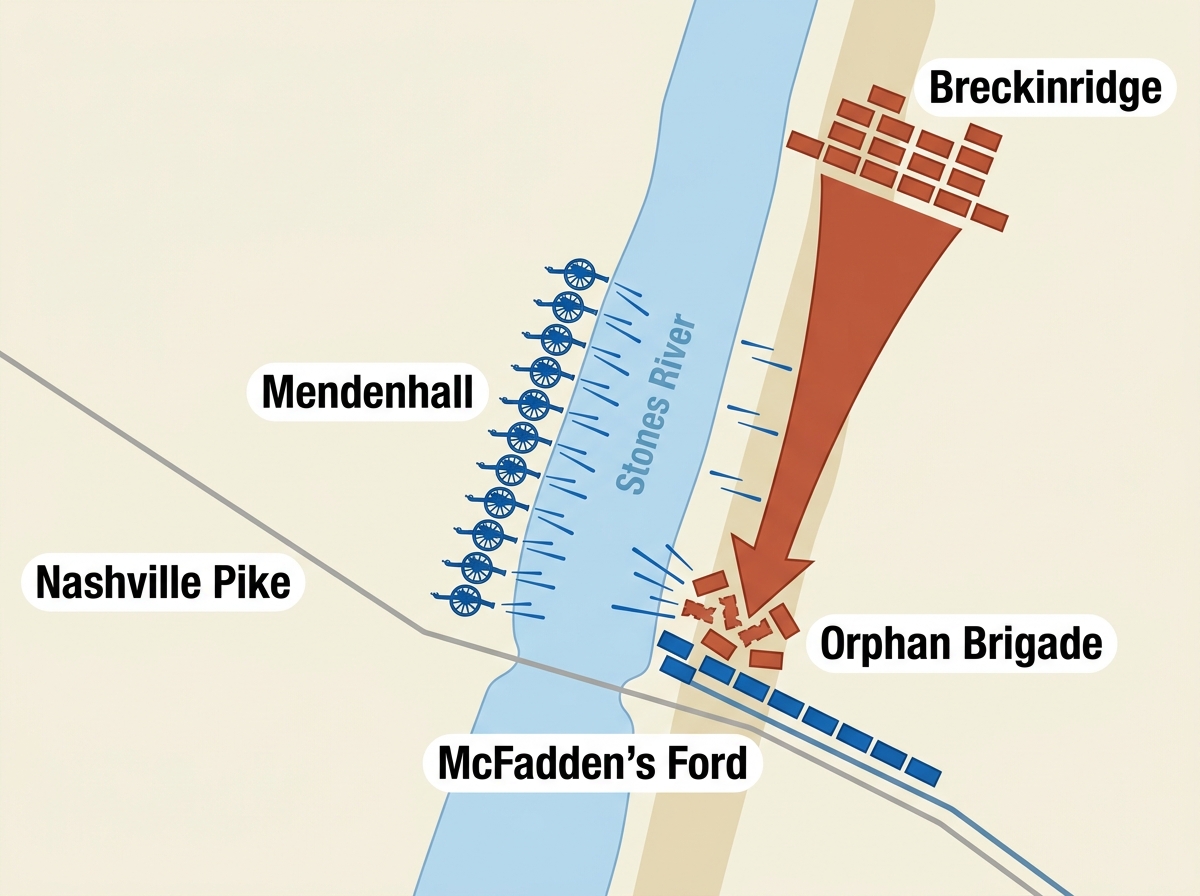
Breckinridge looked at the ground and saw a death trap. The Union held the high east-bank hill, yes, but across the river, on the west bank, the rising ground was perfect for massing artillery, and any attack on the hill would have to go forward with the enemy’s guns looking straight down its flank from across the water. He protested the order as suicidal. Bragg overruled him. At about four o’clock, Breckinridge attacked anyway.
Breckinridge protested the order, telling Bragg the attack would be a slaughter.
Into the Massed Guns
For a few minutes it looked like he might be wrong. The charge hit hard and drove the Union defenders back, down off the hill and across McFadden’s Ford, a shallow crossing on Stones River. And that was exactly the disaster Breckinridge had feared, because the moment his men surged across the open low ground by the ford, they came under the eye of the gun line the Union had spent the day building on the west bank. Captain John C. Mendenhall (North) had massed roughly fifty cannon there, wheel to wheel. As Breckinridge’s men crowded into the open by the river, all of it opened at once.
It was over in under an hour. The massed guns shredded the Confederate assault where it stood, the shells tearing through ranks packed into open ground with the river at their backs. More than 1,800 Confederates fell in roughly sixty minutes, better than a third of the five thousand men who made the charge. The Kentucky soldiers of Brigadier General Roger W. Hanson (South), the famous "Orphan Brigade," Kentuckians who could not go home because their state stayed in the Union, were nearly destroyed, and Hanson himself was mortally wounded. As the broken survivors fell back through the smoke, a Union counterattack drove them the rest of the way. The whole ferocious gamble had lasted less than an hour and accomplished nothing but the gutting of one of Bragg’s best divisions.
A Self-Inflicted Catastrophe
A self-inflicted catastrophe for the South.
Bragg ordered a frontal assault that his own commander on the ground called suicidal, and it was. Breckinridge’s charge briefly drove the Union back across McFadden’s Ford, then ran straight into roughly fifty massed Union guns on the far bank and was annihilated in under an hour, losing more than 1,800 men and gutting the Orphan Brigade. The attack gained nothing and bled the Army of Tennessee at the exact moment it could least afford it.