Bragg (South) struck first. At about six o’clock on the morning of December 31, before most of the Union right wing had finished breakfast, the Confederate attack came howling out of the cedars: some ten thousand men under Lieutenant General William J. Hardee (South), one of the army’s best tacticians, coming on in a great wave with more divisions filling in close behind. The Union soldiers on that flank, the men of Major General Alexander M. McCook (North), were quite literally caught at their cook fires, rifles stacked, coffee on.
The problem for the Union was geography as much as surprise. McCook’s right flank was not anchored on anything; it simply hung in the air, out past a creek called Overall, with nothing solid to brace against. So when the Confederate wave hit and then wheeled, there was nothing to stop it from curling around the open end. The whole Union right began to fold backward, hinging in place, "like a jackknife" closing: the line bent back on itself and driven roughly three miles, all the way to the Nashville Pike and the railroad beside it. By mid-morning the Union army’s entire right half had been knocked loose and was reeling toward the rear.
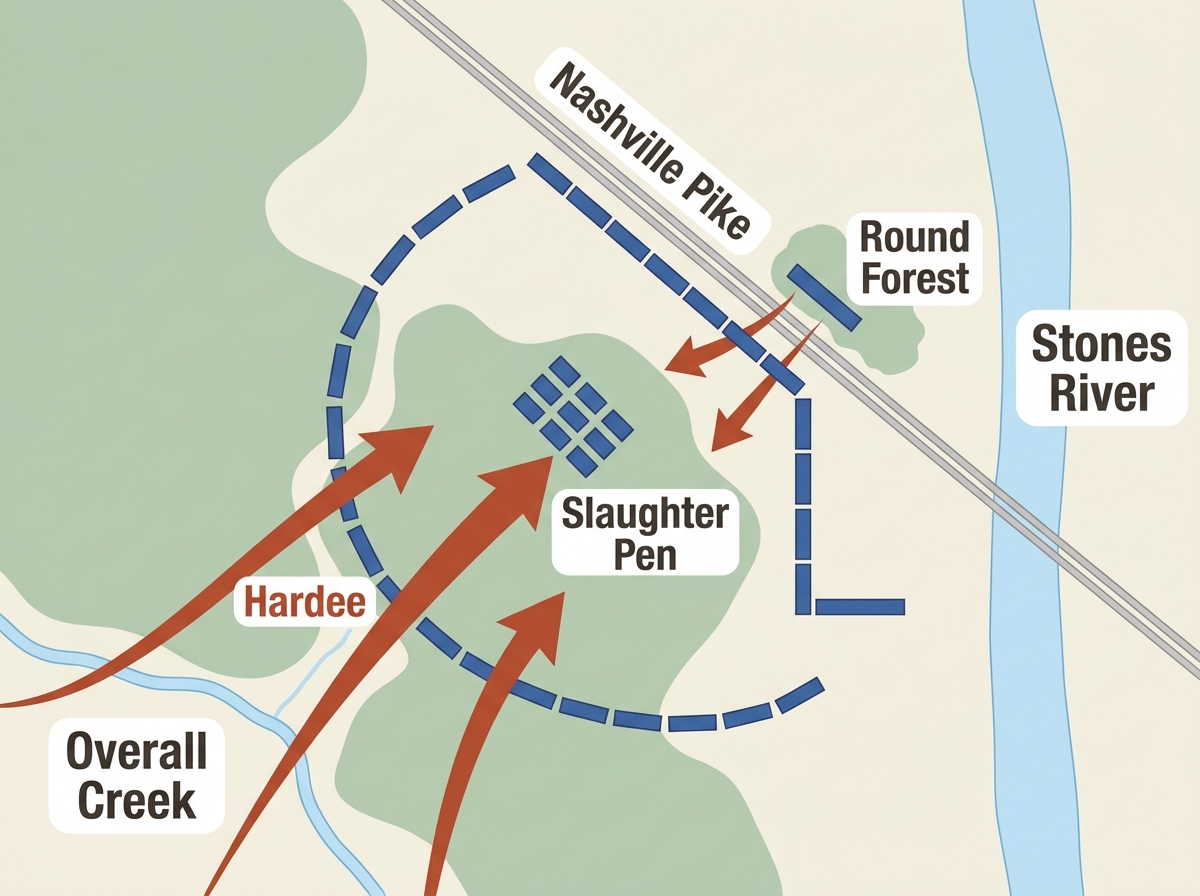
The Slaughter Pen
What kept it from becoming a rout (a total, panicked collapse) was a holding action in the cedars so brutal the soldiers named the place for it. The division of Brigadier General Philip H. Sheridan (North), a short, ferocious officer near the start of a career that would make him famous, dug in among the cedar brakes and refused to break. For roughly four hours Sheridan’s men stood and bled in a sector that earned the name the Slaughter Pen, the eastern red cedars splintering overhead and the limestone underfoot slick where men had fallen, the Confederates coming on through the gloom in wave after wave and Sheridan’s line firing into them at a few dozen yards until the cedars in front were carpeted. The cost was staggering: all three of Sheridan’s brigade commanders were killed, and more than a third of his division went down. But the four hours they bought were the four hours the rest of the army needed to form a new line. Around eleven o’clock, his ammunition gone, Sheridan finally pulled back.
The morning had its private horror, too. Riding near the front, Rosecrans’s chief of staff (the officer who runs an army’s headquarters), Lieutenant Colonel Julius P. Garesché (North), was killed at the general’s side, decapitated by a cannonball as the two rode together. Rosecrans (North), spattered with the blood of his own friend, rode on and kept the army in hand, galloping the lines, plugging gaps, holding the thing together by force of will.
"The enemy has yielded his strong position and is falling back."
The substance of Bragg’s telegram to Richmond the night of December 31, reporting that he had won.
The Knockout That Never Landed
The Confederates did not land the knockout, and part of the reason was friction inside Bragg’s own army. False reports of Union troops moving up another road, tangled with the bad blood between Bragg and one of his generals (a feud the next section will return to), pulled an entire fresh division away from the main blow at the decisive moment. Bragg had bent the Union line nearly double, but he could not snap it. As the short December day ended, he believed he had won, and wired Richmond to say so.
He was wrong, and he found out that night across the lines. In the Union camp, some of Rosecrans’s officers urged him to retreat, since the army had been mauled and the right wing wrecked. Rosecrans refused, backed firmly by his two other wing commanders: Major General George H. Thomas (North), who held the center, and the man who held the left, Major General Thomas L. Crittenden (North). (Two Thomases, confusingly: Thomas the center general, Crittenden the left.) He would stay and fight it out.
A Battle the South Failed to Finish
A near-disaster for the Union, and a battle the South failed to finish.
Bragg’s dawn surprise folded the Union right back three miles and very nearly destroyed Rosecrans’s army before breakfast. But Sheridan’s stand in the Slaughter Pen and the anchor near the Nashville Pike kept the line from collapsing, and Confederate friction kept Bragg from landing the killing blow. The South held the field at dusk and thought it had won. The Union army was still alive.