In the spring of 1863 the Mississippi River was the spine of a continent, and the Confederacy was sitting on the one vertebra that mattered. Trace the river south from where it leaves Union hands and you eventually run up under a bluff town in western Mississippi where the channel doubles back on itself in a tight hairpin bend. The town sat on high ground on the east bank, and its guns looked straight down on the water below: heavy cannon dug into the bluff in clusters called batteries. Any boat coming downriver had to pass directly under those batteries, slowly, in plain sight. That town was Vicksburg, and together with Port Hudson, Louisiana, downstream, it held the last Confederate-controlled stretch of the Mississippi. As long as Vicksburg stood, the river was closed.
That mattered for reasons both blunt and strategic. The Mississippi was how the farms of the Northwest (Ohio, Illinois, Iowa) got their grain and pork to market, and the Confederacy had corked the bottle. It was also the seam of the rebellion itself. East of the river lay the heart of the Confederacy; west of it lay Texas, Arkansas, and most of Louisiana, the so-called Trans-Mississippi, which funneled cattle, men, and supplies eastward across the water. Take Vicksburg and you opened the river to Union traffic and sawed the Confederacy clean in two. Abraham Lincoln understood this exactly. He is supposed to have told his cabinet that Vicksburg was the key, that the war could never be brought to a close until that key was in the Union’s pocket, and whether or not those were the precise words, the idea was his, and it was correct.
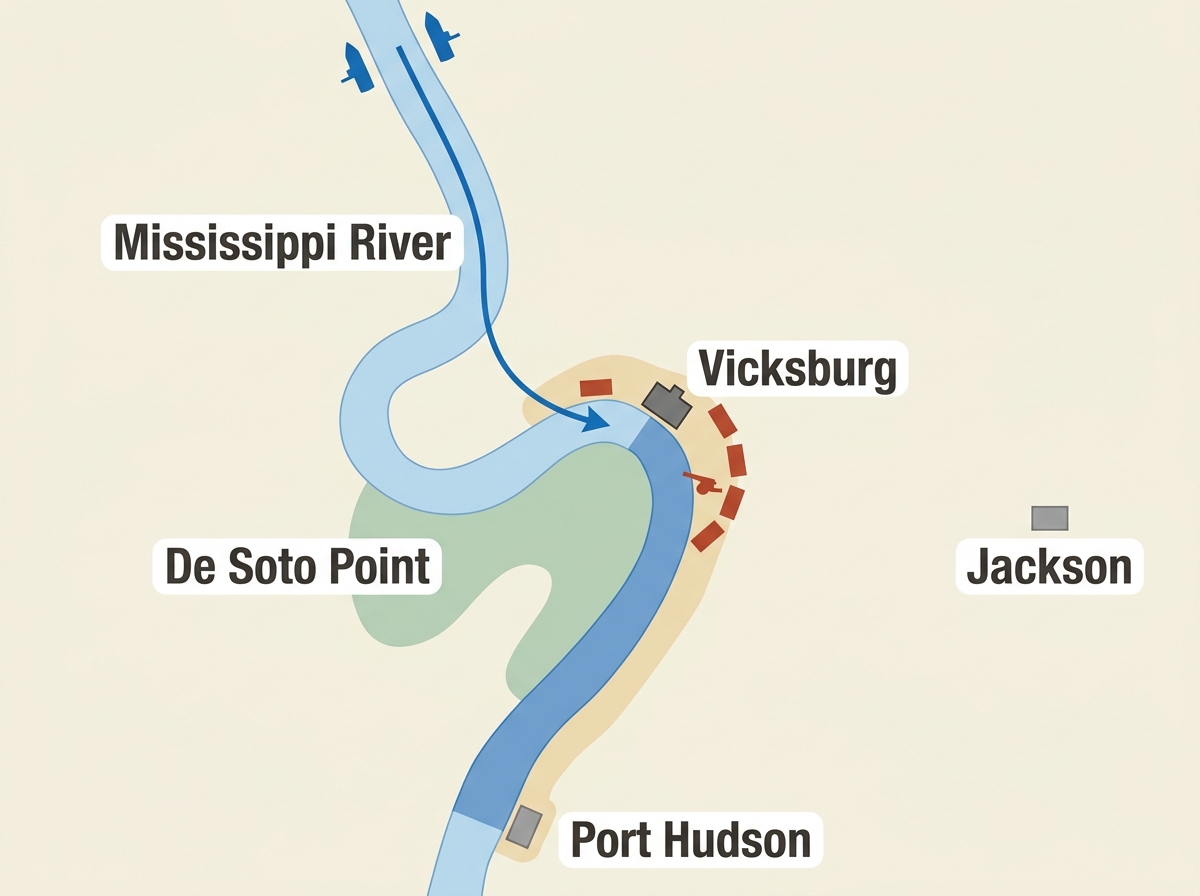
The man sent to turn the key was Major General Ulysses S. Grant, commanding the Army of the Tennessee. Grant was the Union’s hardest-driving western general, the victor of Forts Henry and Donelson the year before, and by the end of 1862 he had a problem that no amount of hard driving had yet solved. Vicksburg could not simply be marched up to and attacked. North of the city lay a maze of swamp, bayou, and flooded bottomland; the bluffs themselves were a natural fortress; and the river batteries made a direct naval passage suicidal.
Western TheatreFort Donelson: where Grant earned his “Unconditional Surrender” nameHe had already learned that the hard way. Late in 1862 he had tried the obvious thing, marching an army of 40,000 straight down the railroad through central Mississippi toward the city. It ended in December when Confederate cavalry under Major General Earl Van Dorn (South) swept in behind him and burned his entire supply base at Holly Springs, destroying something like a million and a half dollars in food and ammunition in a single morning. With his pantry in ashes and his supply line cut, Grant had no choice but to turn around and march back. The same week, his lieutenant William T. Sherman (North) tried the other obvious thing, storming the bluffs just north of Vicksburg at Chickasaw Bayou, and was thrown back bloody. So by the new year both straightforward roads to Vicksburg, the overland march and the frontal assault, were closed. The double failure taught Grant that a long supply line was a noose, a lesson he would cash in, spectacularly, the following spring.
The country he was trying to break in half was a country that existed for one reason. The Confederate states had seceded barely two years earlier to protect and extend the enslavement of four million Black people, on whose forced labor the cotton economy of the lower Mississippi Valley, Vicksburg’s own valley, was built. The river plantations Grant’s army would soon march past were worked by enslaved people, and the war to open the river was, underneath everything, a war against the slaveholding republic those plantations sustained. Every mile Grant advanced down this valley, the institution the South had seceded to protect began dissolving behind him.