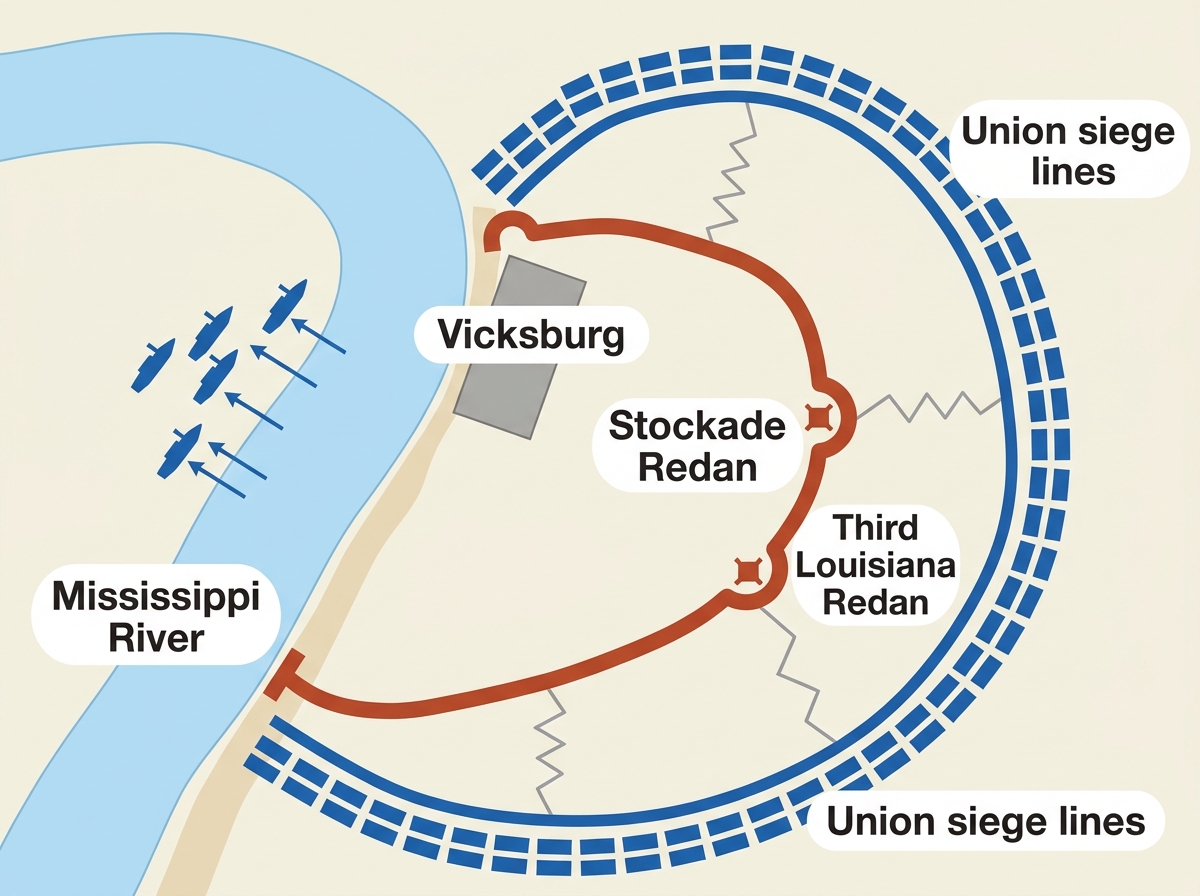
Grant did not want a siege. He wanted to take the city by storm and be done with it, and on May 19 and again on May 22 he tried. The defenders waited behind a nine-mile arc of dug-in dirt forts, earth-and-log strongpoints with sloped, angled walls, the kind of fortification engineers in this era built by the dozen and gave names like the Stockade Redan and the Third Louisiana Redan (a redan is simply an arrowhead-shaped earthwork fort, its point aimed out at the attacker). The first assault, on May 19, threw Grant’s men at the Stockade Redan and was thrown back with about a thousand Union casualties against perhaps seventy Confederate. The second, on May 22, was bigger and worse: a broad assault across a three-mile front at ten in the morning that failed bloodily, costing roughly 3,200 Union men against fewer than five hundred Confederate. Part of that slaughter came when Major General John A. McClernand (North), one of Grant’s corps commanders (a corps was one of the army’s three big wings, tens of thousands of men under a single general), overstated a breakthrough on his front and drew reinforcements into a position that didn’t exist, feeding more men into the killing ground. It helped get McClernand relieved of his command weeks later.
A Regular Siege
Two failed assaults in three days settled it. Grant would not bleed his army against those works again.
"I now determined upon a regular siege, to ‘out-camp the enemy,’ as it were, and to incur no more losses."
Grant, Personal Memoirs
So the army dug. Union engineers ran some fifteen miles of approach trenches zigzagging toward the Confederate works, brought up around 220 guns, and settled in to strangle the city while Porter’s (North) fleet shelled it from the river. For forty-seven days, from May 18 to July 4, the lines tightened and the bombardment never really stopped.
Underground
Inside the perimeter were not only Pemberton’s (South) soldiers but more than three thousand civilians, and to understand the siege you have to go where they went, which was underground. Into the soft yellow clay of the Vicksburg hillsides (loess, a clay so fine and firm you can carve a room into it with a spade) the residents dug something like five hundred caves. They called them bombproofs. Some were single rooms; some were big enough to hold several families, with furniture carried down from the houses above, carpets on the dirt floors, candles in niches scooped out of the walls. People moved their whole lives into the hills and learned to live by the rhythm of the shelling, timing every dash above ground, for water, for air, for cooking, to the gaps between bombardments, dropping back into the earth when the guns opened again.
One of those cave-dwellers was Mary Webster Loughborough, who had come to Vicksburg with her husband, a Confederate officer, and her small child, and found herself trapped in the city when the siege closed around it. She wrote it down. Her diary became a book, My Cave Life in Vicksburg (1864), one of the few civilian eyewitness accounts of what the siege felt like from the inside of one of those holes in the ground. She described lying awake in the dark as the shells came down, the ground shaking, never sure the cave would hold:
"I shall never forget my extreme fear during the night, and my utter hopelessness of ever seeing the morning light."
Mary Loughborough, My Cave Life in Vicksburg
It is one of the campaign’s stranger facts that the caves worked: despite roughly 22,000 shells fired into the town over the siege, fewer than a dozen civilians were killed.
Starved by Degrees
What finally broke Vicksburg was not the shelling but hunger. The food ran out by degrees. The beef went first. Then the garrison and the townspeople began killing and eating their mules and horses; then dogs went into the pot; then, in the public meat market, rats appeared for sale, reportedly around $3.50 apiece, close to two weeks’ pay for a private, and people bought them. Bread was baked from ground dried peas and cornmeal, a heavy, sour loaf that turned the stomach. By the end, one account records, "shoe leather became a last resort of sustenance for many adults." Disease did what the diet started: by late June, scurvy, malaria, dysentery, and chronic diarrhea had put half the garrison sick or in the hospital. Meanwhile Grant’s army, fed and resupplied by the open river behind it, only grew, swelling toward 70,000 men as reinforcements came down to guard against Johnston. Pemberton’s army did the opposite. It shrank, starved, and sickened, with no relief coming. One army grew while the other wasted away, and that gap was the whole arithmetic of the siege.
There was still some fighting. The Union engineers tunneled a mine under the Third Louisiana Redan, packed it with explosives, and blew it up on June 25, opening a smoking crater the storming party rushed but could not hold; a second mine went off July 1. But by then the explosions were almost beside the point. The city was being starved to death.