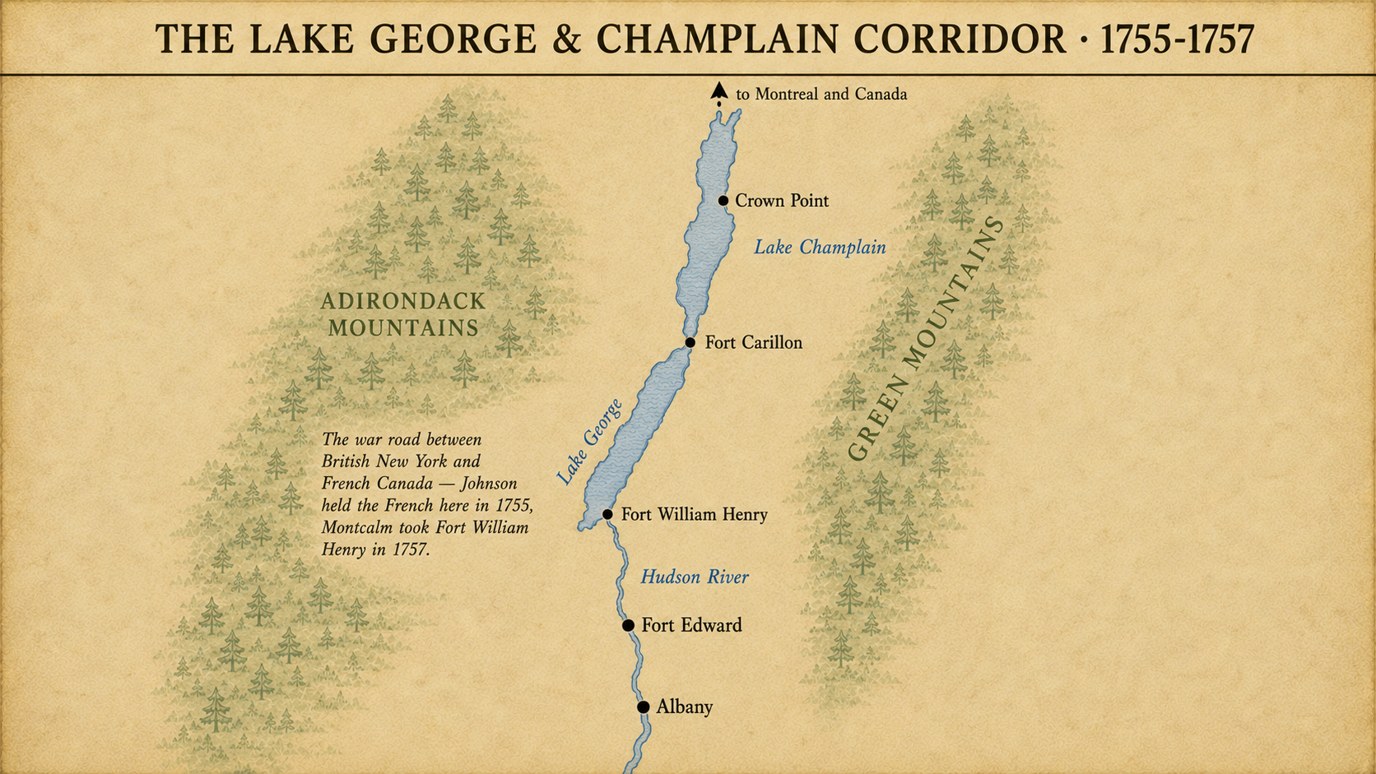
While the British army gathered itself after Howe’s death, the French commander spent every hour he had building a trap. Major General the Marquis de Montcalm (French) had perhaps three to four thousand men, most of them French regulars, with only a few hundred Canadian militia and around six hundred Native allies, far fewer warriors than had come to him the year before. Two things had thinned their numbers. The Fort William Henry campaign of 1757 had ended with the French unable to stop their Native allies from killing and capturing surrendered British prisoners, and the bad blood from that day had strained the alliance. And smallpox, caught in the crowded camps at William Henry, had swept back west with the returning warriors and killed many, so that whole western nations stayed home in 1758. The roughly six hundred who did come were not bystanders. They screened the army’s flanks and scouted the woods around the works while the regulars built.
Badly outnumbered, Montcalm did the one thing that could even the odds: he made his men fight from behind a wall. On the high ground about three-quarters of a mile northwest of the fort, the Heights of Carillon, his soldiers worked without rest to throw up a defensive line. They built a breastwork, a chest-high wall of stacked logs with a trench dug behind it for the men to stand in and fire over. And out in front of it they built an abatis: acres of trees felled with their tops facing the enemy and their branches sharpened into points, a tangled, bristling thicket of wood, the eighteenth century’s version of barbed wire. A man trying to cross it could not run, could not keep his formation, could not do anything but pick and claw his way through the snags while the muskets behind the wall took their time. On the flanks they set redoubts with cannon, and they screened much of the work with cut shrubs and saplings so that, from a distance, the deadliness of it would not show. By July 7, when the Chevalier de Lévis came in with about four hundred more men, the line was very nearly finished. Lévis, Montcalm’s most able subordinate, took command of the French left.
What undid the British was that they never understood what they were looking at. Abercromby sent aides, among them his engineer, Matthew Clerk, to study the French works from a height across the river. Clerk came back with a fatally wrong report: the defenses, he said, looked unfinished and flimsy and could be “easily forced, even without cannon.” They were neither unfinished nor flimsy; they were nearly complete and cleverly hidden. Clerk also pointed to a hill that overlooked the whole French line, Rattlesnake Hill (later called Mount Defiance), and urged that guns be hauled up it to fire down into the works. From that hill, the cannon could have made the breastwork untenable. Abercromby ignored the hill.
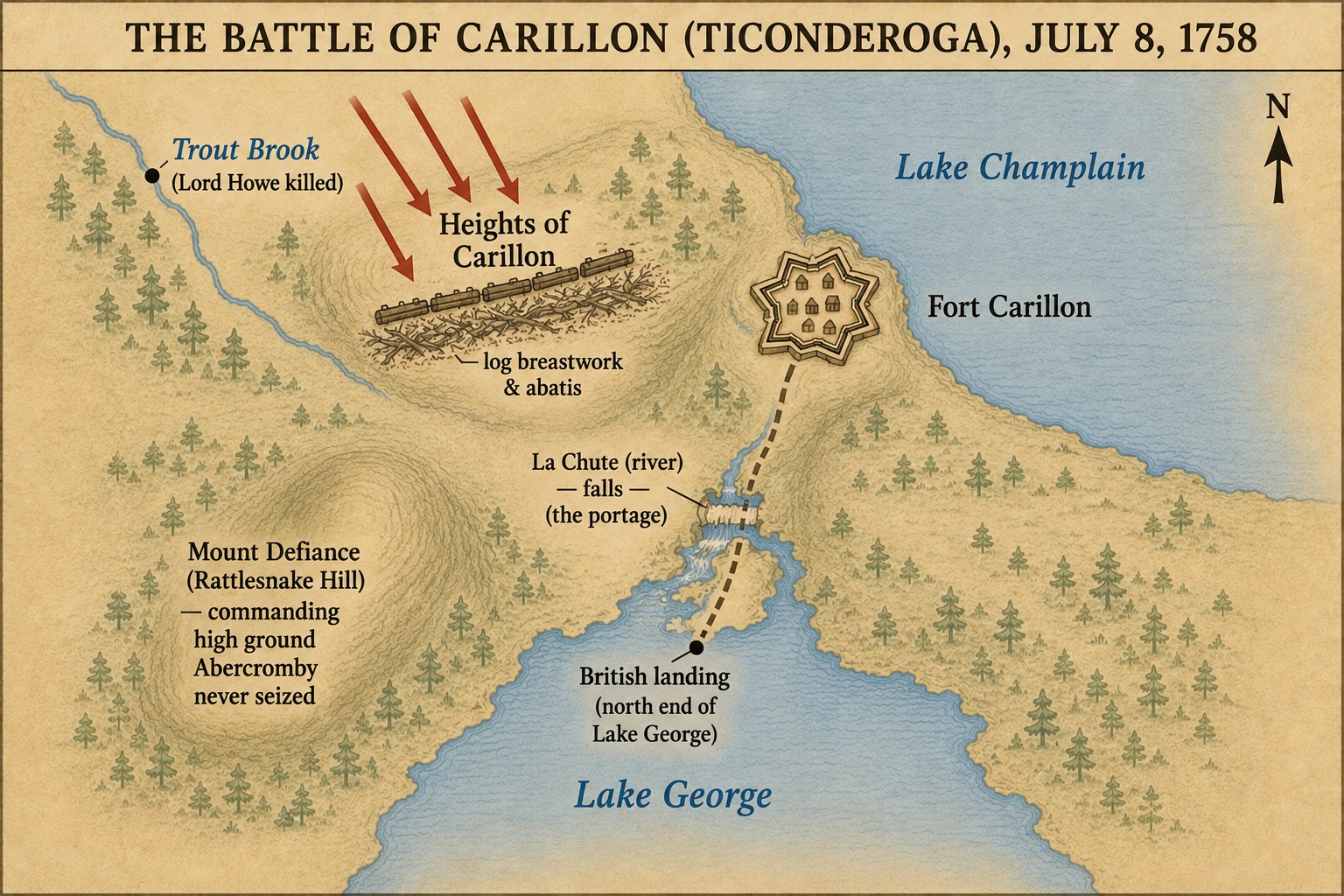
And then Abercromby made the decision that would define the day and ruin his name. He had the heavy artillery, the very thing built to smash a log wall to splinters. He chose not to use it. There was an attempt to float a few light guns down the river toward the fort, but the barges were fired on and two of them sank, and the effort was abandoned. Anxious about rumors that French reinforcements were coming, acting on a report he had never had verified, Abercromby ordered his army to take the Heights of Carillon by frontal assault, on foot, against the breastwork and the abatis, with no cannon brought forward to break the line first. He sent infantry with muskets and bayonets against a fortified wall, and he kept the one tool that could have won the battle parked in the rear. The choice was his alone.
The assault began around half past noon. The plan called for one coordinated rush by the whole army, but in the forest, against an obstacle nobody had properly seen, coordination fell apart almost at once, and the great attack came on instead as a series of separate, piecemeal waves. The men reached the abatis and the abatis did exactly what it was built to do. Imagine being one of them. You hit a belt of felled trees too thick to run through, branches sharpened to points at chest and throat, and you cannot go forward at a walk, let alone a charge. You climb and twist and pull, snagged at every step, while the man on your left and the man on your right do the same, and your neat line breaks into knots of men clawing at the same tangle of wood. The volleys come from a wall of logs you cannot see over, close enough that you can hear the order to fire before each one lands. Formations dissolved into clumps of struggling soldiers caught in the sharpened branches, and from behind the wall the French fire came down on them in sheets. One British officer, Captain Charles Lee, remembered it plainly.
The fire was prodigiously hot, the slaughter of officers very great, almost all wounded, the men still furiously rushing forwards without any leaders.
Wave after wave went in through the afternoon, by some accounts for four to seven hours, attacks broken and re-formed and sent again, around two o’clock, again near half past two, a last desperate push around five. None of them broke through. The breastwork held every time. The men who pressed hardest of all were the 42nd Highlanders, the regiment known as the Black Watch, who tore at the abatis with their hands and in places actually reached the foot of the breastwork before they were cut down. They could not get over the wall. Nobody could. By the end the Black Watch had lost roughly half its strength, somewhere above six hundred men out of about nine hundred, with more than three hundred of them killed, a regiment gutted at the foot of a wall it never crossed. An officer of another regiment who watched them wrote that he was “penetrated” with “a mixture of esteem, grief, and envy” at “the great loss and immortal glory acquired by the Highlanders.”
And then, with the assaults failing and the dead heaped in the abatis, Abercromby ordered a full retreat, and the retreat turned into something close to a panic. The largest army in America fell back from the wall, hurried down to its boats, and fled back up Lake George the way it had come. It still outnumbered the French by something like four to one. It had not been beaten by numbers or by maneuver. It had thrown itself, again and again, against a log wall its commander had refused to soften with the guns sitting behind him, and when that did not work it ran.