By the summer of 1760, the French and Indian War in Canada was very nearly lost. Quebec, the great fortress city on the St. Lawrence River, had fallen to the British the year before. The French had thrown one last punch in the spring, winning a hard battle just outside the city’s walls at Sainte-Foy in April, only to find that the river thawed in the British navy’s favor: when a British fleet sailed up first, the French had to give up the siege and fall back. That left one place still flying the white flag of the French king in Canada. Montreal, an island town up the St. Lawrence, was the last French stronghold on the continent, and in 1760 the British decided to end the war by taking it.
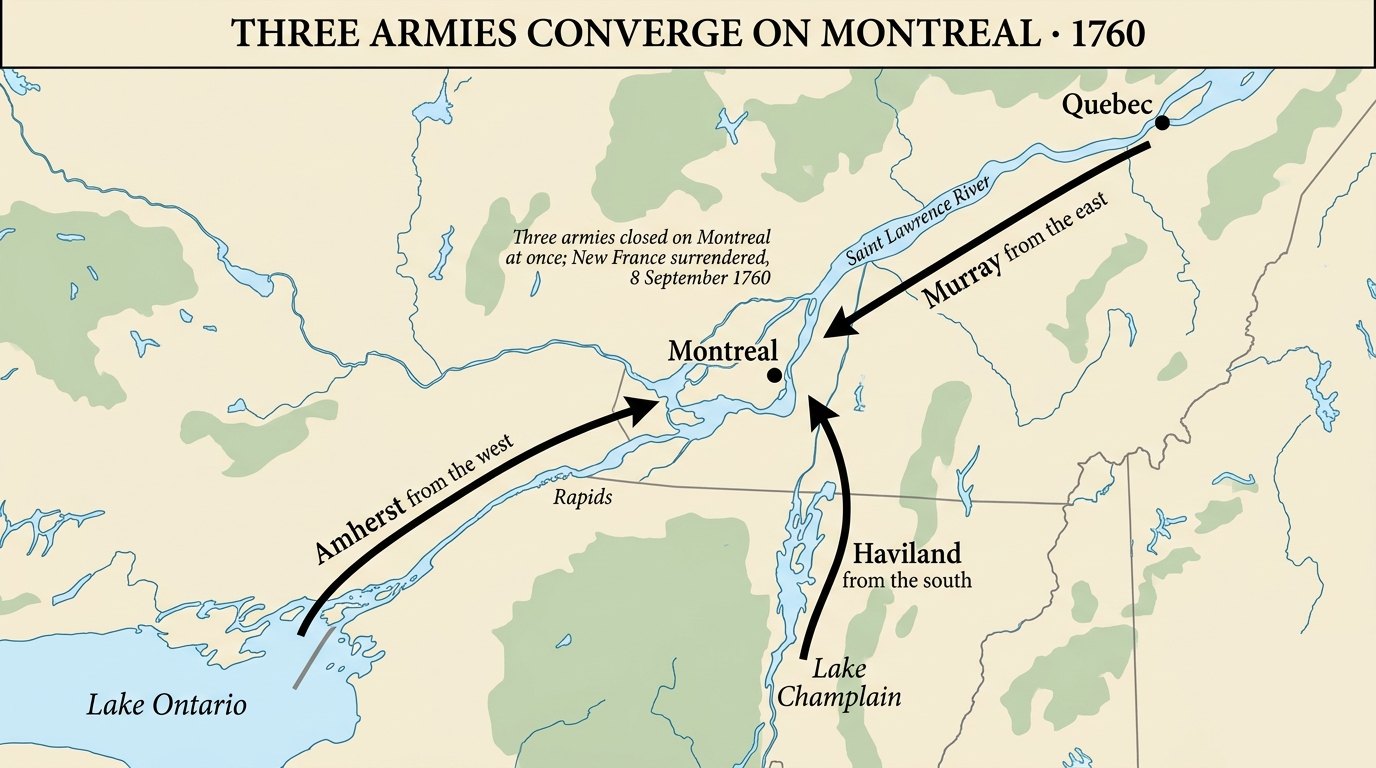
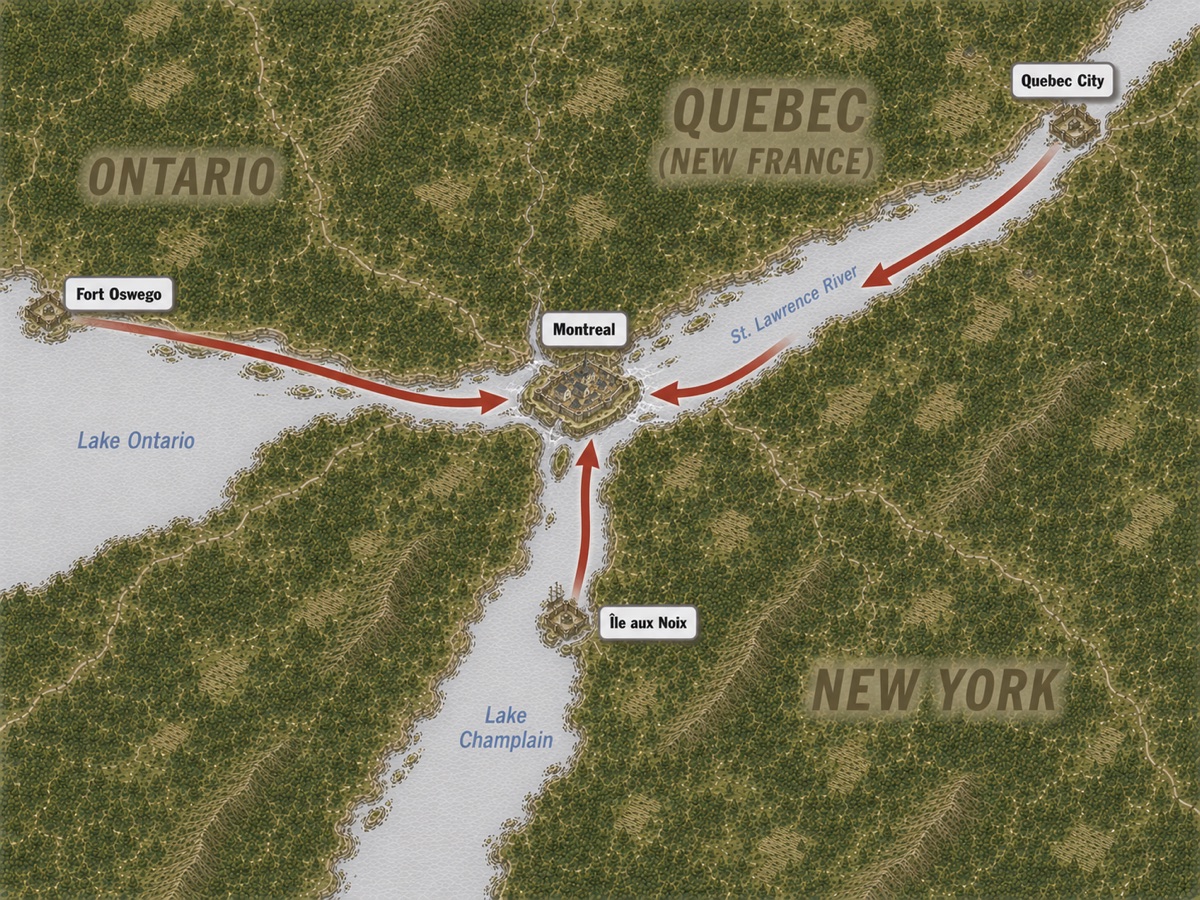
The man in charge was Major General Jeffery Amherst (British), the commander-in-chief in North America, and the plan he built was less a battle than a closing fist. Three separate British armies, roughly eighteen thousand men in all, would set out from three different edges of the colony and converge on the one island at the same time. If it worked, the French would wake one morning with enemies on every side and nowhere left to run.
The trap closed from three sides at once. From the south came Brigadier General William Haviland (British), pushing north up the Lake Champlain corridor, the chain of lakes and the Richelieu River that runs like a back door from New York toward Montreal. From the east came Brigadier General James Murray (British), driving up the St. Lawrence from fallen Quebec, part marching overland, part riding armed boats. And down from the west, taking the hardest road of all, came Amherst himself, descending the length of the St. Lawrence from Lake Ontario after leaving Oswego on August 10. Each column was a small army in its own right: roughly thirty-four hundred men with Haviland, somewhere between thirty-eight hundred and four thousand with Murray, and around ten to eleven thousand with Amherst, the whole of it crammed into flotillas of whaleboats and bateaux (flat-bottomed river boats) where the rivers allowed. Three columns, three hundred miles apart at the start, all of them aimed at the same island.
Amherst’s route had a French cork in it. Sitting on a small island in the upper St. Lawrence was Fort Lévis, a little stockade of wooden walls and a handful of cannon, and the Chevalier de Lévis, the French field commander, had ordered it held to buy time. The man who held it was Captain Pierre Pouchot (French), with a garrison of only a few hundred regulars and Canadian militia. Against him came Amherst’s whole army. It should have been over in an afternoon. Instead Pouchot’s tiny garrison held the huge British force at bay for about a week, even damaging and crippling British warships in the river, before he finally ran out of ammunition and surrendered on August 24. The British took the fort’s guns and stores and moved on, having lost only about two dozen men in the siege.
The river itself was the next enemy. Above Montreal the St. Lawrence breaks into a stretch of rapids, fast white water studded with rocks, and Amherst had to run his whole army down it in open boats. He had no choice; the army could not march that country with its artillery. Around September 4 the flotilla ran the rapids, and the water took its toll. Boats were smashed on the rocks and men were thrown into the current. The British counted about eighty-four drowned (French observers thought far more, as many as three hundred and thirty-six). It was the bloodiest day of Amherst’s whole campaign, and not one of those deaths came from enemy fire.
That last fact is the strange heart of this story. A French force under an officer named the Chevalier de La Corne was posted to defend the rapids, and a few hundred warriors firing from the banks could have turned the British passage into a massacre. No one came. The Canadian militia did not turn out, and the Native warriors did not appear, because the Native nations of the St. Lawrence, the cluster of mostly Catholic communities later known as the Seven Nations of Canada, had already made their own separate peace and stepped out of the war (the reason why is its own thread, told further down). So Amherst’s army drowned by the dozen on the rocks, but it was never shot at, and on September 6 it came ashore near Lachine, about twenty-two miles (35 km) from Montreal. The French pulled back inside the town’s walls.
By then the other two fists were arriving. Haviland had come up the Champlain corridor against the forts held by Colonel Louis Antoine de Bougainville (French), who, too weak to stand, set them on fire and fell back toward Montreal; Haviland was slowed less by fighting than by crowds of habitants (French Canadian settlers) and deserters streaming into his camp to surrender. Murray was coming up the river from Quebec. The three armies, which had started weeks apart and hundreds of miles apart, arrived at Montreal within about twenty-four hours of one another. It was a remarkable piece of timing, and for the French inside the walls it was a closing trap.