The strangest thing about the victory is that the man who won it did not live to know how completely he had. Wolfe was hit early in the wrist and waved it off; then he was struck again, twice more, in the body, and went down for good, just as the French line broke and his men surged forward. He died there on the field, in the very moment of the triumph he had gambled everything on, and his body was carried down to the ships within hours. He was thirty-two. The legend later grew that he had spent the eve of battle quietly reciting Thomas Gray’s poem "Elegy Written in a Country Churchyard," lingering on the line about how the paths of glory lead but to the grave; it is a lovely story and a famous one, but it is a story, not a verified fact, and so are the polished dying words later put in his mouth.
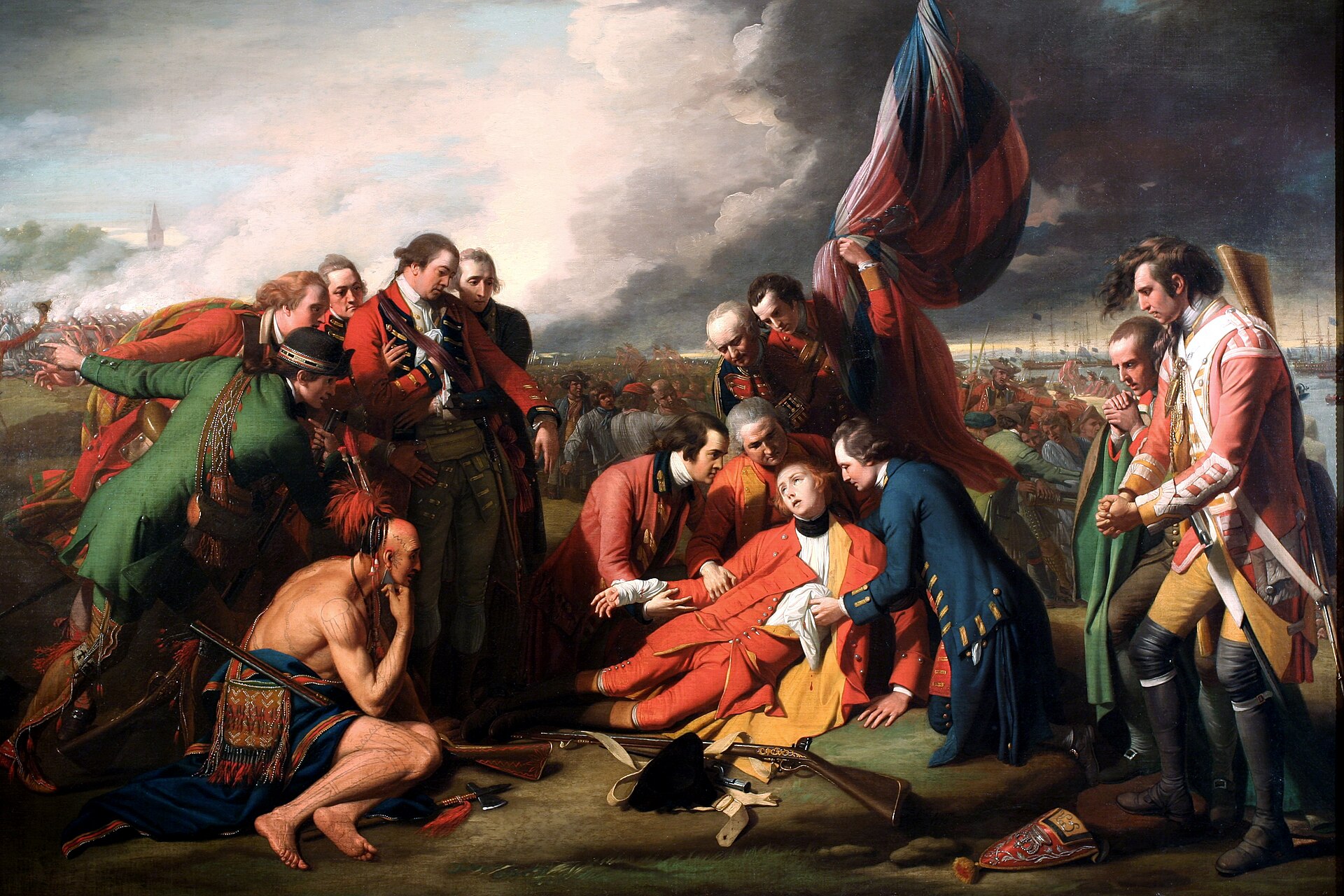
Across the field his enemy was dying too. Montcalm was caught in the rout and shot in the lower body, and he kept his seat on his horse long enough to be carried back into the city through the Saint-Louis gate. He was told that night that he had only hours. He received the last rites and died at dawn the next morning, September 14, 1759. They buried him inside the city, in a hole torn in the chapel floor of the Ursuline convent by a British shell. The tradition holds that he said he was glad he would not live to see Quebec surrender; like Wolfe’s last words, the exact line is tradition, not record, and is best left as the legend it is.
So both commanders died of the same battle, within a day of each other, the victor on the field at the moment of his triumph and the loser inside the walls he had failed to hold. Two armies had lost their generals on a single morning. What was left was the arithmetic of a beaten city.
It did not have long. Bougainville’s force arrived too late to do more than skirmish with the British rear, now under Brigadier General George Townshend (British), and then drew off. With the field lost, the relief gone, and the walls full of the wounded and the frightened, Quebec surrendered five days after the battle, on September 18, 1759. The capital of New France was in British hands.
And no help was coming. The year 1759 was Britain’s Annus Mirabilis, its "year of wonders," when British arms won victory after victory across the globe, at sea off the coasts of France and in the war in Germany and in India and in the West Indies, until the whole French war effort was buckling at once. France had neither the ships nor the men to spare for a relief expedition up a frozen river to a captured colony at the far edge of the world. Quebec fell into the middle of a cascade of disasters, and there was no one left to come for it.
That was the battle that decided the war and, with it, who would own the heart of North America. But it is worth being honest that it did not quite end the war on the spot. The French army had not been destroyed, only beaten, and it came back. The next spring, under the Chevalier de Lévis (French), it marched on the British garrison shivering inside Quebec and beat them in open battle at Sainte-Foy on April 28, 1760, a fight bloodier than the Plains of Abraham itself, costing the British on the order of a thousand casualties, several times the loss of the September battle. For a few weeks it looked as if the French might take their capital back.
The BattlesSainte-Foy, the French counterstroke of spring 1760Then the river decided it again, just as it had decided everything at Quebec. In May 1760 the ships that came up the thawed St. Lawrence flew British colors, not French. With no relief, no reinforcement, and no navy of his own, Lévis had to give up the siege and fall back to Montreal. The last act came that September, when British armies closed on Montreal from three directions at once and the last stronghold of New France surrendered on September 8, 1760. Three years later, at the peace table in Paris, France formally signed Canada away. It had all turned, in the end, on a single short, sharp morning on a farm field above a river, where a doomed general’s gamble and a disciplined volley settled a continent.
The BattlesMontreal, the final surrender of New France in 1760