By 1759 the war that had started with a fifteen-minute skirmish in a Pennsylvania glen had been running for five years, and the early years had gone badly for Britain. Now London had a plan, a fleet, and a man in charge who meant to finish it. The British Secretary of State, William Pitt the Elder, had decided that 1759 would be the year New France fell. He was right. By the time it was over, the British were calling it their Annus Mirabilis, Latin for the Year of Miracles, and the heart of French North America, the string of towns along the St. Lawrence River, had been cut out of the map.
That year, a British fleet came up the St. Lawrence River that the French had believed no enemy navy could survive, and the war turned. What followed was a coordinated three-front invasion designed in London, the fall of the western forts, the long summer agony of Quebec, a battle on a farmer's field that killed both generals in a single afternoon, a French victory the following spring that changed nothing because the wrong navy arrived, and the surrender of Montreal that ended the war in North America. And running underneath all of it, the calculations of the Native nations who watched the French counterweight collapse and began, quietly, to do the arithmetic of what came next.
Pitt's Three Arrows
The man who designed the year was not a soldier and never left London. William Pitt the Elder was Britain's Secretary of State, the minister who ran the war, and he had concluded that beating France meant beating it in North America rather than on the battlefields of Europe. So he poured men and money across the Atlantic. He asked the American colonies for 20,000 troops; their governors delivered around 17,000, and these joined the British regulars already in North America.
His plan for 1759 was to hit New France from three directions at once, so that no matter where the French concentrated their thin forces, the other two blows would land. New France was the French colony of Canada, a long thread of settlements running up the St. Lawrence River from Quebec to Montreal, with a chain of forts reaching far into the interior to hold the fur trade. Pitt meant to sever the thread and snap the chain in the same season.
The first arrow flew east, up the St. Lawrence: Major General James Wolfe would sail from the captured fortress of Louisbourg and lay siege to Quebec, the capital of New France. The second flew west, against Lake Ontario: Brigadier General John Prideaux would take Fort Niagara, the hinge of France's entire western supply and fur-trade network. The third drove north up Lake Champlain: General Jeffery Amherst, the commander-in-chief in North America, would push through the forts guarding the approach to Montreal. If all three succeeded, the French would be cut off from the west, severed from the Ohio Country, and pinned against the river with nowhere to go.
Three arrows, one target: the narrow corridor of towns that was all of settled New France.
The Western Pillar Falls
Fort Niagara sat where the Niagara River meets Lake Ontario, in what is now Youngstown, New York. It was not just a fort. It was the cork in the bottle: the post that connected French Canada to the whole western interior, the Great Lakes, the Ohio Country, and the fur trade that was the economic spine of France's empire in the continent's heart. Take Niagara and the French west fell off the map.
The French commander, Captain Pierre Pouchot, had a serious problem before the British ever arrived. He had earlier been ordered to send roughly 2,500 of his men southward, which left him defending the fort with only about 500. In July 1759 a British and Iroquois force came down on him and laid siege to the fort. A siege is the slow way to take a fortified place: you surround it, cut off its food and reinforcements, and either starve the defenders out or batter the walls down with heavy guns. Prideaux ran the siege; Sir William Johnson, the Superintendent of Indian Affairs and the most important man in British dealings with Native nations, commanded the Iroquois auxiliaries alongside him. Among the senior Iroquois leaders allied with the British was Sayenqueraghta (Seneca), of the Haudenosaunee, the confederacy of Six Nations the British called the Iroquois.
The war storyFort NiagaraPrideaux did not live to take the fort. During the siege he was killed by his own artillery, struck down by a fragment from one of his own mortars firing nearby. Command passed to Johnson, which was its own small drama: a regular-army officer, Lieutenant Colonel Frederick Haldimand, technically outranked him, but Johnson held a royal colonel's commission as commander of the Iroquois auxiliaries, and that was enough to make the authority stick. The Superintendent of Indian Affairs now commanded a British siege.
What decided Niagara, though, happened off to the side, in a conversation between Native nations that neither European command fully controlled. A French relief column was marching to break the siege, and it had Native allies of its own. But the British-allied Iroquois sent word to their French-allied Iroquois counterparts that they did not intend to fight other Iroquois, and urged them to stand aside too. Kinship across the confederacy outweighed the alliance with France. Many of the French-allied warriors melted away from the relief expedition before it ever reached the fort. The neutrality was a deliberate Iroquois choice, made for Iroquois reasons, and it gutted the French column's strength.
What was left of that column walked into a trap. About 2 miles (3 km) south of the fort, at a place called La Belle Famille, Johnson set his men at a chokepoint on the portage trail and held their fire until the French were close. The relief force, led by François-Marie Le Marchand de Lignery and Charles Philippe Aubry, was shattered. At least 334 French were killed and dozens captured, Lignery among the mortally wounded, against roughly a dozen British and allied dead. Pouchot, inside the fort, at first refused to believe his relief had been destroyed. Once prisoners confirmed it, he surrendered, on July 26, 1759, with the honors of war, the customary terms that let a beaten garrison march out with its weapons shouldered and its flags flying, a formal acknowledgment that it had fought with dignity. A garrison of around 600 marched out.
The fort's fall set off a chain reaction. The French abandoned and burned their other western posts rather than have them taken; Fort Rouillé went up in flames at the hands of its own garrison. Britain now held the Great Lakes and the door to the Ohio Valley. The western pillar of New France had collapsed in a month, and the French interior was cut off from the sea.
Meanwhile, Amherst's northern arrow moved more slowly than Pitt had hoped. He advanced up Lake Champlain against Fort Carillon, which the British renamed Ticonderoga, and Fort St. Frédéric. The French did not fight for either. They blew up the forts and withdrew, so that Amherst took the smoking ruins almost for free, five killed and thirty-one wounded at Ticonderoga, against the 2,000 casualties the British had suffered storming the same ground the year before. But Amherst then stopped to build a new fort and did not reach Montreal in 1759. Two of Pitt's three arrows had struck home. The third, and the deepest, was lodged in front of Quebec, and it would take all summer to drive in.
The Long Summer Under the Guns
Quebec was the capital, the prize, and a problem. The city sat on a height above the St. Lawrence, behind walls, with the river itself as its moat, and Montcalm, the commanding general of French regular forces, held the surrounding country with somewhere between 12,000 and 13,000 men. Wolfe himself reportedly called it the strongest country in the world. Wolfe had about 8,500 troops, fewer than the 12,000 originally planned after a measles outbreak thinned the ranks, and he had something the defenders could not match: the Royal Navy.
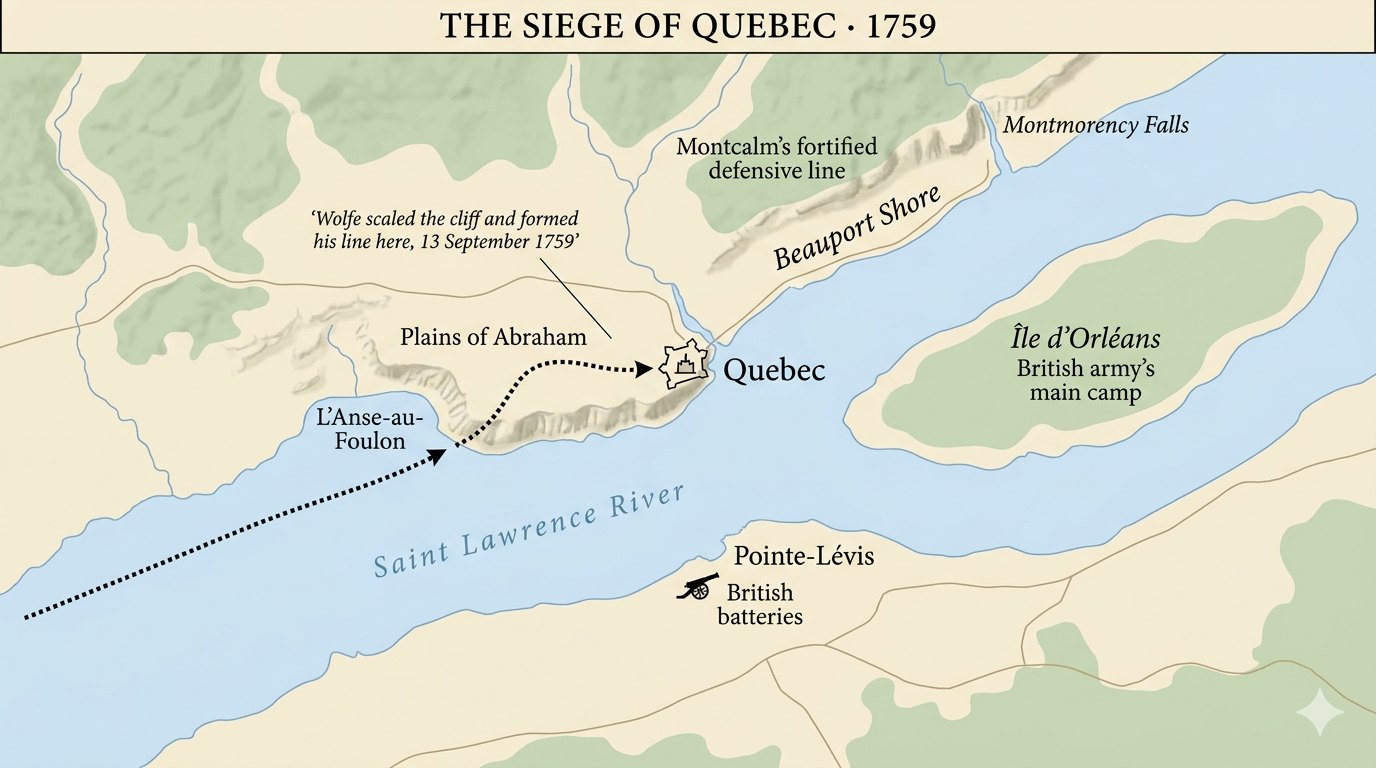
The fleet was the whole campaign. Admiral Charles Saunders had brought it up the treacherous St. Lawrence, water the French believed too dangerous for a hostile fleet to navigate, and without that fleet Wolfe could not have been there at all. The British established a base on the Île d'Orléans, an island in the river just below the city, in late June 1759, and then they settled in to a siege that would last all summer.
The French tried to break that fleet before it could break them. On the night of June 28, they sent seven fireships and two fire-rafts, vessels packed with combustibles and set alight, drifting down on the British ships anchored off Île d'Orléans. Saunders had been warned. His sailors rowed out, grappled the burning hulls, and towed them clear before they could spread. A month later, on July 28, the French tried again with roughly a hundred fire-rafts, and got the same result. Both attempts failed, and the fleet that survived them was left free to pound the city and, in September, to put Wolfe's army ashore.
There was a deep crack on the French side too. Montcalm and the Governor General of New France, Pierre de Rigaud de Vaudreuil, the colony's civilian head, disagreed about almost everything. Vaudreuil favored the colonial way of war, raids and ambushes using Canadian militia and Native allies. Montcalm, a European professional, preferred formal battle and was openly dismissive of Indigenous tactics. The two men ran the defense of New France barely speaking the same strategic language.
What the city endured that summer was not a clean siege of maneuver. It was a bombardment. From a battery at Point Lévis across the river, a battery being a positioned bank of heavy guns, British artillery hammered Quebec for roughly two months. They fired more than 10,000 explosive shells and 40,000 cannonballs into the town, three times the ordnance used to take Louisbourg the year before. The gunners used carcasses, incendiary shells packed with a vicious mixture of saltpeter, sulfur, pitch, turpentine, broken glass and even loaded pistol barrels, so that anyone trying to put out the fire risked the barrels firing in their faces. By the time it was over, 503 houses and a church lay destroyed in the city proper. The cathedral was burned out in late July; the Church of Notre-Dame-des-Victoires in early August. More than fifty of the best houses in the Lower Town were gone.
The people under the shells were ordinary townsfolk, and one of them left a record. Jean-Félix Recher, a parish priest who stayed in the city through the bombardment, wrote that the gunfire terrorized the whole town. The women, with their children, were continually in tears, he wrote, wailing and praying. Groups of them gathered to recite the rosary, asking for divine protection from the things falling out of the sky. His was the voice of the people the campaign histories forget.
The countryside fared no better. While the city burned, Wolfe sent troops out to lay waste the French settlements along the river. He had issued written orders threatening to destroy the harvest, houses and cattle if the city did not yield, and his men carried it out. An estimated 1,400 stone houses and manor farms across the surrounding parishes were destroyed over the course of August. In early September a large raiding party under Major George Scott, including all six of the army's American ranger companies, was sent to burn out the south shore. Colonists were killed in the burning. This was systematic collective punishment of a civilian population, the deliberate destruction of farms and villages to break the will of the people who lived in them, and historians have called it that rather than treating it as a mere miscalculated tactic. It was also a strategic failure: far from frightening neutral inhabitants into surrender, it hardened them into active enemies. The Wolfe-and-Montcalm story that history remembers is a duel of two generals; the people who actually paid that summer were the farmers whose manors were torched and the families who prayed under the shells.
A Battle Before Breakfast
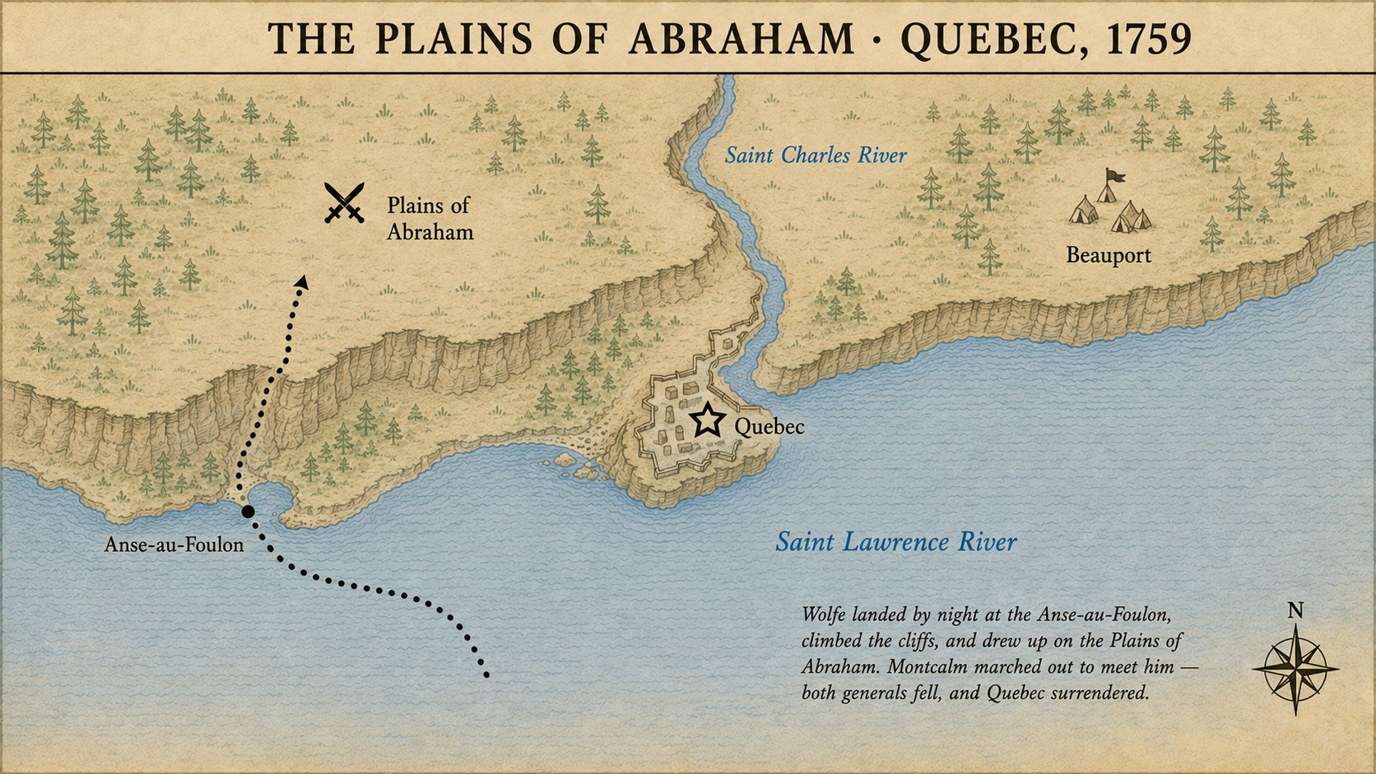
By September, Wolfe was running out of summer and patience. He had spent months failing to draw Montcalm out from behind his defenses, and the river would freeze him out before long. So he gambled on a place the French thought no army could use: a cove called L'Anse-au-Foulon, about 1.9 miles (3 km) upstream from the city, at the foot of a cliff 174 feet (53 m) high. The French believed the height itself was a wall. They were wrong.
On the night of September 12 into the early hours of September 13, 1759, British boats slipped down the dark river and British troops began climbing the cliff. A British officer answered a French sentry's challenge in fluent French and the column was waved through. (Which officer it was, the accounts cannot agree.) The guard post at the top was commanded by Louis Du Pont Duchambon de Vergor, who failed to raise an effective alarm. By dawn, somewhere between 4,400 and 5,000 British soldiers stood in battle order on the Plains of Abraham, a farmer's open field just west of the city walls. Montcalm woke to find an army where there was supposed to be a cliff.
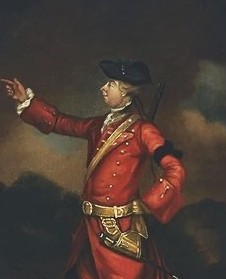
What he did next is generally judged his worst decision of the war. Around ten in the morning, rather than wait for reinforcements, Montcalm ordered a general advance. His reasoning was that every hour he waited, the British would dig in and drag up more guns from the river, and the army on the plains was the only thing standing between Wolfe and the city walls behind it; he judged that he had to drive them off the heights at once, before they could fortify. He had a separate force under Louis Antoine de Bougainville upstream at Cap Rouge that could have come up behind the British and trapped them against the cliff they had just climbed, and the Chevalier de Lévis was not yet on the field either. But Bougainville had missed the night movement downriver and was hours away. By attacking immediately, Montcalm threw away his one chance to crush Wolfe between two forces.
The battle that decided the fate of a continent lasted only minutes. Wolfe had drawn his men up in a line two ranks deep instead of the usual three, widening his front and the weight of his fire. His were British regulars, the professional full-time soldiers of the crown, trained and drilled to stand shoulder to shoulder and hold their fire under pressure. Much of Montcalm's advancing force was Canadian militia, part-time colonial volunteers who could fight hard but had never been drilled to hold a tight battle line, and some of them broke ranks to fire and reload from cover in the way they knew. The British held their volleys until the advancing French were within about 30 yards (27 m), then fired together. The disciplined double crash tore the French line apart. The attack broke and the French ran.
Both commanders died of it. Wolfe was hit several times, in the wrist, the groin, and the chest, and was carried to the rear as his men were winning. By tradition, told and retold more than a century later by the historian Francis Parkman in his 1884 book Montcalm and Wolfe, he heard that the French were giving way and ordered a colonel to cut off their retreat, then said something close to "Now, God be praised, I will die in peace." These words come down through later reconstructions, not a contemporary transcript, and the exact phrasing varies in every telling. The same is true of the gentler legend that the night before the battle Wolfe recited a poem, Thomas Gray's Elegy Written in a Country Churchyard, to his officers in the boat and said he would rather have written those lines than take Quebec. It is plausible and was passed down by a young midshipman who was there, but it is tradition, not record.
Montcalm was shot as he rode back toward the city with the fleeing army. He lived through the night and was told he would not see morning. By the traditional account, again from Parkman, he answered that he was glad of it, that he would not live to see the surrender of Quebec. He died around five in the morning on September 14, 1759, and was buried in a crater that a bursting shell had torn in the floor of the choir of the Ursuline chapel in Quebec. Two enemy commanders, killed by the same battle within hours of each other, on a field that was over before most of either army had fired a shot.
Quebec surrendered five days later, on September 18, 1759. The field army on the plains had been the city's only real defense, and now it was broken and gone: Montcalm was dead, and Vaudreuil had pulled the surviving French army back upriver, leaving no force that could relieve the town before winter. The British were now free to drag their siege guns up to the landward gates, and the fleet still held the river at the city's back. A garrison inside the walls, cut off and unrelievable, had nothing to hold for. The job of signing the city away fell to its acting governor, Jean-Baptiste Nicolas Roch de Ramezay. Brigadier General George Townshend, who had taken overall command when Wolfe fell, accepted the surrender, then sailed home to Britain, handing the ruined city and its garrison to Brigadier General James Murray.
The Wrong Ships
Holding Quebec turned out to be harder than taking it. Murray spent the winter of 1759 to 1760 inside a wrecked city with around 7,000 to 8,000 men and watched them die. Scurvy, cold, and disease cut his effective force to roughly 3,800 by spring. The civilians fared no better than the soldiers. The townspeople who had survived three months under the shells now spent the winter in a ruined city with their stores burned and the countryside that fed them laid waste, and they starved and froze alongside the garrison. For them the conquest did not end with the surrender; it carried straight on into a winter of scarcity in the rubble of their own town.
The French had not given up. Command of all French forces in North America had passed after Montcalm's death to François Gaston de Lévis, the Chevalier de Lévis, and over the winter he rebuilt and retrained the beaten French army at Montreal. The moment the river ice broke in the spring of 1760, he marched downstream to retake Quebec before the navy could arrive, because everything now turned on whose ships reached the river first.
The war storySainte-FoyThey met on April 28, 1760, at Sainte-Foy, just west of the city, near the old battlefield. Murray made the aggressive choice. Rather than wait behind Quebec's walls, he marched out with about 3,800 men and twenty-two guns (twenty cannon and two howitzers) to hit Lévis's roughly 5,000 before the French were fully deployed. It went wrong. The fighting closed to short range and ran for two bloody hours; French counterattacks rolled up the British left, and Murray's men fell back into the city, spiking and abandoning their cannon in the retreat (spiking a gun means driving a metal spike into its firing hole to wreck it so the enemy cannot turn it around and use it). It was one of the bloodiest battles ever fought on Canadian soil. The French lost 833 men killed and wounded; the British lost 1,182. Lévis had won a stand-up field victory, a rare thing for France in this war.
And yet the victory changed nothing, for a reason that had nothing to do with how the battle was fought. Lévis had beaten Murray in the field, but he had only three cannon and no siege train, the train being the heavy battering artillery, the big mortars and siege guns, that an army needs to knock down fortress walls rather than just shoot at men. Without it he had no way to breach Quebec's fortifications. He could only sit down outside the walls and wait, hoping French ships would come up the river with the guns and supplies he lacked. Both armies watched the water for the first sails of spring.
The sails, when they came in May 1760, were British. HMS Lowestoffe, HMS Diana, and HMS Vanguard came up the St. Lawrence and destroyed Lévis's supply ships on the river. No French relief fleet was coming, because French naval power had already been broken at sea: smashed at Quiberon Bay off the French coast in November 1759, where Admiral Edward Hawke wrecked France's Atlantic fleet, and finished off in lesser actions the following summer. France could not send ships to Canada because France no longer had the ships to send. Lévis lifted his siege and retreated to Montreal. The battle of Sainte-Foy had gone to France; the campaign had been decided not on the Plains of Abraham or at Sainte-Foy but out in the Atlantic, by the Royal Navy. The land battles were almost beside the point. Whoever controlled the river controlled Canada, and Britain controlled the river.
Three Armies and a Surrender
For the final act, Amherst went back to Pitt's original idea and aimed three armies at a single point. Montreal was the last French stronghold, and in the summer of 1760 some 18,000 British troops closed in on it from three directions, so that Lévis, with a melting army, could not possibly defend against all of them.
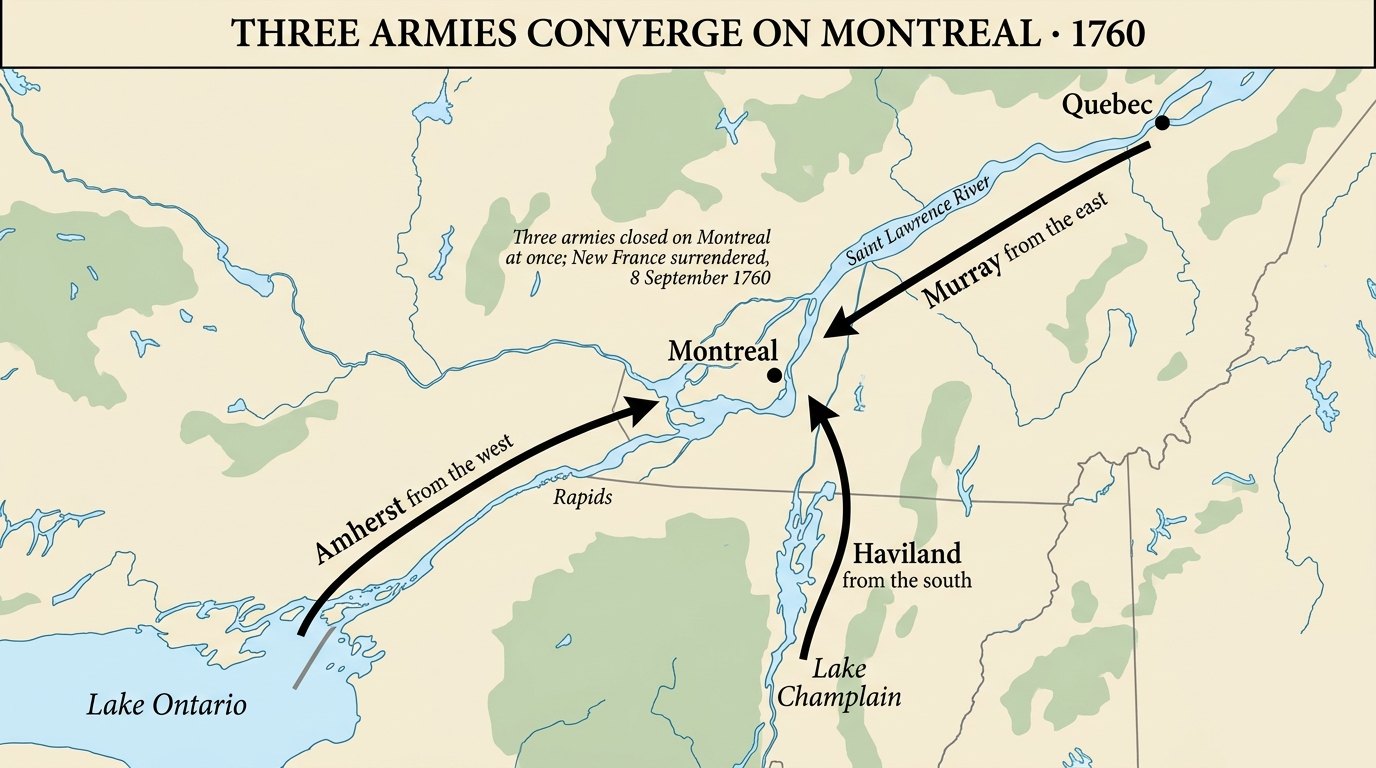
Amherst himself led around 10,000 men, including roughly 700 Iroquois, down the St. Lawrence from Lake Ontario, a route that cost him 84 men drowned and 46 boats wrecked in the violent Lachine rapids before he even saw the city. Murray brought about 4,000 west from Quebec along the river, disarming the riverside parishes as he came; thousands of Canadian militia, seeing the end, simply deserted and went home to their farms. The third force, around 3,400 men under Brigadier General William Haviland, pushed north from Crown Point up Lake Champlain and the Richelieu River. Haviland took Île-aux-Noix, the island fort where Bougainville now commanded, forcing Bougainville to slip away by night after a British raid seized his ships, then rolled up the forts behind it. By September 6 and 7, all three armies stood around Montreal. Pitt's original design had finally come off: three forces converging on one point, so that Lévis's melting army could not block all of them at once and was simply boxed in.
There was nothing left to fight with, and with Montreal surrounded, the last French city, the last French army, and the last supply line on the continent were all in the same closing trap. Vaudreuil presented fifty-five articles of capitulation on September 7. A capitulation is a formal surrender whose detailed terms are negotiated and written down in advance, article by article, rather than a simple laying-down of arms. On September 8, 1760, he signed it, surrendering New France. The war in North America was over.
There was one bitter ceremony at the end. Amherst refused to grant Lévis and his soldiers the honors of war, the customary right of a beaten army to march out with colors flying and drums beating. His stated reason was the conduct of the war itself, the French use of Native allies in raids he called barbarities and breaches of faith. Denied the right to carry their flags out with dignity, Lévis ordered his battalions to burn their regimental colors, the official battle flags that carried a regiment's identity and honor and whose capture by the enemy was a lasting disgrace, rather than surrender them as British trophies. The standards of the regiments of New France went into the fire.
The terms the civilians got were, by the standards of the age, generous. French Canadians kept their property and their property law, could not be deported, and, in articles that mattered enormously in a Catholic colony falling under a Protestant crown, kept the free exercise of the Roman Catholic faith and the standing of their clergy. The capitulation even explicitly protected the continued ownership of enslaved Black and Indigenous people by French Canadians, a term Amherst granted. The Acadians were the conspicuous exception. These were the French settlers of the Atlantic coast whom Britain had already torn from their homes and scattered in earlier years, tens of thousands forcibly deported in one of the worst humanitarian acts of the entire war, and now, with the rest of New France being handed generous terms, Britain refused to repatriate the Acadian prisoners it still held. And Article 40 made a promise to the Native nations who had fought for France, that they would keep the lands they lived on, their faith, and face no punishment for the war. That promise was about to prove worthless.
The Counterweight Removed
For the Native nations of the Great Lakes and the Ohio Country, the fall of New France was not a liberation and not a defeat. It was the loss of a counterweight. For generations they had played the two European empires against each other, trading with both, allying with whichever served their interests, and using the rivalry itself to protect their own ground. The French had been the more useful partner: they came to trade and garrison, not to clear forests and plant farms, and they kept the alliance greased with the steady gift-giving and the trade in powder and shot that Native diplomacy ran on. With France gone, that whole system was gone.
The shift had been visible all through the conquest. At Niagara, the Iroquois had refused to fight each other and crippled the French relief. In the Montreal campaign, around 800 French-allied warriors were disarmed by William Johnson; many had already abandoned the French cause and some signed on with the British as scouts. These were not surrenders. They were the pragmatic moves of nations watching one of their two leverage points disappear, and trying to bank goodwill with the side that was clearly going to win.
But the side that won did not intend to keep playing the game. Amherst, now master of the interior, regarded gift-giving as a bribe he no longer had to pay. He cut it off, restricted the sale of gunpowder and ammunition, and reasoned that with the French gone, the Native nations had nowhere else to turn and would simply have to accept British terms. He left only a few hundred troops scattered across the western forts. He had badly misread the situation. The nations did not see themselves as conquered subjects; they had never been conquered at all. As the Shawnee diplomat Nimwha put it, the British thought themselves masters of the country because they had taken it from the French, who had no right to it in the first place, because it was the property of the Indians.
The Article 40 promise of secure lands and no punishment turned out to be empty under Amherst's administration, and the gap between the promise and the practice did exactly what such gaps do. By 1761 Seneca messengers were carrying calls for united resistance to the Great Lakes and Ohio nations. A Lenape spiritual leader, Neolin, known as the Delaware Prophet, was preaching that the nations had to push the British out or be destroyed by them, by sickness and by the alcohol the traders brought. And in May 1763, once word spread that France had formally signed Canada over to Britain, Pontiac, a leader of the Ottawa nation, launched the coordinated war that bears his name. The conquest of Canada had removed the French counterweight, and the people who had used that counterweight longest were the first to feel its absence and the first to fight back.
The war in North America ended in 1760. The reckoning over who would actually hold the continent was only beginning.