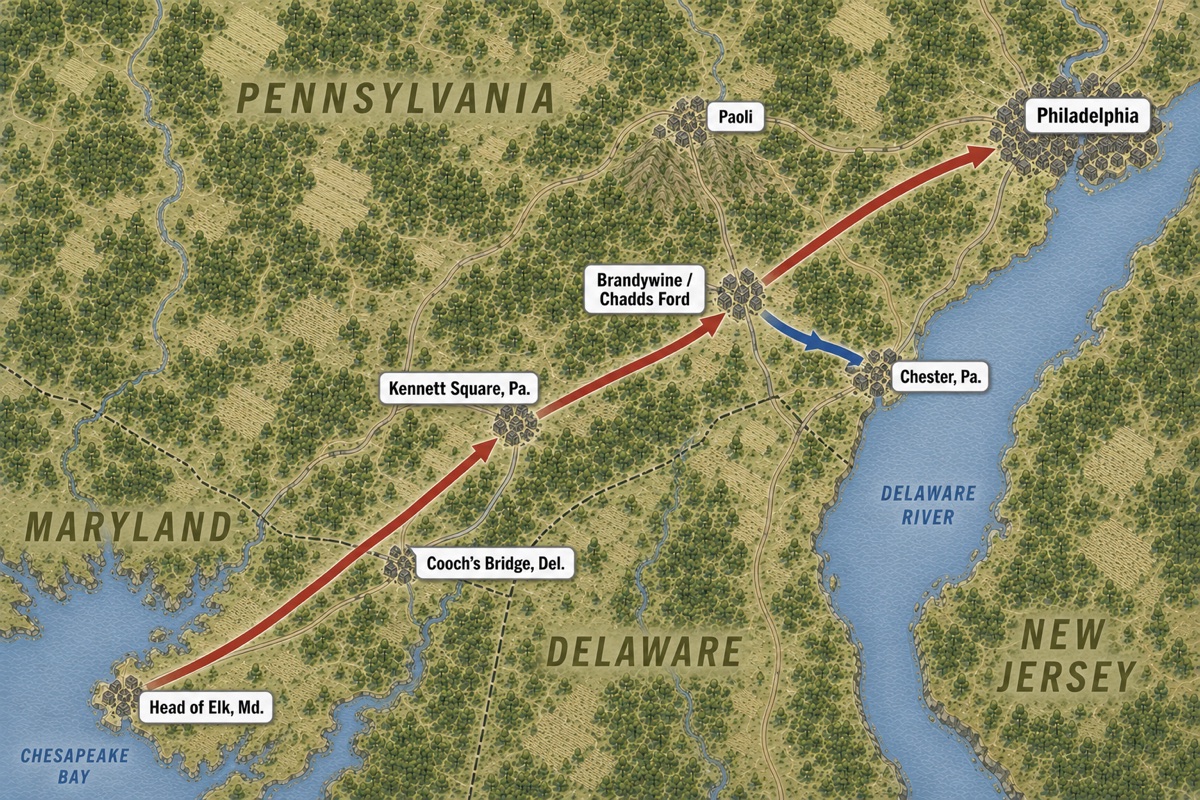
At midnight on September 11, 1777, from the town of Chester on the Delaware River, where his beaten army was still walking in, George Washington (American), commander of the Continental Army, reported the day to John Hancock, the president of the Continental Congress (the assembly governing the rebelling colonies, sitting up the river in Philadelphia). "I am sorry to inform you," he wrote, "that in this days engagement we have been obliged to leave the enemy masters of the field." The missing apostrophe is his; the candor is too. And then, in the same letter, the sentence that turned out to matter more:
Notwithstanding the misfortune of the day, I am happy to find the troops in good spirits; and I hope another time we shall compensate for the losses now sustained.
The counting afterward says a great deal about the day, including how hard it is to count. The British and their Hessians (the German troops serving with them) filed an official return of 587 casualties, call it around 580 to 600, and only about 40 of them were Hessians. American observers guessed British losses at 2,000, but they were guessing from a distance. On the American side there is no return at all. None was ever issued, and none survives, so every American figure is an estimate: roughly 200 to 300 killed, 500 to 750 wounded, and 350 to 400 captured, a total somewhere around 1,100 to 1,300. Nathanael Greene, the American division commander whose stand at Dilworth had covered the retreat, put his own army's loss at 1,200 to 1,300. Eleven of the army's fourteen guns on the field were gone.
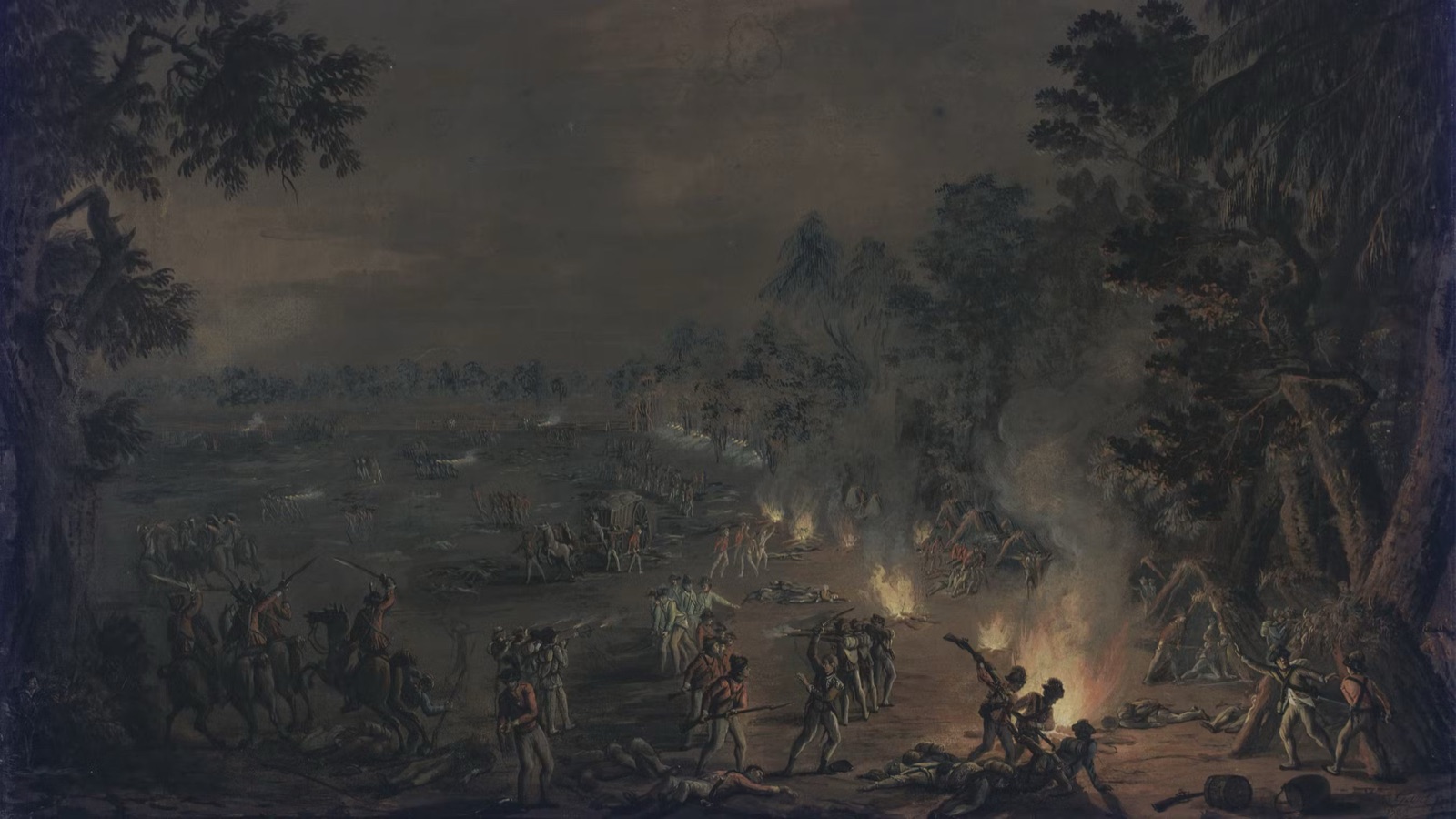
What followed was two weeks of the war going Britain's way. On September 16 the armies met again near the White Horse Tavern and a torrential storm soaked every cartridge on the field, washing out the battle before it happened; it is remembered, a little wryly, as the Battle of the Clouds. Then came the night of September 20. Anthony Wayne (American), the Pennsylvania brigadier whose division had held Chadds Ford, was camped near Paoli Tavern, in his own home county, shadowing the British army. Major General Charles Grey (British) took a force against the camp at midnight with a piece of cold professional discipline: he ordered muskets unloaded and flints removed (the flint is the stone that sparks the gunpowder; no flint, no accidental shot to alarm the sentries), so that the attack would be made silently, with the bayonet alone. It earned him the name "No Flint Grey," and it worked completely. The modern count is about 53 Americans killed, with some 113 wounded and 71 captured; older accounts ran the dead as high as 150 or more. Many of the American dead had multiple bayonet or sword wounds, and American propaganda said men had been killed begging for quarter (the formal word for mercy and surrender). Americans called it, immediately and ever after, the Paoli Massacre. Strictly by the rules of eighteenth-century war it was a lawful night attack, devastating because it was disciplined; "massacre" was the American framing, and the multiple wounds and the dark made it easy to believe. Wayne, criticized afterward by a court of inquiry, demanded a full court-martial (a formal army trial) to judge his conduct, and on November 1, 1777 it found that he "did every duty that can be expected from an active, brave and vigilant officer" and did "acquit him with the highest honor."
Philadelphia had already begun emptying two days before Paoli. On September 18 and 19, on a warning from Alexander Hamilton (a young officer on Washington's staff) that the British could cross the Schuylkill River outside the city, Congress fled, first to Lancaster, Pennsylvania for a single day, then on to York, Pennsylvania, farther west. The city's bells went too, hauled away to Allentown and hidden under a church floor, among them the State House bell that Americans now call the Liberty Bell. On September 26, 1777, fifteen days after Brandywine, Lord Cornwallis, the British general whose flank march had won the battle, led a column of British and Hessian grenadiers into Philadelphia unopposed. The rebel capital, the largest city in America, had fallen.
The campaign of General Sir William Howe, the British commander in chief, had been executed about as well as any British operation of the war. The sea move put his army where Washington had to fight; the flank march at Brandywine was longer and bolder than the Long Island version and worked completely; he beat the main American army in the open field and took the enemy's capital, and his official casualty bill for the battle was about half his enemy's. As pure generalship, Brandywine was arguably Howe's masterpiece. And then there is everything the masterpiece did not buy. He did not pursue at nightfall, and the Continental Army got away intact, in decent order, with its morale surprisingly whole; Washington had it back on the attack within a month, falling on Howe's camp at Germantown on October 4. Capturing the capital paralyzed nothing, because the American government was not the kind that lived in a building: Congress simply kept governing from York. And the same autumn, the northern British army that Howe had sailed away from surrendered at Saratoga on October 17, the defeat remembered ever since as the war's true turning point. Howe had won a city. What Britain needed him to win was an army, and the army was still out there, in good spirits, promising to compensate another time.