Major John Pitcairn (British), the Royal Marines officer leading the column's advance companies of regulars (the king's professional soldiers), reached Lexington, a town astride the road about 11 miles out of Boston and 6 to 7 short of Concord, a little before 5 a.m. On the town green he found about 77 militiamen (the town's part-time citizen soldiers) drawn up in parade-ground lines under Captain John Parker (American), a 45-year-old farmer, a French and Indian War veteran, and a man dying of tuberculosis. He had not formed them across the Concord road. They stood off to the side of it, a presence rather than a barricade, and not an ambush. Six days later Parker swore a deposition (a formal statement made under oath) about his intentions.
concluded not to be discovered, nor meddle or make with said Regular Troops (if they should approach) unless they should insult or molest us; and upon their sudden Approach, I immediately ordered our Militia to disperse and not to fire
Mounted officers, commonly said to include Pitcairn, rode forward shouting at the militia to disperse ("Disperse, you rebels!" in the colonial accounts). The men were filing off, though not grounding their arms, when a shot came from somewhere. Nobody has ever established who fired it: a regular, a militiaman, an onlooker, an accident. Some regulars swore it came from behind a hedge or a tavern corner, and a captured British officer, Lieutenant Edward Gould, gave the most honest contemporary answer, deposing that he could not say which side fired first. What followed is certain. The regulars fired volleys and charged with bayonets, and their officers needed some minutes to beat the firing back down. Eight Americans were killed and ten wounded, against one regular lightly wounded. Jonathan Harrington dragged himself to his own doorstep and died at his wife's feet. It took minutes.
The column reached Concord around 7 a.m. The local militia, too few yet to fight, withdrew across the North Bridge over the Concord River to a hill beyond it and watched the town fill with regulars while companies from neighboring towns marched in to join them. Below, the grenadiers (the big assault companies) searched the locations marked on the map General Thomas Gage (the British commander in Boston, who had ordered the raid) had supplied, and found the leftovers of a stockpile two weeks gone: three 24-pounder siege guns too heavy to have been moved, which lost their trunnions; gun carriages and tools, burned; about 500 pounds of musket balls dumped in the millpond (the town later fished most back out); flour and salt fish staved open and dumped. A detachment sent 2 miles to Colonel James Barrett's farm, where the map promised heavy weapons, found nothing of consequence: cannon lay plowed into the furrows under the searchers' boots. The officers in town mostly behaved correctly, paying for what they took, but the burning gun carriages set the town house alight by accident, and although regulars joined the bucket line that doused it, the militia across the river saw only the smoke. Concluding the town was burning, they formed up and advanced, at about 9:30 in the morning.
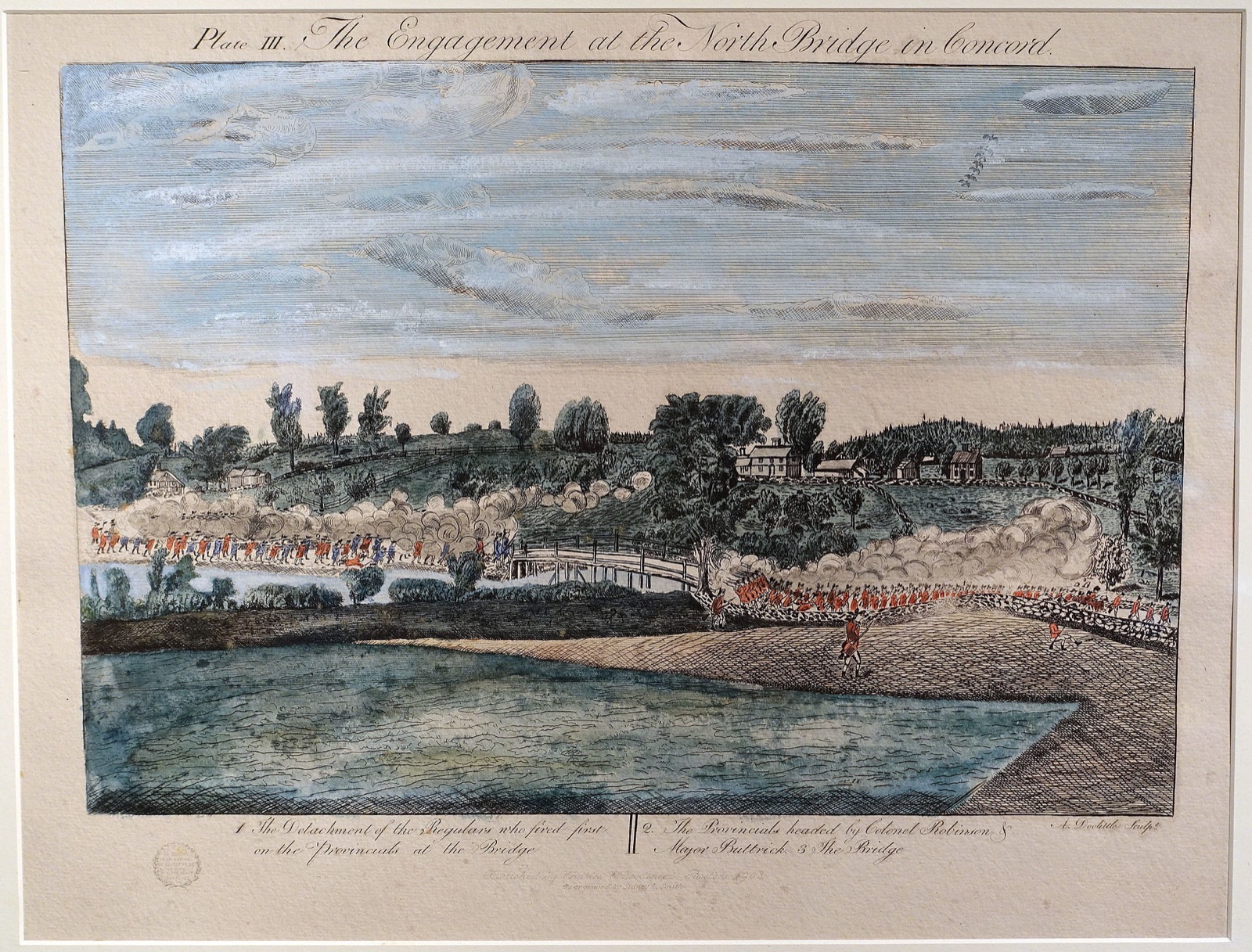
About 400 militiamen came down in column on the 90 to 100 regulars at the bridge, who fell back across it and fumbled into a bad formation. Here there is no mystery about the first shot: the regulars fired first, scattered shots and then a volley, killing Captain Isaac Davis of Acton, whose company led, and Abner Hosmer. Major John Buttrick of Concord ordered the reply, by tradition crying "Fire, fellow soldiers, for God's sake, fire!" The volley killed three regulars and wounded nine, four of the eight officers among them, and broke them; they ran for town. It was the first ordered American volley against the king's troops, and that volley, not Lexington, is what "the shot heard round the world," the poet Ralph Waldo Emerson's much later phrase, commemorates.
In the minutes after the fight, a wounded regular trying to rise was struck in the head with a hatchet by a young Concord man (tradition names Ammi White) and died. The killing is real, and it grew monstrous in the telling: by the time the story reached Boston the man had been scalped and mutilated, a version that entered Gage's official account. One ugly blow had become a propaganda atrocity running in both directions, and some historians read the regulars' rage that afternoon partly through the rumor.
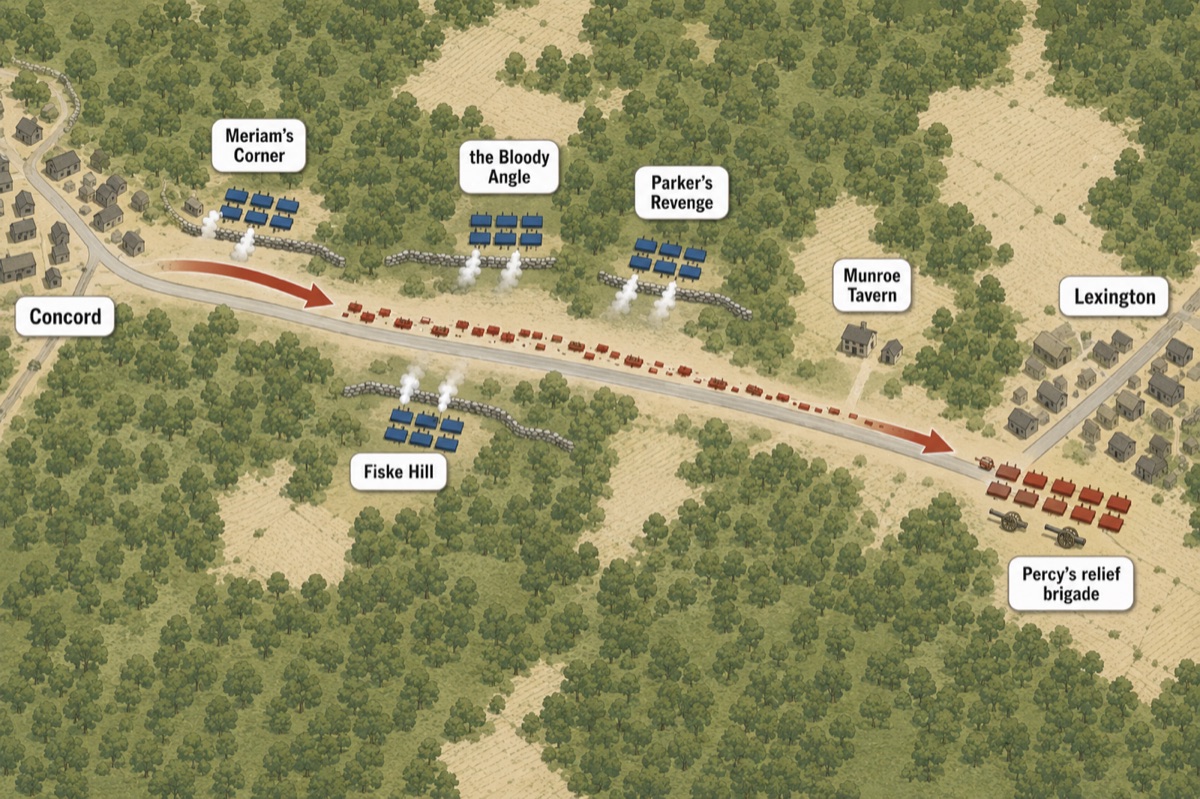
Lieutenant Colonel Francis Smith (British), the expedition's commander, then sat in Concord for about two hours, gathering wounded and hiring carriages, while the hills kept filling. The march for Boston began around noon, back down the same single road the column had marched out on, and the real battle began with it. At Meriam's Corner, a mile east, where a small bridge forced the flanking parties (light infantry detachments sweeping the fields wide of the road to keep ambushers off the column) to fold back in, the gathered companies opened fire; two regulars died. The pattern held for 16 miles.
Imagine the road from inside the column. You have been awake since the muster on the Back Bay beach at 10 the night before. You waded ashore through a marsh and stood soaked in the dark for hours, you marched the rest of the night, and you have been fighting since dawn. Now every stone wall on both sides of the road is a firing line that empties and refills, town by town, with men you almost never see; they shoot from behind cover and are gone before the smoke clears. The only answer is the flanking parties sweeping the fields, so the column walks, and bleeds, and walks. By the time it is over, you will have been under arms for about 21 hours.
At a double bend in the Lincoln woods later named the Bloody Angle, fire from both sides of the road killed about eight men. At the Lincoln and Lexington town line, Parker's reformed company, the morning's survivors, ambushed the column from a wooded rise: Parker's Revenge, known from a single account told 50 years later but fixed on the ground by archaeologists who recovered the musket balls in the 2010s. Somewhere in this stretch of road (sources split on the exact spot) Smith was shot in the thigh, and at Fiske Hill discipline began to fail outright; Pitcairn's horse threw him and bolted into the American lines with his pistols, and the retreat was nearing a rout.
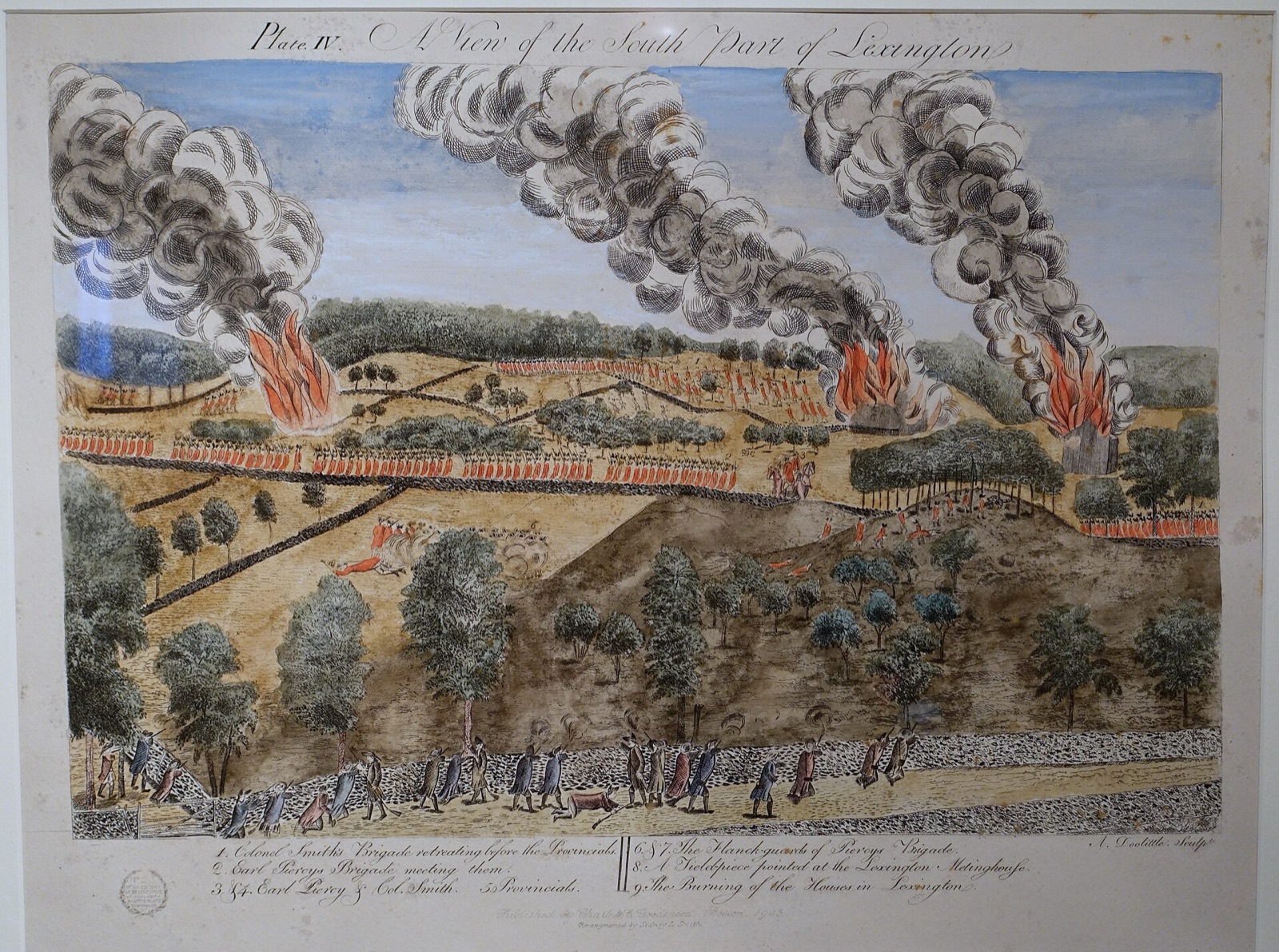
Percy saved it. Brigadier General Hugh, Earl Percy (British), heir to the Duke of Northumberland and the commander of the relief brigade Smith had sent back for before dawn, met the column east of Lexington green between 2 and 3 p.m. with perhaps 1,000 to 1,400 fresh men and two 6-pounders (field guns firing a six-pound ball). Smith's exhausted men collapsed inside the brigade's shelter while the cannon, the first artillery fire of the war, broke up the militia massing in pursuit, and Percy's men torched several houses that snipers were using or could use. On the other side of the walls, Brigadier General William Heath (American), a Roxbury farmer and the first American general officer on a battlefield of the Revolution, had reached the fight by mid-afternoon, and by his own later account fed the arriving companies into a moving ring of skirmishers (men fighting spread out in loose order) around the column rather than letting them mass into targets for the guns. Then the march resumed behind a rotating rearguard and strong flanking parties sweeping the walls and houses, and those sweeps were where the day's ugliness lived: houses cleared with bayonets, then looted.
The worst came at Menotomy (now Arlington), the last big town on the road back before Cambridge, between about 4:30 and 5:30 p.m., where fresh companies from Essex County waited in a town the road ran straight through; the Danvers company had covered 16 miles in about four hours to be there. The fight went house-to-house and hand-to-hand, and it cost roughly 25 American and 40 British dead, half the British dead of the entire day. At Jason Russell's house, Russell, 58 and lame, was killed defending his own doorstep along with 11 other Americans shot or bayoneted in the house and yard, the bloodiest single spot of April 19. Samuel Whittemore, a Menotomy man in his late 70s, killed three regulars before being shot, bayoneted, and left for dead; he recovered and lived into his nineties. Unarmed men in the houses and taverns died too. The plundering that came with the house-clearing is in the British officers' own diaries: Lieutenant John Barker of the 4th Regiment of Foot wrote that "The plundering was shameful" and, of the cleared houses, "All that were found in the houses were put to death." Lieutenant Frederick Mackenzie of the 23rd Regiment set down how the afternoon's two crimes fed each other.
Many houses were plundered... I have no doubt this inflamed the Rebels... Some soldiers who stayed too long in the houses were killed in the very act of plundering.
Gage's written orders had forbidden exactly this. The honest ledger of the road is even-handed and grim: the regulars plundered and killed in the houses, the militia shot men from ambush all day, and both sides' propaganda inflated both.
At Cambridge (the river town where the road home crossed the Charles), Percy made the day's smartest call, swerving off the expected route over the Great Bridge (the road's crossing of the river), where an ambush had been prepared, and making for Charlestown instead, a town on its own peninsula just across the water from Boston, where the navy's guns could cover the approach. The column reached Charlestown Neck (the narrow strip joining the peninsula to the mainland) at dusk, around 7:30 p.m., under the covering guns of the warship HMS Somerset, whose presence ended the pursuit. The militia ring of skirmishers that had hung on the column all afternoon broke off at the Neck. But the militia did not go home. They camped in a ring around Boston.