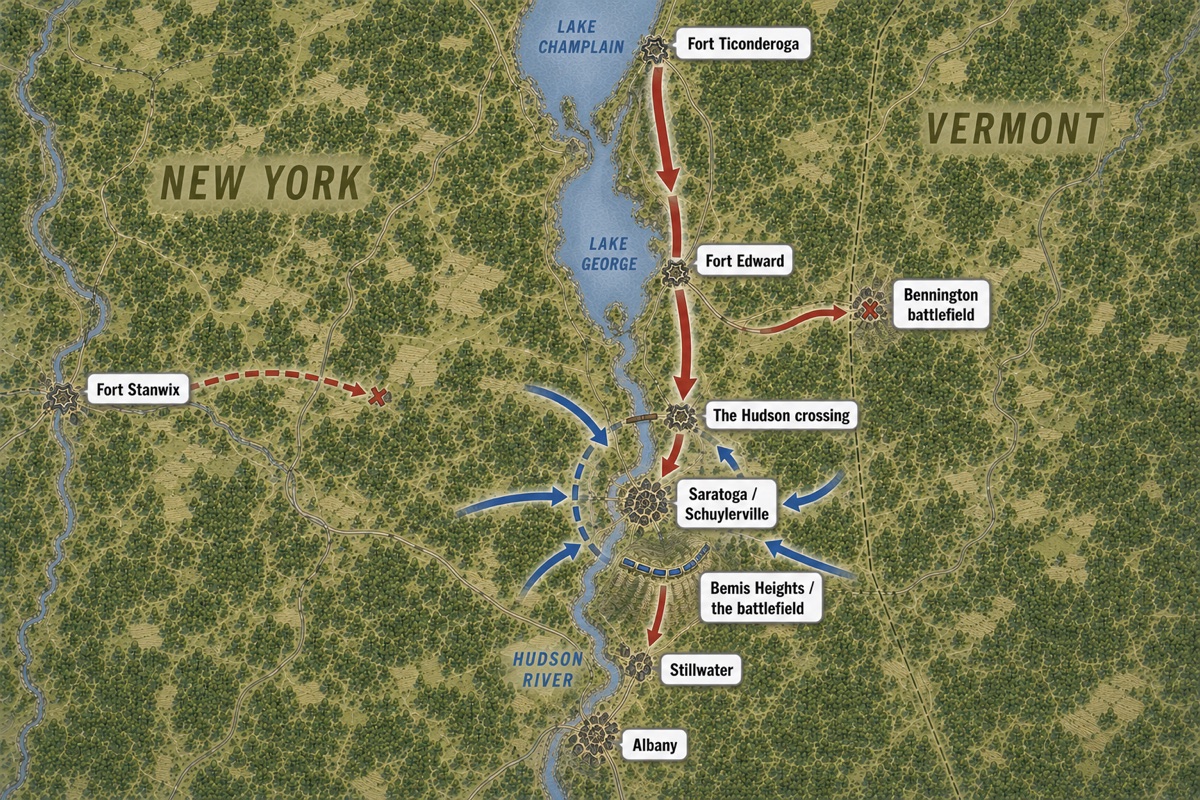
The British army that buried Simon Fraser at sunset on October 8 began retreating that same night, north through cold rain to the settlement of Saratoga (the present town of Schuylerville). It left its hospital behind, some 300 sick and wounded men trusted to American mercy, and most of its baggage. Frederika Riedesel rode the retreat in a calash (a light open carriage) with her three daughters, and spent the next six days in the cellar of a house under American artillery fire. Eleven cannonballs went through the house above her; she wrote of hearing them rolling overhead while the wounded sheltered around her.
By October 12 the trap had closed. Gates's army stood across the south and west; John Stark, the victor of Bennington, was back with fresh militia, sealing the river to the north at Fort Edward; American guns commanded the camp itself. Around 5,800 worn-down effectives were ringed by a force conservatively put at well over 15,000, with some counts running to 20,000. On October 13 Burgoyne's council of war voted to open talks.
One last hope was already dead, though nobody at Saratoga knew it. On October 8 Henry Clinton had written Burgoyne from the captured Highlands forts: "Nous y voici, and nothing now between us but Gates. I sincerely hope this little success of ours may facilitate your operations." The courier, Lieutenant Daniel Taylor, was caught two days later. He swallowed the message, sealed inside a hollow silver bullet; New York's American governor, George Clinton, ordered him dosed with an emetic, the bullet reappeared, and Taylor was hanged as a spy on October 18, one day after the army he was riding to save had surrendered. Clinton, the British general, had in fact kept his word, in a fashion. He came up the Hudson on October 3 with about 3,000 men, stormed the Highlands forts on October 6, and sent raiders far enough upriver to burn Kingston, still about 50 miles short of Albany: a raid, not a rescue, with no orders and no intention to fight through. Nothing he did could have arrived in time.
What Burgoyne salvaged at the table was remarkable. He flatly refused the word "capitulation," and the document signed on October 16 is the Convention of Saratoga. Under its terms the army marched out of camp with the honors of war (meaning the men marched out under their own flags, drums beating and weapons shouldered, not as captives) and grounded its arms at the riverside; in exchange it would march to Boston and embark for Britain, on the condition that its men never serve again in North America during the war; officers kept their sidearms and baggage. Gates accepted terms this generous because Clinton was loose in the Highlands behind him and he wanted Burgoyne's army in hand immediately. When he briefly demanded that the British ground their arms inside their own camp, surrender-style, Burgoyne threatened to break off and fight, and Gates folded within hours.
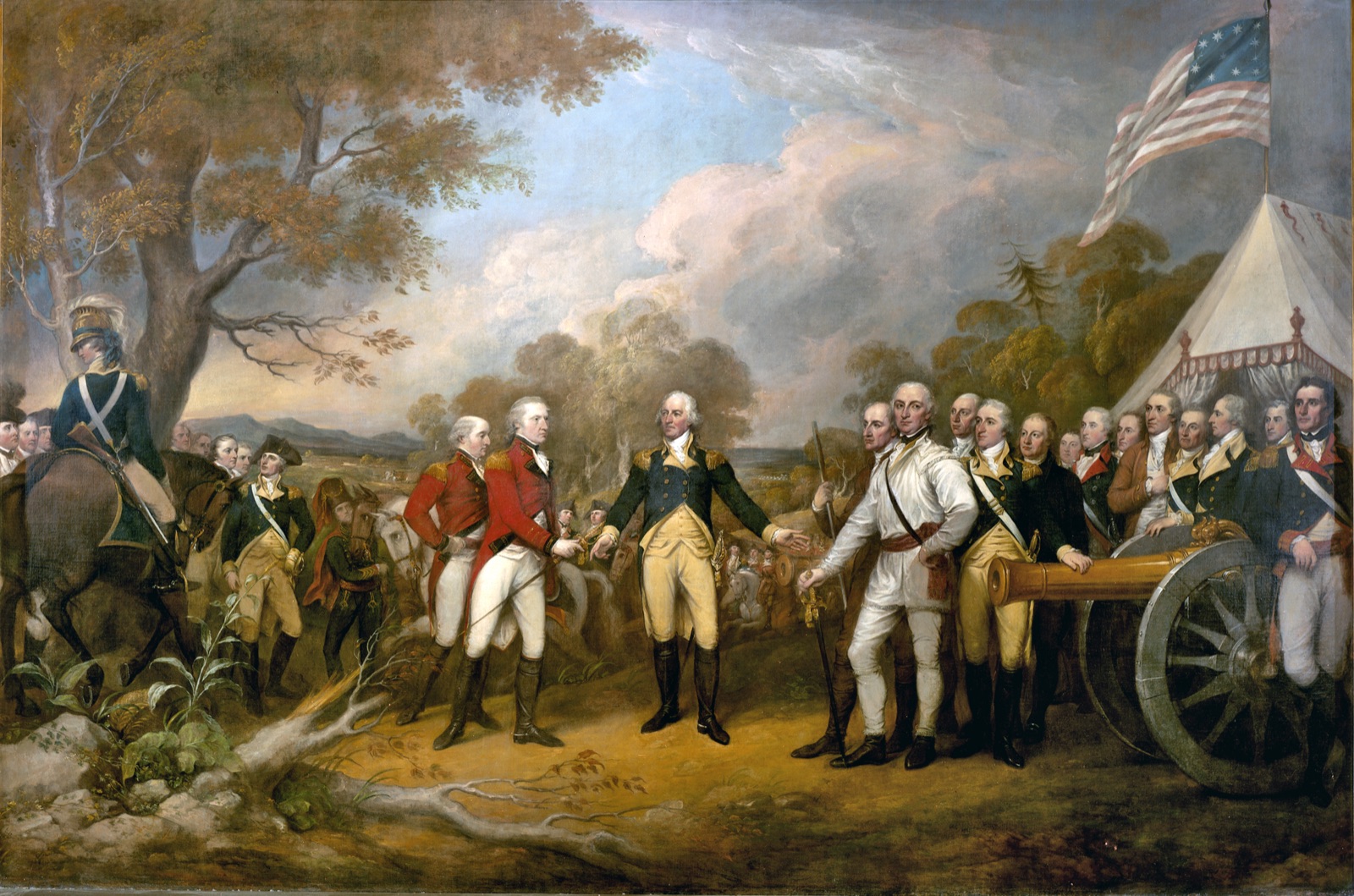
On October 17, 1777, nearly 6,000 British, German, and provincial troops marched to the meadow by the ruin of Fort Hardy and laid down their arms: all that remained of the army of nine to ten thousand, counting its auxiliaries, that had left Canada in June, along with more than two dozen guns and some 5,000 muskets. Burgoyne, in full dress, offered his sword to Gates. By the famous account, written down long afterward by an officer who was there, the exchange went like this.
The fortune of war, General Gates, has made me your prisoner.
Gates, returning the sword: "I shall always be ready to bear testimony that it has not been through any fault of your Excellency." The two generals dined together that day, the captured German officers among the guests, and American bands are said to have played Yankee Doodle. Gates crowed in a letter commonly said to be to his wife: "If Old England is not by this lesson taught humility, then she is an obstinate old slut, bent upon her ruin."
What happened to the Convention Army afterward is a story Americans tell less often, and it should be told plainly: Congress broke the deal. It never ratified the convention and never let the army sail, reaching for pretext after pretext, a dispute over surrendered cartridge boxes, a bitter line of Burgoyne's ("the public faith is broke") seized on as proof Britain would void the bargain, the plain fear that every man shipped home would simply free another soldier for service elsewhere. The army was marched to Cambridge, Massachusetts, then, in the winter of 1778 to 1779, some 700 miles south to Charlottesville, Virginia, and then onward again as the war moved. Thousands deserted or melted into the American population. The officers were eventually exchanged, Riedesel and Phillips in 1780, and Burgoyne himself was paroled home in May 1778 (released on his word of honor not to serve against America until formally exchanged) to defend the campaign in Parliament, which he did for the rest of his public life, never commanding in the field again. Most of the privates who grounded arms at Saratoga did not see home before the peace of 1783. It was a genuinely shabby episode on the winning side.
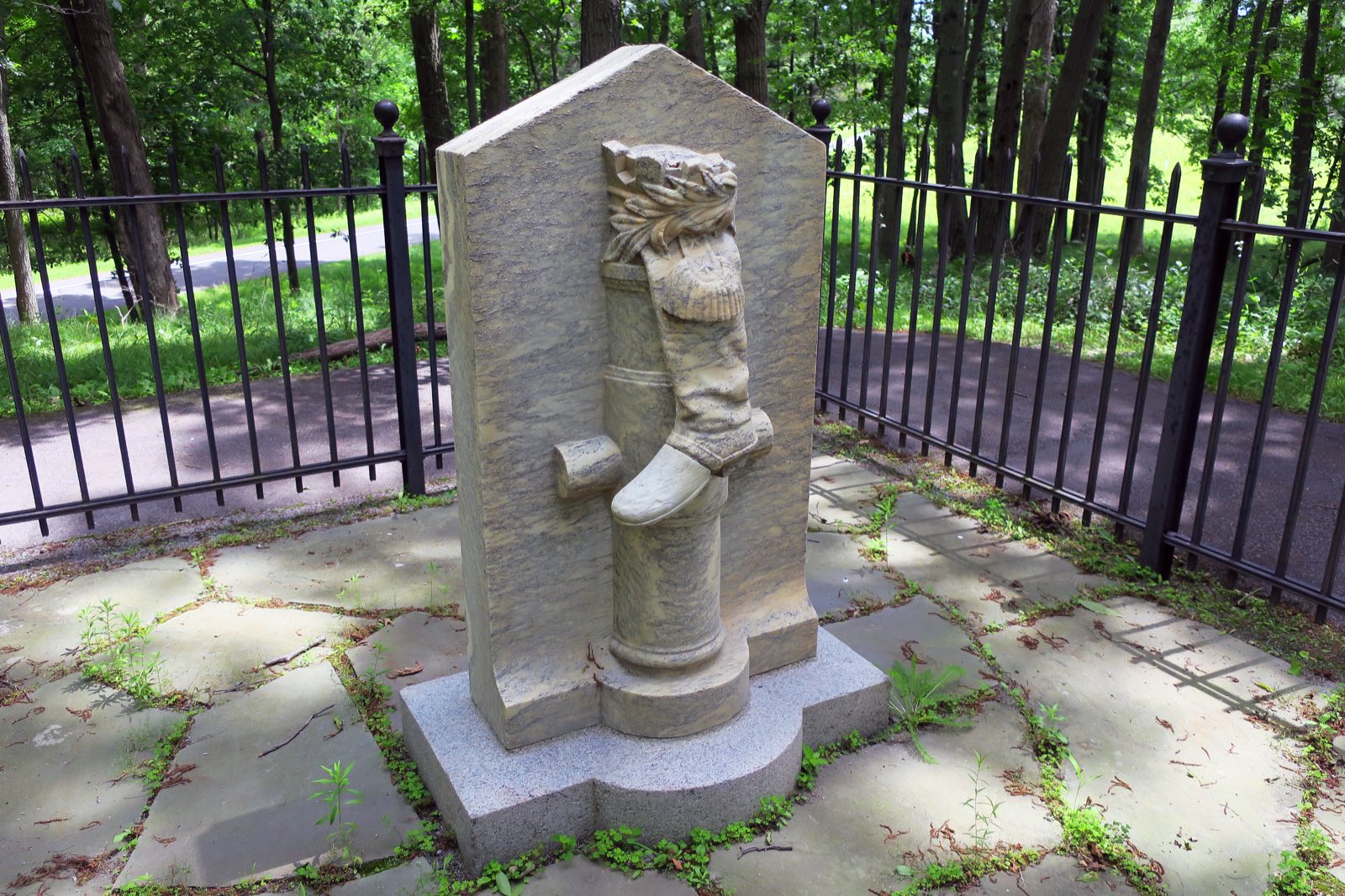
Arnold's reward was strange in a different way. He spent months crippled in an Albany hospital while the credit for Saratoga was fought over, and the grievance that ended at West Point three years later arguably begins in that hospital bed; that story belongs elsewhere in this war. At the spot where he fell at the Breymann redoubt there stands a monument, erected in 1887: a single sculpted boot, for the shattered left leg, dedicated to the memory of "the most brilliant soldier" of the Continental Army, "who was desperately wounded on this spot... winning for his countrymen the Decisive Battle of the American Revolution and for himself the rank of Major General." His name appears nowhere on it: a war memorial that honors a man it refuses to name.
And then there is the half of the story that happened across an ocean. The news of Saratoga crossed in about six weeks, carried from Boston by a courier named Jonathan Loring Austin, who reached Benjamin Franklin outside Paris on December 4. The story goes that Franklin called out to ask whether Philadelphia was taken, and Austin answered yes, but that he brought greater news: Burgoyne and his whole army were prisoners of war. Two days later the French foreign ministry summoned the American commissioners; on December 17 France communicated its decision to recognize the United States; and on February 6, 1778, two treaties were signed in Paris, one of friendship and commerce, one of alliance. By June 1778 Britain and France were shooting at each other, and Spain followed the next year. Saratoga moved France because it was proof, the demonstration Versailles had waited two years for, that the Americans could destroy a British field army, and because Paris feared London would now offer the rebels terms they might accept. The rebellion had become a world war, and a world war was something Britain could lose. London did offer terms, in the end: everything short of independence, and it arrived too late. The inside story of that diplomacy is told in its own chapter.
Off the fieldThe French alliance: the diplomacy behind the treaties