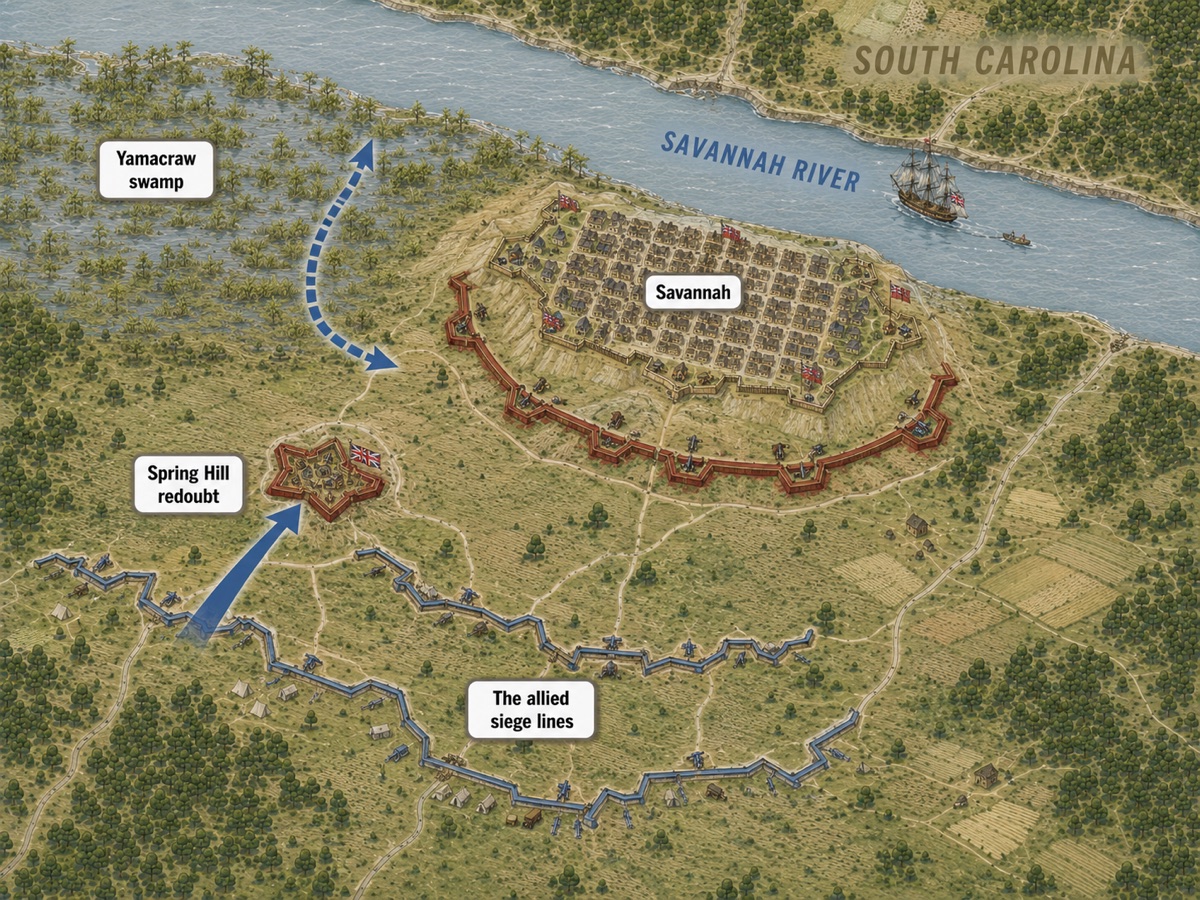
The columns formed in the dark around one in the morning on October 9, 1779, to attack before first light, and almost nothing went the way it was drawn. The fog and the swamps wrecked the timetable. The column of Colonel Arthur Dillon (French) lost its way in the Yamacraw swamp northwest of town and came out into the open under the British guns. A feint (a fake attacking move meant to pull defenders away from the real blow) by several hundred militia on the far left was easily stopped. Instead of striking together in darkness, the main columns went in piecemeal, fragmented rather than together, at first light, around half past five, against works whose defenders were awake and waiting.
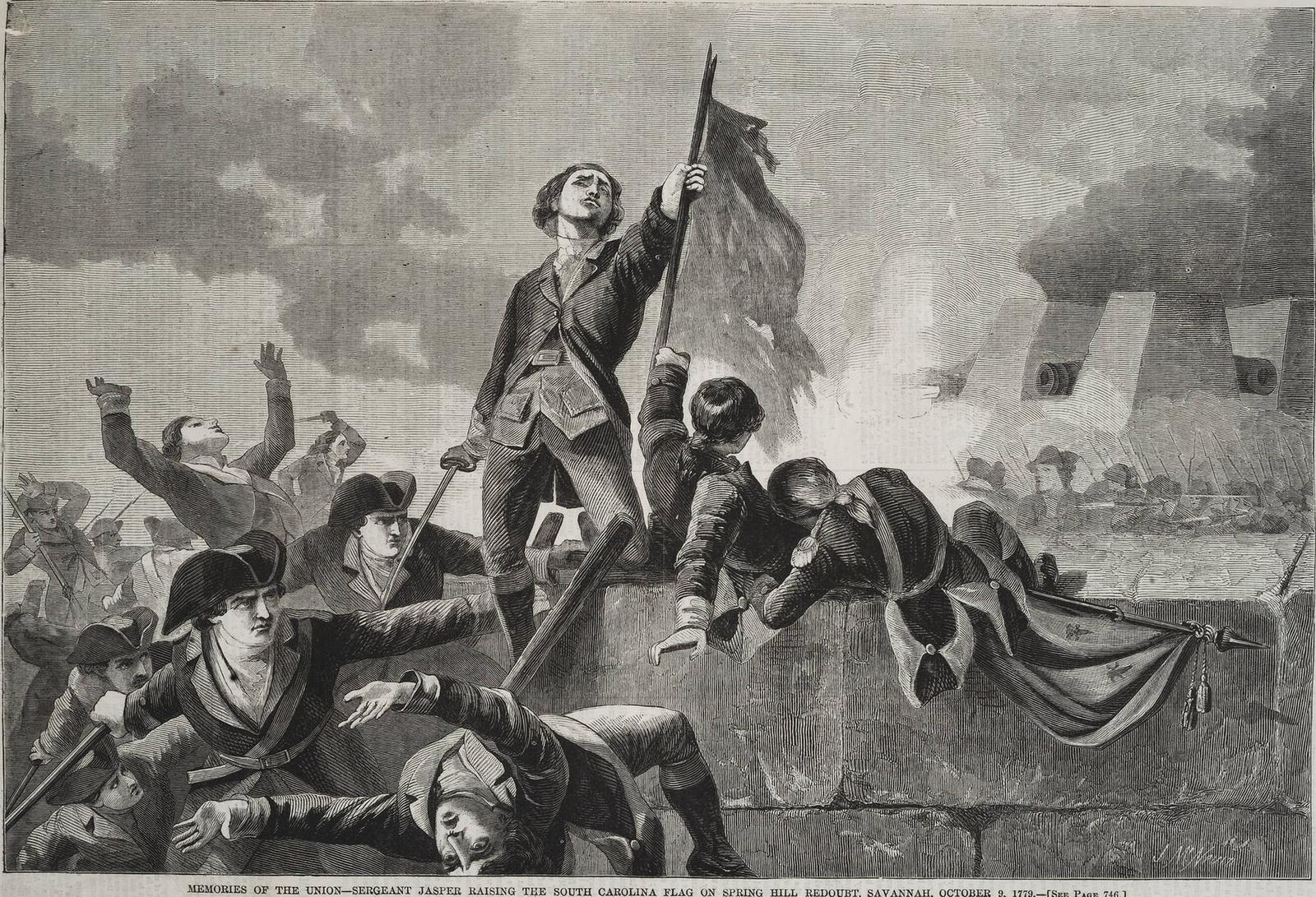
At the Spring Hill redoubt the assault broke and died almost at once. Grapeshot (a cannon round that sprays a cloud of iron balls) and musket fire poured out of the works into the white-coated French columns, and the dead and wounded of the first wave filled the ditch in front of the redoubt before the second wave could reach it. The Americans of John Laurens (American) cut into the abatis (a belt of felled trees with sharpened branches, laid as an obstacle in front of the works) and reached the parapet (the earth wall at the top of the redoubt). Two lieutenants of the 2nd South Carolina, Hume and Bush, planted the regiment's colors on the rampart and were killed; a third officer holding them was mortally hit. Sergeant William Jasper (American), the man who had remounted the colors under British fire at Fort Sullivan three years earlier, was mortally wounded keeping a color up, and carried one off the field as the attack collapsed. The Swedish count Curt von Stedingk (French) got an American flag onto the entrenchment for a moment before the cross-fire shot his men off it; he came back with about twenty men, every one of them wounded, and remembered the retreat, with the cries of his dying comrades in his ears, as the bitterest moment of his life. For a moment it was the highest the allies got. The comte d'Estaing (French), leading on foot, was shot twice and stayed up.
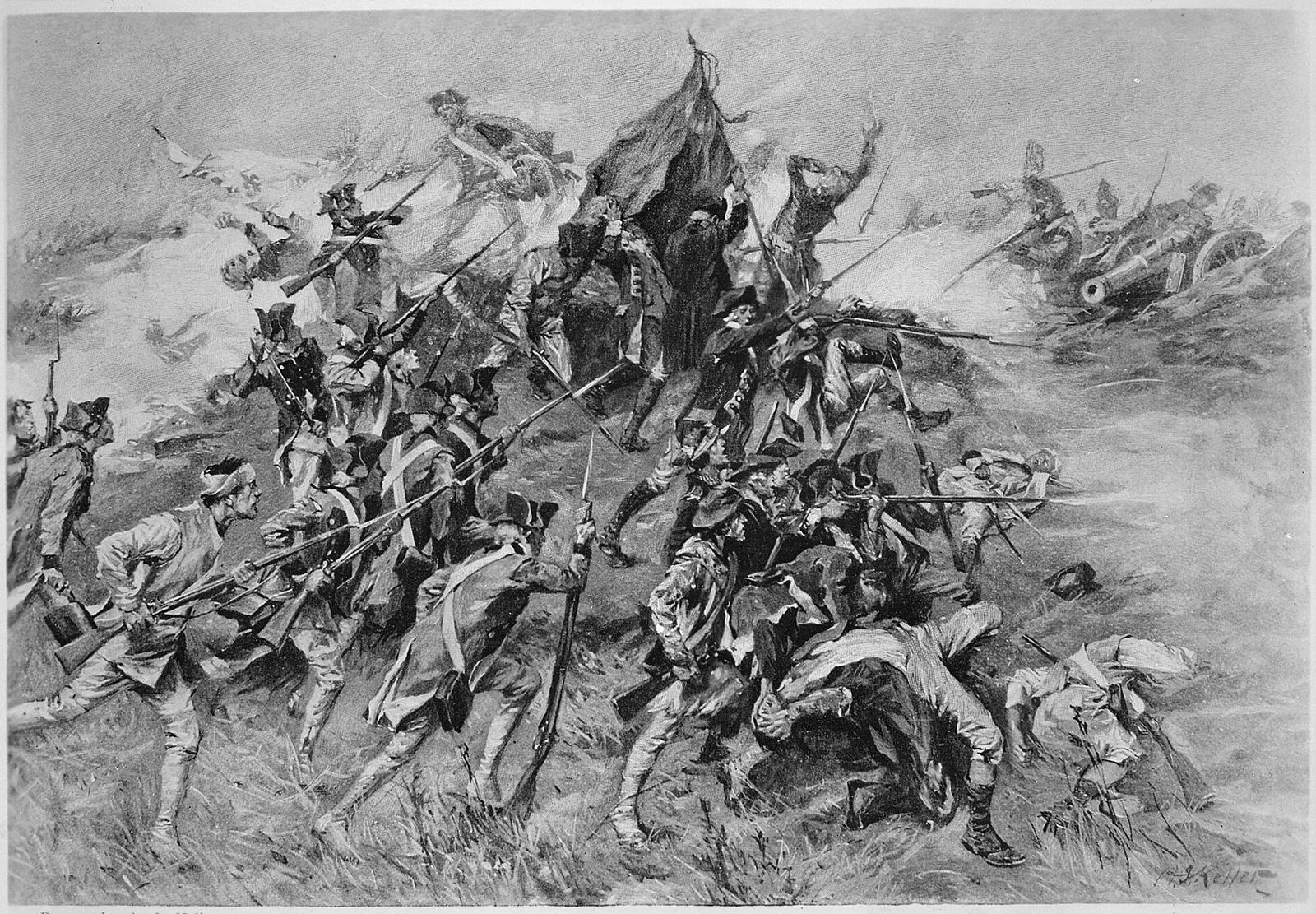
Casimir Pulaski (American) had been waiting with about 200 horse to charge through the breach the infantry was supposed to open, the same man whose charge at Brandywine had covered the army's escape, now waiting for a gap that never came. When no breach opened, he rode forward into the smoke between the redoubts, by most accounts trying to rally the wavering infantry and find a way through. Grapeshot cut him down. He was carried off the field and taken aboard the privateer brig Wasp (a privately owned armed merchant vessel, not a Continental Navy ship), and he died about two days later, generally dated October 11. The father of the American cavalry, the man Franklin had sent over as famous throughout Europe for his bravery, was gone, and where his body went is a question that has never been fully settled.
After about an hour of this, d'Estaing ordered the retreat. The cost is honest only as a range. Around 800 allied soldiers were killed or wounded, plus over a hundred taken prisoner, the great majority of them French, in less than an hour. The British lost about 155 in all, roughly 40 of them killed; Captain Thomas Tawse died defending the Spring Hill redoubt. It was close to five allied casualties for every British one, one of the bloodiest hours of the war for the attackers.
As the shattered columns came back, the Chasseurs-Volontaires de Saint-Domingue stood in the reserve that covered their withdrawal. What they did there is the most carefully bounded thing on this page. The documented record is this: the roughly 545 men of the unit were at the siege, were officially assigned to labor and reserve duty, served under fire, and took casualties. Tradition holds more. Nineteenth-century memory, most popular retellings, and the monument later raised in Savannah credit them with covering the allied retreat outright and blunting a British counterattack, saving much of the army. Contemporary French records of a dramatic rear-guard stand on October 9 are thin, and scholars note that the unit is systematically occluded by the colonial archive, which cuts both ways: it neither proves the heroic version nor lets anyone erase the men who stood in the reserve while the columns came apart. What is safe to say is that the Chasseurs held the reserve that covered the broken army's withdrawal, and that tradition credits them with blunting the British counterattack and saving lives in the retreat.
The siege lifted within days. D'Estaing, wounded, re-embarked his guns and his men; the works were abandoned on October 17 and 18, the French fleet sailed and dispersed, and Lincoln marched back up the road to Charleston. The second straight joint operation, after the wreck at Newport the year before, had ended in failure and mutual blame, with the French and Americans pointing fingers at each other: the Americans over being summoned to fight in France's name without their counsel, the French over an army they had supplied most of the blood to defend. Franco-American relations hit their wartime low. The bruised alliance held, but barely, and that mattered, because the same French fleet the alliance would need to seal the trap at Yorktown two years later was the fleet that had just failed twice in a row. The southern war the British had wanted now had its theater. Sir Henry Clinton called the news "the greatest event that has happened the whole war," and proved he meant it. With the French fleet gone he sailed south from New York in December, laid siege to Charleston, and took it on May 12, 1780: Lincoln surrendered the city and some 5,000 men, the largest American capitulation of the war. The full southern war, Camden and Kings Mountain and Cowpens and Guilford Courthouse, and a civil war burning through the backcountry, followed from there. Savannah itself stayed British until July 1782.
Off the fieldThe French alliance: the diplomacy behind the fleet off TybeeThe men who came back out of the trenches scattered into very different stories. Maitland was dead in Savannah by October 26, of the fever he had carried from Beaufort. Pulaski's bones became an argument that outlived everyone who knew him. His contemporaries split at once: shipboard accounts said he died aboard the Wasp and was buried at sea near the mouth of the Savannah, while a parallel tradition said his body was landed and buried at Greenwich plantation, near Thunderbolt outside the town. In 1854 remains from Greenwich were placed under a new Pulaski monument in Savannah's Monterey Square; those remains were exhumed in 1996, and after years of stalled identification reinterred with full military honors in 2005. Then, in 2019, a Georgia Southern-led team reported a finding that was messier than it is often retold: the team ran two rounds of mitochondrial DNA extraction, and the first sample comparison produced no match before a second pairing succeeded, matching a grandniece's profile and excluding roughly 99 percent of the population. With that, and with the skeleton found consistent with Pulaski's known injuries, they concluded the Monterey Square remains are most likely Pulaski's, which, if so, would confirm the Greenwich burial over the burial-at-sea story. The same study found that the skeleton bears female-typical features, leading the researchers to suggest, as a hypothesis and not a proven finding, that Pulaski may have been intersex. A 2022 article challenged the identification itself, the two-attempt sequence among its grounds. Both the identification and the hypothesis still have scholarly challengers, and the burial that the dispute began with is, after two and a half centuries, only most-likely settled.
Jasper got the opposite fate: not an argument, but a legend that grew over the plain facts. The documented core is William Moultrie's account, that the colors went up on the rampart and their bearers were soon killed, and that Jasper supported one of the colors until he took his death wound, brought it off with him, and died a little time after. Everything richer than that, the deathbed speech bequeathing the colors to the woman who had presented them, the heroic print of a man shot down planting the flag on the parapet, is later embroidery in the mold of the storytellers who mythologized his earlier exploits. He was a brave man who died hard in a failed assault. The legend made him a tableau.
And the men of Saint-Domingue carried Savannah home. The Chasseurs-Volontaires went back to a French sugar colony where the contradiction they had marched into, free and enslaved men of color fighting for a liberty their own home denied them, would explode within a dozen years into the Haitian Revolution. Veterans of the unit appear in the standard scholarship among the revolution's leaders; men like André Rigaud are said to have served at Savannah, and the unit's recruiting ground around Cap-Français supplied much of the revolution's officer class. Tradition puts the future king of Haiti, Henri Christophe, in the ranks at Savannah as a boy of about twelve, a drummer or servant with the unit; no contemporary muster roll proves it, and it is best told as the tradition it is. The men's memory eventually got its monument: in 2007 a Haitian Monument was dedicated in Savannah's Franklin Square, sculpted by James Mastin, honoring the Chasseurs-Volontaires, with a young drummer figure for the boy Christophe is said to have been. Its placard calls their stand "the most brilliant feat of the day," which is the monument's tribute rather than history's settled verdict, and the gap between those two things, the documented reserve and the honored legend, is exactly the gap this whole battle keeps asking you to hold open and look at honestly.