The first man the victory killed was on the American side, and it killed him by accident.
During the 13-gun salute on February 25, a captured British 6-pounder cannon touched off the loose gunpowder charges stacked at the battery, and the blast terribly burned Maj. Joseph Bowman (American), Capt. Worthington, and four privates. Bowman, who had kept the journal that carried the whole march, died of the burns on August 14, 1779: the campaign's only American officer death, and he was killed by the celebration, not the fight.
Clark's reports do not mention the accident. The man who wrote the only trustworthy day-by-day record of the march goes unnamed in the commander's account of it, and that silence is the first small instance of a habit this section keeps finding: the legend that grew on Vincennes was always tidier than the record underneath it.
Before the reckoning, there was one more prize to take. Two days after the surrender the armed row-galley Willing (a flat-bottomed river gunboat of the kind used on the Ohio and Mississippi) came up the Wabash with about 40 more men, two days too late to fire a shot. Helm led about 50 men in boats upriver and captured the British supply convoy coming down from Detroit, seven boats and about 40 prisoners and a fortune in goods. Among the captives, taken on the river with the convoy, was Philip Dejean, Detroit's notorious British-appointed judge. The fort, the governor, and the supply train were all in American hands within a week.
Then there is the matter of the governor himself, and the name the frontier had given him. Clark sent Henry Hamilton (British), Maj. Hay, and more than twenty others under escort about 1,200 miles east to Williamsburg, Virginia, where they arrived in June. The governor of Virginia now was Thomas Jefferson, and Jefferson and his council treated Hamilton not as a prisoner of war but as a war criminal, the Hair-Buyer, and jailed him in irons.
So what was the Hair-Buyer? The epithet was real propaganda doing real work, and the honest version is more uncomfortable than the legend. What the record supports is that Hamilton, on orders from London, organized and supplied Native war parties against the frontier and rewarded the returning parties, which presented scalps as proof, with goods. What the record does not support is that he paid a price per scalp. No such payment is documented; he denied it; and the standard scholarly treatment reads the per-scalp bounty as Clark's propaganda theme, not a fact. Meanwhile, American governments paid literal, written scalp bounties in the very same war: Pennsylvania, in April 1780, offered $2,500 in Continental currency for a Native scalp and $3,000 for a prisoner. Both of those things are true at once, and the page holds them together. Hamilton organized a brutal frontier war, and the specific crime his jailers named was one they could not prove and one their own side committed on paper. The irony was not lost on the proceedings: Jefferson's own government, which had jailed him for scalp-buying, eventually let the charge go. He refused a parole whose terms would have gagged him; George Washington and British threats to retaliate against American prisoners pressed Virginia to relent; the charge was quietly dropped; and Hamilton was paroled in October 1780 and exchanged the following spring. He ended his career a colonial governor and died in office in 1796.
Off the fieldThe nations caught between two empires, told wholeFor the Native nations, the fall of Fort Sackville meant less than the legend says. Hamilton's capture removed one organizer and dried up one supply point, but Detroit, the real engine of the frontier war, never fell; Clark could never get the men or the money for the Detroit expedition, and it never came. The Odawa war chief Egushawa, Pontiac's successor, who had advised Hamilton and run his scouts, escaped Vincennes with his war band intact and fought on into the 1790s. And the frontier war got worse after 1779, not better: Bird's invasion of Kentucky in 1780, La Balme's destruction the same year, the slaughter at Blue Licks in 1782, the massacre of peaceable Christian Delaware at Gnadenhutten in 1782, all of it still lay ahead. The men who bore the sharpest immediate cost were the Odawa warriors from the Lakes, far from home on a raiding party, who walked into a town that had changed hands and were killed in a ceremony staged for the watching nations, their deaths useful to Clark's lesson precisely because they were not the nations he meant to teach. The Wabash towns that had watched the fort fall, the Piankeshaw and their neighbors, made or kept peace with the Americans, but American victory carried, for the Wabash and Lakes nations alike, the longer catastrophe of unrestrained settlement. The threat to Kentucky was blunted; it was not eliminated.
And what did the campaign win the United States? Less than the story it later told, and the two are worth keeping separate. It gave the infant American government real administration-in-fact at Kaskaskia, Cahokia, and Vincennes, a legal fig leaf in Illinois County, Virginia, and the founding of Louisville behind it. What it did not do is win the Old Northwest at the peace table. The traditional claim, that Clark's conquest delivered the territory northwest of the Ohio to the United States in the 1783 Treaty of Paris, is on the wrong side of modern scholarship. Britain did cede that territory, for reasons negotiated in Paris that most historians agree had little to do with Clark's 1779 march. Clark himself never wrote that he had won the Northwest; others wrote it for him, and the writing outlasted the man. The hero of Vincennes at 26 was a debt-ruined, hard-drinking, half-forgotten man by his fifties; a stroke and an amputated leg came in 1809, and he died in 1818, his own memoir, the source of the march's most cinematic details, written partly to salvage a reputation that the West had let slide.
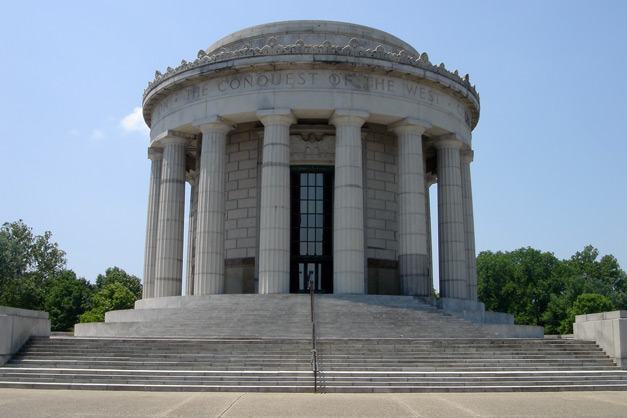
The last word the country gave the campaign is a building. The George Rogers Clark Memorial, a sixteen-column granite and marble rotunda, was built from 1931 on the presumed site of Fort Sackville and dedicated in June 1936 by President Franklin Roosevelt; inside stands a bronze Clark beneath seven murals of the campaign. The fort's exact footprint has never been found, and lies somewhere within the park. The 1936 building is high-imperial commemoration of exactly the conquest narrative the record will not quite support. The march was real, and as hard and as daring as any in the war. The legend that grew on top of it, the empire won by 170 men, is the part the historians keep trimming back. Downes put the trimmed-back version best: Clark "assisted the French and Indian inhabitants of that region to remove themselves from the very shadowy political rule of the British." The march made the legend. The negotiators made the map.