In April 1775 there was no American army. There were militias, which is not the same thing, and the difference is the whole start of this story. A militia was every able-bodied man in a town, roughly sixteen to sixty, required to keep a musket and turn out a few days a year for drill (Massachusetts asked for at least six). The officers were neighbors, often elected, indistinguishable from the men they led, and everyone had a farm or a trade to get back to. That arrangement was magnificent for exactly one thing: a single desperate day. On April 19, 1775, when thousands of armed New Englanders swarmed a British column on the road back from Concord, the system worked precisely as designed. A war is the thing it was not designed for. Militiamen served for days or weeks and went home, legally, when their term ran out or the harvest called; there was no supply train, no sustained discipline, no command beyond neighbors cooperating. The crowd that penned the British inside Boston was an army only by courtesy. Somebody now had to turn it into a real one, inside a society that distrusted real armies on principle, and keep it standing eight years.
That distrust was the army's other enemy, alongside poverty. The men who built the colonial case against Britain had spent a decade warning that permanent professional armies were the death of liberty, and the British regulars garrisoning Boston were their living proof.
Congress adopts an army
On June 14, 1775, the Second Continental Congress voted to adopt the New England forces besieging Boston (along with forces gathering near New York) as a Continental Army, and authorized ten companies of expert riflemen from Pennsylvania, Maryland, and Virginia as the first troops raised directly under continental authority. That date is still kept as the birthday of the United States Army. The next day Congress had to decide who would command it.
It chose a Virginian, unanimously, and the choice was as much political as military. This was a New England army fighting a New England siege. Put a New Englander at its head and the other colonies could tell themselves this was somebody else's quarrel; put a Virginian at its head and a regional fight became a continental one. John Adams made the nomination speech and Samuel Adams seconded it. Years later Adams recalled telling Congress of a "Gentleman from Virginia who was among Us" who would "command the Approbation of all America, and unite the cordial Exertions of all the Colonies better than any other Person in the Union." The phrasing is Adams remembering his own speech long afterward, but the strategy in it is real.
The Virginian was George Washington, and he had two other things going for him. He had commanded the Virginia Regiment in the French and Indian War, which made him about as experienced a soldier as any native-born American then alive. And he had spent the spring attending Congress in a military uniform, the buff-and-blue of his Fairfax Independent Company, the only delegate to come to work dressed for the war everyone could feel coming. While others debated, one man showed up looking ready, and Congress noticed.
He accepted on June 16 and did something that mattered out of all proportion to its cost: he refused a salary, asking only that Congress cover his expenses, which he then accounted for meticulously the whole war. (Different ledgers tally those expenses to wildly different totals, so the honest figure is "six figures in the money of the day," not a clean number.) Refusing pay was a statement about what kind of officer he meant to be: not a man enriching himself on a standing army, the very thing his countrymen feared, but a citizen lending his service. On July 3, 1775, he took command at Cambridge, Massachusetts, and got his first look at what he had agreed to lead.
The army that dissolved in front of the enemy, twice
What Washington found at Cambridge was brave, filthy, short of gunpowder, and held together by enlistments that all expired with the calendar. He was a Virginia planter looking at a Yankee army where officers were elected by, and dressed like, their own privates, and his snobbery shows. To his cousin Lund Washington in August 1775 he wrote that the New England privates "would fight very well (if properly Officered)," then added that they were "an exceeding dirty & nasty people," and savaged the officers as "the most indifferent kind of People I ever saw," boasting that he had already broken one colonel and five captains "for Cowardice, & for drawing more Pay & Provision's than they had Men in their Companies." It was a private letter and a planter's prejudice, but it caught a real clash: an army of equals, handed to a man who believed ranks ought to mean something.
The deeper problem was the clock. Almost the entire force had signed on only to the end of 1775; men could begin leaving December 1 and all were free to walk on January 1, and by late fall they were leaving in droves, Nathanael Greene (one of Washington's most capable generals) losing about three-quarters of his brigade. Washington said so to his friend Joseph Reed in November: "Could I have foreseen what I have, & am like to experience, no consideration upon Earth should have induced me to accept this Command."
Now picture what he had to do next. The British army sat a musket-shot away, and Washington had to let one army walk home and sign up a brand-new one in the same trenches, without the enemy noticing how empty those trenches briefly were. He told Congress's president John Hancock that to "disband one Army and recruit another, within that distance, of Twenty odd British regiments, is probably more than ever was attempted." He plugged the gaps with short-term militia, and the British, never realizing how hollow the lines opposite them had become, evacuated Boston in March 1776 anyway.
Then it happened again. The army raised for 1776 ran on the exact same one-year term, so it too expired on December 31, this time mid-campaign with the war's survival visibly at stake, days after the river crossing at Trenton. Washington rode along the veteran regiments and personally begged them to stay six weeks past their discharge for a ten-dollar bounty he pledged on his own authority before Congress had agreed to it. (There is a famous version of the speech he supposedly gave, but it comes from one sergeant's recollection set down decades later, so treat the words as legend and the appeal itself as fact.) Enough stayed to fight at Princeton. The army had nearly dissolved itself twice in twelve months, both times by design, and that twice-repeated near-death is what finally convinced Congress to stop building armies that fired themselves every New Year's Eve.
Who actually served
Picture a landless boy of nineteen, with no farm to get back to and no trade that needed him, taking a cash bounty to sign years of his life away. Stand next to him a new immigrant just off the boat, Irish or German, with no land and few prospects, and a man who had come over as an indentured servant and worked off his term with nothing to show for it. Those are the men who filled the long-war Continental Army. Not the small farmer with the musket over his fireplace.
For a few months in 1775 the whole country seemed to want in. The historian Charles Royster gave this war-fever a name, the rage militaire, the passion for arms that briefly put tens of thousands of ordinary householders under arms. It carried a fantasy with it: a short, glorious war won quickly by virtuous citizen-soldiers who then went home. By 1776 the fever had broken and never came back. What arrived instead was a long grinding war, and the men with farms and shops and families increasingly decided that someone else could fight it.
So who was the someone else? Historians have answered by going through the muster rolls (the army's attendance registers), tax lists, and pension files, and what they keep finding is that the long-war Continental Army was a poor man's army. The typical private was young, late teens or early twenties, and poor: in the studied samples the great majority of long-service privates came from the propertyless or nearly so, one frequently cited finding being that under about ten percent owned taxable property. He was disproportionately an immigrant, a laborer, or a former servant; substantial shares of several state lines were Irish-born or German-born, and indentured servants, some convicts, even British deserters were taken on as the war ground forward and the recruiters grew less choosy. These are regional studies generalized, so the right way to hold them is "the rolls suggest," not "the census proves," but the pattern is unmistakable.
The men were pulled in by money and by quotas. To recruit, the states offered a bounty (a cash payment at enlistment, the only lever for a man signing years away for paper wages), and when volunteers ran short they drafted from the militia, with a catch: a drafted man with money could pay a poorer neighbor to serve in his place. The law allowed it, and the rate climbed all war. So the poor served for the propertied, by contract.
The yeoman-minuteman, the small farmer who grabbed the musket over his fireplace, is real, but he belongs to April 1775 and the militia surges, the citizens who turned out for a day and went home. He is not the man who stood in the Continental Line in 1778, 1779, and 1780. That man was, overwhelmingly, someone a settled society could most easily spare.
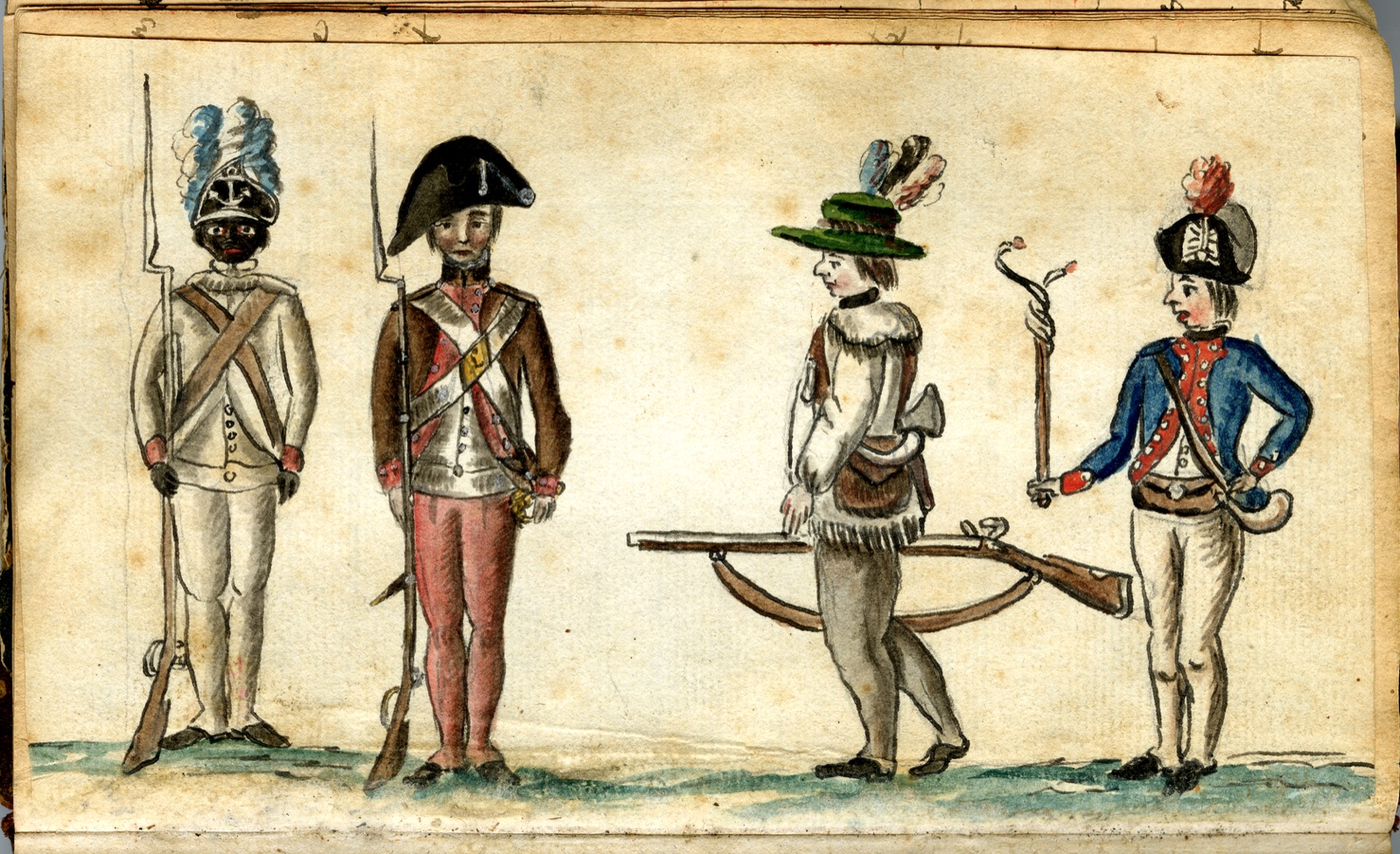
They included thousands of Black soldiers, one of the genuinely remarkable facts about the institution, and an easy one to overstate, so it is worth stating precisely. An official field tally, the "Return of the Negroes in the Army" of August 24, 1778, compiled under Adjutant General Alexander Scammell, counted 755 Black soldiers across roughly fourteen brigades of Washington's main army, about 3.6 percent of that force's rank and file, and more like five to eight percent in the brigades where they served. That return left out the Rhode Island and New Jersey regiments; counting those pushes the snapshot toward 950. Across the whole war, somewhere between 5,000 and 8,000 men of African descent served on the American side. And in the main army they served integrated: Black and white privates in the same companies, messes, and tents, the 1st Rhode Island Regiment being the notable exception that ran the other way, with Black rank and file under white officers. This was the last time soldiers of African descent served in racially integrated regular U.S. Army units at any scale until the Korean War era; the Army was ordered desegregated by executive order in 1948 and did it during Korea, in the early 1950s, so the integration of the Revolutionary ranks stood unmatched for some 170 years. The point is not that the army held an ideal of racial equality. It did not; it integrated because it needed bodies, and Washington's own policy on Black enlistment zigzagged before it settled. The full story of how those men got there, of Lord Dunmore's proclamation and the 1st Rhode Island, belongs to the chapter on slavery and the Revolution.
Women belonged to the army too, in their thousands: soldiers' wives and others who traveled with it the whole war, washing, nursing, and selling small goods to the troops, and who were officially carried on the ration rolls. They earned their bread and they have their own chapter; here it is enough to say they were there, and counted.
Three years, or the war
The cure for an army that dissolved every December was an army that signed on for the long haul. On September 16, 1776, with the two near-deaths fresh, Congress passed the Eighty-eight Battalion Resolve, setting a standing establishment of 88 battalions, about 60,000 men on paper, apportioned among the states by population, with enlistments not for one year but for "three years or during the war." To get men to sign, it offered a twenty-dollar cash bounty and 100 acres of land to privates and noncommissioned officers who enlisted for the duration, the land scaling up by rank.
That phrase, "three years or during the war," was meant to give the enlister a choice, and its ambiguity would become the legal heart of the worst mutiny of the war. Did a man sign for three years, or for the war, whichever came first, or whichever the recruiter later decided? Nobody had nailed it down, and four years on, with the war grinding past the three-year mark, that loose wording would put thousands of veterans and their officers on opposite sides of a knife.
The army was organized by state. Each state raised, clothed, and in theory paid its own numbered regiments, the Pennsylvania Line, the Connecticut Line, and so on, which together made up the Continental Line under Washington and Congress. States performed unevenly at supplying their own lines, so a soldier in a poorly run state's regiments could go cold and unpaid while another state's men did better, an inequity that fed straight into the breakdowns to come.
And the 88 battalions were a paper army, never close to filled. A regiment's paper strength ran around 580 to 750 men, but in the field it commonly mustered half that or less. Across the whole conflict perhaps 230,000 men served in the Continental Army at one time or another, yet at no single moment were there ever more than about 48,000 under arms, and never more than about 13,000 in one place. On paper, this; in reality, a fraction of it.
Paid in something that was turning into nothing
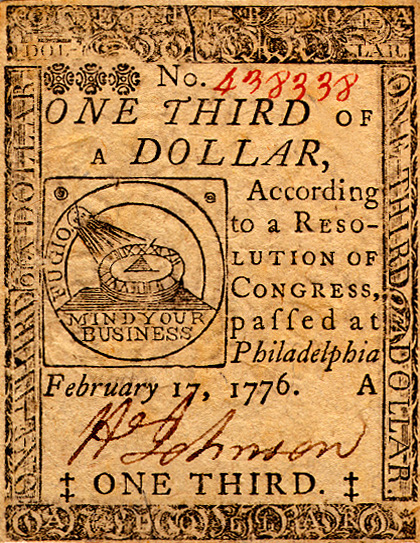
Put yourself in the ranks on payday. Your pay was set at six and two-thirds dollars a month, routinely months and eventually years in arrears, and when it finally came it came in Continental paper that was worth less by the week. You were not simply unpaid, bad as that was; you were paid in a substance that evaporated in your pocket between payday and the store, as did your enlistment bounty and anything you tried to send home. Meanwhile civilians, sensibly, would rather sell their flour to the British for hard coin (gold or silver) than to their own army for notes nobody trusted. The man in the ranks was learning that patriotism had a market exchange rate, and his was crashing.
Here is why the paper was dying. Congress could not tax. It could only ask the states for money (requisition them), and they chronically sent less than asked, or it could print. So it printed: between 1775 and 1779 it emitted somewhere around 200 to 240 million dollars in Continental currency, paper with no tax revenue standing behind it to give it value. With nothing underneath it, state paper inflating alongside it, and British counterfeiters flooding the colonies with fakes, the Continental dollar slid and then plunged. It was worth maybe a third of hard coin in 1777, perhaps a sixth or an eighth in 1778, and by early 1780 had fallen to around 40 to 1, a level Congress itself made official that March by formally devaluing it at exactly that rate. By early 1781 it took 75, or 100, or in some places well past 100 paper dollars to buy a dollar of silver, and in May 1781 it simply stopped circulating. (Every depreciation table disagrees on the month-to-month rates, so these are ranges; the one hard anchor is Congress's own 40-to-1 devaluation.) Americans came out of the war with a new phrase for anything worthless: "not worth a Continental."
How the system broke
The famous winter is Valley Forge, and almost everyone has the wrong picture of it. The main army, about 12,000 soldiers (plus several hundred women and children with it), marched into Valley Forge, around twenty miles from British-occupied Philadelphia, on December 19, 1777, built well over a thousand log huts on a defensible plateau, and marched out on June 19, 1778. As many as 1,700 to 2,000 of them died there, something like one man in ten to one in six.
But they did not freeze to death in snowdrifts. They died of disease, the influenza, typhus, typhoid, and dysentery that breed in crowding and filthy water, and about two-thirds of the deaths came not in the depths of winter but in the warmer months of March, April, and May 1778, when the thaw and the camp's own waste did their work. The winter itself was, by Pennsylvania standards, ordinary. Valley Forge was not a meteorological catastrophe but a catastrophe of supply, and the difference matters, because a broken supply system is something humans build and can fix, and a blizzard is not.
The mechanism was logistics, not scarcity. The hunger and nakedness were real. Washington wrote to Congress's president Henry Laurens that unless the commissary was repaired, "this Army must inevitably be reduced to one or other of these three things. Starve—dissolve—or disperse," and reported in the same letter "no less than 2898 Men now in Camp unfit for duty, because they are barefoot and otherwise naked," nearly a quarter of the force. But the food existed in America. It simply did not reach the camp. Two departments were supposed to feed and clothe the army: the commissary bought food, and the quartermaster moved everything, and both broke at once. The Quartermaster General was Thomas Mifflin, the man responsible for transport, forage, and supply, and he had soured on the job. He drifted into politics, effectively stopped doing the work after mid-1777, and resigned that autumn, so the army went into winter quarters with its whole supply department leaderless: no forage system, broken wagon contracts, food rotting at depots for want of anyone to haul it. The Clothier General's department failed the same way, with clothing sitting in warehouses that never reached the men. And Congress, unable to pay cash, kept trying to buy supplies with certificates (IOUs) that farmers learned to dodge.
It got fixed, partly, by competence: Washington put Nathanael Greene in as Quartermaster General in the spring of 1778, and Greene audited the mess, reorganized the department, pre-positioned depots, and got the wagons rolling. Then the next fix created the next failure. In 1780 a broke Congress switched to a "system of specific supplies," requisitioning actual goods, beef and flour and rum, from the states by quota, and the states under-delivered on goods exactly as they had on money; the hunger crises of 1779 to 1781 sit squarely on that mechanism. The soldiers starved because the system was broken: a Congress with no power to tax, a supply corps leaderless at the worst moment, a dead currency, and state quotas nobody enforced. Not because there was no food.
The bloody-footprints image, the one detail of Valley Forge as grim as legend says, is real, but it belongs to the marching and to memory. Washington wrote, months later in April 1778, of men "without Shoes, by which their Marches might be traced by the Blood from their feet." A young private named Joseph Plumb Martin, who enlisted at fifteen and wrote his memories down some fifty years later as an old man with a pension claim on file, remembered men going barefoot "till they might be tracked by their blood upon the rough frozen ground." Martin is the eyewitness this chapter leans on, but always at arm's length: his texture and his grievances are gold, his exact half-century-old dialogue handled with care. He remembered, too, what the supply failure looked like on a feast day, when Congress proclaimed a thanksgiving and the army's share of the celebration was the whole problem in one bitter line.
it gave each and every man a half a gill of rice, and a table spoon full of vinegar!! — Joseph Plumb Martin, recalling Congress's 1777 Thanksgiving "gift" (memoir, 1830)
The Prussian with the invented résumé
The thing Valley Forge is actually remembered for, the redemption, arrived on February 23, 1778, in the person of a charming, broke, middle-aged German, and the best part is that he was not quite who anyone thought.
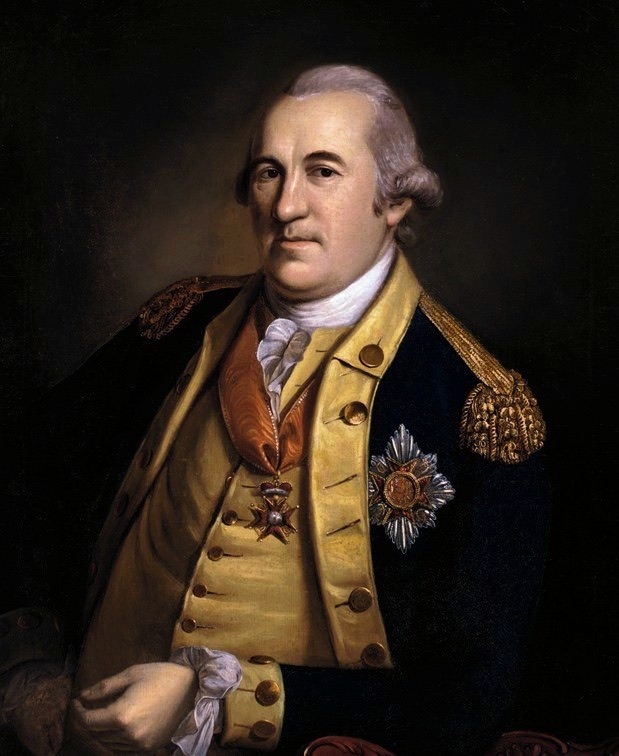
Friedrich Wilhelm von Steuben presented himself as a Prussian lieutenant general, recommended to Congress in a letter from Benjamin Franklin as "a Lieutenant General in the King of Prussia's service." He was nothing of the kind. His real Prussian career had been respectable but modest: a captain and staff officer, out of the army since 1763, unemployed and deep in debt when the Americans found him in Paris. His "Baron" came from later service at a tiny German court, not from Prussian nobility that mattered. The kindest explanation for the inflation is that his actual staff title, rendered into French, looked grander than it was, and that Franklin and Silas Deane, who badly needed Congress to take their find seriously, did not hurry to correct the impression. Congress and Washington were promised a Prussian lieutenant general. They received a half-pay captain, who turned out to be exactly what the army needed, and nobody who watched him work ever asked for a refund.
What he did was teach the army to drill, and the method was clever. Instead of trying to train 12,000 men at once, he started with a single model company, about 100 to 150 men drawn from Washington's guard and the brigades, and drilled it personally, which alone astonished everyone, because a European general doing a sergeant's job of marching privates back and forth was a thing nobody had seen. Once that company had it, he cascaded the trained men outward into every brigade as instructors, so the lessons multiplied instead of bottlenecking on one teacher. He standardized the marching step, the manual of arms (the drilled motions for handling and loading a musket), and above all the bayonet and the maneuver from marching column into firing line. The difference was not cosmetic: an untrained force under fire bunches, panics, or freezes, while a drilled one executes the rehearsed sequence faster than the enemy can reload. Drill was survival.
He pulled this off speaking almost no English, drilling in French and German through translators, and when the men fumbled and his vocabulary of correction ran dry he would swear at them in German, then French, and then, gloriously, call for an aide to "come and swear for me in English." The men loved him for it. (That line comes down through his secretary's circle in several versions, so it is a good anecdote rather than a pinned quote, but the scene is well attested.) Over the following winter he wrote the army's first drill manual, the Regulations for the Order and Discipline of the Troops of the United States, the "Blue Book," approved by Congress in 1779 and used by the U.S. Army until 1814, and was made Inspector General, with the rank of major general, in May 1778.
It took. Ten days after leaving Valley Forge, at Monmouth on June 28, 1778, the army maneuvered under fire and traded volleys with British regulars to a standstill, the kind of stand-up fight the mob at Cambridge could never have managed. The drill had turned them into soldiers.
The harder winter nobody remembers
If Valley Forge's winter was ordinary, the one that earned the legend came two years later and got none of it. The army wintered at Morristown, New Jersey, in 1779 and 1780 with around 10,000 to 12,000 troops hutted at Jockey Hollow, through what was very likely the coldest winter of the entire eighteenth century in that region, the only one on record cold enough that the waters around New York City froze solid, hard enough to haul heavy loads across. More than two dozen snowstorms swept the camp, and a January blizzard left something like four feet of snow. Washington, looking back that spring, wrote that "the oldest people now living in this Country do not remember so hard a winter as the one we are now emerging from." Supply was worse than at Valley Forge, because this was the winter the specific-supplies system was failing, the currency was dead, and the roads were buried; Joseph Plumb Martin's starving passages, the ones people quote about Valley Forge, are actually about this camp. Yet fewer men died here, because the army had learned the lesson of Valley Forge that disease was the real killer, and met this winter with better huts, better sanitation, and smallpox held in check.
The quietest decision of the war
That smallpox was held in check at all was the result of a decision made three years earlier, and the story doubles back to find it. Through all of it, the steadiest killer was never the British. For every soldier who fell in battle, several died of disease, and the most feared was smallpox, which had already helped wreck the American invasion of Canada in 1775 and 1776. So back in February 1777, from an earlier winter encampment at Morristown and well before Valley Forge, Washington made one of the boldest medical decisions in military history, so quietly that it is barely remembered: he ordered the entire Continental Army inoculated against smallpox.
This was not vaccination, which did not yet exist. It was variolation (deliberately infecting a healthy person with material from a real smallpox sore, to give a milder controlled case and lifelong immunity), and it was genuinely dangerous: a few percent of those inoculated died of it, and all were laid up and contagious for weeks. An army caught half-down with deliberate pox would be helpless, so it was done in secret, in rotations, a batch at a time, so the enemy would never know the lines were weak. It may have been the first mass military immunization on record, and it worked: smallpox went from a strategic threat that could gut a campaign to a rare event in the ranks. The man remembered for crossing a river had, the month after, quietly inoculated his whole army against the thing far more likely to destroy it.
The breaking points
By 1780 the bill for all of it, the dead currency, the broken supply, the years of arrears, came due, and the army began to break. What followed is usually filed under "mutiny," which makes it sound like men abandoning a cause. It was closer to a labor strike by veterans who were owed everything and paid nothing, and who kept insisting, even in revolt, that they were not changing sides, and proved it.
The first crack was the Connecticut Line on May 25, 1780, at Jockey Hollow. After days on fractional rations, by Martin's account a little musty bread and a little beef every other day and then nothing, two regiments paraded under arms without orders, ready to march off and take food by force. Officers and steadier troops shoved them back into camp, and a colonel named Return Jonathan Meigs was bayoneted in the scuffle and survived. Nobody was executed, because the grievance was as plain as hunger and about five months' missing pay. Martin was there in the ranks: "The men were now exasperated beyond endurance," he remembered; "they could not stand it any longer; they saw no other alternative but to starve to death, or break up the army, give all up and go home."
The big one came on January 1, 1781, again at Jockey Hollow: the Pennsylvania Line, somewhere between 1,500 and 2,400 men, long-service veterans being held to the harsh reading of that 1776 phrase "three years or during the war." They had served their three years and were now told the war's end was their out, not the three-year mark, all while being paid next to nothing for years on a twenty-dollar bounty when new recruits were lured in for hundreds. They killed or wounded several officers in the first eruption, then did something disciplined: they elected a Board of Sergeants from among themselves and marched in good order toward Princeton and Philadelphia to put their case to Congress and Pennsylvania. This was a negotiation conducted with muskets, not a desertion.
And they proved which side they were on. When the British commander Sir Henry Clinton, smelling opportunity, sent secret emissaries offering British pay and pardons if they would come over, the Pennsylvanians arrested them and handed them to the army, and the two men were tried as spies and hanged. The mutineers then settled with Pennsylvania's civilian president Joseph Reed, with General Anthony Wayne, the Pennsylvania Line's own commander, as the army's man on the scene: soldiers who had enlisted in 1776 and 1777 could take their discharge on their own oath about what their term had been. About half the Line took the discharge (many re-enlisting later for fresh bounties), the rest getting furloughs and back-pay promises. Their grievance, everyone privately admitted, was just, and not one was executed.
Three weeks later the same spirit flared in the New Jersey Line, about 200 men at Pompton on January 20, 1781, inspired by how well the Pennsylvanians had done and demanding the same things. This time Washington made the opposite call, the hard, unromantic counterweight to the story. He had conceded to Pennsylvania because he had to; a second successful mutiny on the heels of the first, he judged, would simply teach the whole army that mutiny worked, and then there would be no army. "Unless this dangerous spirit can be suppressed by force," he wrote, "there is an end to all subordination in the Army, and indeed to the Army itself." He sent General Robert Howe with 500 to 600 New England troops, who surrounded the camp at dawn on January 27, forced an unconditional surrender, and court-martialed three ringleaders on the spot (tried by a panel of officers under military law). Two of them, David Gilmore and John Tuttle, were shot by firing squads made up of their own fellow mutineers. The third was reprieved.
Both things have to be held together. The grievances were real, and Washington and everyone around him knew the men's claims were just; and the same institution that negotiated with one set of starving veterans shot two of the next set, by their comrades' hands, to keep the rest from learning the wrong lesson. The army survived 1781 on exactly that calibrated mix of concession and killing. The real indictment, the one nobody could say in public, ran not against the soldiers but against the Congress and the states that had made true grievances they could not afford to fully answer.
The army that chose not to be a threat
After Yorktown in 1781 the fighting was effectively over, but the peace was not signed, and the army sat waiting at Newburgh, New York, with nothing to do and everything owed to it. The officers faced being sent home with years of pay in arrears and a 1780 congressional promise of half-pay pensions for life (a pension of half your active-duty pay for life, the only deferred compensation ever promised to officers who had often had no pay at all) that Congress had no money to fund and the states had no intention of honoring. Some men in Philadelphia, nationalists around the financier Robert Morris and including Gouverneur Morris and Alexander Hamilton, saw the army's righteous anger as a useful fire: if the soldiers got angry enough, perhaps the states could finally be frightened into granting Congress the power to tax. It was a dangerous game to play with armed, unpaid men.
In March 1783 it nearly caught. An anonymous paper, written by a young major named John Armstrong Jr. (an aide to General Horatio Gates), circulated through the camp calling an unauthorized mass meeting and hinting that the army should refuse to disband, or even to keep fighting if the war resumed, until it was paid. This was the unthinkable thing: an army turning its weight against the civilian government it served. Washington forbade the irregular meeting and called his own for March 15.
He came and spoke against the anonymous appeal, and the words did not land. Then he pulled out a letter from a congressman to read aloud, fumbled with it, and reached for a pair of spectacles almost none of his officers had ever seen him wear, saying, as one of them recorded it afterward, "Gentlemen, you will permit me to put on my spectacles, for I have not only grown gray, but almost blind, in the service of my country." (The line is not in his prepared text; it survives through eyewitnesses, and the wording wobbles a little from account to account.) The room broke. Officers who had been ready to threaten the republic an hour earlier were in tears, and the meeting voted its confidence in Congress instead. Historians still argue how close to a real coup this ever was, and how deliberately the men in Philadelphia stoked it; what is not in doubt is that the most dangerous moment came and went in a camp assembly hall, and the army stood down.
Then it went home, mostly unthanked. With a preliminary peace ending the fighting, Congress voted in the spring of 1783 not to discharge the soldiers but to furlough them (sent home temporarily, with the legal obligation to return if called, rather than discharged), which was cheaper and reversible if the peace fell through, and the furloughs began on June 13, 1783. The men walked home with three months' pay in "Morris notes" (paper backed by Robert Morris's personal credit) and final-settlement certificates for everything else they were owed. Those certificates were paper promises, and a man with no shoes and a long road home could not eat a promise, so most sold them to speculators for a fraction of face value, and watched other men buy their back pay at a discount. Joseph Plumb Martin put the bitterness plainly:
When the country had drained the last drop of service it could screw out of the poor soldiers, they were turned adrift like old worn-out horses, and nothing said about land to pasture them upon. — Joseph Plumb Martin, remembering the 1783 discharge half a century later (memoir, 1830)
The officers, before they scattered, founded a fraternal order, the Society of the Cincinnati, named for the Roman farmer-general Cincinnatus, who left his farm to save Rome and then went straight back to his plow. Its membership was to pass down through eldest sons, hereditary, and that single clause set off a real panic that the Revolution had just bred a military aristocracy. Washington tried to get the hereditary feature abolished; the state societies balked; the reform quietly died. A people who had spent eight years terrified of a standing army ended the war with an officers' order that passed its membership to their sons.
And there is the meaning of the whole thing. The republic's first national institution was an army with every reason to be furious: starved by a broken system, paid in paper that turned to nothing, held past its enlistments, and sent home with promises it had to sell to strangers to afford the walk. It had the grievance, it had the guns, and at Newburgh it had the moment, and it chose not to use any of that against the government it had built. The United States began with the one thing its founders feared most, a standing army, and the most important thing that army ever did was decide to lay itself down. The men who walked home unthanked in 1783 had won the war; the institution they had been, and then ceased to be, had settled the larger question, that in this country the army would answer to the government, and not the other way around.