In the summer of 1776 the thirteen colonies stopped calling themselves colonies and started calling themselves states, and that single change in vocabulary forced a question down onto every household in America: which side are you on? Somewhere in New Jersey that year a father held a royal commission while his own father drifted toward independence, and the two of them never spoke as friends again. The political story (Chapter 5) ends with the parchment and the cheers. The story underneath it was just beginning, and it was not a story about Americans against Britain. It was a story about Americans against each other.
In 1775 almost everyone on the field, in both armies, was a British subject. The argument was conducted in the language of the rights of Englishmen, by men who had grown up under the same king. Edmund Burke, the British statesman who defended the Americans in Parliament, never once called it "the American Revolution." He called it the American war, a civil war inside the empire, and from the first shots he doubted the empire could ever be whole again. Officers and politicians on both shores reached for the same adjective for it: unnatural. A war among one people.
It was a civil war three ways at once. Britons against Britons, in the sense Burke meant. Americans against Americans, because a large minority of the colonists never wanted independence at all and a good number of them took up arms to stop it. And families against themselves, split down the middle by the same quarrel that split the country, sometimes never to be repaired.
The fifth of the country that lost
Start with a number, because the number is where the myths live. You have probably heard that John Adams said the Revolution split Americans into thirds: a third for it, a third against it, a third sitting on the fence. It is one of the most repeated lines in American history, and it is wrong. Adams did write about thirds, in a letter to James Lloyd in January 1815, but he was describing how Americans had felt about the French Revolution in the 1790s, not their own in the 1770s. The line gets lifted out of its letter, pointed at the wrong revolution, and passed along as fact. It is not a description of 1776. It is a misquotation.
So put it down and reach for the real estimate. The standard quantitative study, by the historian Paul H. Smith, counted Loyalists from their militia rolls, their regimental enlistments, their compensation claims, and the records of those who fled, and arrived at roughly a fifth of the white population, with other scholars landing in the same fifteen-to-twenty-percent neighborhood. (Count the enslaved into the total and the figure drops to about a sixth, a different denominator measuring a different thing, so a fifth of white Americans is the careful version.) Patriots were the larger group, but not an overwhelming majority. And the largest group of all may have been neither. The historian Alan Taylor, who argues this was genuinely America's first civil war, sketches a rough split of about a fifth Loyalist, two-fifths Patriot, and two-fifths a wavering middle who chose a side by which army was nearest, which way their neighbors leaned, and what their own families were doing, rather than by principle. That middle is the biggest faction in the story and the one most easily forgotten, because it left the fewest speeches behind.
The Loyalists called themselves Loyalists. Their enemies called them Tories, borrowing the name of a British political party and flinging it as an insult, the same way "Whig," another borrowed party name, got pinned on the patriots. The patriots coined "Tory"; the Loyalists coined nothing kinder back. Both words are in the sources and both will appear here, but it is worth knowing which side meant which as an insult.
Who were they? Not one kind of person, because the easiest mistake is to imagine the Loyalist as a single cartoon. They were royal officeholders, governors and judges and customs men whose salaries and oaths ran straight to the Crown. They were Anglican clergy, many of whom had literally sworn allegiance to the king as the head of their church, and the parishioners who sat in their pews, especially in New England and New York where Anglicans were a self-conscious minority surrounded by other faiths. They were recent immigrants, above all the Scottish Highlanders of the Carolinas and the Mohawk Valley, many of whom had sworn loyalty to the Crown after their own failed rebellion a generation before and now held their land on the king's terms. They were merchants whose credit and trade tied them to London. They were tenant farmers in the Hudson Valley who chose the king partly to spite the great patriot landlords who had crushed their rent protests in the 1760s. And tens of thousands of enslaved people calculated, correctly, that the British were the side offering freedom: Lord Dunmore, the royal governor of Virginia, had promised liberty in November 1775 to any enslaved person who would leave a rebel master and serve the king, which made Loyalism, for them, the emancipation side. (Their war is large enough to need its own telling, in the chapter on slavery and the Revolution; note here only that the offer was one of the strongest pulls toward the king's lines that the war produced.)
And some of them were simply people who thought the patriots were wrong. This is the category the patriotic version of the story leaves out, and it is the one that matters most for understanding the war as a war between reasonable people. Peter Van Schaack of New York is the face of it. A lawyer who read the same Enlightenment philosophers the patriots read, he agreed that the taxes were unjust and still concluded that the case for armed rebellion against a lawful king had not been made: better to keep petitioning an empire that had protected the colonies than to tear it apart, and a mob enforcing virtue at the end of a rope frightened him more than a Parliament three thousand miles away. New York banished him for it, and he spent the war in exile in London, declining to act against his own country even as it punished him. Men like Van Schaack were not cowards and they were not traitors. They lost, which is a different thing.
Loyalism was not spread evenly across the map. It ran strongest in the middle colonies and the Deep South: in New York, above all in the city, on Long Island, and up the lower Hudson; in New Jersey; in Georgia; and in the South Carolina backcountry. New York was the single largest source of soldiers for the king. It ran weakest in New England and Virginia, where the patriot grip was firm. In the South the line often fell between the backcountry and the tidewater, with up-country settlers taking the king's side against the coastal gentry who ran the rebellion, though that was a tendency and not a law: the southern backcountry also bred some of the most ferocious patriot militia in America, which is exactly why the fighting there became what it became.
How many of them actually fought? Over the whole war, about nineteen thousand Americans enlisted in the regular Loyalist regiments, the "provincial line." That meant they were the Loyalist regular army, full-time soldiers organized and paid like British redcoats and serving on the same regular-army footing, distinct from the part-time local militia, and they were organized into some fifty units. At no single moment were there more than about ten thousand of them under arms at once. Beyond the regulars came thousands more in local militia, irregular bands, and the unglamorous work of guiding and spying, a number no one ever counted. These were not a handful of bitter aristocrats. This was an army's worth of Americans fighting other Americans.
The Franklins
If you want to feel what the war did to families, you do not need a stranger. You can use the most famous American who ever lived.
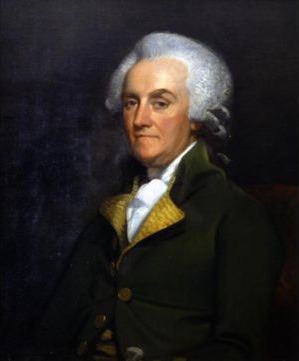
Benjamin Franklin had one surviving son, William, born out of wedlock around 1730 and raised in Benjamin's own house. For most of their lives they were not just father and son but partners. William was at his father's side through the years in London, through the experiments, through the long campaign to defend the colonies inside the empire. And in 1763, while the two of them were together in England at the height of their closeness, William was made royal governor of New Jersey. He owed the post, in a sense, to being Benjamin Franklin's son.
When the crisis came, the son stayed the king's man. While his father moved toward independence, William held his royal commission and tried to keep New Jersey loyal. In January 1776 the militia put him under watch; in June, after he attempted to convene the royal legislature one last time, the New Jersey Provincial Congress declared him "an enemy to the liberties of this country," arrested him, and sent him to Connecticut. He spent two years a prisoner there. When he was caught issuing pardons and corresponding for the Crown, they gave him eight months of solitary confinement in the Litchfield jail, a filthy cell with no writing materials. While he was held, his wife Elizabeth died in British-occupied New York, and his request to go to her was refused. He never saw her again.
Exchanged at the end of 1778 for a captured patriot official, William went to occupied New York City, the Loyalist capital, and there he did not retire quietly into exile. He became president of the Board of Associated Loyalists, an organization that sent Loyalist raiders out of New York to plunder and kill along the New Jersey and Connecticut shores. Under his board, in April 1782, Loyalist irregulars would hang a captured patriot militia captain on a New Jersey beach (a killing we will come back to). The break between father and son was now not just political. It was blood spilled.
In August 1782 William sailed for Britain. He never lived in America again.
The Franklins were the most famous case, not the only one. In New York, the Morris family of Morrisania managed to put nearly every position in the war under one roof. Lewis Morris signed the Declaration of Independence. His half-brother Gouverneur Morris helped write the Constitution. Another half-brother, Staats Long Morris, was a major-general in the British army, posted by the War Office to a distant garrison on Minorca specifically so that he would not have to fight on his native soil. And their mother, Sarah, was a Loyalist who handed the family estate over to the British military once they occupied New York. One household: a Signer, a framer, a British general, and a Loyalist matriarch. In Massachusetts the split landed on the Quincy brothers with an almost unbearable neatness. Samuel Quincy had been the prosecutor at the Boston Massacre trials (Chapter 3), the man arguing the Crown's case against the soldiers; his brother Josiah Quincy Jr. had been on the defense, helping John Adams win the soldiers a fair hearing. When the war came it reversed them. Samuel, who had prosecuted for the Crown, became a Loyalist and sailed for England in 1775; his wife disagreed and stayed behind with the children, and Samuel never came home. Josiah, who had defended the king's soldiers, was the patriot, and died at sea that same spring returning from a political mission, the two brothers passing in opposite directions across the same ocean.
The machinery of choosing sides
Nobody got to stay on the fence for long, and the reason is worth understanding because it is the most uncomfortable part of the patriot story. The Revolution did not win allegiance only by persuasion. It built machinery to extract it, and the machinery was coercive by design.
It began with the committees. To enforce the boycott of British goods that the Continental Congress had organized in 1774 (Chapter 5), towns and counties elected committees of inspection, observation, and safety. These were not lynch mobs; they were elected or quasi-elected local bodies, the seed of self-government. But their job quickly grew beyond watching what people bought. They summoned suspects, demanded public recantations and printed them in the newspapers, decided who could travel, disarmed the people they called "disaffected," and recommended arrests. By 1775 and 1776, across most of the country, these committees were the government, and they were watching their neighbors.
Then came the oaths. Every one of the thirteen states required a loyalty oath of its citizens, and eleven of them required swearing off allegiance to the king outright, an oath of abjuration, which simply means an oath renouncing the king; New Jersey had one in place by September 1776. Refusing to swear had a price, and the price was a deliberate machine for making neutrality impossible. A non-juror, a man who refused the oath, could be disarmed; militia officers were empowered to walk into his house and take his guns. He could be taxed at double or triple the normal rate; Maryland used treble assessments. He could lose the vote, lose the right to hold office, sit on a jury, sue in court, buy or sell land, or practice a profession. In Massachusetts a man who refused the oath could be jailed and shipped out of the state within forty days, at his own expense. You did not have to fight for the king to be punished. You only had to decline to swear against him.
Then came confiscation. Every state passed laws to seize Loyalist property, and they used them. New York's Forfeiture Act of 1779 was the most aggressive: it named prominent Loyalists, banished them, declared that a named Loyalist who returned could be put to death by order of the legislature, and put their estates up for sale through state commissioners. Massachusetts banished some three hundred named Loyalists, headed by the former royal governor, and made the return of a banished person punishable by death. There is no reliable single figure for the total value of what was taken; the best measure we have is what the Loyalists themselves would later claim back from the British government, which ran to millions of pounds. The point is the scale: this was not a few estates here and there. It was a systematic transfer of property out of the hands of the losing side.
The machinery's sharpest edge was death, and it was used. In Philadelphia in November 1778, Pennsylvania hanged two Quakers, John Roberts and Abraham Carlisle, convicted of treason for aiding the British during their occupation of the city, despite a petition for mercy signed by hundreds of their neighbors. Executions like that were rare. The threat behind them was not.
And then, lower in the machinery, was the violence done to the body. Tarring and feathering was the Revolution's signature crowd punishment, usually either waved away as rough humor or inflated into murder, and it was neither. Pine tar was heated until it would pour, the victim was stripped, the scalding tar was applied to bare skin, feathers were thrown on, and the man was carted through the streets as a spectacle. It was torture and it was theater. It was also, in the great majority of cases, not fatal: a survey of more than seventy recorded incidents found no deaths from the tarring itself. But "not fatal" is a long way from harmless, and the worst-documented case, the customs officer John Malcolm in Boston, shows what it actually did. A crowd dragged him out one winter night, stripped him, poured scalding tar on his bare skin, feathered him, and carted him through the cold for hours, whipping him and threatening to hang him and to cut off his ears until he cursed the king. When he finally warmed up afterward, his tarred flesh peeled off in strips, and he was bedridden for some eight weeks. He had brought a measure of it on himself; he had clubbed a man in the street that day. And the man he had clubbed, watching the crowd's revenge go too far, tried to cover Malcolm with his own coat. Even in the cruelty there was a flash of the shared humanity that civil wars are supposed to extinguish. (Malcolm's tarring came in early 1774, a year before the war proper; it is the established practice the war then inherited and made worse.)
All of that ran one direction where the patriots held the ground. Where the king's men held the ground, the same machine ran the other way, wearing a red coat. Occupied New York City was the Loyalist capital for the whole war, under military rule, its rebel-leaning residents subject to suspicion, surveillance, and seizure: the British army requisitioned rebel houses for quarters and supply and stripped abandoned patriot estates for the war effort. When the British took Charleston in 1780 they did the same in the South, running a commissioner of sequestered estates who seized rebel plantations and turned their crops and their enslaved labor to the Crown's account. The Board of Associated Loyalists that William Franklin came to lead sent raiders out to plunder and kidnap and kill in revenge. And the British built their own engine for abolishing neutrality, the exact mirror of the patriot oaths. After Charleston fell, the British commander Sir Henry Clinton issued a proclamation in June 1780 that voided the paroles most South Carolinians had taken and demanded a full oath of allegiance, including a willingness to bear arms for the king, on pain of being treated as a rebel. At a stroke he abolished sitting-it-out for everyone in the state. Where the patriot test oaths punished a man for declining to swear against the king, Clinton's oath punished a man for declining to take up arms for him; between the two instruments, the fence was closed from both ends. Men who had been quietly trying to stay neutral now had to fight for the king or be counted his enemy, and thousands who would have stayed home chose rebellion instead. It is widely judged one of the worst blunders Britain made in the entire war, and it is the sharpest irony in the whole story: the largest faction in America, the people who wanted only to be left out of it, were not allowed to be, by either side.
The dirty war
There were two wars going on, and the second ran the entire length of the first. One was the war of the great battles, fought between Washington's Continentals and the British army, the war that gets the maps and the monuments. The other was a war of neighbors, fought in the gaps between the armies for the whole seven years, and it was uglier than most of what the regulars did to each other.
Its clearest landscape was the Neutral Ground. Between the British lines around Manhattan and the American lines up in the Hudson Highlands lay some thirty miles of Westchester County that belonged to neither, raided by both for seven years. Two kinds of armed bands worked it. The "Cowboys" were Loyalist-aligned cattle thieves who drove stolen livestock down to the British market in New York (the first time Americans used that word, for raiders, not ranchers). The "Skinners" were the label that stuck to the patriot-aligned plunderers, though that name owes as much to a novel written decades later as to anything anyone was called at the time. Bands on both sides robbed whoever they could catch, regardless of politics, and the plain truth of the Neutral Ground is that allegiance was mostly a pretext for the theft. By 1783 it was a wasteland of burned fences, stripped farms, and abandoned fields, its people robbed by whichever side reached them first.
New Jersey was so fought-over they called it the cockpit of the Revolution, the pit where the fighting never stopped. It changed hands and allegiance again and again, and the winter raiding of 1777, the Forage War of constant small-unit skirmishing over food and fodder, shaded into years of neighbor-on-neighbor violence, worst in Monmouth County. There a failed Loyalist uprising early in 1777 left armed Loyalists hiding in the pine woods, the "Pine Robbers," part partisans and part bandits, kept alive by a British-held New York that paid hard money for Jersey timber and food. The patriots answered in kind. Monmouth's Association for Retaliation, formed in 1780 to protect its members, did its own share of plundering peaceable Loyalist neighbors and settling private scores under cover of the cause. This was the cycle that produced the killing William Franklin's board would approve: in April 1782, Loyalist raiders took the captured patriot captain Joshua Huddy from custody, rowed him to the Jersey shore, and hanged him on the beach in revenge for a Loyalist's death, leaving a placard on his body. Washington was so enraged he threatened to hang a British officer chosen by lot in return. The scandal helped finish off the Board of Associated Loyalists and sped William Franklin's departure for England. Neighbor killing neighbor, with the most famous patriot in the world's son signing off on it.
The worst of it was in the southern backcountry, and there the civil war stopped even pretending to be anything else. After Charleston fell and Clinton's no-neutrality proclamation lit the fuse, the Carolina and Georgia backcountry collapsed into open partisan war: Whig militia against Tory militia, neighbor against neighbor, each atrocity feeding the next. When General Nathanael Greene arrived to take command of the southern army at the end of 1780, he wrote to Alexander Hamilton in something close to disbelief.
The division among the people is much greater than I imagined and the Whigs and Tories persecute eachother, with little less than savage fury. There is nothing but murders and devastations in every quarter. — Nathanael Greene, 1781
The cycle had a shape, and naming the links is the only honest way to tell it, because each side's atrocity was the other side's justification. The British and Loyalists hanged captured patriots at Camden, Ninety Six, and Augusta. In May 1780 at the Waxhaws, the cavalry of Banastre Tarleton, a British officer commanding the British Legion (a unit whose name sounds imperial but was recruited almost entirely from American Loyalists), cut down a force of surrendering Virginia Continentals. Whether Tarleton ordered the killing is genuinely disputed: his horse went down, his men believed him killed, and control was lost. What is not disputed is that the patriots took from it a battle cry, "Tarleton's quarter" and "Remember Buford," that licensed their own killing of men trying to surrender.
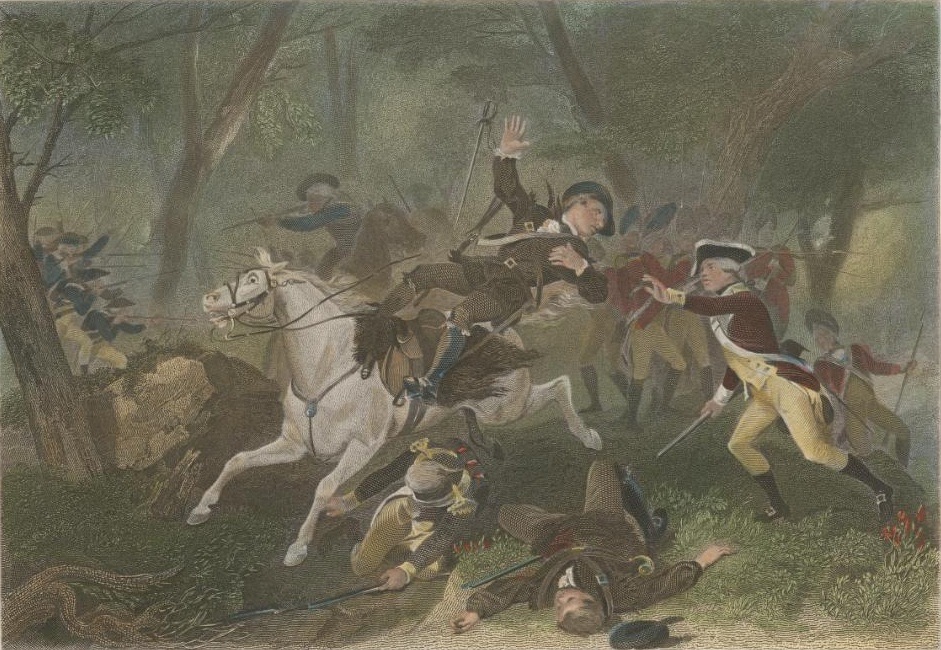
That cry was answered at Kings Mountain in October 1780, and Kings Mountain is the clearest proof on offer, so it is worth slowing down on what it was even though its full story belongs to a battle page of its own. A force of about nine hundred patriot backcountry militia, including the "Overmountain Men" (frontier settlers from the far side of the Appalachians, in what is now Tennessee and western North Carolina), stormed a hill held by Major Patrick Ferguson and roughly eleven hundred Loyalists. Ferguson's command was about a hundred Loyalist provincials from New York and New Jersey and Connecticut and some eight hundred Carolina Loyalist militia. When the fighting was over Ferguson was dead and his force destroyed. Here is the fact that makes the whole argument in a single line: of the roughly two thousand men on that field, the only British soldier present was Major Ferguson himself. Every other man on both sides, the ones who stormed the hill and the ones who died defending it, was American. The hundred provincials in red coats were American colonists wearing the king's uniform. A battle remembered as a famous American victory over the British was, almost to a man, Americans killing Americans.
And it did not end with the battle. A week after Kings Mountain, the victorious patriot militia convened a rough field court at Biggerstaff's Old Fields near Gilbert Town, North Carolina, tried some thirty Loyalist prisoners, condemned a dozen, and hanged nine of them, justifying it as payment for the patriots the British had hanged at Camden and Ninety Six and Augusta. Nine men swung from a single oak in two days, and it was meant to be remembered. The cycle turned again four months later at the Haw River, where Loyalist militia riding to join the British mistook a patriot legion in green coats (the same green Tarleton's Legion wore) for Tarleton's men; the patriots rode down their line trading friendly greetings and then fell on them, killing at least ninety, some of them prisoners cut down afterward to cries of "Remember Buford."
Nobody in this came to the cruelty clean, and the backcountry's bitterest figure shows how the cruelty was manufactured. To see it, back up a few years, because his wound came before most of what was just described. Thomas Brown was a young English-born planter in Georgia who wanted no part of the patriot cause. In August 1775 a Liberty crowd demanded he swear to it; he refused, and they fractured his skull with a musket butt, tied him to a tree, burned his feet until he lost two toes, partly scalped him, and tarred and feathered him. "Burnfoot" Brown survived, carried the headaches the rest of his life, and became one of the most feared Loyalist partisan commanders in the South, leading the King's Rangers (a Loyalist irregular force operating out of Georgia) with a hardness his enemies never forgave and never let him forget. The mob that tortured Thomas Brown into the king's camp got back everything it had given him, with interest. That is the lesson the southern backcountry teaches: each side made the other, and then each side blamed the other for what it had made.
The cycle's last turn came in late 1781, when the Loyalist major William Cunningham, called "Bloody Bill," caught a band of patriot militia with rain-soaked guns, accepted their surrender, and then killed all but two of them, among the dead the captains Sterling Turner and James Butler. From there he opened a weeks-long revenge expedition of burnings and executions across the South Carolina backcountry that his enemies remembered as the Bloody Scout. By then the killing barely needed a reason. It had become its own engine.
The exodus
When the war was lost, the losing side did what the losing side of a civil war does. It left.
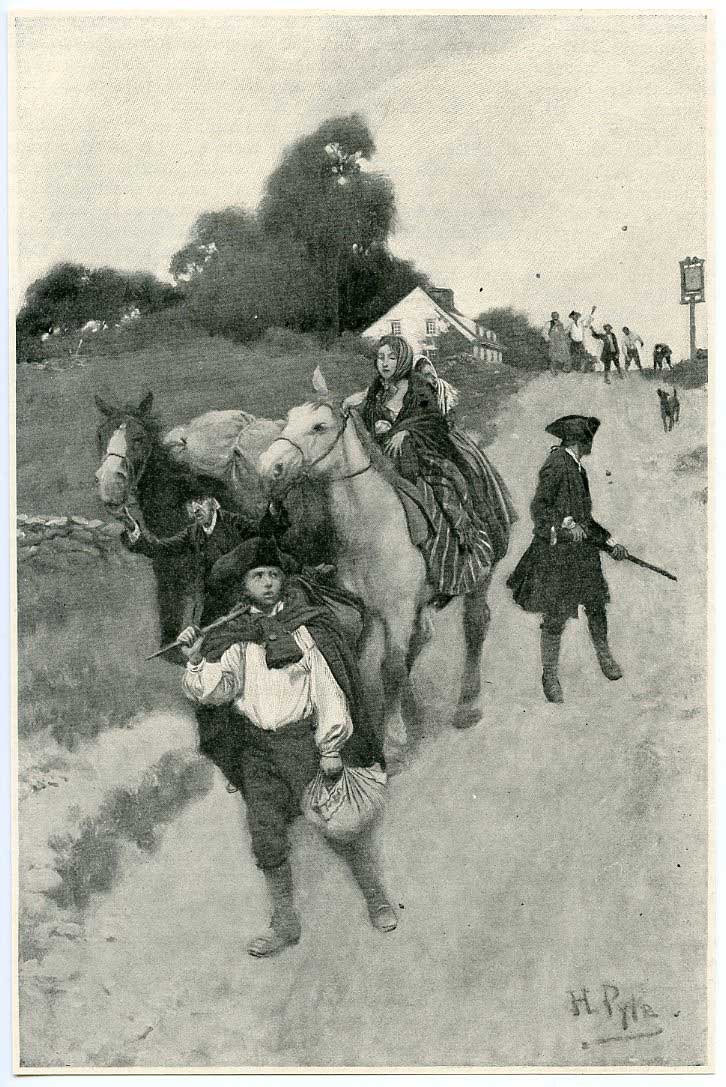
About sixty thousand Loyalists fled the new United States during and after the war, by the careful modern count of the historian Maya Jasanoff. They did not flee alone. Some eight thousand of them were free Black Loyalists, people who had won their freedom by reaching the British lines, and the refugees also carried away with them roughly fifteen thousand enslaved people, so the same migration that delivered some to freedom carried others off in chains. Counting everyone, perhaps seventy-five thousand people in all, which Jasanoff reckons at somewhere around one American in forty, sailed away from the country rather than live in it. (Older estimates ran higher, up to eighty or a hundred thousand; Jasanoff's sixty thousand is the careful modern floor.)
Where did they go? Most went north, into what was left of British North America. Around thirty thousand poured into Nova Scotia, so many that in 1784 Britain carved a brand-new colony, New Brunswick, out of the territory just to hold them. Several thousand more went up to Quebec. Some thirteen thousand crossed to Britain itself, the imperial homeland most of them had never seen. And around six thousand, mostly southerners, sailed to Jamaica and the Bahamas, taking the great majority of those fifteen thousand enslaved people with them, which is the plainest possible reminder that for thousands of human beings the Loyalist exodus was not a choice at all. The Loyalist diaspora reached, in small streams, as far as the British outposts of the Caribbean and beyond.
Nova Scotia is where you can watch the dream and its collapse in one place. A company of Loyalist refugees from New York chose a fine harbor on the Atlantic coast, and the first fleet landed in May 1783; the governor named the new town Shelburne after the prime minister who had just negotiated the peace. Within about a year it held some ten thousand people, which made it, by some reckonings and for one strange moment, the fourth-largest town in North America, behind only New York, Philadelphia, and Boston. Then the props came out. Government rations stopped in 1787, and the same year hundreds of houses already stood empty; by 1789 two-thirds of the town was abandoned; a generation later its population was counted in the hundreds. A boomtown built on refugees and rations, and when the rations stopped, it emptied. Just outside Shelburne, the settlement of Birchtown became the largest community of free Black people anywhere in North America, and it learned the bitterest lesson of all: promised land that never came, votes denied, a white population that turned on them, until in 1792 more than a thousand Black Loyalists gave up on Nova Scotia entirely and sailed for a new colony in Sierra Leone, on the coast of Africa, to try once more to be free. Their full story belongs to the chapter on slavery and the Revolution; here it stands as the exodus's harshest epilogue.
There was one more institution waiting for them, and it makes the point as cleanly as anything else. Parliament set up a commission in 1783 to compensate the Loyalists for what they had lost, and to it the exiles brought their claims: deeds, witnesses, inventories, proof that they had truly been loyal and truly been ruined. The numbers tell the scale of the catastrophe and the stinginess of the relief at once. Loyalists filed 3,225 claims seeking more than eight million pounds; the commission, after years of humiliating inquiry into every applicant's losses and loyalty, paid out about three million, roughly thirty-seven pence on the pound. But the existence of the commission is itself the deepest fact here. A government had set up an office to compensate the refugees of an American war, and the refugees were Americans. The British state formally recognized that it had losers in this fight, and that they were people it owed something to. These were war refugees, and everyone at the time understood them as such.
The long quiet
Here is the part of the story that should be hard to believe, given everything that came before it. After a civil war this savage in places, after the hangings and the burnings and the tar and the seizures, the country did not keep killing. It mostly stopped.
The Treaty of Paris in 1783 asked the states, in soft and non-binding language, to restore confiscated Loyalist property and to halt further persecution. The states largely ignored the property part; confiscations were not undone. But the open season was over, and what did not happen next is the genuine headline. There were no mass executions of the defeated. There was no permanently proscribed class of citizens, no generation of Loyalist guerrillas waging revenge from the hills. For an eighteenth-century civil war, the aftermath was startlingly mild, and historians have puzzled over the mildness ever since.
The mechanics of forgiveness turned out to be cheap and procedural, which is much of the explanation. There were simply too many Loyalists to put on trial for treason; you cannot prosecute a fifth of the country. So the states reached for the same instrument they had used to coerce loyalty in the first place: the oath. A man swore allegiance to his new state, a patriot neighbor vouched for him, and the matter was closed. Most Loyalists who had stayed kept or recovered their property and quietly became American citizens. Across the 1780s the discriminatory laws came down; Pennsylvania repealed its test act in 1789; in New York the young lawyer Alexander Hamilton, of all people, took up the defense of Loyalist clients against the state's revenge statutes, arguing that the peace treaty overrode them. Many of the exiles themselves drifted home once tempers cooled, slipping back into towns that had banished them as though the fever had simply passed.
But not everyone got the quiet. The reabsorption was real and it was surprising, and it was also not for the named, the prominent, and the banished. The men whose lives had been declared forfeit by statute, the great Loyalist families written into the confiscation acts, had no road home; for them there was only England. The Black Loyalists who had fled to Nova Scotia did not get folded gently back into anything; they got denied land and sailed for Africa.
And William Franklin never came back at all. When his father wrote his will, he made the cut explicit and put the reason in writing: "The part he acted against me in the late war, which is of public notoriety, will account for my leaving him no more of an estate he endeavoured to deprive me of." He left his only son some distant land claims and forgave some debts, a pointedly token inheritance. Years earlier, when William had written from London asking to revive "that affectionate Intercourse and Connexion" they had once had, defending himself as a man who had "uniformly acted from a strong Sense of what I conceived my Duty to my King," Benjamin had allowed, once, that "We are Men, all subject to Errors," which sounded for a sentence like the door opening, and then closed it: "there are Natural Duties which precede political Ones." A son's first duty was to his father, and his son had chosen the king. They met one last time, briefly and coldly, in England in 1785, mostly to settle business; there was no reconciliation. Benjamin Franklin died in Philadelphia in 1790, honored by a nation he had helped invent. William Franklin died in London in 1813, still an exile, the will standing as his father's last verdict.
Indeed nothing has ever hurt me so much and affected me with such keen Sensations, as to find my self deserted in my old Age by my only Son; and not only deserted, but to find him taking up Arms against me, in a Cause wherein my good Fame, Fortune and Life were all at Stake. — Benjamin Franklin to William Franklin, 1784
So the war that began among Britons ended by sorting one people into two countries. The United States was one of them. The other was English Canada, which the Loyalist refugees substantially founded, the empire's second try at a North America, built out of the people the first one had cast off. The Revolution did not only divide America from Britain. It divided America from itself, and then it populated a second nation with the half that lost. The country had to decide not only what it would be but who would be allowed to belong, and for a long and lucky stretch afterward, most of the people who had guessed wrong were quietly let back in.