In 1775 slavery was legal in every one of the thirteen colonies. Not most of them. All of them. Massachusetts, where the first shots were fired, allowed one person to own another, and so did every colony to its north and south. Out of roughly two and a half million people in British America, about half a million were enslaved, which is to say that close to one person in five living in the colonies that were about to declare that all men are created equal was, in law, the property of someone else.
The people of the time saw this perfectly well, and a striking number of them said so out loud. The contradiction at the center of the American Revolution, a war for liberty waged by enslavers, was named at the time, on every side, in pamphlets and private letters and even in the first draft of the Declaration of Independence. And the Revolution did two opposite things with it at once. It set off the first wave of abolition in the history of the Atlantic world, and it left slavery deeper and more secure where most of the enslaved actually lived.
Running underneath both, the steadiest thread in the whole story, were Black Americans themselves, who fought on both sides of this war for the same thing, their own freedom, and who took it from whichever army was selling it cheapest. That is the one consistent set of motives in this chapter. Everyone else's motives were tangled. Theirs were not.
The landscape in 1775
It is tempting to file slavery under "the South" and move on. That is wrong. Slavery in 1775 was legal everywhere and dominant in the South, which is a different and more uncomfortable sentence.
Where it was dominant, it was overwhelming. In Virginia, the largest and most influential colony, enslaved people made up about forty percent of the population. In South Carolina they were a majority, around sixty percent of everyone in the colony, and in the rice parishes of the lowcountry the share ran far higher still, so that a white planter might live surrounded by Black people he owned and feared in roughly equal measure. Maryland and North Carolina each held well over a hundred thousand enslaved people. This was not an institution at the edges of Southern life; it was the economy, the labor system, and the social order all at once.
But the North was not clean. New York held the largest enslaved population of any Northern colony, with slavery woven into the working economy of New York City; the first real count, the 1790 census, would put the state's enslaved population above twenty-one thousand. New Jersey held more than eleven thousand. New England's numbers were smaller, a few percent, but real: enslaved people worked in Boston and Newport and on Connecticut farms. And Rhode Island merchants, in Newport and Bristol, were the leading American carriers of the Atlantic slave trade itself, the people who sailed the ships that brought captives across the ocean. The colony that would soon raise a regiment of formerly enslaved soldiers was, at the same moment, the American capital of slave trading.
The contradiction contemporaries saw
The cleanest way to show that the contradiction was visible in 1775, and not a later invention, is to let the people of that year say it themselves, because they did, repeatedly, and in their own words.
In London, Samuel Johnson, the great dictionary-maker, had no patience for the colonists. He thought their grievances overblown and their cause unjust, and in a 1775 pamphlet attacking them he landed the line that has outlived every other thing said about American independence that year.
How is it that we hear the loudest yelps for liberty among the drivers of negroes? — Samuel Johnson, 1775
Johnson was a hostile witness. He opposed American independence and slavery both, and the line landed because it was true. It did not take an enemy of the Revolution to see it. Almost a year before the fighting started, Abigail Adams wrote to her husband John from Braintree, Massachusetts, in plainer, more anguished form: "I wish most sincerely there was not a slave in the province. It always appeared a most iniquitous scheme to me — fight ourselves for what we are daily robbing and plundering from those who have as good a right to freedom as we have." She wrote that amid rumors that enslaved people in Boston were planning to offer to fight for the royal governor in exchange for their freedom, which shows the enslaved had already done the same arithmetic everyone else was doing, only sooner.
And then there is the one that is hard to read. In 1773, two years before he stood up and said "give me liberty or give me death," Patrick Henry wrote a private letter to a Quaker abolitionist who had sent him an anti-slavery book. Henry agreed with the book. He called slavery "repugnant to humanity." And then, owning people the entire time he wrote it, he confessed: "I am drawn along by the general inconvenience of living without them. I will not, I cannot justify it." He knew exactly what he was doing, said it was wrong, and kept doing it because freeing his slaves would be inconvenient. He put none of his own spin on it, and there is none to add.
The contradiction even made it into the Declaration of Independence, and then got cut out. In his draft, Thomas Jefferson, who enslaved more than a hundred people, wrote a long passage blaming King George for the slave trade itself, accusing him of having "waged cruel war against human nature itself" by "captivating and carrying" Africans "into slavery in another hemisphere." It is a remarkable thing for a slaveholder to have written, and incoherent in the same breath, because Jefferson went on to accuse the King of the opposite crime too: of "exciting those very people to rise in arms among us," meaning that the King's offer of freedom to enslaved people who would fight for him counted, to Jefferson, as an outrage as well. Enslaving them was a crime, and freeing them was also a crime. Congress cut the whole passage, partly at the insistence of South Carolina, Georgia, and Northern merchants in the slave trade. What survived was one cold phrase, the charge that the King had stirred up "domestic insurrections amongst us." That phrase was about the enslaved.
Many founders called slavery evil in private. Almost none of the slaveholding ones acted against their own holdings. Both halves are the record.
Dunmore's proclamation
Then the war forced the question, and it was the British who forced it first, for reasons that had nothing to do with conscience.
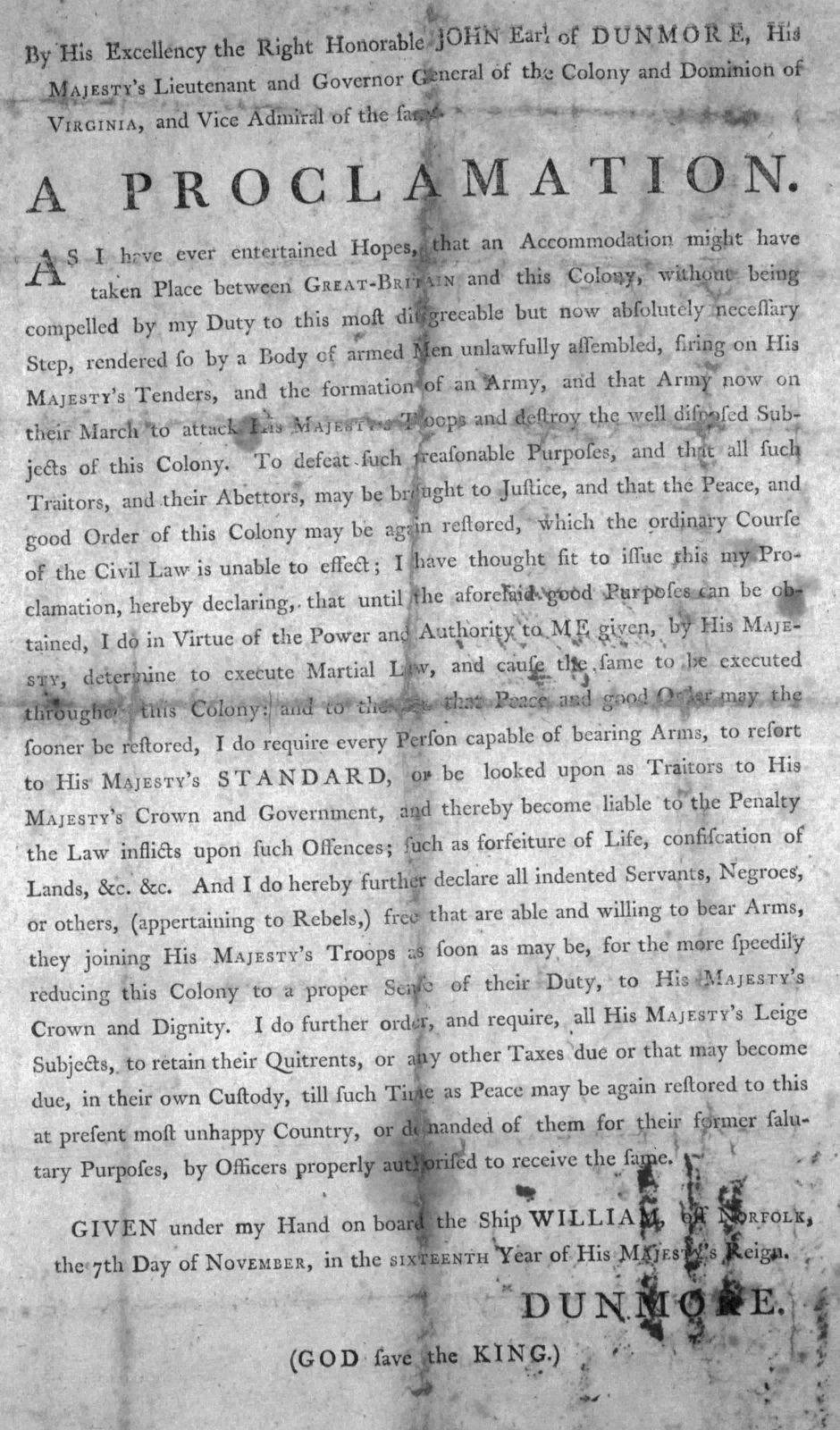
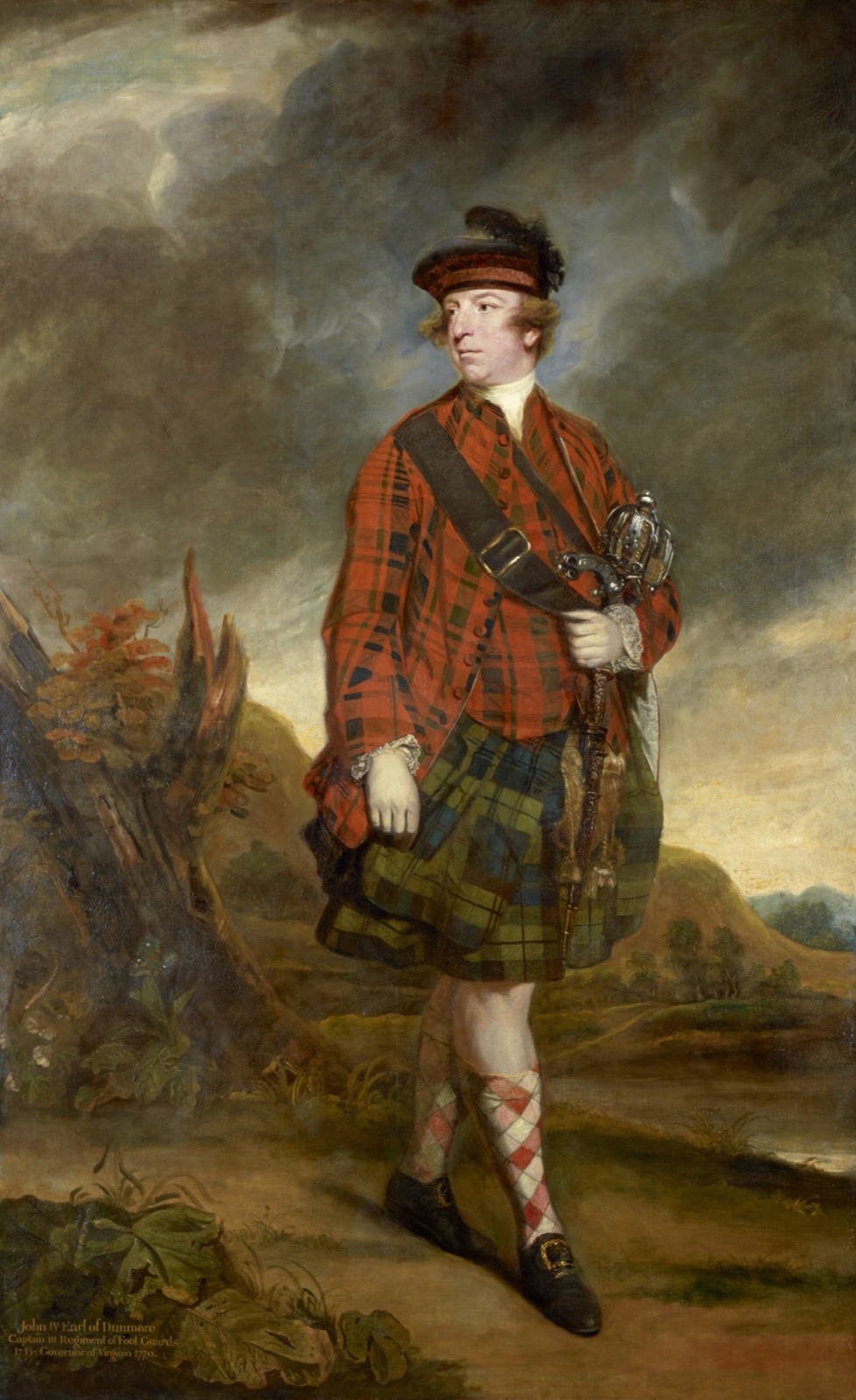
By the autumn of 1775, John Murray, the fourth Earl of Dunmore and the last royal governor of Virginia, had been driven out of his capital and was running what was left of his authority from a warship in the Chesapeake. He was losing, he needed soldiers, and he was sitting in a colony where forty percent of the people were held in bondage by the very planters in rebellion against him. On 7 November 1775, aboard the ship William off Norfolk, he signed a proclamation, proclaimed publicly a week later, that offered freedom to a specific group of enslaved people: "all indented servants, Negroes, or others (appertaining to rebels) free, that are able and willing to bear arms, they joining his Majesty's troops." (The word "indented" is the period spelling of indentured.)
Read the limits, because they are the whole truth of it. The offer applied only to people enslaved by rebels; if you were owned by a Loyalist, you stayed a slave. It applied only to those "able and willing to bear arms," meaning able-bodied men, not their wives or children. And the stated purpose, in the document itself, was "the more speedily reducing this colony to a proper sense of their duty," which is to say crushing the rebellion. Dunmore was no abolitionist: he personally enslaved dozens of Africans in Virginia and the Caribbean, and had bought a plantation outside Williamsburg the year before. He was a slaveholder offering freedom to other men's slaves as a weapon of war, and the men who took him up on it knew it and came anyway, because a cynical offer of freedom is still an offer of freedom, and they were in no position to be choosy about the motives of the person opening the door.
One of the men who answered was Harry Washington, enslaved at Mount Vernon by George Washington himself, who escaped to Dunmore's fleet in 1776. Keep his name; this chapter ends with him an ocean away.
They came in the hundreds. Estimates of how many reached Dunmore's lines run from around eight hundred to around two thousand, and they included women and children he had never invited. From the men, Dunmore formed an all-Black unit with white officers, the Ethiopian Regiment. A Virginia newspaper reported that the soldiers wore the words "Liberty to Slaves," apparently on their uniforms, which, if the report is right, is a pointed answer to Patrick Henry's "Liberty or Death," made by the very people Henry kept enslaved. The regiment fought, with a small share in an early skirmish at Kemp's Landing, and then was beaten badly at Great Bridge in December 1775, after which Dunmore abandoned Norfolk for his ships.
What killed most of them was not the Patriots. It was disease. Dunmore's floating community, crowded onto ships and islands, became a death trap, and smallpox above all tore through it. In the spring of 1776 his forces moved to Gwynn's Island in the Chesapeake, and hundreds of the Black recruits sickened and died there. When Patriot troops landed in July they found the dying and the unburied dead, and somewhere in those camps the sashes reading "Liberty to Slaves" were being buried with the men who had worn them. When Dunmore finally quit Virginia in August 1776, only about three hundred Black survivors sailed with him. The first mass bid for freedom of the war ended, for most who made it, on a sickbed.
But the proclamation did something its author never intended, one of the most important second-order effects in the whole Revolution. By threatening to free their human property, Dunmore terrified white Southerners and shoved the wavering ones toward independence. A planter who might have hesitated over a tea tax did not hesitate when the Crown started arming his slaves. The historian Gary Nash judged that the proclamation "became a major factor in convincing white colonists that reconciliation with the mother country was impossible." Richard Henry Lee of Virginia wrote that Dunmore's conduct had, a few Scots excepted, "united every Man in that large Colony." The British attempt to use slavery against the rebellion helped guarantee the rebellion would succeed as a slaveholders' cause.
Self-emancipation at scale
Four years later the British widened the offer, and the trickle became a flood. (Self-emancipation is exactly what it sounds like: freeing yourself, by running, without waiting for an owner or a law to do it.)
On 30 June 1779, Sir Henry Clinton, the British commander-in-chief, issued the Philipsburg Proclamation from his headquarters in New York. It promised "to every NEGROE who shall desert the Rebel Standard, full security to follow within these Lines, any Occupation which he shall think proper." This was a far bigger door than Dunmore's. It applied across all the colonies, and it required no military service, so that any enslaved person of a rebel who could reach British lines was protected, women and children included. It was the largest invitation to self-emancipation in American history to that point.
It was also, like Dunmore's, carefully self-interested. The same proclamation threatened that any Black man captured fighting in the rebel army would be sold, and it left every Loyalist's slaves untouched. The British were freeing the enemy's slaves while protecting their friends' and threatening to sell the ones who fought for the wrong side. Freedom here was a lever, not a principle, both halves printed in the same document.
How many people seized the offer is the single most fought-over number in this story, inflated and deflated for two centuries. Tens of thousands of enslaved people ran to British lines over the course of the war; that much is beyond dispute. The count is not. Older histories, including the standard work of Sylvia Frey and Gary Nash, put the total flight as high as eighty thousand to a hundred thousand. More recent scholarship, led by the historian Cassandra Pybus, reworked the evidence and argued those figures were wildly too high; her estimate for the number who actually reached British lines is closer to twenty thousand to twenty-five thousand, with the work of Maya Jasanoff pointing to the same order of magnitude. We do not have a firm number, and the honest range is wide. What is not in dispute is that the flight was enormous and that disease, smallpox above all, killed perhaps half of those who ran before they ever tasted the freedom they had risked everything for. The largest emancipation movement of the century ran straight through an epidemic.
Even Jefferson's famous figure belongs in the doubtful column. He claimed that Virginia alone lost "about thirty thousand" enslaved people in 1781 during Cornwallis's campaign, most of them, he said, to smallpox and camp fever. The number echoed through the history books for two hundred years, until Pybus's reexamination, pointedly titled "Jefferson's Faulty Math," concluded it was a baseless extrapolation. The flight was real and vast; the count is genuinely unsettled; no single clean total should ever be printed as if it were known.
One of those tens of thousands was Harry Washington, the man who had escaped Mount Vernon to Dunmore's fleet in 1776. He served in the British lines through the war, and at war's end was carried to Nova Scotia as a free man, his age recorded there as forty-three; in 1792 he would sail again, across the ocean to West Africa. The commander of the Continental Army spent the war chasing the British while one of his own enslaved people fought on the other side for the freedom Washington's cause would not give him. And he was not the only one to run from that plantation: in April 1781, when a British warship came up the Potomac, seventeen enslaved people fled Mount Vernon to reach it.
Black Patriots
Not everyone bet on the British. Thousands of Black Americans fought for the Patriot side, often for the same reason their counterparts ran the other way: because that was where they thought freedom lay, or because that was the side they were standing on when the war reached them. Crispus Attucks, among the first to die in the whole conflict, on King Street in 1770 (Chapter 3), was of African descent. Black men, free and enslaved, were at Lexington, at Concord, and at Bunker Hill before George Washington ever took command of the army.
What we know about them is often thinner than the legends that grew up later. At Bunker Hill, a free Black soldier named Salem Poor, who had bought his own freedom, did something that impressed fourteen Massachusetts officers enough that on 5 December 1775 they petitioned the legislature on his behalf, writing that he "behaved like an Experienced officer, as Well as an Excellent Soldier," and that "in the Person of this Sd. Negro Centers a Brave & gallant Soldier." No other soldier at Bunker Hill received a testimonial like it. And yet the petition never says what he actually did; the officers wrote that "to set forth the particulars of his conduct would be tedious." The later story that he shot a British officer is nineteenth-century tradition with no contemporary evidence behind it. So what we have is solid: a contemporary document, signed by fourteen witnesses, naming a Black man's courage. We have the courage, not the deed, and we should not invent one. The similar tale of Peter Salem, another Black soldier said to have fired the shot that killed a British major at Bunker Hill, is also a legend that surfaced decades later; he certainly served, but the famous shot is a story, not a record.
George Washington's own position on Black soldiers lurched back and forth in a way that maps the war's pressures exactly. In July 1775, just after taking command, his headquarters told recruiters not to enlist any "deserter from the Ministerial army, stroller, negro, or vagabond," a list that lumped free and enslaved Black men in with vagrants and the enemy's runaways. On 12 November 1775 his general orders barred all Black men, free or enslaved, from enlisting at all. Five days after that, Dunmore's proclamation was published, and the calculation changed overnight, because every Black man Washington turned away was a man the British would happily arm. On 30 December 1775 he reversed course for free Black veterans, announcing that since "Numbers of Free Negroes are desirous of inlisting," recruiting officers could "entertain them." Congress agreed in January 1776 for free Black men who had already served. After that the rule and the practice drifted apart: as white enlistments dried up, Black men were quietly taken in well past the formal limits, and they served, overwhelmingly, in the same units as white soldiers rather than in segregated ones. Historians have argued that the late-war Continental Army was the most racially integrated American army the country would field before Vietnam.
The one famous exception ran in the other direction. In February 1778, Rhode Island, unable to fill its quota of Continental soldiers, voted that "every able-bodied negro, mulatto, or Indian man slave" in the state could enlist, and that any who did "shall be immediately discharged from the service of his master or mistress, and be absolutely free." The state compensated the owners at market value. About eighty-eight enslaved men enlisted in the first four months, and together with free Black and Native recruits the regiment counted roughly a hundred and forty men of color out of around two hundred and twenty-five. Alarmed at the cost, the assembly shut the slave-enlistment window after four months, on 10 June 1778. The 1st Rhode Island Regiment, sometimes called the Black Regiment, fought creditably that August at the Battle of Rhode Island, helping repel repeated assaults during the retreat from a failed operation against Newport. But be precise about what it was. It was never all-Black; it had white officers throughout, and later white replacements. It was a one-state, four-month experiment born of desperation, not a Continental policy. And the freedom it offered came with a price tag the state paid to the enslavers. It was real, and it was also exactly as far as the Patriot side was willing to go, which was not far.
How many Black men served the Patriot cause in all is, like the flight numbers, a range rather than a figure. The long-standard estimate is about five thousand; the Daughters of the American Revolution's Forgotten Patriots project has documented around sixty-six hundred named soldiers and sailors of color; recent scholarship argues for eight to ten thousand or more. The records are too thin for a better answer than "somewhere between five and ten thousand."
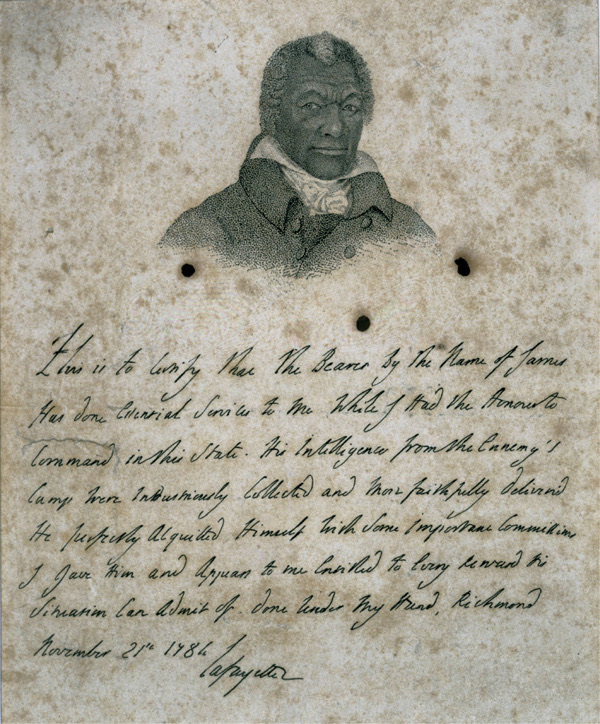
The grind of getting free for that service is best seen in one man. James Armistead was enslaved in New Kent County, Virginia. With his owner's consent, he served the Marquis de Lafayette in 1781 as a spy, slipping into Cornwallis's camp and feeding Lafayette intelligence while feeding the British disinformation, work that helped set up the trap at Yorktown that effectively won the war. And then Virginia's 1783 law freeing enslaved men who had served as soldiers did not cover him, because a spy was not a soldier. It took a testimonial from Lafayette and a special act of the legislature in 1787, which compensated his owner two hundred and fifty pounds, to make him a free man, under the name James Lafayette. The man who helped win the decisive battle of American independence spent six more years owned before the country he had served got around to freeing him.
Slavery inside the cause
At the same time the Patriot army recruited Black men for freedom, it ran on slavery in ways that deserve their own accounting.
Start with substitutes. State drafts let a man called up for service hire someone to go in his place, and slaveholders in several states sent enslaved men to serve as their substitutes. Freedom was sometimes promised for it, sometimes granted, and sometimes denied once the war was over and the enslaver wanted his property back. The abuse got common enough that Virginia passed a law in 1783 freeing enslaved men whose owners had passed them off as free substitutes and then tried to re-enslave them after they had risked their lives, the legislature calling out owners who had broken their own solemn promises. The free army needed a law to stop its own soldiers from being dragged back into slavery by the men they had served for.
Then there is the plan that might have changed the story, and didn't. John Laurens was a South Carolinian, Washington's aide, and the son of Henry Laurens, the president of the Continental Congress and one of the largest slave traders in American history. The younger Laurens proposed raising whole battalions of enslaved men who would be freed in exchange for their service. Alexander Hamilton backed it in a March 1779 letter, arguing bluntly that "the negroes will make very excellent soldiers," that their "natural faculties are probably as good as ours," and that giving them their freedom would have a good influence "by opening a door to their emancipation." Congress, in March 1779, went so far as to recommend that South Carolina and Georgia raise three thousand Black soldiers, with owners compensated and the men freed at war's end with fifty dollars apiece. It recommended this only "if they shall think the same expedient," and they did not. South Carolina rejected the plan furiously, three separate times, in 1779, 1780, and 1782, refusing even when the British occupied Charleston in between. One South Carolina leader reported it was "received with great resentment, as a very dangerous and impolitic Step."
The plan died with the man who carried it. Washington, writing to John Laurens in 1782, diagnosed the failure without quite condemning it: "That spirit of freedom which at the commencement of this contest would have gladly sacrificed every thing to the attainment of its object has long since subsided, and every selfish passion has taken its place." Washington was an enslaver who never put his own weight behind the plan, so this is a man describing a tide he was floating on, not fighting. A month later, in August 1782, John Laurens was killed in a pointless skirmish at the Combahee River in South Carolina, and the idea of a Black battalion freed for its service went into the ground with him.
And then there is the bluntest fact in the chapter, the one no euphemism survives contact with: the army of liberty paid some of its soldiers in human beings. From April 1781, the South Carolina general Thomas Sumter recruited state troops by promising them payment in enslaved people, confiscated from Loyalist owners, on a scale of roughly one enslaved person per private for ten months' service and more for officers. In February 1782 the South Carolina legislature formalized the practice into law. Georgia went further still, using enslaved people to pay public officials and settle the state's military debts. Not everyone went along; the partisan commander Francis Marion refused to recruit men on those terms. But the system was real and legal: a soldier could fight for American liberty and be handed a human being as his wage. Beneath all of it ran the quieter, constant fact that enslaved people dug the fortifications, drove the wagons, and cooked the food for both armies. Unfree labor underwrote the war for freedom from the bottom up.
The first abolition wave, and the entrenchment
Out of this same war came something genuinely new in the history of the world: the first time any government anywhere had moved to legislate slavery out of existence. It happened in five Northern jurisdictions, and the precise mechanisms matter, because the gap between "abolished slavery" and what actually happened is where the honesty of this section lives. The shape of all of it was set by one bedrock problem: slavery was legal property, so ending it immediately meant either paying owners for that property or confiscating it, and almost no legislature would do either. Gradualism was the price of doing it at all.
Vermont came first, on 8 July 1777. Vermont was not even one of the thirteen colonies; it was an unrecognized breakaway republic. Its founding constitution declared that no adult could be held as a slave, no man past twenty-one and no woman past eighteen, unless they consented. That made it the first written constitution anywhere to ban adult slavery. It also came with loopholes, because children could still be held until those ages and enforcement was weak for years, so the ban was first and it was leaky, both at once.
Pennsylvania passed the first actual abolition statute by an elected legislature, the Act for the Gradual Abolition of Slavery, on 1 March 1780, and the word "gradual" is carrying an enormous load. The act freed no one then alive. Every person enslaved in Pennsylvania on the day it passed remained enslaved for the rest of their life, provided their owner registered them. Only children born after the act were born "free," and even that freedom came with a long string attached: each such child owed indentured service, meaning bound and unpaid labor they could not quit, to their mother's enslaver until the age of twenty-eight. They were not slaves from birth, but they were tied to the same household, working without wages, for nearly three decades. Pennsylvania still had enslaved residents into the 1840s. This was abolition that began the end of slavery without freeing a single living person, and that gradualism is the honest face of Northern emancipation.
Massachusetts ended slavery a third way, through neither a constitution nor a statute but a courtroom. Its 1780 constitution declared that "all men are born free and equal," and enslaved people took the state at its word. Elizabeth Freeman, an enslaved woman known as Mum Bett, sued for her freedom under that clause in 1781, alongside an enslaved man named Brom; the jury freed them. That same year an enslaved man named Quock Walker won his own freedom suit, and in a related 1783 case the chief justice of Massachusetts told the jury that slavery was simply incompatible with the new constitution, that "there can be no such thing as perpetual servitude of a rational creature." Massachusetts never passed an abolition law and never amended its constitution to ban slavery. Slavery there withered under the weight of these verdicts and a collapsing willingness to defend it, until by the 1790 census Massachusetts reported zero enslaved people, the only one of the original states at zero. It was ended by court verdict and social collapse, not by statute. (Connecticut and Rhode Island would pass their own gradual-abolition acts in 1784, just after the war.)
Even Virginia cracked open a door. Its 1782 manumission act let owners free enslaved people privately, by deed or will, for the first time since 1723 without petitioning the legislature case by case. (To manumit is for an owner to free a person they have enslaved; the act simply made that owner's choice legal without a special petition.) Virginia's free Black population jumped from a couple of thousand in 1782 to around twelve thousand eight hundred by 1790. But measure that against the roughly two hundred ninety-three thousand people still enslaved in Virginia in 1790, and manumission had freed a few percent. And the door did not stay open; in 1806 Virginia would require newly freed people to leave the state within a year or risk being enslaved again.
That is the whole of the good news, and the other side of the ledger is larger. South of Pennsylvania the war ended with slavery legally untouched everywhere it had existed, and in South Carolina and Georgia it ended positively reinforced, by Sumter's bounties and by the ferocious defense of human "property" that ran straight through the peace negotiations. Planters rebuilt their enslaved labor forces. The international slave trade reopened in the lower South. The legal machinery of slavery came out of a revolution for liberty stronger, not weaker, in the places where nine of every ten enslaved Americans actually lived. None of this needs the cotton boom to explain it; cotton's great expansion was still years off in 1783. The entrenchment was already real, built out of legal continuity and the war's own bargains, before cotton entered the story at all.
The evacuation
The war ended where so much of it had been fought over, at the water's edge, in New York harbor in 1783, with thousands of Black people waiting to find out whether they would sail to freedom or be handed back to slavery.
The peace treaty contained a clause, Article 7, barring the British from "carrying away any Negroes or other property" of Americans, and when word of it reached the Black refugees behind British lines in New York, it produced terror. Boston King, who had been enslaved in South Carolina, had escaped to the British, and had become a Methodist preacher, described it in a memoir years later: a "report prevailed at New-York, that all the slaves, in number 2000, were to be delivered up to their masters," and "this dreadful rumour filled us all with inexpressible anguish and terror, especially when we saw our old masters coming from Virginia, North-Carolina, and other parts, and seizing upon their slaves in the streets of New-York, or even dragging them out of their beds." The freedom they had risked everything for was, for a few weeks, in danger of being canceled by a sentence in a treaty.
It came down to a meeting. On 6 May 1783, at Orangetown, New York, George Washington met the British commander-in-chief, Sir Guy Carleton, who had succeeded Sir Henry Clinton, and pressed for the return of escaped enslaved people as American property under the treaty, including, pointedly, his own runaways from Mount Vernon. Carleton refused. Britain, he said, had promised these people their freedom in proclamations issued years before the treaty was signed, and the national honor required keeping that promise; according to a memoir by William Smith, who was present, "no interpretation could be put upon the Articles inconsistent with prior Engagements binding the National Honor." Carleton's stand was genuinely honorable, and it was also argued entirely inside the logic of property. He did not dispute that people could be owned; he proposed instead that the British compensate the owners in money, and the ledger he was already keeping of every Black person who embarked existed partly so those claims could be settled later. He kept faith with the formerly enslaved in the language of the slaveholders' own property law.
That ledger was the Book of Negroes, kept by British officials between April and November 1783, recording the names, ages, descriptions, and former owners of the Black refugees leaving New York, and whether each carried a certificate of freedom. The certificate was the thing that mattered at the dock. It was a British military document, signed in the name of the commandant of New York, Brigadier General Samuel Birch (or General Musgrave), that named its bearer a free person under the wartime proclamations; without one you could not board a ship out. The process was not automatic. A joint British-American board sat at the embarkation, and a former owner could come before it and try to prove that a given person was his property rather than a freed Black Loyalist. People lost those hearings: the records include men and women claimed back and handed over before they could sail. That is why Boston King's terror and Carleton's national-honor stand both make sense at once. The certificate was real protection, but only people who had reached the British before the 1782 ceasefire held it securely, and the board, not the refugee, decided the close cases. The Book records about three thousand people. It survives in two original copies, has been digitized by the Nova Scotia Archives, and is the largest single document of its kind in eighteenth-century North America, a census, in effect, of people who had freed themselves. Boston King again, on receiving his certificate: "each of us received a certificate from the commanding officer at New-York, which dispelled all our fears, and filled us with joy and gratitude."
Most of those three thousand sailed to Nova Scotia, where the settlement of Birchtown became one of the largest free Black communities in North America. The promises of land and provisions were mostly broken: poor land or no land, wage exploitation, legal inequality, and in 1784 outright anti-Black riots at nearby Shelburne. David George, a Baptist preacher who had freed himself behind British lines at Savannah, remembered in his 1793 account preaching in the open: "I began to sing the first night in the woods at a camp, for there were no houses then built. The Black people came far and near." Disillusioned with Nova Scotia, 1,196 of these Black Loyalists boarded fifteen ships in January 1792 and sailed to West Africa, where they founded Freetown in Sierra Leone. Boston King was among them. So was David George. So was Harry Washington, once enslaved at Mount Vernon, who had now crossed the Atlantic to freedom in the opposite direction his ancestors had been carried.
But New York was the registry of the free, and it was not the whole evacuation. From Savannah in 1782 and from Charleston late that same year, the British carried off far larger numbers of Black people who were not free at all, the human property of departing Loyalists, roughly thirty-five hundred from Savannah and more than five thousand from Charleston, shipped to Jamaica, East Florida, and other plantation colonies to remain enslaved or be sold. Some Black people the British themselves held as captured "rebel property" were kept or sold off as well. The same empire that kept its word at New York carried thousands of others into continued slavery from two ports down the coast. British emancipation in this war was real, and selective, and self-interested, all three at once, and the chapter that told you only the first part would be lying by omission.
The sober landing
So count it up. The Revolution produced the first wave of abolition at the scale of states in the entire history of Atlantic slavery; five Northern jurisdictions ended or began ending slavery between 1777 and 1784, the first polities anywhere to legislate it toward extinction. It freed, by flight and service and court verdict and manumission, tens of thousands of people. It created the first large free Black communities and institutions of the new nation, the churches and schools and petitions that would carry the next fight.
And it left slavery untouched where it mattered most. The first United States census, in 1790, counted almost seven hundred thousand enslaved people, nearly two hundred thousand more than the half million of 1775. Virginia alone held two hundred ninety-two thousand of them. The republic born from a war for liberty was, at its birth, the largest slaveholding nation in the hemisphere after Brazil and the Caribbean sugar colonies, a slaveholders' republic with a free-soil fringe along its northern edge.
Both of those Black Americas, the free settlers founding Freetown across an ocean and the nearly seven hundred thousand people still held in the new nation's own fields, came out of the same eight years. The Revolution was the largest emancipation event in American history before the Civil War, and it was the moment the American foundations of slavery were poured again, deeper. Both are true. The country would spend the next eighty years discovering it could not keep them both, and would settle the question only with a far bloodier war.