One small tax had been left standing in the law books, deliberately, as Parliament's flag planted in colonial ground (Chapter 3). The duty on tea was still there, three pence a pound, collected as the tea came into port. It collected almost nothing, because the colonies had largely stopped buying the legal, taxed tea and gone back to the smuggled kind, and for three years that was where the matter sat, burning very low. Then, in 1773, Parliament did the one thing that could fan it back to life: it tried to make the colonists buy that taxed tea after all, by making it cheaper than the smuggled kind. Parliament thought it was offering a bargain. The colonists saw a trap, and they were right. To see how a cheaper cup of tea could end with men throwing a fortune into the harbor, start with the three quiet years before it, and with what was being built in them.
The lull breaks down
The calm of 1770 to 1773 was real, but not empty. Two things happened in it that put the question of colonial rights back on the table, and a third got built in answer that would matter more than either.
The first was a fire in Rhode Island. The Royal Navy ran revenue schooners (small, fast warships used as customs patrol boats) up and down the American coast to catch smugglers, and one of them, HMS Gaspee, worked Narragansett Bay under a lieutenant named William Dudingston, thoroughly hated by the locals. On 9 June 1772, chasing a packet boat called the Hannah, the Gaspee ran aground in the shallows off Gaspee Point near Warwick and stuck fast. In the small hours of the next morning a flotilla of longboats full of Providence men, led by the merchant John Brown and the ship captain Abraham Whipple, rowed out to the stranded schooner, boarded her, shot and wounded Dudingston, put his crew ashore, and burned the Gaspee to the waterline.
The burning was a serious crime, but it was not the part that frightened people; London's response was. A royal commission of inquiry was set up to find the men who had done it, and it was empowered to ship suspects across the ocean to be tried in England, away from any Rhode Island jury that might know them and refuse to convict. This was the old vice-admiralty nightmare (Chapters 1 and 2) made flesh: an Englishman dragged from his own town and tried three thousand miles from any neighbor who could speak for him. Rhode Islanders simply stonewalled the commission, which could not gather enough evidence and gave up; nobody was ever prosecuted. But the threat had been made out loud, and it traveled.
The second thing was about money, and about a purse-string. Word reached Massachusetts in the fall of 1772 that the Crown would now pay the salaries of the colony's senior judges directly out of London funds, the same trick already used on the governor (Chapter 3). For generations the assembly had voted those salaries itself, year by year, which gave it leverage over the men on the bench. A judge who held his commission "during pleasure" (removable whenever the Crown wished) and now drew his pay from London depended on London for, as John Adams later put it, "Bread as well as office." Chief Justice Peter Oliver and his four associate judges first took half-pay from the province while waiting on the Crown's share; under public pressure through 1773 the associates backed away from the Crown salary, but Oliver refused to, and the Massachusetts House began moving toward impeaching him. First juries, with the Gaspee; now judges; the lull was over in everything but name.
The answer to both was a new machine for resistance. At a Boston town meeting that November, Samuel Adams, with Joseph Warren a key collaborator, moved to create a standing Committee of Correspondence, a permanent body whose job was to state the rights of the colonists in writing and send that statement out to every other town. Instead of each town reacting to each crisis on its own, a few hours late and out of step with its neighbors, the towns would be wired together by a constant exchange of letters, so that the next outrage could be answered everywhere at once, in one voice. More than a hundred Massachusetts towns formed answering committees within months. Then the idea jumped the colony line. In March 1773 the Virginia House of Burgesses (Virginia's elected colonial assembly) created the first standing intercolonial committee of correspondence, naming men whose names would soon be famous, among them Peyton Randolph, Richard Henry Lee, Patrick Henry, and Thomas Jefferson. By February 1774 eleven colonies had committees; with Pennsylvania's the following spring, every colony that would one day rebel had one. The resistance had grown a nervous system, so that the next time Parliament reached out to touch the colonies, they could flinch as one body.
A private scandal added one more reason to trust nobody in the royal establishment. Benjamin Franklin, serving in London as agent for the Massachusetts House, had got hold of old private letters that Thomas Hutchinson, by now the royal governor of Massachusetts, had written years before, in one of which he argued that the colonies, at their distance from Britain, could not keep every English liberty, that there must be "an abridgment of what are called English liberties." Samuel Adams saw to it that the letters were published in June 1773, and to patriot readers they were a confession that the governor himself had been quietly arguing in London for cutting their rights down. The House petitioned the Crown to remove him. Boston, that autumn, would take nothing on faith from Thomas Hutchinson, and it was about to face him over a cargo of tea.
The trap baited as a bargain
The Tea Act of 1773 was a trap, but to see how, begin with a company that had nothing to do with America and everything to do with why the tea was coming.
The East India Company was the gigantic, half-governmental trading corporation that ran Britain's commerce with India and China, and in 1773 it was sliding toward collapse. It owed the British government £400,000 a year by agreement, it had been hammered by famine and war in Bengal and by a credit panic the year before, and it was sitting on something like seventeen or eighteen million pounds of tea, unsold, rotting in British warehouses, because cheap smuggled Dutch tea had eaten its American market alive. Too big and too entangled with the state to fail, the company was propped up by Parliament with a massive government loan and, crucially, with a plan to get that warehouse mountain of tea moving.
That plan was the Tea Act, which received royal assent on 10 May 1773, and its mechanics are worth getting exactly right, because the whole crisis turns on them. Before the Act, company tea took a long, expensive road to an American teacup: London auction to British wholesalers to colonial merchants to shopkeepers, everyone taking a cut along the way. The Tea Act cut that road short. For the first time the company could ship its tea directly to America in its own name and sell it through a handful of hand-picked colonial agents called consignees (local merchants chosen by the company to receive and sell its tea on commission), and the various duties the tea would have paid in Britain were refunded or waived. With the middlemen and the British duties stripped out, the price fell far enough that legal company tea would now undersell the smuggled Dutch tea Americans had been drinking.
And that is the trap. Nobody was being squeezed; colonists were being offered cheaper tea than ever. But there was a catch sewn into the price, the one duty the Act deliberately left in place: the three-pence-a-pound Townshend tax, still collected in the colonial port as the tea landed. So every cheap, legal cup now carried that tax inside it, and to drink it was to pay the tax, and to pay the tax was to concede, with your own money, that Parliament had the right to tax the colonies whenever it pleased. This was the Declaratory Act's bare principle (Chapter 2) dressed up as a discount. Lord North had kept the tea duty precisely as a token of the right to tax (Chapter 3); now he had built a clever little machine to make Americans swallow it voluntarily, by making refusal cost them money.
The Act also united two groups who did not usually march together: men of principle and men of money. The Whigs (colonial politicians who held that Parliament had no right to tax the colonies without their consent) objected to the duty outright. But the merchants had their own reason to hate the Act, and it had nothing to do with principle: by selling only through its chosen consignees, the company had cut every other colonial tea merchant out of the trade in one stroke, the honest importers and the smugglers alike, the whole world of men like John Hancock. The legal merchant feared a monopoly, the smuggler feared cheap legal tea drowning his business, the Whig feared the principle, and the Tea Act fused all three fears into one opposition. That autumn the company sent its tea to four ports, Boston, New York, Philadelphia, and Charleston, naming a handful of consignees in each. In Boston the list included Richard Clarke and his sons, Benjamin Faneuil, Joshua Winslow, and, pointedly, the governor's own two sons, Thomas Jr. and Elisha Hutchinson, the men who alone of all the ports' consignees would refuse to back down, because the governor would not let them.
The standoff at Griffin's Wharf
The fight began before the tea arrived, with the consignees. In every other port the company's agents, faced with the town's anger, simply resigned, and that ended it. Boston's would not. Early in November the Sons of Liberty (the resistance network that had organized the Stamp Act protests) sent the Clarkes an anonymous summons to appear at the Liberty Tree and resign publicly; the consignees did not come. A crowd led by William Molineux went to Clarke's warehouse instead and tried to force the counting-room door, and on 17 November another attacked Richard Clarke's house. Still they would not resign. Stiffened by Hutchinson, whose own sons were among them, they took refuge at Castle William, the British fort on a harbor island, and waited.
Then the ships came in, and it matters that all three were ordinary colonial-owned merchant ships carrying the company's tea as freight, not company vessels. The Dartmouth, owned by the Rotch family of Nantucket (Quaker whaling merchants), arrived on Sunday, 28 November 1773 with 114 chests of tea, and it was her arrival that started the clock that would govern everything. The Eleanor and the Beaver followed over the next two weeks with the rest, and all three ended up tied at Griffin's Wharf.
Now the squeeze. British customs law gave a ship twenty days, once she formally entered port and reported her cargo, to land that cargo and pay the duty on it. If the twenty days ran out unpaid, customs officers could seize the cargo themselves, and seized tea could then be landed under the guns of the warships in the harbor, the duty effectively collected. For the Dartmouth, the first ship in, that clock ran out on 17 December, which made the night of the 16th the last chance to do anything.
What made it a genuine trap was that the escape was blocked at both ends. The town's demand was simple: send the ships back to England with the tea still aboard, duty unpaid. But a ship that had formally entered port could not legally clear outward (get the customs permission to depart) until her duty was paid, and the duty was the one thing the town would not allow. The one man who could grant a pass to let the ships slip past Castle William, the fort that guarded the harbor mouth, and the warships beyond it, was Governor Hutchinson, and Hutchinson flatly refused. His refusal had a logic of its own: he had watched mob pressure roll back royal authority at every crisis since the Stamp Act, and he believed that granting the pass now would concede that a crowd in the street could override the law whenever it chose to gather. So the tea could not land, because the town would not let it; the ships could not leave, because the governor would not let them; and the clock ran on regardless of what anyone wanted.
The town met the standoff with mass meetings unlike ordinary town meetings. Ordinary town meetings were for qualified voters; these were open to anyone, and called themselves "the Body of the People." The day after the Dartmouth docked, a meeting at Faneuil Hall overflowed and moved to the Old South Meeting House, the largest building in Boston. The Body resolved that the tea must go back without a penny of duty paid, and posted an armed watch of twenty-five men on the ships so not one chest could be quietly landed in the night. The meetings went on through the first half of December as the clock wound down.
On 16 December the Dartmouth's twenty days were nearly up. Somewhere between five and seven thousand people, in a town of about sixteen thousand, packed into and around Old South in a cold rain for the last meeting. They sent the Dartmouth's owner, young Francis Rotch, riding out one last time to Hutchinson's country house at Milton to beg for the pass that would let his ship go home. Rotch rode back after dark with the answer everyone expected: refused. Inside Old South thousands stood pressed together in the candlelight, soaked and silent, waiting to hear what could be done now that the last door had shut. By the famous account, Samuel Adams then rose and said this meeting could do nothing further to save the country, the words long retold as a prearranged signal to launch what came next. That signal story is doubted now: the line first surfaced in print a century later, and witnesses said people did not move until ten or fifteen minutes after the remark, so it reads better as a thing Adams may have said than as the starting gun of legend. However it began, war whoops sounded at the door, and the crowd spilled out of Old South down toward Griffin's Wharf.
The destruction of the tea
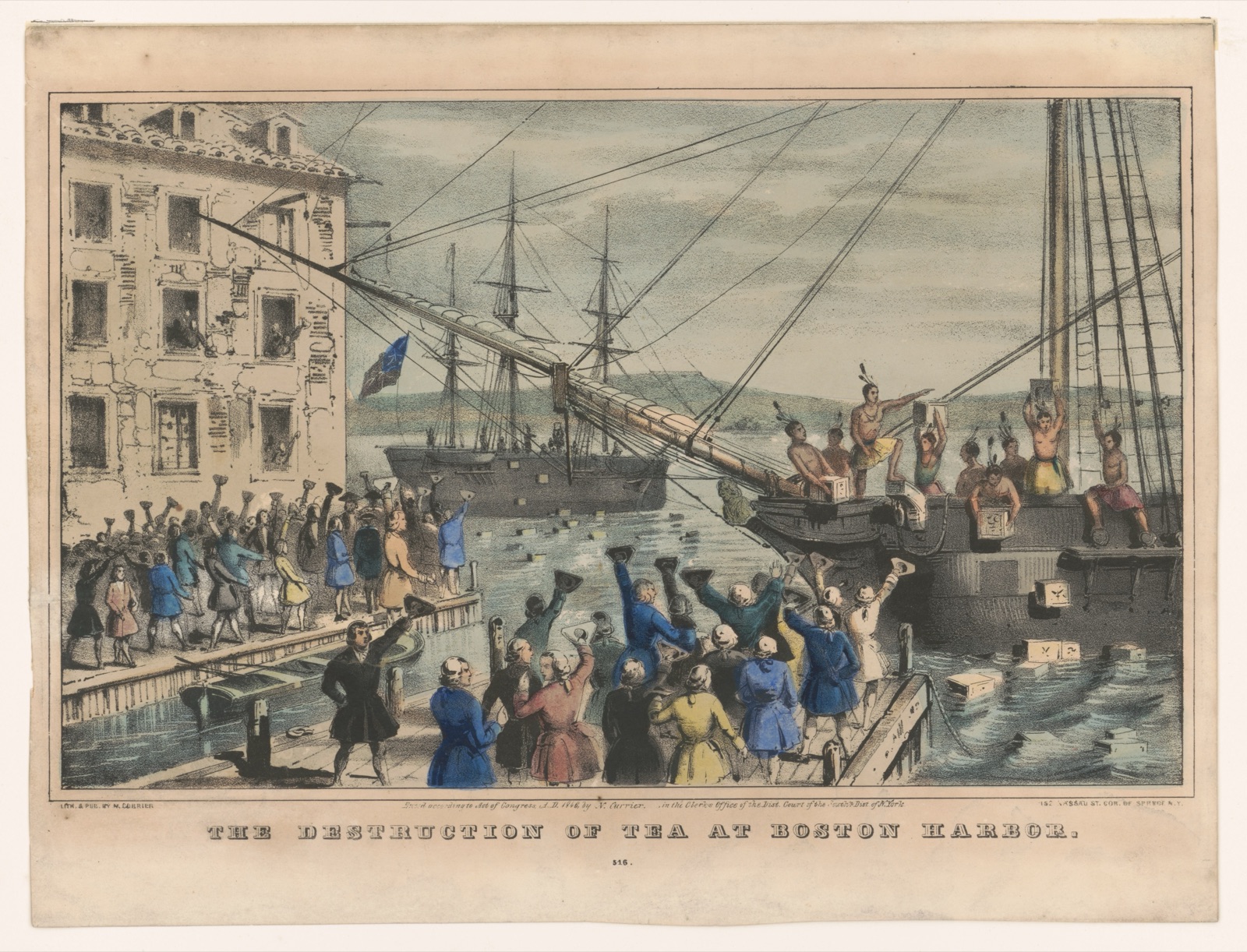
What happened next took about three hours and was, for a riot, astonishingly orderly. Beginning around six or seven in the evening on Thursday, 16 December 1773, parties of men boarded all three ships at Griffin's Wharf, broke open the holds, hauled the chests up on deck, split them with hatchets, and tipped the tea and the broken chests into the harbor, where the low tide left it heaped in the shallows. When it was done they had destroyed more than 340 chests (the traditional figure is 342; the three ships' manifests of 114, 114, and 112 add up to 340), over 92,000 pounds of tea, around 46 tons, worth £9,659 in the money of the day, a fortune poured into the sea.
The men who did it wore a disguise, and it needs handling with some care, because it is so often gotten wrong. They wrapped themselves in blankets worn like coats, smeared their faces dark with soot and lampblack (a fine black pigment), and carried hatchets they called tomahawks, costuming themselves loosely as "Mohawks." This was not an attempt to fool anyone into thinking actual Mohawk people had done it, and no Mohawks were anywhere near Boston; everyone present knew perfectly well who these men were, neighbors all. The disguise hid individual faces, because what they were about to do was a hanging-level crime against property the Crown protected, and it carried a meaning besides: to costume yourself as a person of this continent, an American, rather than a Briton. Many were not men of standing but young apprentices and journeymen, sixteen of the documented participants still in their teens. Estimates of how many took part run from thirty or so core organizers up to a hundred and thirty or more once volunteers from the meeting joined in; about 116 are documented by name, though that count leans heavily on claims and family memories recorded long after.
The discipline is the part that lasted, and it was deliberate. Nothing but the tea was touched. There was no looting and no damage to the ships, and the men swept the decks clean when they finished. The organizers knew that a looting riot would have squandered the whole point of the act, turning a stand on principle into common theft and handing London exactly the lawless mob it wanted to see. So when one man tried to stuff tea into the lining of his coat to keep, the others stripped it off him and roughed him up: this was destruction, not theft. One padlock got broken, a ship captain's private property, and a replacement was sent to him the next day. No one was killed; the only real injury was to a man named John Crane, knocked cold by a falling crate and at first taken for dead, who came around later. Every man there swore himself to secrecy, a vow most of them kept for decades and many to the grave; only one participant was ever even arrested, and no one was ever convicted.
The strangest detail is what did not happen. Royal Navy warships lay close by in the harbor, well within range, and watched the whole thing without firing a shot. No order came to attack townspeople committing what was, on the surface, three hours of vandalism in a crowded port. One participant remembered it six decades later: "We were surrounded by British armed ships, but no attempt was made to resist us."
Then there was no other Alternative but to destroy it or let it be landed. — John Adams, diary, 17 December 1773
John Adams wrote that the next morning, and it shows how even a cautious, lawyerly patriot squared the destruction with himself. Landing the tea, he reasoned, meant "giving up the Principle of Taxation by Parliamentary Authority, against which the Continent have struggled for 10 years," and the ships could not get past the fort and the warships to take it home, so there was nothing else for it. He did not flinch from what had been done; he exulted in it, calling it "the most magnificent Movement of all" and "an Epocha in History" (his spelling of epoch). That a man as careful as Adams reached for words like majesty and sublimity over the destruction of private property tells you how completely the principle had come to outweigh the property.
But it did not look that way to everyone, and the disapproval was not only English. To many Americans this was simply a town destroying a private company's goods and then refusing to pay for them, a crime dressed up as a cause. Benjamin Franklin, no friend of the tea tax, thought Boston ought to make good the loss out of its own pocket, and plenty of moderate colonists agreed that a stand on principle did not license the wrecking of property. The destruction had shocked the colonies' friends almost as much as their enemies.
One thing nobody called it that night was the Boston Tea Party. To the people who did it and the people who heard about it, it was "the destruction of the tea." The jaunty name we use would not show up in print for another fifty years or so, in the 1820s or 1830s, long after the men who did it were old or gone.
The other ports
Boston was not the rule. It was the exception, and the difference is the whole point: the same company tea went to four ports, and only in Boston was any of it destroyed, because only in Boston did the consignees refuse to resign and the governor refuse to bend. The other three cities show what the normal outcome looked like.
In Charleston the ship London arrived on 2 December 1773. The consignees were pressured into resigning, and when the twenty days ran out with nobody to claim the tea, the customs collector seized the 257 chests for non-payment and locked them in the cellars of the Exchange building. There they sat until the revolutionary government later sold the tea off to help fund the cause. No harbor, no hatchets.
In Philadelphia the Polly came up the Delaware in late December with a much larger load, 697 chests, but a committee had warned off the river pilots and the captain with handbills promising to tar and feather anyone who helped land the tea. A mass meeting of perhaps eight thousand people on 27 December, one of the largest gatherings the colonies had yet seen, resolved that the tea would not land; the consignees had already quit. Captain Ayres took the hint, reprovisioned, and sailed the Polly and all her chests straight back to England.
New York's turn came late, because its tea ship had been blown off course. The Nancy did not reach Sandy Hook until 18 April 1774, by which time her consignees had resigned months earlier, and her captain was persuaded, under threat, to turn around for England without unloading. A few days later another ship arrived claiming to carry no tea at all, but New Yorkers found 18 chests the captain was smuggling in on his own account and dumped those in the harbor, a small New York tea party of its own. The pattern, in three cities out of four, was resignation and turn-back. Boston became the flashpoint not because Bostonians were braver but because Hutchinson and his consignee sons had made retreat impossible there.
Parliament's answer
News of the destruction reached London in January 1774, and it landed badly even with the friends of America. This was not a tax to argue over; it was the wanton destruction of a private company's property by a town that then declined to pay for it. Lord North's government resolved to make an example, not of all the colonies, but of Boston and Massachusetts specifically, to cut the radicals off.
It began with Franklin, the most prominent American in London and lately exposed as the man who leaked Hutchinson's letters. Two days after the news broke, on 29 January 1774, he was made to stand for the better part of an hour in the chamber of the Privy Council (the King's senior advisory council, the most powerful body in Britain) known as the Cockpit, while the Solicitor-General, Alexander Wedderburn (the Crown's senior lawyer), flayed him before a packed and jeering audience. Wedderburn called Franklin a "true incendiary" and named him the "first mover and prime conductor of this whole contrivance." The room laughed and applauded as the abuse landed, and Franklin stood through all of it without changing his face. The next day the government stripped him of his post as deputy postmaster-general for North America, a paid Crown appointment that had put one of America's most famous men on the British government's own payroll. He wrote later: "I made no justification of myself, but held a cool, sullen silence, reserving myself to some future opportunity." The man humiliated in the Cockpit had come to London as one of the empire's great believers in itself; he did not stay one.
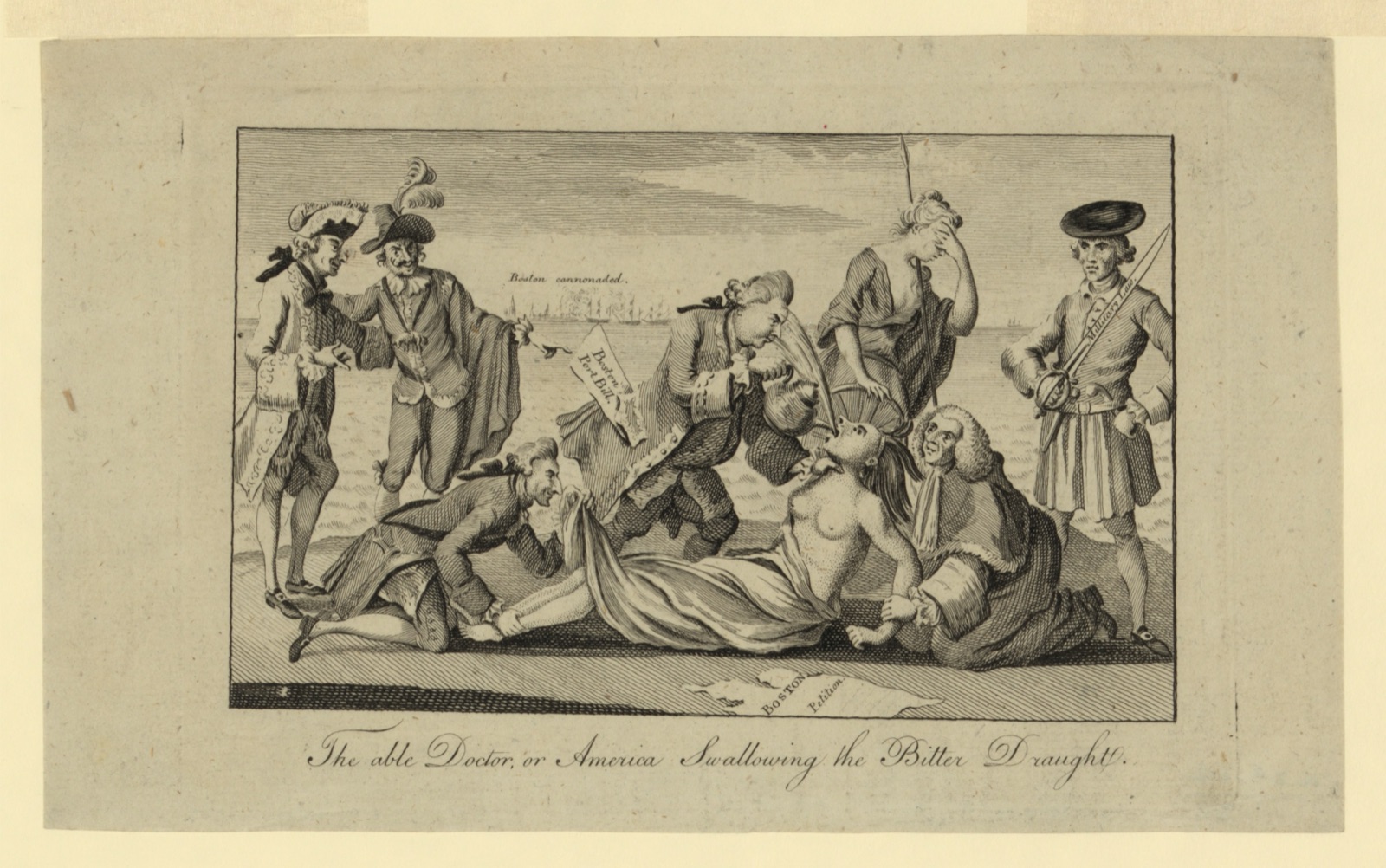
Then came the laws. Across the spring of 1774 Parliament passed a series of acts to punish Boston and bring Massachusetts to heel, what Americans would later come to call the Intolerable Acts (the men who passed them called them the Coercive Acts, and that is what they were in 1774). They came one at a time.
The Boston Port Act, given royal assent on 31 March 1774 and in force from 1 June, closed the port of Boston outright. No ship could load or unload there until the town paid the East India Company and the customs for the destroyed tea and the King was satisfied that order had returned; customs business was moved up the coast to Salem and Marblehead. The Act passed the Commons without even a recorded vote against it and the Lords unanimously, a measure of how completely British opinion had turned against Boston.
Next, and far larger, came the Massachusetts Government Act of 20 May 1774, which went after something bigger than a harbor: it rewrote the colony's charter (the Crown-issued document that legally guaranteed Massachusetts its form of self-government), the 1691 grant that had governed the province for over eighty years. The Council, the upper house of the legislature, had been elected; now the Crown would appoint it. Judges, sheriffs, and most officials would be appointed by the governor, juries would be summoned by those appointed sheriffs, and town meetings, the bedrock of New England self-government, were limited to one a year unless the governor granted permission for more. This was the Act that frightened the other colonies most. Boston could be told it had earned its punishment by destroying property; but if Parliament could simply abolish the elected government of one colony by a vote in Westminster, it could abolish any colony's, and no charter anywhere was safe.
The Administration of Justice Act, also of 20 May 1774, let the governor move the trial of a royal official charged with a capital crime, committed while putting down a riot or enforcing the revenue laws, to another colony or to Britain. On its face it was a fair-trial measure for officials who could not get an impartial hearing locally. Colonists read it the other way around and called it the "Murder Act," the charge being that a royal official could now kill a colonist and be whisked away to a friendly court where no local jury would ever judge him.
The Quartering Act of 1774, on 2 June, applied to all the colonies and let a governor take over unoccupied buildings to house troops when the barracks would not serve. The schoolbook image of redcoats billeted in people's parlors is wrong: this Act reached empty buildings, not occupied homes.
And then there was the Quebec Act, which received royal assent on 22 June 1774 and was not actually part of the punishment at all. It was a long-planned settlement for the formerly French Canada that Britain had conquered, and on its own terms it was a tolerant one: it allowed the free practice of Catholicism, restored French civil law (which meant no jury in civil cases), set up government by an appointed council with no elected assembly, and extended Quebec's boundary south and west to the Ohio and Mississippi rivers, over land that Virginia and other colonies claimed for themselves. From Canada's side it was a generous accommodation of a conquered people. To American Protestants it read as three insults stacked together: a Catholic Church on their border, a colony with no elected assembly, and a land-grab swallowing the west they wanted. Because it came out of the same session as the punishments, the colonists simply lumped it in with them as a fifth Intolerable Act, whatever Parliament had intended by it.
Boston under the blockade, and the call that followed
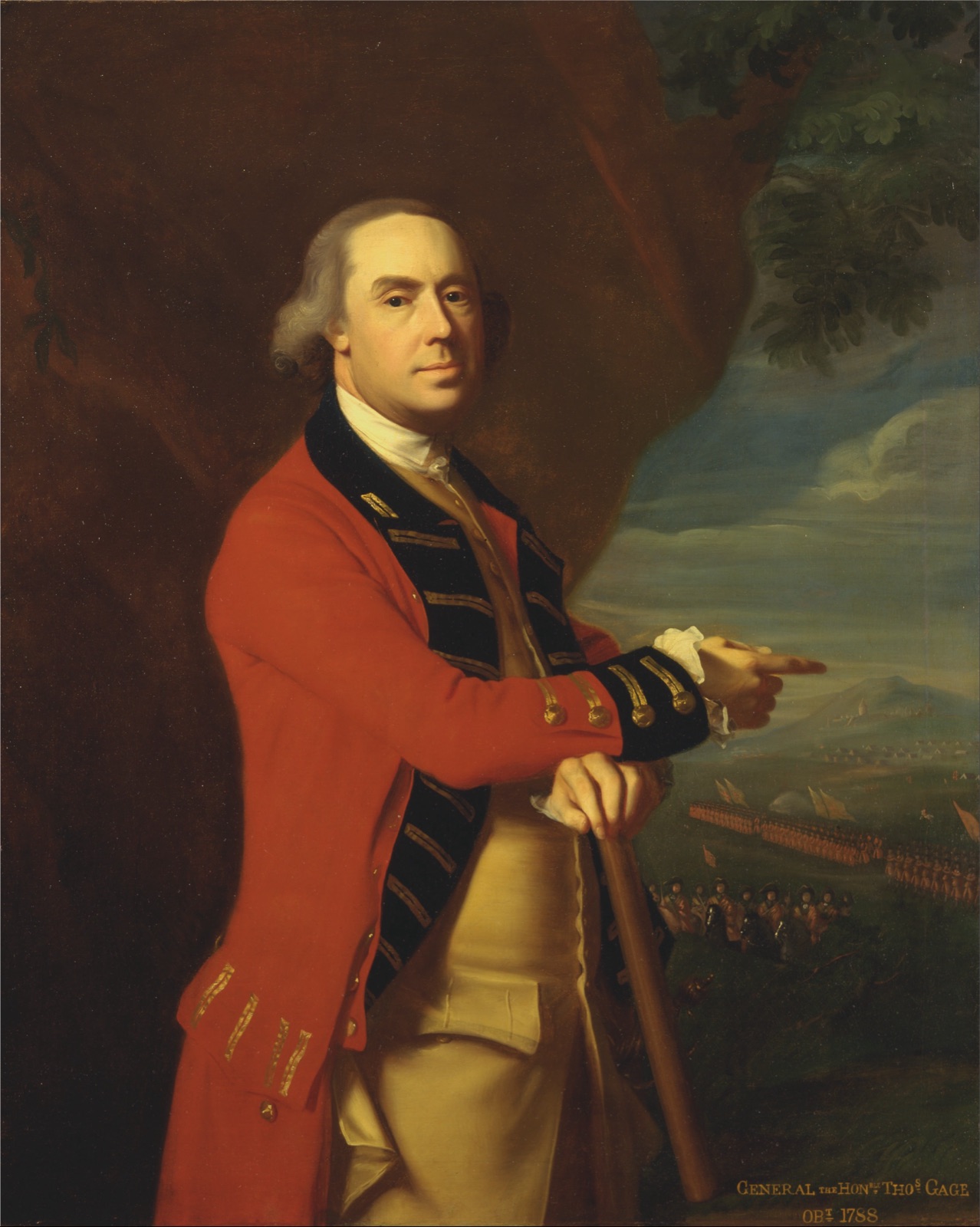
To enforce all this, London changed who ran Massachusetts. On 13 May 1774 General Thomas Gage, the commander-in-chief of the British army in North America, landed in Boston as the colony's new royal governor: a general where a civilian had been, which told the town exactly what kind of government it was now under. Thomas Hutchinson, who had refused the pass and held the line through the whole tea crisis, sailed for England on 1 June, and never saw America again.
That same 1 June the Boston Port Act took effect and the Royal Navy sealed the harbor. The day was marked across the colonies as a day of mourning, with fasts, tolling bells, and flags at half-mast, not just in Boston but in towns that had never seen a tea ship. Gage moved the seat of government up to Salem as the Act required, and Boston, a port city whose whole life ran through its wharves, was cut off from the sea.
And here the punishment did the opposite of what it was designed to do. It had been meant to isolate Boston and frighten the other colonies into keeping their distance; instead the committees of correspondence, built two years earlier for exactly this moment, carried Boston's appeal out across the continent, and relief came pouring back in, overland and through Marblehead, the legal landing point, for Boston's Committee of Donations to distribute: grain and rye and corn by the thousands of bushels, rice from South Carolina, sheep and cattle driven down from Connecticut and across New England, flour, fish, and money. By the end of the year more than a hundred relief shipments had arrived. A town that London had tried to make a cautionary example of was instead being fed by every colony that watched it happen, and every colony had noticed that a Massachusetts-wide demolition of self-government could just as easily come for them.
So the colonies began, separately and then together, to reach for the one answer big enough to meet a continental threat: a meeting of them all. In Virginia, the royal governor dissolved the House of Burgesses, ordering it to stop meeting, on 26 May for daring to declare a day of fasting in sympathy with Boston. The next day the burgesses walked down to the Raleigh Tavern in Williamsburg and proposed an annual congress of all the colonies, and the committees carried the idea from colony to colony through the early summer.
In Massachusetts it came to a head behind a locked door. On 17 June 1774 the House, meeting in Salem, took up the question of sending men to such a congress. Gage got wind of it and sent the province secretary, Thomas Flucker, with a proclamation dissolving the assembly before it could act, but the House had the door locked. Flucker stood on the stairs outside and read the dissolution to a door that would not open, while inside the members went ahead and voted: five delegates, Thomas Cushing, Samuel Adams, John Adams, Robert Treat Paine, and James Bowdoin, to meet the other colonies at Philadelphia that September. The order to disband had arrived too late, and a closed door had kept it out just long enough.
The delegates would gather in Philadelphia in the fall. What they would do once they got there was, that summer, anyone's guess.