Yorktown did not end the war. It ended Britain's appetite for it, which is a different thing.
When Cornwallis surrendered his army in Virginia in October 1781, he handed over one field army of seven or eight thousand men. Britain still had the rest. Its garrisons sat in New York City, Charleston, and Savannah; it held Canada, Nova Scotia, and East Florida; it had the largest navy in the world, tens of thousands of troops across its North American posts, and no military reason it had to quit. The war was lost politically, not annihilated on the field, and for two more years the fighting actually went on, some of its ugliest after Yorktown, not before. There was nothing inevitable about the ending. Britain stopped because Britain decided to stop.
The terms the Americans got in Paris were astonishing. But the country those terms created came with costs paid by people who never sat at the negotiating table: the Loyalists, the Native nations, the enslaved, the unpaid soldiers, and some twenty-five thousand of the dead. The treaty is where you read, article by article, who was about to pay for the victory.
The frontier kept bleeding
The two years between Yorktown and the final treaty were not quiet. On the frontier they were among the bloodiest of the whole war.
In March 1782, Pennsylvania militia under Colonel David Williamson rode into the Moravian mission town of Gnadenhutten in the Ohio country and murdered ninety-six unarmed Christian Delaware, pacifists who had taken no side, men and women and children, and no one was ever punished for it. Five months later a British, Loyalist, and Native force ambushed a column of pursuing Kentucky militia at the Licking River and killed about seventy of them in minutes at a place called Blue Licks; among the dead was Israel Boone, the son of Daniel Boone, who was there and had warned against the rash pursuit. That was nearly a year after Yorktown. The native-nations chapter tells both stories in full. The timing is the point: the surrender that supposedly ended the war did nothing to stop the killing on the western edge of it.
And here is the thing the schoolbook version leaves out: while Britain was losing the American war, it was winning its world war. The Revolution had pulled in France, then Spain, then the Dutch, turning a colonial rebellion into a global contest, and in that wider war, 1782 went Britain's way. In April, off the islands called the Saintes near Guadeloupe, Admiral Sir George Rodney shattered a French fleet under the Comte de Grasse, the same admiral whose ships had sealed Yorktown the year before; de Grasse's flagship surrendered with de Grasse himself captured aboard, and the planned invasion of Jamaica was finished. In September, at Gibraltar, Spain and France threw the full weight of their siege at the British garrison with ten purpose-built floating batteries, engineered to be fireproof and unsinkable, carrying more than five thousand men. The defenders fired red-hot shot into them and burned all ten. Gibraltar, besieged since 1779, never fell.
So picture the British position in the autumn of 1782. The fleet had just won in the Caribbean, the Rock had just held, the sugar islands and India and Gibraltar were secure, and only the American piece of the war was lost. Letting the thirteen colonies go was not a military collapse. It was a calculation made in the House of Commons: cut the one unwinnable war, keep everything still winning. The war had also been ruinously expensive, the national debt roughly doubled across it, and a generation earlier the previous Treaty of Paris, the one that ended the French and Indian War in 1763, had opened with exactly this problem, a victorious empire staring at its own bill. Britain had been here before.
London turns
The news of Yorktown reached London on the last Sunday of November 1781. Lord George Germain, the minister responsible for the American war, carried it straight to the prime minister, Lord North, at Downing Street.
How North took it comes down to us through a chain worth naming, because the scene is famous and the sourcing is not airtight. The diarist Sir Nathaniel Wraxall asked Germain how the prime minister had reacted. As Germain told the story, North took the news "as he would have taken a ball in his breast," threw open his arms, and paced the room crying out "O God! it is all over!" again and again. Wraxall wrote it down decades later, in memoirs he published in 1815. So this is North's reaction as remembered by the man he told it to, retold long after by a memoirist with a flair for a scene. Probably close to true, but not a transcript.
King George III took it differently. Where North wanted out, the king wanted to fight on; his first note acknowledged "the deepest concern" at the disaster in Virginia and showed no intention of quitting at all.
The Commons made the choice for both of them. The Commons is the lower house of Parliament, where a government survives only as long as it holds a majority of votes there. In February 1782 a motion against continuing offensive war in America failed by a single vote, then passed a few days later, 234 to 215, the House formally resolving against the further prosecution of offensive warfare on the continent. On 20 March 1782, North stood up in the Commons and announced his resignation rather than lose a no-confidence vote he knew was coming. A no-confidence vote is a formal motion declaring that Parliament has lost faith in the government; once it passes, the ministry has to resign. North had been prime minister for twelve years, and his was the first British government ever effectively brought down this way, by a House that had simply withdrawn its support.
The king took it harder than North did. Around the end of March he drafted an abdication message. Finding himself unable to conduct the war "with effect" or get any acceptable peace, it read, "His Majesty therefore with much sorrow finds he can be of no further utility to his native country which drives him to the painful step of quitting it for ever." He never sent it. But he wrote it, which tells you how hard losing America landed on him. He was not a cartoon tyrant shrugging off a colony; he was a king who briefly contemplated giving up his throne over it.
The man who took over the peace was the Earl of Shelburne, after a short-lived ministry under the Marquess of Rockingham, the man who had repealed the Stamp Act back in 1766 (Chapter 2), died that summer. A ministry is the cabinet, the prime minister and his senior ministers, who govern as a bloc and fall together; when Rockingham's broke, Shelburne formed the next one. Shelburne's view of American independence explains why the Americans got terms as generous as they did.
He did not see independence as a catastrophe to be minimized. He saw it as an opportunity. Britain, he reasoned, could keep the profits of America, its trade, without the costs, the garrisons and the governors and the wars. The new republic was going to be a customer, and a generous boundary, handing the Americans the whole interior west to the Mississippi, was the way to bind that customer to British commerce and pry it loose from France. The new free-trade thinking of the age, the world of Adam Smith's Wealth of Nations, ran in exactly this direction. So the generosity in the treaty that is coming was not sentiment. It was strategy: keep the sugar islands and India and Gibraltar, which paid, and concede the continental interior to a country you intended to sell to for the next century.
The negotiators and the Vergennes problem
Congress had named five commissioners to make the peace, official envoys empowered to negotiate and sign, and four of them ended up signing. Benjamin Franklin was in Paris throughout, the senior man and the one the British wanted to deal with. John Jay arrived from his frustrating posting in Madrid in June 1782. John Adams came down from the Netherlands in late October. Henry Laurens reached Paris two days before the preliminary articles were signed; captured at sea in 1780, he had spent more than a year in the Tower of London, the only American ever held there, and had been exchanged for Cornwallis himself. The fifth, Thomas Jefferson, was appointed but never crossed the Atlantic in time; his earlier appointment had lapsed amid his wife's illness and death, and when he was named again his sailing was held up until word came that the deal was already done.
On the British side, the preliminaries were negotiated by Richard Oswald, an elderly Scottish merchant who knew America well and was chosen by Shelburne precisely because he would be a congenial channel to Franklin; the definitive treaty the next year was signed for Britain by David Hartley, a member of Parliament, a longtime friend of Franklin, and a steady opponent of the war. One dry detail: Oswald had grown rich partly in the Atlantic slave trade, and Laurens, formerly one of the largest slave merchants in America, had been his Charleston associate, so both sides' peacemakers had slave-trade money on their hands. That was the company the table kept.
Now the part where the Americans broke their orders. Congress, desperate for French support after the military disasters of 1780, had sent its commissioners instructions in June 1781 that put them on a very short leash. They were "to undertake nothing in the negotiations for peace or truce without their knowledge and concurrence," the they being the French, "and ultimately to govern yourselves by their advice and opinion." The only things Congress treated as non-negotiable were independence and the French alliance; everything else, the commissioners were to clear with Versailles, where the Comte de Vergennes, France's foreign minister, ran the war and the diplomacy from the king's court outside Paris.
They did not. From the fall of 1782 the Americans negotiated their terms directly with Oswald without telling Vergennes what those terms were and without asking his advice. That was a flat violation of the June 1781 instructions, and it should be stated plainly: Franklin, Jay, and Adams were not following their orders, and they knew it. The man who pushed hardest for going around the French was Jay, and his reason was a suspicion.
That September, Vergennes's under-secretary, a man named Rayneval, slipped off to England in secret under a false name. Jay got wind of it and concluded that France was about to sell American interests short, working out a deal with Britain and Spain to hem the new republic in east of the mountains, since Spain badly wanted to keep the Americans away from the Mississippi. So Jay, without Franklin's agreement, sent his own back-channel messenger to London to tell Shelburne that Britain's real interest lay in a fast, generous, direct deal with the Americans alone. The honest version: Jay's suspicion was real and consequential, but probably overdrawn. Rayneval's errand was mostly about Franco-Spanish business, Gibraltar above all, not about carving up America. Jay was partly right in spirit, since France was certainly not fighting for American maximalism, and partly chasing a thinner conspiracy than he thought.
Here is the precise thing they did and did not do. They negotiated and signed without French knowledge of the terms, which broke their instructions. But the document they signed was a set of preliminary articles, meaning provisional terms that would take effect only once a general peace was reached, and they were written to be explicitly conditional on Britain and France settling first. The preamble said the treaty was "not to be concluded untill terms of a peace shall be agreed upon between Great Britain and France." So it was not a separate peace in the legal sense; the 1778 alliance's pledge that neither ally would make a separate peace was bent in spirit, not broken in letter. Both halves are true: a real violation of their orders, wrapped inside a document carefully built so it could not jump ahead of France.
Vergennes's reaction was not rage. He was struck less by betrayal than by how much the Americans had extracted. "The English buy peace rather than make it," he marveled. His formal protest, sent to Franklin that December, reproached the commissioners mostly for the discourtesy of shipping the articles off to America without informing the French court.
What Franklin sent back took nerve. He showed the draft to Adams, Jay, and Laurens, who unanimously told him to send it, and then he sent it. "Nothing has been agreed in the Preliminaries contrary to the Interests of France," he wrote, "and no Peace is to take Place between us and England till you have concluded yours." He conceded the commissioners had neglected a small point of propriety. And then he turned the knife with perfect calm: "The English, I just now learn, flatter themselves they have already divided us. I hope this little Misunderstanding will therefore be kept a perfect Secret, and that they will find themselves totally mistaken." Do not let the British see daylight between us, because that is exactly what they are hoping for.
The English buy peace rather than make it. — the Comte de Vergennes, 1782
And then the part that proves it worked. Vergennes accepted the apology, and France extended a fresh loan of six million livres in 1783, livres being the French currency of the day; the first money crossed the Atlantic on a ship that also carried the preliminary articles home to Congress. The foreign minister who had just been cut out of the deal financed its delivery.
The terms, article by article
The preliminary articles were signed on 30 November 1782; the definitive treaty that made them final was signed the following September, its terms nearly identical. There were ten articles. Here is what they actually said.
Article 1 acknowledged independence, and it did so one state at a time. "His Brittanic Majesty acknowledges the said United States," it read, and then it named them, "New Hampshire, Massachusetts Bay, Rhode Island and Providence Plantations, Connecticut, New York, New Jersey, Pennsylvania, Maryland, Virginia, North Carolina, South Carolina and Georgia, to be free sovereign and independent states." The king recognized thirteen states, listed individually, not one nation, the plural a legal self-portrait that was an argument about what the United States even was, and one that would not be settled for eighty more years.
Article 2 drew the boundaries, and they were enormous. The line ran from the highlands of the northeast, down the 45th parallel, through the middle of the Great Lakes, west to the Mississippi, and down the middle of the Mississippi to roughly the line of Florida. The new republic got everything from the Atlantic to the Mississippi and from the Great Lakes to the edge of Florida, roughly doubling the territory the thirteen states actually occupied. That land was full of nations who had not surrendered it and were not consulted. Almost all of the new half was Native homeland, which we will get to, because that is the single largest item on the bill.
Article 3 was John Adams's crusade, and it turned on one carefully chosen word. Americans would "continue to enjoy unmolested the right to take fish" on the open ocean banks off Newfoundland, "unmolested" meaning without interference from British patrols, but would have only the "liberty to take fish" along the coasts and to dry their catch on the unsettled shores of Nova Scotia and Labrador. A right is held; a liberty is a permission, and a permission can be revoked. Adams, New England's man, fought this distinction to the final session and counted the fisheries among the great services of his life, and the line between right and liberty would feed Anglo-American fishing quarrels for decades.
Article 4 said creditors "shall meet with no lawful impediment to the recovery of the full value in sterling money of all bona fide debts heretofore contracted." In practice that meant British merchants could sue Americans, mostly southern planters, for prewar debts. The states obstructed it for years; it became one of the two great broken promises of the treaty.
Article 5 was the Loyalists' article, and it was designed to be toothless. Congress, it said, "shall earnestly recommend it to the legislatures of the respective states" to restore the confiscated estates of the Loyalists. Recommend was the whole trick, because Congress had no power to compel the states, and every negotiator on both sides knew the recommendation would be ignored. The British needed the words to show Parliament they had not simply abandoned the king's friends; the Americans gave them the words and nothing behind them. When the peace reached London, British critics savaged this article as exactly what it was, the abandonment of the Loyalists, and the fury over it helped bring Shelburne's own government down a few months later.
Article 6 promised no future confiscations and no future prosecutions "for, or by reason of, the part which he or they may have taken in the present war," the forward-looking half of the Loyalist settlement, flouted in the first postwar years about as widely as Article 5.
Article 7 ordered the war ended and the British armies withdrawn, and folded into it were eleven words about human beings. The British, it said, would leave "without causing any destruction, or carrying away any Negroes or other property of the American inhabitants." Henry Laurens, who had reached Paris two days earlier, procured that clause on the day of the preliminary signing; it was interlined into the document, and the witnesses' notes record the insertion. It is a slaveholder's clause, doing its work in a single grammatical move, classing people as "property" alongside furniture and livestock. The British commander in New York, Sir Guy Carleton, refused to apply it backward: people already freed by British proclamation, he held, were not "property of the American inhabitants" to be handed back, and in declining, freed them. The slavery chapter tells that whole confrontation; here it is enough to hold the three things together, the treaty text, the man who slipped the clause in, and the general who declined to honor it the way the slaveholders wanted.
Articles 8, 9, and 10 were the housekeeping: the Mississippi would "forever remain free and open" to British subjects and American citizens; conquests made before news of the peace arrived were to be handed back without compensation; and ratifications, the formal final approval by each government that turns a signed draft into a binding treaty, were to be exchanged within six months of the definitive treaty's signing, a clock that would nearly embarrass Congress.
There was also a secret. The 30 November preliminaries carried a separate article, kept hidden from France: if Britain ended the war still holding West Florida, the boundary between West Florida and the United States would run farther north than the line offered to Spain. It never came to anything, because Spain kept the Floridas, the two Florida colonies, East and West, that Spain and Britain were dividing between them, but the commissioners had signed it behind their ally's back, and when the packet reached America it caused real discomfort.
The American treaty was only one of several signed the same day; Britain settled separately with France and Spain at Versailles. Spain took East Florida, kept West Florida and Minorca, and got nothing on Gibraltar, which the siege's failure had made non-negotiable. France got the island of Tobago and the post of Senegal, and a mountain of debt that historians have been pointing toward 1789 ever since. The boundary muddle in the Floridas, left vague, would poison relations between the United States and Spain for years.
Signed, sealed, ratified
The preliminary articles were signed on 30 November 1782 by Oswald for Britain and by Adams, Franklin, Jay, and Laurens for the United States, conditional, by their own terms, on Britain and France settling. Britain, France, and Spain signed their own preliminaries that January, and the guns fell silent.
The definitive treaty was signed on Wednesday, 3 September 1783. Not at Versailles, where the great powers had signed theirs, but in a hotel room on the Left Bank of Paris, the lodgings of David Hartley at the Hôtel d'York, by Hartley, Adams, Franklin, and Jay; Laurens was not there. A deliberately ordinary room for the independence of a new country, signed across a table in rented lodgings.
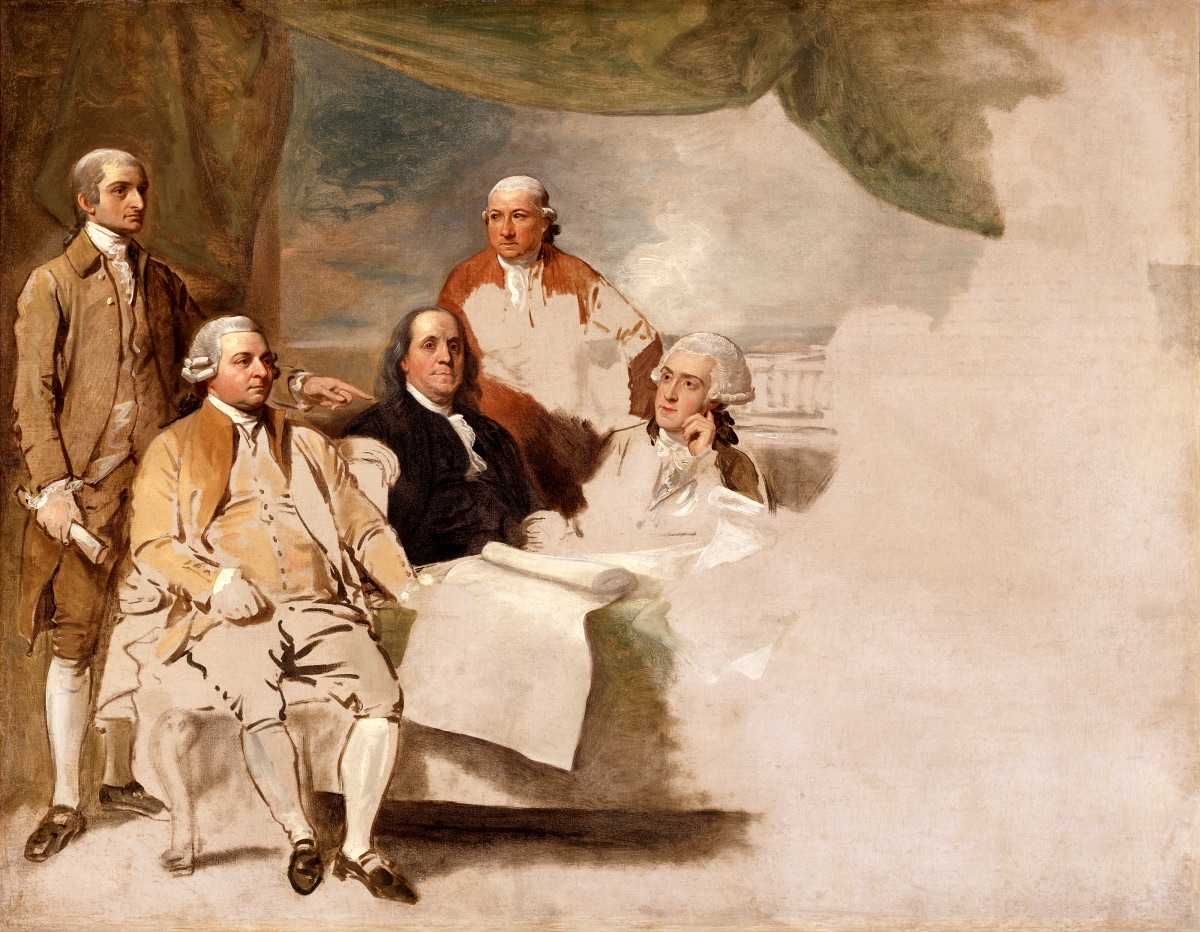
There is a painting of the men who made the preliminary deal, and it tells the truth precisely because it was never finished: the British side is blank because Oswald and his secretary refused to pose for a picture of their own defeat. Benjamin West, the Pennsylvania-born artist who was at that moment also the history painter to George III, began a group portrait of the peacemakers. The American side is done: Jay, Adams, Franklin, Laurens, and Franklin's grandson William Temple Franklin, the commission's young secretary, all sit finished on the canvas. The right half, where the British negotiators were supposed to sit, is bare. Richard Oswald and his secretary Caleb Whitefoord refused to pose, and West never finished it.
Then the treaty had to come home and be ratified, and it nearly did not make it in time. A treaty needed the approval of nine states, and through the winter of 1783 and into 1784 Congress, meeting in the Old Senate Chamber of the Maryland State House at Annapolis, could not get nine delegations into the room at once. The delegates were scattered, and Jefferson insisted, against those who wanted a shortcut, that nine states were constitutionally required and seven would not do. The arrival of one delegate from South Carolina finally completed the ninth delegation, and on 14 January 1784 Congress ratified unanimously, uncomfortably close to the six-month deadline. The ratification crossed the Atlantic late, the formal exchange in Paris did not happen until May, and the deadline was technically blown, which nobody by then was inclined to make anything of.
Who paid
Vergennes, the French foreign minister who had been cut out of the deal, was right that the English had bought peace rather than made it. But a peace that good for the men in the room was paid for by people who were never in it.
The Loyalists paid first, the colonists who had stayed loyal to the Crown. Around sixty thousand of them left the new United States rather than live in it, carrying roughly fifteen thousand enslaved people, scattering to Canada, the Caribbean, and Britain. Article 5's "earnest recommendation" produced almost nothing from the states, so the Loyalists who got anything got it from Britain: Parliament set up a claims commission that examined more than three thousand claims and paid out, over years, on the order of three million pounds, Britain compensating its own refugees for a treaty article it had agreed to let die. The civil-war chapter follows them into exile.
The Native nations paid the largest share, and the treaty paid them the cleanest insult available, which was silence. It contains no Native signatories, no Native provisions, and no mention of Native nations anywhere in its ten articles. Britain signed away the entire trans-Appalachian West, the homeland of the Haudenosaunee, the Six Nations of the Iroquois Confederacy, along with the Shawnee, the Delaware, the Cherokee, and dozens of other nations, many of them Britain's own wartime allies, without telling them, consulting them, or naming them. The nations the treaty erased were not defeated at any Paris table; the land transfer was a fiction performed entirely by the people who wanted the land. The United States then treated the handed-over country as conquered and, in 1784, at a post called Fort Stanwix, forced a punitive land-cession treaty on the Haudenosaunee. The native-nations chapter carries that forward. The single strongest sentence in the whole treaty is the one that is not in it.
The enslaved paid in two directions at once, some winning their freedom and some losing it, depending on which way the ships were sailing. At New York the British registered around three thousand Black refugees and carried them away to freedom over loud American protest, the people Carleton, the British commander in New York, had refused to apply Article 7 backward to, since they had already been freed. From Savannah and Charleston the year before, they had already carried off far larger numbers, several thousand at each port, but most of those were carried away still enslaved, the human property of departing Loyalists. And Article 7's eleven words had a fifty-year afterlife: American slaveholders' compensation demands poisoned relations between the two countries for decades, recurred after the War of 1812, went to the Tsar of Russia for arbitration, and were settled only in 1826, when Britain paid the United States more than a million dollars for people it had freed in the second war.
The soldiers paid in worthless paper. The army that had won the war was sent home beginning in the summer of 1783 with three months' pay and final-settlement certificates, paper promises of money owed. To a man walking home broke, with no farm waiting and no cash in his pocket, a certificate that might be honored someday was worth less than a meal today, so most of them sold the paper to speculators for a fraction of its face value and took whatever they could carry. The army chapter tells what those men were owed and how little they got. The line on the bill is short: the country could not pay the soldiers who had made it.
And then the dead. The standard scholarly count puts American military deaths at around twenty-five thousand, from battle, from the camp diseases that killed more men than any battle, and from the prison ships in New York harbor where men died by the thousands in the dark. Some twenty-five thousand, and probably more, with higher estimates running well above that; and on top of the soldiers sit the uncounted dead, the Patriot civilians, the Loyalist dead, the British and German dead, the Native dead, most of whom no one ever tallied. Twenty-five thousand was about one percent of a population of two and a half million. Put as a share of the people alive to die, the Revolution was the deadliest war in American history except for the Civil War. That is the honest form of the claim, and it is grim enough without rounding up.
The endings
The British left in stages. Savannah went first, in the summer of 1782, the garrison and officials and Loyalists and their enslaved people sailing for St. Augustine and the West Indies and New York. Charleston followed in December, more than four thousand Loyalist civilians and over five thousand people of African descent carried out. New York, the largest and the last, did not empty until the end of 1783, almost two full years after Yorktown.
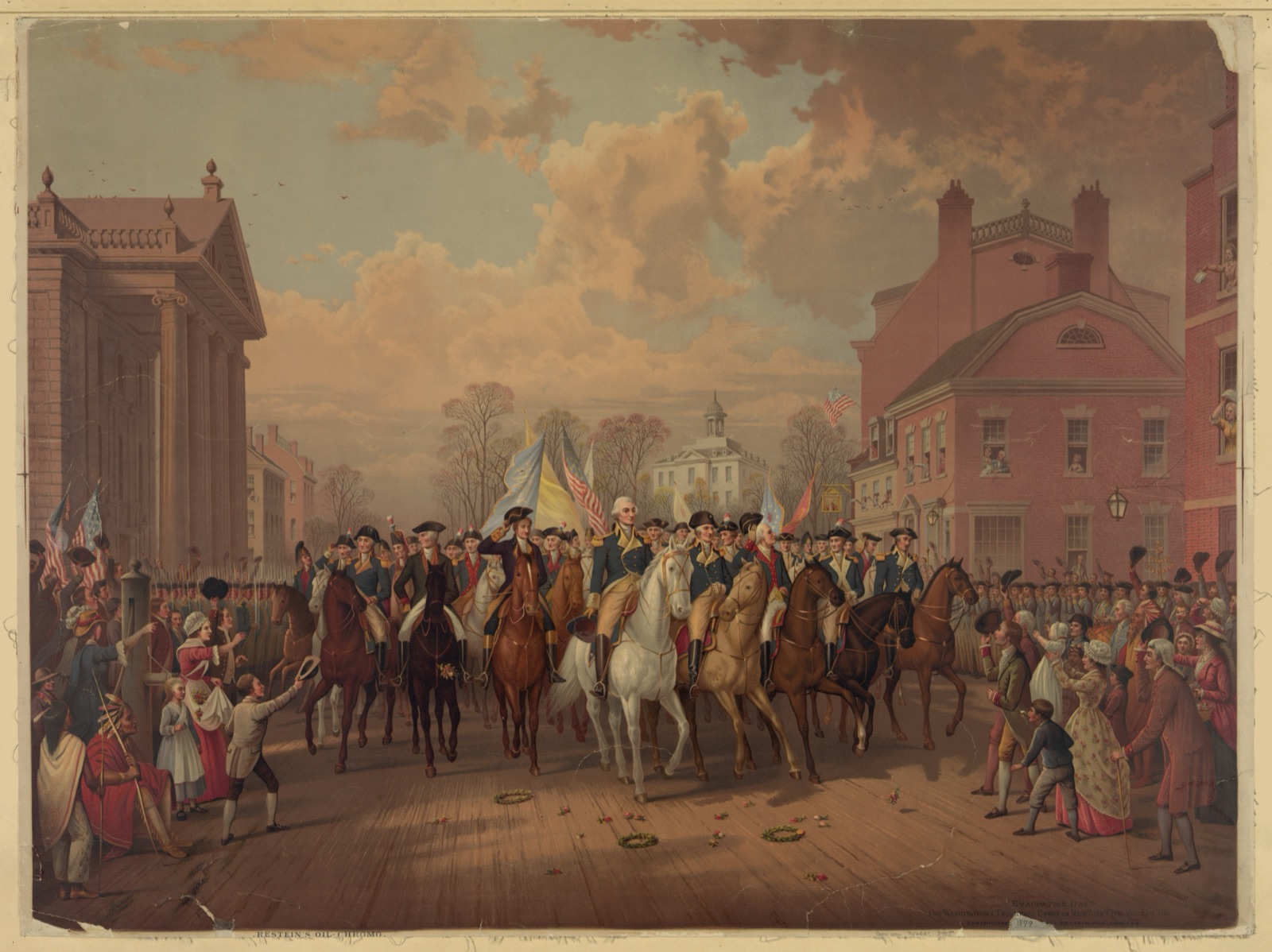
The day New York emptied, 25 November 1783, the city had been under British occupation for seven years. The handover was set for noon, and as the last redcoats rowed out to their ships, Washington and Governor George Clinton rode into Manhattan at the head of the American column. New York kept the date, "Evacuation Day," as a civic holiday for the next hundred years.
There is a famous story attached to that morning, and it is worth telling the way New York told it for a century, which is to say as a story. The departing British, so the tale went, nailed their flag to the pole at Fort George, cut away the ropes, and greased the pole so no one could climb it and run up the American colors before the fleet had cleared the harbor. A young veteran named John Van Arsdale nailed cleats to the pole, climbed it hand over hand, tore down the British flag, and raised the Stars and Stripes while the British could still see it from their decks. It is a wonderful story, and it is also mostly a story: its fullest telling was written a full century later, for the 1883 centennial, by Van Arsdale's own grandson, and the details shift from version to version. Some flag incident at Fort George that morning is plausible; the polished heroics are family legend. New Yorkers loved it because it was the perfect small image of the larger thing: the British, leaving, denied even the last gesture.
Nine days later, on 4 December 1783, Washington said goodbye to his officers in the Long Room of Fraunces Tavern on Pearl Street. The only firsthand account of that afternoon is a memoir written by one of the officers in the room, Colonel Benjamin Tallmadge, a cavalry officer and Washington's chief of military intelligence through the war, who set it down in 1830, forty-seven years after the fact, so it is a recollection, not a transcript. By that recollection, Washington filled a glass of wine and said, "With a heart full of love and gratitude I now take leave of you. I most devoutly wish that your latter days may be as prosperous and happy as your former ones have been glorious and honorable." Knox, standing nearest, stepped forward, and Washington, too overcome to speak, embraced him in silence, and then every officer in the room, one after another, in a room where, Tallmadge wrote, "Not a word was uttered to break the solemn silence that prevailed, or to interrupt the tenderness of the interesting scene."
With a heart full of love and gratitude I now take leave of you. — George Washington at Fraunces Tavern, from Tallmadge's 1830 memoir
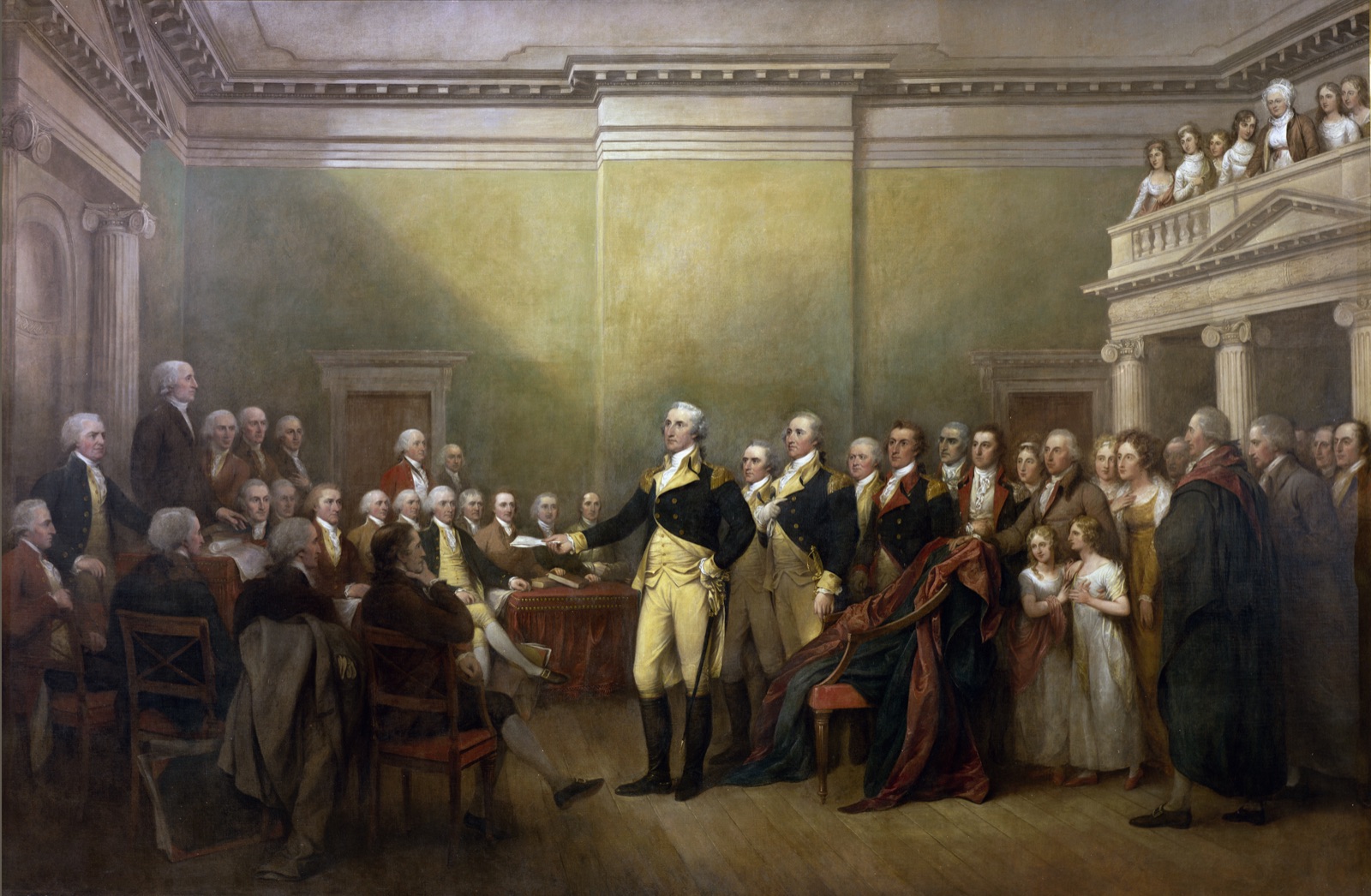
Around noon on 23 December 1783, in the Old Senate Chamber of the Maryland State House at Annapolis, Washington stood before the Congress of the United States to give back his commission as commander in chief. The man presiding over Congress that day was Thomas Mifflin, the failed quartermaster general of the Valley Forge winter, the man whose department had let the army freeze and starve; now, as President of Congress, it fell to him to receive the commission of the general who had held that army together through it. The delegates sat with their hats on while Washington stood bareheaded before them, the small staged detail that said which of them outranked the other: the civilians keep their hats on, and the general takes his off.
His hand shook as he read. An eyewitness, James McHenry, wrote that same day that it was "a solemn and affecting spectacle; such an one as history does not present," that "the spectators all wept," and that Washington, reaching the passage commending his officers to the country's care, "was obliged to support the paper with both hands." He read to the close. "Having now finished the work assigned me," he said, "I retire from the great theatre of Action — and bidding an Affectionate farewell to this August body under whose orders I have so long acted, I here offer my Commission, and take my leave of all the employments of public life." He laid the commission on the table, left Annapolis that afternoon, and reached Mount Vernon on Christmas Eve, a private citizen for the first time in eight and a half years.
Having now finished the work assigned me, I retire from the great theatre of Action — and bidding an Affectionate farewell to this August body. — George Washington, resignation address, 23 December 1783
There is a line that gets attached to this moment, and it has to be handled honestly. The story goes that George III, told what Washington meant to do, said that if Washington really gave up his power and went home to his farm, "he would be the greatest man in the world." The trouble is that the line comes to us only through the painter Benjamin West, who said the king said it, and West told it in at least two versions years apart that do not match each other. So it is not the king's words. It is a story the King's own painter told, worth knowing in that form and no stronger. What does not depend on any king's verdict is the act itself: a victorious general, commanding the only real army on the continent, handed his power back to a Congress so broke it could not pay the men he was dismissing, and then he went home. The Society of the Cincinnati, the officers' fraternity founded that same spring, had taken its name from the Roman farmer-general Cincinnatus, who won his war, laid down his command, and went back to his plow. At Annapolis the name became a literal description of what Washington did.
The ledger left open
The treaty was signed, and then almost nobody honored the parts of it that were inconvenient.
Britain, despite Article 7's promise to withdraw with "all convenient speed," kept its garrisons in the northwestern posts, Detroit, Niagara, Oswego, and the others, on what was now United States soil, until 1796. Its excuse was that the Americans had broken the treaty first, by blocking British creditors under Article 4 and never restoring Loyalist property under Article 5, and the excuse was true. Both sides broke the treaty first, depending on who was counting. The debts and the Loyalist promises stayed broken for more than a decade, and a government that could not enforce its own peace treaty became one of the arguments for replacing it, part of the road to the Constitution.
And the West the treaty so generously gave away was full of nations that had surrendered nothing; Fort Stanwix and everything after it belonged to people who had not been at any table in Paris. The new territory also carried a contradiction the treaty did not touch and could not resolve, whether the country that doubled in size would carry slavery into the new land or keep it out, a question the next eighty years would be spent fighting over.
So the ending is a room in Annapolis: a general with shaking hands laying a piece of paper on a table, a Congress in tears, a hat held in the hand, and a road home in the cold. The country that the treaty made was twice the size of the country that had fought for it, deeply in debt, undeniably victorious, and wholly unfinished, an argument about itself that it had only just begun to have. The rest of it is that argument.