In 1775 the rebels owned no warships. Not a few, not some. None. There was no naval administration, no dockyard that could build a battleship, no officer corps, no flag at sea. Across the water sat the Royal Navy, the largest and most experienced fleet in the world: somewhere around 270 vessels, more than a hundred of them ships of the line (the battleships of the age, big enough to stand in the main fighting formation). It had beaten the French and the Spanish navies inside living memory. The thirteen colonies proposed to fight it with nothing.
That should have ended the war at sea before it began, and in one sense it did. The Americans could never take command of the ocean, and the remarkable thing about their naval story is that they never tried. They didn't have to. Sea power, for Britain, meant three things: it could land an army anywhere on a thousand miles of coastline faster than George Washington could march to meet it; it could feed and arm that army across three thousand miles of water; and it could close American ports and choke the rebel economy with blockade (the practice of stationing warships off an enemy's harbors to stop ships going in or out). To beat that, the rebels would have needed a fleet they could not build. So they set themselves an easier task. Make the ocean expensive for Britain, run gunpowder in, embarrass the enemy where you could, and stay alive until somebody with a real navy joined the fight.
That, in the end, is exactly what happened. The man who finally tipped the war did it with twenty-eight French ships of the line in a battle where not one American vessel was present. The American war at sea was never one war but several, fought at once and barely on speaking terms: a tiny official navy, a swarm of legalized pirates, and a single captain who turned a sinking ship into a legend, with the war's darkest single place running underneath all of it.
A navy on paper
It began with fishing boats. In the fall of 1775 Washington was besieging the British army inside Boston, and he had a problem that was almost comic in its plainness: he had no gunpowder, and he had to watch British supply ships sail unmolested into Boston harbor carrying the very thing he lacked. His answer was to take small New England fishing schooners (fast two-masted coasters), bolt a few guns to them, crew them with soldiers who had been fishermen in civilian life, and send them out to rob the supply line.
The first was a schooner called Hannah, sailing in early September 1775 under Captain Nicholson Broughton, and she took a prize (a captured enemy vessel) within days. Over the next two years the little fleet grew to a half-dozen converted schooners working out of Beverly and Marblehead, Massachusetts. They took dozens of prizes, and one of them changed the war. On the evening of November 28, 1775, the schooner Lee, under Captain John Manley, fell in with a fat, unarmed British ordnance brig called the Nancy near the mouth of Boston harbor. The Nancy, not realizing what Lee was, actually signaled her for help; Manley sent across a boat of men with their weapons hidden and took her without a fight. Her hold was a quartermaster's dream: roughly two thousand muskets, a hundred thousand flints, tons of musket shot, barrels of powder, and a thirteen-inch brass mortar, the exact military stores an army outside Boston had no other way to get. One lucky capture by a re-purposed fishing boat had re-armed Washington's lines. That asymmetry, a tiny investment paying an enormous return when it lands, is the whole American sea war in a single night.
The Continental Congress, meanwhile, decided to build a real navy, and the decision was not unanimous. A great many delegates thought challenging the Royal Navy was lunacy; Samuel Chase of Maryland is supposed to have called it "the maddest idea in the world." They voted to do it anyway. On October 13, 1775, Congress moved to fit out armed vessels to cruise against British supply ships, the date the United States Navy still keeps as its birthday. In December it ordered thirteen frigates built (frigates being the fast, single-gun-deck cruisers of the age, smaller than a ship of the line, used as scouts and raiders and convoy escorts). And, in a flourish that tells you how little Congress understood the sea, it ordered all thirteen built in three months.
What happened to those thirteen frigates is the Continental Navy in miniature. Four were burned or scuttled by their own side in 1777, before they ever sailed, to keep them out of British hands as the enemy advanced. Of the eight that did get to sea, the Randolph blew up in action in 1778 with more than three hundred men aboard, among the worst single-ship death tolls of the entire age of sail; the rest were captured or run aground, one by one, until the last was taken in 1781. Not a single one of the thirteen survived in American service to the end of the war. Across the whole conflict the navy floated perhaps sixty vessels, never more than about thirty-one at once, and took on the order of two hundred prizes. By war's end almost nothing was left. Congress sold the final ship in 1785, and the United States then had no navy at all, none, until 1794.
The navy's one and only fleet operation of the entire war makes the point as well as anything. Early in 1776 its first and only commander in chief, Esek Hopkins of Rhode Island, took a squadron of eight small converted merchantmen to sea. His orders pointed him at the American coast; instead he sailed for the Bahamas to grab British military stores from the island of New Providence, where on March 3 a landing party of marines and sailors under Captain Samuel Nicholas took the island's two forts without firing a shot (the first amphibious operation the Continental Marines ever made, amphibious meaning an attack from ships onto land). The haul was real enough, nearly a hundred cannon and a dozen and a half mortars. But the gunpowder, the actual reason for the trip, had been quietly shipped out of the harbor the night before, right under the squadron's nose. And on the way home the whole fleet failed to take one lonely twenty-gun British ship, the Glasgow, which mauled one of Hopkins's vessels and got clean away. Eight ships against one, and the one won the exchange. Hopkins was censured, suspended, and finally dismissed. The navy never operated as a fleet again.
Set the official navy down honestly, then. It carried diplomats and dispatches, ferried Benjamin Franklin to France, and produced the war's one immortal sea fight; what it never did was break a blockade, win a fleet action, or frighten the Royal Navy. A nuisance and a flag, not a fleet.
The real navy was a business
The actual American sea war was not fought by the navy at all. It was fought by privateers, and privateering was, at bottom, a business.
A privateer was a privately owned, privately armed ship licensed by a government to attack and capture enemy vessels in wartime. The license was a single piece of paper called a letter of marque, and that paper was everything. With it, a captured enemy crew were lawful prisoners of war and the seized ship was lawful "prize," to be sold for profit. Without it, the identical act was piracy, a hanging offense. The paper was the only thing standing between a respectable merchant captain and the gallows.
Here is how the machine ran. A syndicate of merchants would fit out and arm a fast ship, apply to Congress or to one of the states for a commission, and post a money bond promising good behavior (enemy ships only, prisoners treated properly). The ship then cruised for enemy merchantmen, and the typical capture involved almost no fighting at all: the prize was usually an unarmed or lightly armed trader that struck her colors, meaning hauled down her flag in surrender, the moment a privateer overhauled her and ran out the guns. A small prize crew (a handful of men put aboard to sail the capture into a friendly port while the privateer kept hunting) brought her in, where an admiralty court ruled the capture lawful and ordered ship and cargo sold at auction. The proceeds were split by a contract agreed in advance: roughly half to the owners, the rest divided among the officers and crew by shares. One rich prize could hand an ordinary sailor more money than years of navy pay.
That last fact is why privateering swallowed the war at sea. For an investor it was a speculative industry, a war lottery; merchant houses in Salem, Newburyport, Boston, Providence, Philadelphia, and Baltimore bought shares in cruises, and fortunes were made and lost on the turn of a single sail on the horizon. Robert Morris, who financed much of the Revolution, caught the logic of it in one line: "One arrival will pay for two, three or four losses." For a sailor the pitch was unbeatable. A cruise ran two or three months against a year's enlistment in the navy, the discipline was looser, and the prize shares could dwarf a navy wage. The Continental Navy could not keep its frigates manned, in part, precisely because the privateers outbid it for crews; navy captains sat in port and watched their men melt away to the privateer wharves. The new money even rearranged the social order, or seemed to. "Fellows who would have cleaned my shoes five years ago have amassed fortunes," James Warren wrote to John Adams, half marveling and half appalled.
How big was the swarm? Nobody knows precisely, and the popular numbers are wildly inflated, because vessels were re-commissioned voyage by voyage and counted more than once. Congress issued something like 1,700 letters of marque, the states issued hundreds more, and perhaps two thousand vessels carried the paper over the war. The prizes they took are the most contested number in the whole story: a conservative count of ships actually captured and condemned runs near six hundred, common scholarship puts it around twenty-three hundred, and records derived from the London insurance market push toward three thousand, several hundred of them later recaptured or ransomed back. The honest version is well over a thousand, several times what the entire Continental Navy managed.
One arrival will pay for two, three or four losses. — Robert Morris, on the arithmetic of privateering (quoted in scholarship)
What did all that capturing actually do to Britain? It did not threaten British control of the sea for one moment. No privateer could fight a frigate, let alone a ship of the line; this was economic harassment, not naval power. But economic harassment, brilliantly scaled, has teeth. Marine insurance premiums in London climbed steeply once American cruisers were loose: one documented series of army-contractor shipping rates rose from around thirteen percent in the spring of 1776 to roughly thirty-two percent by that summer, with West Indies routes worse still. The numbers vary by route and year, but the direction is plain; insurance roughly doubled, and worse on the bad runs. British merchants petitioned, prices rose, and the government had to organize convoys (groups of merchant ships sailing together under warship escort), which tied up Royal Navy ships that would otherwise have been tightening the blockade. One Lloyd's of London broker, watching the lawyers argue over whether American captures even counted as ordinary war losses, grumbled that "the Loss of a Ship taken by the Provincials is like to make work for the Lawyers, the Underwriters declaring that they are not Pirates, and the Policy not providing against Rebels."
The unglamorous part is part of the truth too. Privateering was a business, and some of it wore its patriotism thin; cruises chased profit, not strategy, and it bled the navy and even the army of coastal men. And it was as dangerous as any battlefield. Plenty of cruises came home empty or never came home at all; the lottery cut both ways, and the losing ticket could be drowning, or a British prison. Thousands of captured privateersmen ended in those prisons, and most of the men who died in the war's deadliest single place were privateersmen, not navy or army at all; Newburyport reportedly lost something like a thousand men to the sea and to captivity. The shares were real. So was the reckoning.
One captain
If the navy as an institution was a disappointment, it produced exactly one figure who was not, and he was a strange man to become America's first naval hero. He was Scottish. He was born plain John Paul in 1747, a gardener's son in Kirkcudbrightshire, on the very coast he would later raid. He went to sea around thirteen and rose to merchant captain, and he added "Jones" to his name after killing a mutinous sailor at Tobago in 1773; he said it was self-defense, and rather than stand trial he fled to America. So the man who became the founding saint of the United States Navy was a Scot fighting Britain with a killing already shadowing his name. Both halves of him, the brilliant fighting captain and the prickly, ambitious striver, were true at once.
He earned his early reputation legitimately. Commanding the little twelve-gun sloop Providence in 1776, he took or destroyed more than a dozen prizes on a single cruise, one of the navy's few unambiguous performers. In 1777 he carried the new flag to France aboard the sloop-of-war Ranger, and it was there, in the spring of 1778, that he did the thing no American had done: he took the war to Britain's home waters.
On the night of April 22, 1778, Jones rowed two boats of men into Whitehaven, the English port he had sailed from as a boy, meaning to burn the hundreds of merchant ships crowded in its tidal harbor. It mostly fizzled. The raiders' lanterns burned out; the story goes that the men stopped at a pub; one of them slipped off and roused the town; and in the end the shore batteries were spiked (their guns disabled by driving a spike into the touch-hole) and a single ship was set alight, the fire quickly doused. The material damage was trivial. The shock was not. It was the first hostile landing on English soil in something like a century, and panic and insurance jitters rippled along the whole coast. On the same day as the Whitehaven raid, Jones crossed the firth to St. Mary's Isle to seize the Earl of Selkirk and trade the nobleman for American sailors held in British jails. The plan was a kidnapping, plainly, and it failed plainly: the earl wasn't home, and the raid netted nothing but the family silver, which Jones let his prize-hungry crew carry off while Lady Selkirk, pregnant, handled the intrusion with composure. The epilogue is pure Jones. He wrote her a long, florid letter of apology, vowing to buy the plate back from his own crew at his own expense, and years later he did exactly that. A piratical act and a chivalric letter, in one man, the same week. Two days later, off the Irish coast, he fought and took the Royal Navy sloop-of-war Drake in about an hour and paraded her into a French port as proof that an American ship could beat a British one in a fair fight.
### Flamborough Head
> eyebrow: He won the battle and lost the ship, and that is the legend
The fight that made him immortal was, by any sane accounting, a disaster he refused to lose.
France had given Jones a worn-out old East Indiaman (a merchant ship built for the long India trade), which he armed with around forty guns and renamed Bonhomme Richard, "Poor Richard," in honor of Franklin. With a small joint squadron under American colors, he was cruising around the British Isles when, late in the afternoon of September 23, 1779, off Flamborough Head on England's own Yorkshire coast in the northeast, he ran straight into a large Baltic convoy carrying the timber, tar, and hemp that were the raw materials of British sea power, escorted by a brand-new British warship, the forty-four-gun Serapis under Captain Richard Pearson. Pearson did the right thing at once: those naval stores were exactly what Britain could not lose, and he put his ship between the enemy and his convoy and waved the merchantmen to safety.
The Serapis was newer, faster, and better armed than the Richard, and early in the fight two of Jones's oldest, biggest guns burst when fired, killing their own crews and wrecking that part of the battery. After that Jones had only lighter pieces left while the Serapis threw heavier shot from more of her deck, and he could not win a gunnery duel, a contest of broadsides (a broadside being every gun on one side of a ship firing together). To lose that duel was to be pounded into surrender, into asking for quarter, which meant asking the enemy to stop killing you and accept your surrender. So Jones did the only thing that gave him a chance. He grappled. The two ships fouled, and Jones lashed them together into one burning raft, and for hours they fired into each other muzzle to muzzle in the moonlight, close enough that crowds reportedly watched from the headland. The Serapis's heavy guns tore the Richard apart below the waterline while Jones's marines and sailors swept the enemy's open deck with musket fire and grenades thrown down from the rigging. Into this, madly, the Richard's own consort the Alliance sailed around the locked pair and fired her broadsides into both ships, hulling Jones's flagship again and again. Whether her French captain was incompetent, deranged, or malicious was never settled; he was later court-martialed out of the navy over other conduct. The plain fact is that one of the American ships shot into its own flagship.
What turned it was a single sailor. A man crawled out along a yard with a bucket of grenades and dropped one through an open hatch on the Serapis, down onto a row of loose powder cartridges, and the explosion ran the length of the British gun deck and killed or burned dozens of men. By then the Richard was sinking under Jones's feet, her pumps failing, fire creeping toward the magazine. His own gunner, certain the ship was going down, began crying out for quarter. Jones would not have it. When Pearson hailed across the water to ask whether the Richard had struck, Jones answered, in his own later words, in the most determined negative, and the fight went on. Around half past ten it was Pearson, not Jones, who struck his colors, hauled down his flag in surrender, and the Serapis was Jones's. His own ship was not. The Bonhomme Richard was too far gone to save; her crew fought the flooding for a day and a half, and on the morning of September 25 she rolled over and sank. The victor's ship went to the bottom. The legend rests on precisely that. He won the battle and lost the ship, and refused to surrender either way.
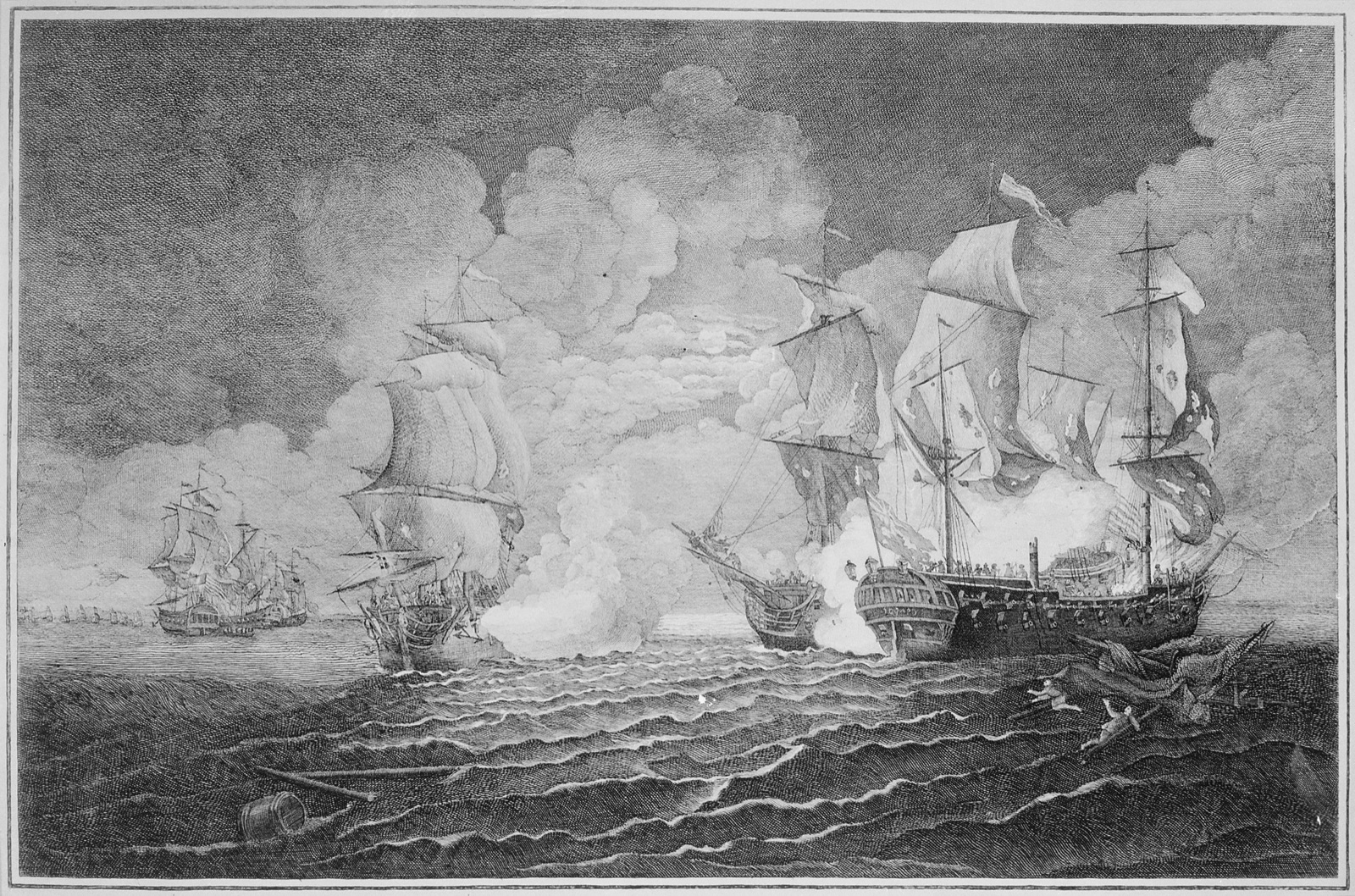
The casualties were appalling for the age, roughly half the men on each ship. And the most famous American naval sentence ever spoken belongs to this deck, which is exactly why it has to be handled with care. Every schoolchild learns that when Pearson hailed to ask whether the Richard had struck, Jones roared back, "I have not yet begun to fight!" Those words are real in the sense that someone wrote them down. They are not real in the sense of being recorded at the time. They first appear in print in 1825, forty-six years after the battle and thirty-three years after Jones's death, in the recollection of his first lieutenant Richard Dale, who had stood beside him on that deck and was supplying his memories to a biographer. What Jones himself actually wrote, in his official report to Franklin ten days after the fight, was quieter and just as defiant: the English commodore "asked me if I demanded quarters, and I having answered him in the most determined negative, they renewed the battle with redoubled fury." The defiance is documented in his own hand. The famous shout is an old man's memory, set down half a century later. The refusal happened; the line is a legend built around it.
…the English Commodore asked me if I demanded quarters, and I having answered him in the most determined negative, they renewed the battle with redoubled fury… — John Paul Jones, official report to Benjamin Franklin, October 3, 1779
There is one more honesty owed to the scene. Captain Pearson lost his ship, but he had saved his entire convoy, which was the whole point of his fight, and Britain knighted him for it. Jones never fought another major action under the American flag. He was feted in Paris, given a gold medal by Congress, served briefly and unhappily as a rear admiral in Catherine the Great's Russian navy (an appointment that collapsed in court intrigue and an unresolved accusation of assaulting a girl), and died alone in Paris in 1792, aged forty-five. His grave was lost for over a century, then found; he lies today in a marble crypt beneath the chapel of the U.S. Naval Academy at Annapolis. The navy that barely existed while he lived made him, after his death, its founding saint.
The worst day
In the same year as Flamborough Head, America's largest naval expedition of the entire war set out, accomplished nothing, and burned itself to the waterline. A famous name went down with it.
In June 1779 a British force of perhaps seven hundred men, with three Royal Navy sloops, occupied a peninsula on Penobscot Bay, a deep inlet on the Maine coast well northeast of Boston, in what was then the Maine district of Massachusetts (today the town of Castine), and began building a fort to anchor a new Loyalist colony on the coast. Massachusetts, not Congress, mounted the response, and it was enormous: more than forty vessels in all, a mix of a few Continental Navy ships, state warships, and chartered privateers, carrying something over a thousand militiamen. The naval commander was Commodore Dudley Saltonstall; the artillery was led by Lieutenant Colonel Paul Revere, the same Paul Revere who had ridden to warn the militia outside Boston in 1775. Yes, that Paul Revere.
The expedition arrived in late July and promptly seized up. The militia stormed a bluff and took ground while the British fort was still half-built, its walls barely chest-high on a man. And then, for more than two weeks, nothing happened. The general would not assault the fort until the commodore destroyed the British sloops in the harbor, and the commodore would not take his ships in under the fort's guns to do it. Councils of war were held; letters flew; the days drained away. While the Americans argued, a Royal Navy relief squadron of seven warships came up the bay, and the American fleet did not fight it. It fled up the Penobscot River, and there, trapped against the shallows, the Americans burned and scuttled their own ships, effectively the entire fleet, more than forty vessels lost. The survivors walked home through the Maine woods. The expedition nearly broke the treasury of Massachusetts and cost the state somewhere around five hundred men.
The blame fell, as blame does, on whoever was nearest. Saltonstall was court-martialed and dismissed from the navy, the chief scapegoat for what had plainly been a collective failure of command. Paul Revere did not escape it either. An army officer accused him of disobedience and unsoldierly conduct during the retreat, the charges turning on a refused order about a boat and his leaving for Boston without leave, and he was relieved of his command. Both halves of what happened next are true: the disgrace was real at the time, and so was the vindication. Revere demanded a full court-martial to clear his name, got it, and in February 1782 was acquitted, the court finding the charges unsupported. Penobscot is routinely called the worst American naval disaster until Pearl Harbor in 1941, a comparison historians like to make rather than a measured statistic. But the bare fact stands on its own: in the same season John Paul Jones was making a legend off the coast of England, the largest fleet America ever assembled in the Revolution destroyed itself, without a battle, in a Maine river.
The dark ledger
Most of the men who chased those prize shares were not navy and not army. They were privateersmen, and if their luck ran out, Britain had a specific place waiting for them. It waited in a Brooklyn cove called Wallabout Bay.
Britain held captured American seamen, overwhelmingly privateersmen, in decommissioned warships, hulks with their masts and guns stripped out, moored off the Brooklyn shore of New York's East River. More than a dozen of these hulks served over the war. Privateersmen in particular fell into a legal trap: under a 1777 act of Parliament they could be denied the ordinary prisoner exchange that returned soldiers home, and so they rotted aboard the hulks for years. The most infamous of them was a former sixty-four-gun ship of the line called the Jersey, hulked and turned into a prison by about 1780, which the men aboard her called simply "Hell."
The conditions are best told once, plainly, and then left to stand. A thousand or more men were packed below decks at a time; dysentery, smallpox, yellow fever, and typhus ran through the dark; the rations were starvation rations skimmed by contractors, and the water came foul from the cask. Survivors remembered the guards' nightly cry as the hatches opened in the morning, "Rebels, turn out your dead," and the dead were carried up and buried in shallow sand on the shore, several a day at the worst of it. A young prisoner named Ebenezer Fox, captured at seventeen and held aboard the Jersey, wrote afterward that "the idea of being a prisoner in such a place was sufficient to fill the mind with grief and distress"; another survivor, Thomas Dring, remembered being forced below into "a current of foul air with accumulated nauseousness which it is impossible for me to describe." And through all of it the British kept up a standing offer: any prisoner could walk off the hulk into freedom the moment he agreed to enlist in the king's own navy or army. The overwhelming majority refused. That refusal, made in the dark by starving men, is the quiet heroism of the whole story.
The idea of being a prisoner in such a place was sufficient to fill the mind with grief and distress. — Ebenezer Fox, captured at seventeen and held aboard the Jersey
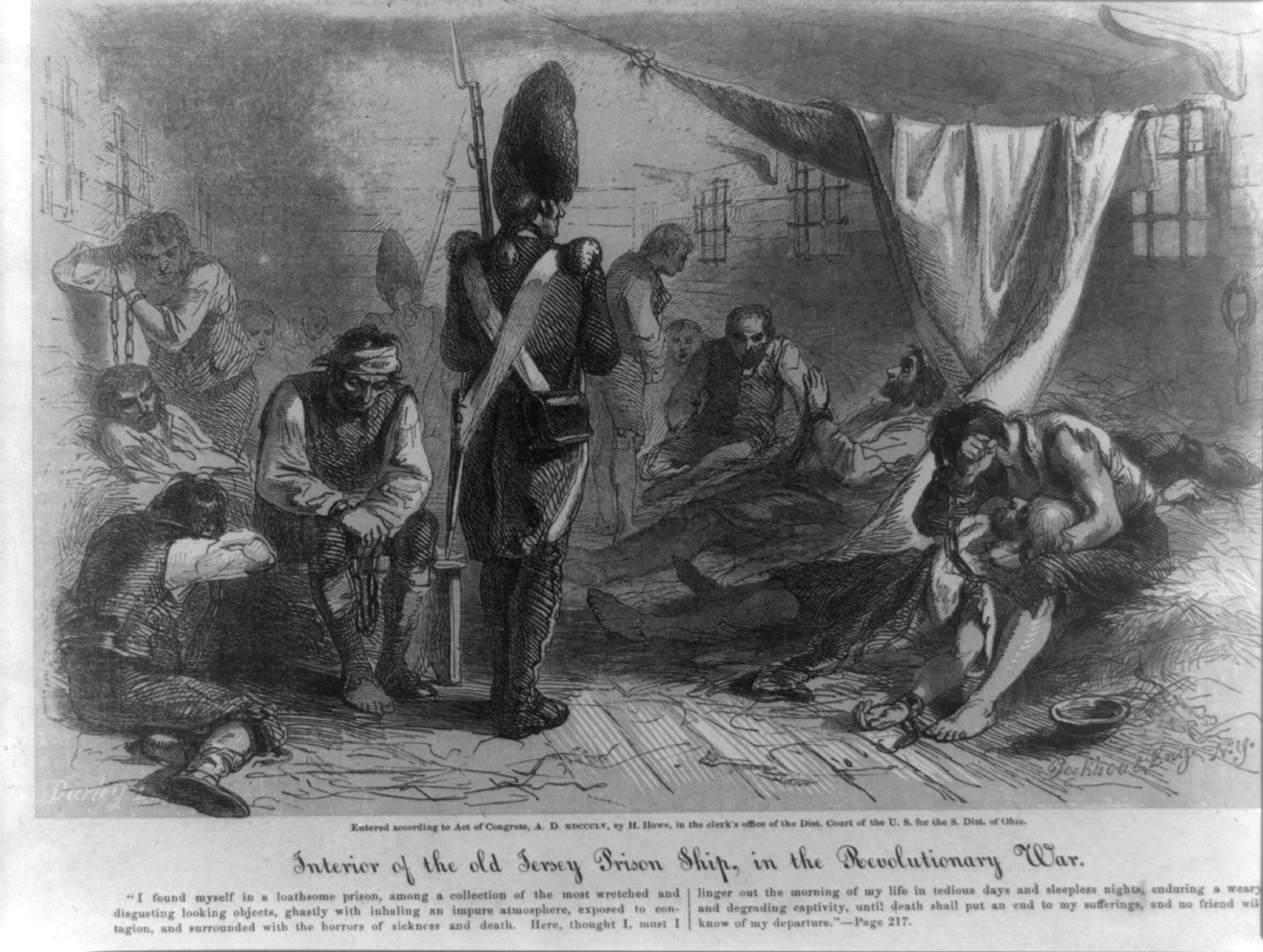
How many died there cannot be pinned down, because no complete death register survives, and it should never be printed as a hard count. The traditional figure for the Jersey and the other Wallabout hulks is around eleven thousand, but that came from early-nineteenth-century estimation, not a body count. Modern scholarship widens the lens and softens the certainty: the historian Edwin Burrows, in the standard study, reckoned that twenty-five to thirty thousand Americans were held in and around New York and that at least seventeen thousand or so may have died in British captivity all told, across the ships and the city's jails and sugar houses, while granting the evidence is fragmentary. For the ships alone, the serious range runs somewhere between about seven and twelve thousand dead.
Set that against the other number and you have the fact that ought to be better known than it is. About six thousand eight hundred Americans died in battle in the entire Revolutionary War. By any of the serious estimates, more Americans died in British captivity than fell in every battle of the war combined, and by Burrows's wider count, roughly twice as many. The deadliest place in the American Revolution was not a battlefield; it was a row of anchored hulks in a Brooklyn cove. For decades the bones washed out of the Wallabout sand with the tides, and they rest today beneath the Prison Ship Martyrs' Monument in Fort Greene Park, a tall column standing over what the harbor did to them.
The battle America didn't fight
Everything the rebels had managed at sea had kept the war alive without ever winning it. Winning it required a real fleet, and the Americans did not have one. They borrowed one.
When France came into the war in 1778 (followed by Spain and then a war with the Dutch), Britain suddenly had to fight a world war without a single ally, spreading the Royal Navy across the Channel, the Mediterranean, the rich sugar islands of the West Indies, India, and America at once. The American blockade, never airtight to begin with, stretched thin and tore, and French fleets began crossing the Atlantic more or less at will. The early interventions disappointed, an admiral missing his chances at New York and Newport and failing bloodily at Savannah, and the allies finally absorbed the hard lesson: naval superiority is worth nothing unless it arrives at the decisive place, at the decisive moment, in overwhelming local force.
In 1781 they finally applied it. Lord Cornwallis, the British commander who had been running the southern campaign, had dug in at Yorktown, expecting the navy to supply him or carry him off if things went wrong. Admiral the comte de Grasse gambled. He brought his entire West Indies fleet, twenty-eight ships of the line, north from the Caribbean and anchored inside the Chesapeake Bay, the wide estuary whose mouth controlled all access to Yorktown. A second, smaller French squadron sailed separately from Newport, carrying the heavy French siege guns. To break this up before it closed, a British fleet of nineteen ships of the line under Rear Admiral Thomas Graves sailed down from New York. What followed, on September 5, 1781, was the single most decisive naval battle of the American Revolution, and not one American ship took part in it. That absence is the entire point: the decisive sea battle of America's war for independence was fought between Britain and France, while the Americans waited on land.
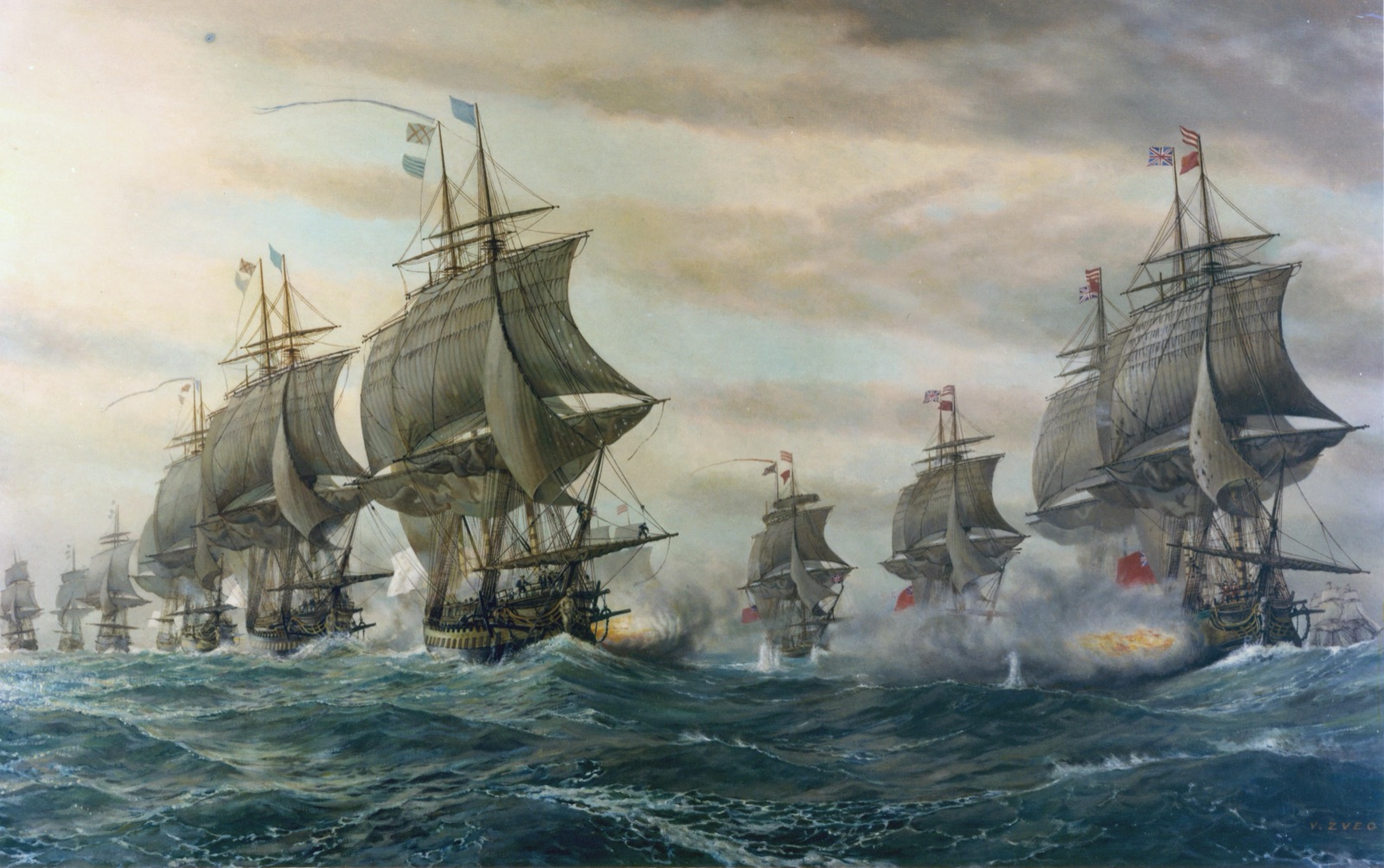
Graves arrived off the capes that morning to find de Grasse already anchored inside the bay, and caught at a bad moment, with hundreds of his men ashore on boat duty. De Grasse sortied anyway, getting twenty-four of his twenty-eight ships out past Cape Henry against the tide rather than be trapped at anchor, his line strung out and short-handed. Graves had the wind, a real advantage under sail: the ship to windward chooses when to close and when to hold off, while the one to leeward can only wait. He had that choice, and a disordered French line to fall on as it came out, and he did not take it. Instead he did what British doctrine told him to do: he formed his own neat line of battle and waited for it to come parallel before engaging. A line of battle was the iron rule of fleet fighting, ships in single file so that every broadside could bear and no friendly ship blocked another's guns, and the Royal Navy's Fighting Instructions prized keeping that line unbroken above almost everything else. Battles between two matched, careful lines tended to be indecisive by their very design, which was exactly the outcome Britain could not afford, because a draw left the French holding the bay.
The fighting, when it finally came in the late afternoon, lasted about two hours, and only the leading and center ships of each fleet ever really engaged. Graves flew contradictory signals, the flags for "line ahead" and "close action" up together, and his rear division read the order to hold the line as the one that governed and never came into the fight at all. His leading ships, his van (the lead division), were badly mauled aloft. The French gunners aimed high, at masts and rigging rather than at hulls, so the British van came through the smoke still afloat but crippled overhead, able to steer downwind but not to maneuver. That is the whole battle in a single image: a fight that wrecked almost nothing and decided everything. The casualties were modest for a battle that decided a war, around ninety British dead and a few ships cut up, one so leaky she had to be burned days later; the French rather fewer. The argument over whether Graves or his subordinate was to blame ran on for years and was never settled; it is fairer to call it what it was, a failure of signals and doctrine rather than of nerve.
The battle was decided in the days after the guns stopped. The two fleets drifted south within sight of each other while Graves's mauled van was in no state to renew the fight, and when both finally turned back for the bay, the French got there first. De Grasse found the Newport squadron already inside with the siege artillery, and now had thirty-five or thirty-six ships of the line sealing the bay. Graves, outnumbered and battered, turned for New York to refit. That settled it. Cornwallis needed the bay to be supplied, reinforced, or evacuated, and after that week he had none of the three. When Britain's relief fleet finally sailed to save him, it left New York on October 19, 1781, the very day Cornwallis surrendered.
And while the Chesapeake decided America, the rest of the Royal Navy was scattered across the globe holding everything else: pinned to the marathon Great Siege of Gibraltar, fighting over the sugar islands of the West Indies, dueling squadrons off India. Britain did not lose the war at sea. It lost the sea at one place, for one month, and that one month was enough. Yorktown happened in the gap.
The honest verdict
America never built a navy that mattered. The Continental Navy lost or burned essentially everything it ever floated; all thirteen of its original frigates were gone before the war ended, and the last ship was sold off in 1785. What America actually had at sea was three things and one borrowed one. It had privateers that stung, hundreds of ships chasing prizes, four-digit prize counts, London insurance rates climbing, a real and painful tax on Britain's commerce that never came close to threatening British command of the ocean. It had one captain who became a legend, mostly by refusing to surrender a ship that was sinking under him. It had a dark ledger of prison hulks that killed more of its sailors than every battle of the war combined. And when the moment came to actually win, it borrowed a navy: an ally's fleet won the decisive battle without a single American vessel present. The rebels never contested command of the sea. They made British sea power expensive, survived it, and borrowed a real fleet for the one month that counted.
The United States remembered all of it. When it finally built a fleet of its own, six frigates authorized in 1794, one of them the Constitution, it built them with the memory of a war it had fought at sea with almost nothing. The navy keeps its birthday in 1775. Its actual fleet begins in 1794. That, though, is a different story.