When the men marched off in 1775, the war did not stay at the front. It came home, into the farmyard and the shop and the account book, and it landed on people the law barely recognized as people. To understand what it landed on, you have to start with a single ugly word: coverture.
Coverture was the rule that governed a married woman's whole legal life under English common law, carried into every American colony. Marriage merged a wife's legal identity into her husband's so completely that, in law, she stopped existing as a separate person. William Blackstone, whose 1765 Commentaries on the Laws of England was the period's standard explanation of the law, put it without flinching: "By marriage, the husband and wife are one person in law: that is, the very being or legal existence of the woman is suspended during the marriage, or at least is incorporated and consolidated into that of the husband." A married woman (the lawyers' term was feme covert, a woman "covered" by her husband) could not own property, keep her own wages, sign a contract, or sue in her own name. An unmarried woman or a widow (a feme sole) could do all of those things. Marriage was the line.
That is the fact every story in this chapter plays against. When the husbands left, somebody had to run the farm, keep the shop open, pay the taxes in money that was losing its value by the month, and decide when to flee an oncoming army. The people who did all of that were, on paper, not allowed to own the very property they were saving.
Deputy husbands
There was already a name for a wife who handled her husband's outside business while he was away. The historian Laurel Thatcher Ulrich called it the "deputy husband": in colonial households a wife routinely stood in for her husband in the family's dealings with the wider world, bargaining, keeping accounts, even handling legal matters, whenever he was gone. Nothing in the culture said a woman could not drive a hard bargain. The catch, as Ulrich noted, was that it was a deputy's power. She acted in his name, not on her own authority. She could run the whole estate and still not sell an acre of it, sign a note against it, or sue over it without his name on the paper.
The war took that occasional role and made it near-permanent. Husbands were not gone for a trading season now. They were gone for years. And the woman left in charge was managing, in his name, an estate the law said could never be hers.
Class decided what kind of war a woman had. A merchant's or lawyer's wife "deputied" a household with land, tenants, and money in it. A propertyless soldier's wife had no estate to run at all; when her husband enlisted or died, her choices narrowed to destitution or the army's baggage train. Abigail Adams's war and a camp follower's war were both real and both hard, but they were not the same war.
Remember the ladies
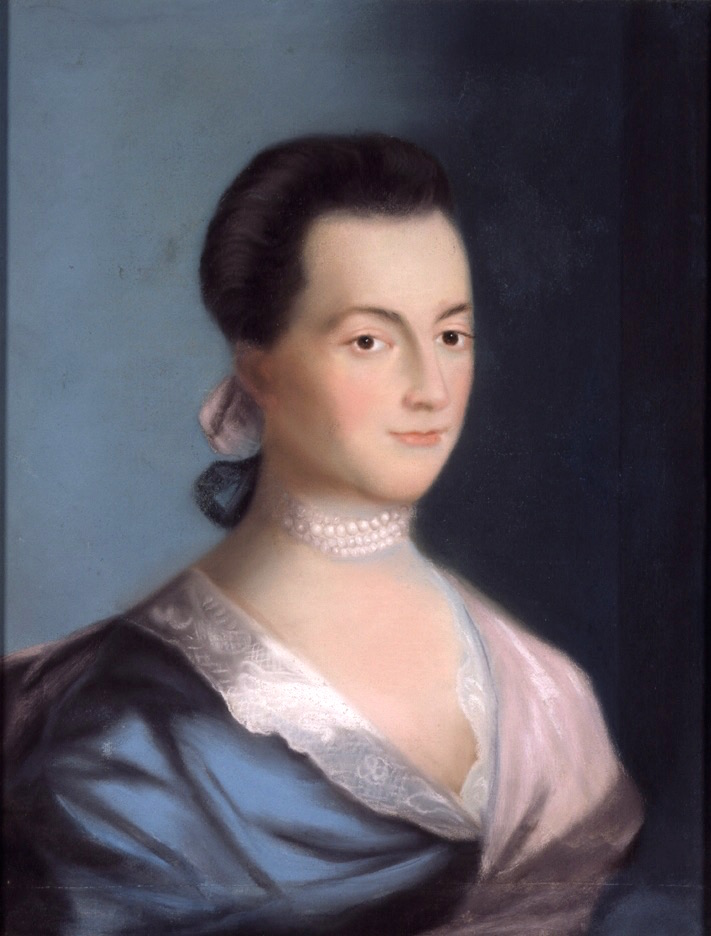
Start with the famous one, because she said the famous thing. In the spring of 1776, with the Continental Congress in Philadelphia inching toward independence, Abigail Adams sat down in Braintree, Massachusetts, and wrote to her husband John, who was in the thick of it. The letter is dated 31 March 1776, and one passage of it has outlived almost everything else either of them wrote.
I desire you would Remember the Ladies, and be more generous and favourable to them than your ancestors. Do not put such unlimited power into the hands of the Husbands. Remember all Men would be tyrants if they could. — Abigail Adams, 1776
She went further, and the rest is sharper than the part people quote. If "perticuliar care and attention is not paid to the Laidies," she warned, "we are determined to foment a Rebelion, and will not hold ourselves bound by any Laws in which we have no voice, or Representation." She was taking the exact argument the colonists were making against Parliament, no laws without a voice in them, and turning it inward, against the men about to write the new code of laws. It is a joke and a threat in the same breath, and she meant both.
It is tempting to make her a suffragist a century and a half early, and tempting is exactly why it is wrong. Abigail Adams was not asking for the vote. Her target was the "unlimited power… of the Husbands," which is to say coverture itself, the arrangement that let a husband own his wife's property and answer for nothing if he abused her. That was the tyranny she had in mind, and it was the daily one. Asking the new republic not to rebuild it into the founding law was radical enough on its own terms. She did not need to be asking for the franchise to be saying something dangerous.
John's reply, dated 14 April 1776, shows how it landed. "As to your extraordinary Code of Laws," he wrote, "I cannot but laugh." He assured her that "We know better than to repeal our Masculine systems," and joked that men would sooner take up arms than surrender the name of master and submit to "the Despotism of the Peticoat." He laughed her off, and that is the truest preview of how the whole thing would end. The man who would help build the republic heard the argument, found it funny, and filed it away. The "Masculine systems," as he promised, did not get repealed.
What the joking hides is that Abigail Adams spent the war proving the argument with her life rather than her pen. John was at Congress from 1774 to 1777, then in Europe on diplomatic missions from 1778 until she joined him abroad in 1784. For the better part of a decade she ran the Braintree farm and its tenants, raised and schooled the children through the war and the epidemics of 1775 and 1776, and handled the family money. More than that, she invested it, working largely through her uncle Cotton Tufts, putting funds into depreciated government securities (war bonds trading far below their face value because nobody was sure the government would ever pay) that paid off handsomely once the new federal government made good on its debts in the 1790s. Economic historians credit her with preserving and growing the Adams fortune. The man who could not stop laughing at her "Code of Laws" came home to an estate she had kept solvent. We can see all of this only because roughly 1,200 letters between them survive. She signed many of them "Portia."
The army's working women
Now the other end of the class divide, the part of the war nobody painted a flattering portrait of. For every woman managing an estate from a parlor, there were others whose husbands' enlistment had pulled the floor out from under them. They did what the desperately poor have always done in a war: they followed the army.
They are called camp followers, and the first thing to say is what they were not. They were not, as a lazy old slander has it, a traveling brothel. The women of the army were overwhelmingly soldiers' wives, soldiers' widows, and refugees, poor women, often with children, who could not keep a household going once their man marched away and so went with him instead. Some were hired nurses; some were sutlers (licensed vendors who sold food, liquor, and small goods to the troops, the eighteenth-century camp store). A few were enslaved or indentured women brought along by others. Prostitution existed at the edges of every army in this period, but it does not describe this population, and the scholarship that has actually counted these women is blunt about that. They were working members of the military community, and the army knew it. The American Articles of War in 1776 swept "all suttlers and retainers to a camp, and all persons whatsoever serving with the armies of the United States" into military jurisdiction. They belonged to the army, in the historian Holly Mayer's phrase, and were subject to its discipline like anyone else in it.
What they did was the unglamorous labor an army cannot move without. The core trade was laundry, paid by the piece, and it was not busywork: clean clothes were disease control, the one defense an eighteenth-century camp had against the lice that carried typhus. A laundress might be bent over a tub of soldiers' shirts within earshot of the guns, and she stayed there because the work was hers and the wages were the only ones she had. Women nursed in the field hospitals, sometimes hired, sometimes simply drafted into it. They cooked, mended, carried water, and ran the sutler's trade. Unless a woman was formally employed as a laundress, nurse, or cook, she earned no wages at all. What she got was a ration: the daily allotment of food the army issued to keep her alive. The documented Continental norm, reconstructed from the army's surviving supply records, was a full ration for a woman and a half ration for each child, though it varied by period, commander, and unit, with some orders cutting women to a half ration; the harsher half-for-women, quarter-for-children version that often gets quoted as policy is not what the records show.
How many of them were there? On the American side, John U. Rees's count from the supply records puts it at roughly one woman for every thirty men, around two to three percent of the army's strength, drifting upward as the war wore on. The British army carried far more. General William Howe allowed six women per company on campaign in 1776 and 1777, and an August 1781 return for British-held New York worked out to about one woman for every four and a half soldiers. After Burgoyne's army surrendered at Saratoga in October 1777, something on the order of two thousand women went into captivity with it. The British, in short, dragged along several times the American proportion.
George Washington's feelings about all of this were a knot he never untied: he needed the work and resented the drag in the same breath. His general orders of 4 August 1777 complained that "the multitude of women in particular, especially those who are pregnant, or have children, are a clog upon every movement," and told his commanders to "use every reasonable method in their power to get rid of all such as are not absolutely necessary." He ordered that the women must not ride in the wagons but march on foot with the baggage, first in 1777 and then in some form nearly every year after. The women stayed anyway, every time, because the army could not get its washing done or its wounded tended without them, and because turning them out the gate meant turning them out to starve. By June 1781 Washington had bent far enough to allow that some would have to be permitted to ride or to walk in the ranks. The clog he kept trying to shed was the only thing keeping his men in clean shirts.
Following the army meant sharing the army's marches, its short rations, its diseases, and now and then its battles. Which is how some of these women ended up not behind the lines but at the guns.
At the guns
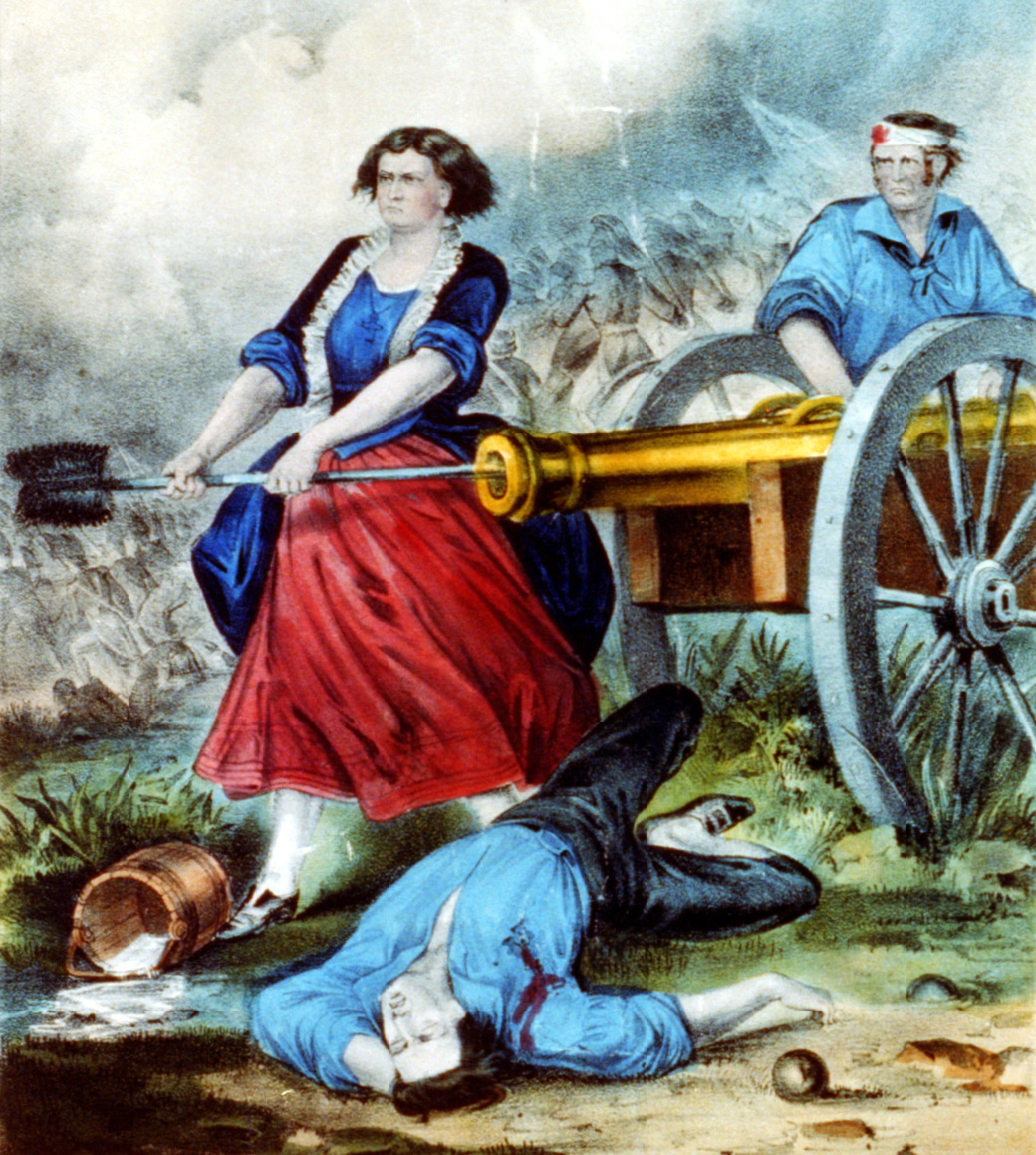
Margaret Corbin is the one we can prove. She was born on the Pennsylvania frontier in 1751 (her parents were killed or carried off in a 1756 raid, though the details there are thin). She followed her husband, John Corbin, a Pennsylvania artilleryman, to war. On 16 November 1776 the British and their Hessian (German) troops stormed Fort Washington at the northern tip of Manhattan. The fort fell, and the assault was as bad as such things get. John Corbin was killed serving his cannon. Margaret stepped into his place at the gun and kept it firing until grapeshot (a cannon load of small iron balls that scattered like an enormous shotgun blast) tore into her, nearly severing her left arm and wounding her in the chest and jaw. The arm never worked again.
What makes Corbin more than an anecdote is what Congress did about her. On 6 July 1779 the Continental Congress resolved that Margaret Corbin, "who was wounded and disabled in the attack on Fort Washington, whilst she heroically filled the post of her husband who was killed by her side serving a piece of artillery," should receive for the rest of her life a pension (a regular government payment to a veteran or a veteran's family) equal to one-half the monthly pay of a soldier, plus a suit of clothes or its cash value. That made her the first woman the United States ever pensioned for military service. Hold both halves of that at once: it was real recognition, written into the record by Congress, and it was set at half of what a man got. She was enrolled afterward in the Invalid Regiment (the unit for soldiers too maimed to fight but still on the books) at West Point, known around the post as "Captain Molly." She died near West Point around 1800, poor and reportedly difficult, and largely forgotten.
There is a strange final beat. In 1926 the Daughters of the American Revolution dug up what they believed were Corbin's remains and reburied them with honors at West Point. In 2017 a forensic study found those remains belonged to an unknown man. Where Margaret Corbin actually lies is unknown; the monument still stands over the wrong grave.
Now the legend. If you have heard of a woman at a Revolutionary cannon, you have probably heard the name Molly Pitcher, and Molly Pitcher is not a person. No contemporary record names any such woman. The legend, a wife carrying water to the gun crews at the Battle of Monmouth in June 1778 who takes her fallen husband's place at the cannon, congealed in the nineteenth century out of several real threads, Corbin's "Captain Molly" story very likely among them. There probably was a real woman, or several, working the guns at Monmouth. The soldier Joseph Plumb Martin, decades later in his 1830 memoir, described one without naming her: a cannon shot from the enemy, he wrote, "passed directly between her legs without doing any other damage than carrying away all the lower part of her petticoat," and she went right on working. The tidy name and the neat story are the invention.
The name got pinned, after she was dead, onto a Pennsylvania woman named Mary Ludwig Hays. What is documented about her is modest. She was at Monmouth with her artilleryman husband. In 1822 the Pennsylvania legislature granted her a forty-dollar annual pension "for services rendered" in the war, without naming Monmouth, a cannon, or any particular deed. Her obituaries in 1832 praised her wartime service to the sick and wounded and said nothing whatsoever about a cannon or a pitcher of water. The "Molly Pitcher" label was attached to her only afterward, by her son's obituary in 1856 and a centennial grave-marking in Carlisle in 1876.
That gap is the real story. The nineteenth century looked back at a war carried, in part, by thousands of anonymous working women, and preferred one tidy heroine with a charming name and a single dramatic act. It is much easier to put a Molly Pitcher on a lithograph than to reckon with the laundresses.
Seventeen months as Robert Shurtliff
Margaret Corbin went to war as a wife and ended up at a gun by circumstance. Deborah Sampson went to war as a man, on purpose.
She was born in Plympton, Massachusetts, in December 1760, bound out as an indentured servant in Middleborough until she turned eighteen, then a weaver and a schoolteacher. In May 1782 she enlisted under the name "Robert Shurtliff" (the spelling wanders across the records) and was mustered into the 4th Massachusetts Regiment, serving with its light infantry company in the lower Hudson Valley. The war's big battles were already over; Yorktown had been won in October 1781. But the nasty little skirmishing war on the "neutral ground" around British-held New York had not stopped, and that is where she served.
She had tried once before and failed, taking an enlistment bounty (the cash signing bonus paid to a new recruit) in Middleborough under another name, spending some of it, and being found out. Her own church, the First Baptist Church of Middleborough, formally withdrew fellowship from her in September 1782 for "dressing in men's clothes and enlisting as a Soldier." The church record is real, which makes it one of the firmest documents we have that she did exactly what the legend says she did.
Near Tarrytown, New York, in the summer of 1782, she was wounded in a skirmish, taking musket balls in the thigh and, by most accounts, a gash to the head. Here the documented spine and the embellished legend part company. What is consistent across the sources, including her own later pension materials, is that she concealed the thigh wound rather than let an army doctor undress her and discover what she was. The vivid particular, that she dug the ball out herself with a penknife and a needle, comes down to us through the embellished memoir we are about to get to. What is not in dispute is that a ball stayed lodged too deep to reach and rode in her leg for the rest of her life. She was found out in 1783 at Philadelphia, when she fell ill with a fever and the attending doctor discovered her secret and chose to keep it. She was honorably discharged at West Point on 25 October 1783, after about seventeen months in uniform.
Then came the longer fight, the one over money. Massachusetts granted her thirty-four pounds in withheld back pay in 1792. Five years later a writer named Herman Mann published The Female Review, an as-told-to "memoir," and it is the reason her story is so tangled: Mann embellished freely, placing her at battles, including Yorktown, she could not possibly have fought, since she did not enlist until 1782. The rule for reading anything in Mann is to trust nothing on his word alone, and the trouble is that Sampson herself leaned on his version when she went on an 1802 lecture tour, performing her own story in uniform and going through the manual of arms (the drill of handling a musket) for the crowd. She had a powerful character witness too: Paul Revere visited her struggling Sharon farm, came away convinced, and in 1804 wrote to Congressman William Eustis that she was "much more deserving than hundreds to whom Congress have been generous." It worked, slowly. In 1805 she was placed on the Massachusetts invalid pension roll, and later moved onto the general list. She died in Sharon in April 1827. In 1838 Congress passed relief for her heirs, what amounted to a survivor's benefit paid on a wife's military service, a first of its own kind.
The offering of the ladies
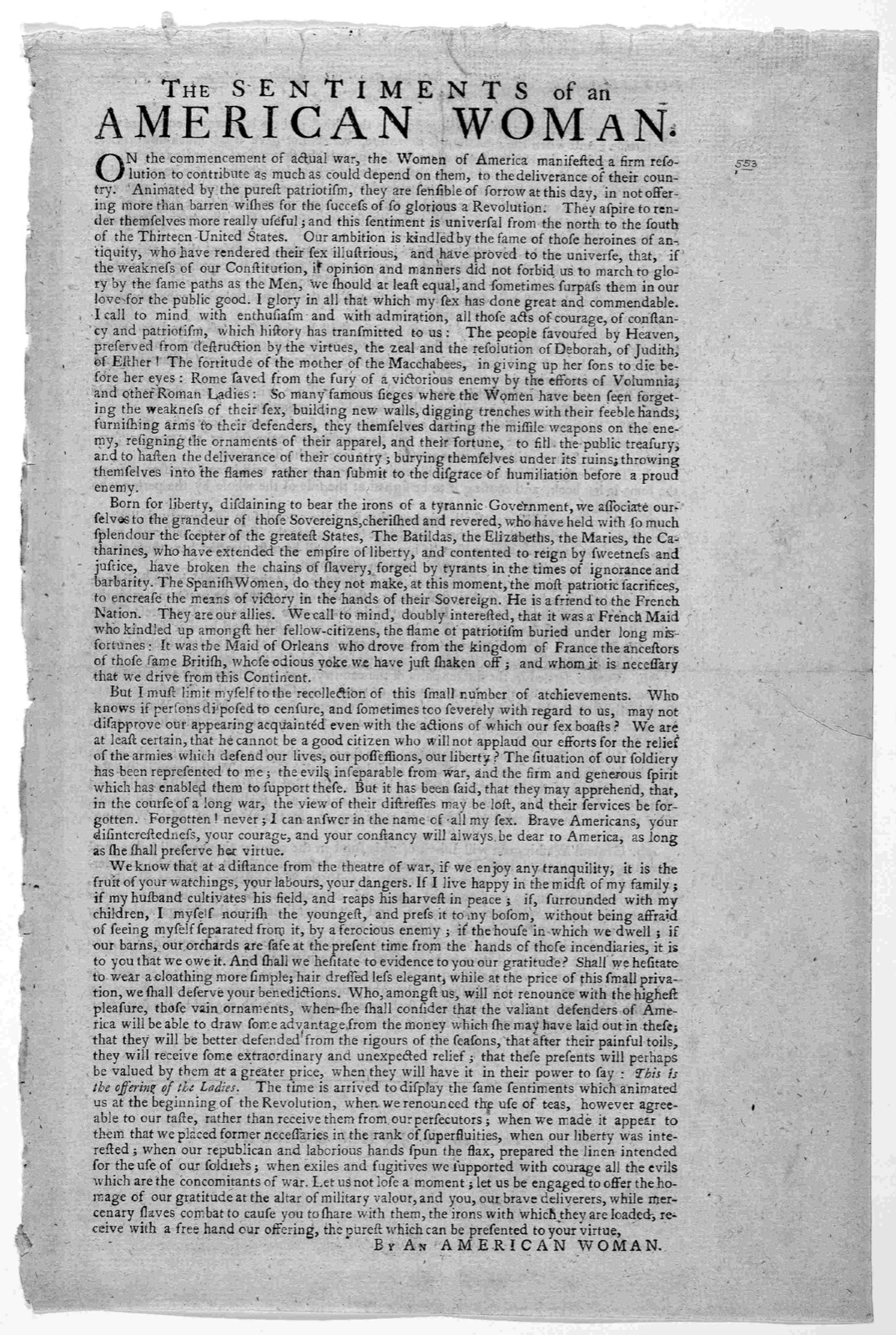
By the late spring of 1780 the cause was in real trouble. The Continental currency was collapsing toward worthlessness, Charleston had just fallen, and Washington was reporting that his troops were nearly out of clothing, pay, and patience. Into that grim season came a broadside (a single printed sheet meant to be posted or handed around, the era's poster and pamphlet in one) that did something new.
It was titled "The Sentiments of an American Woman," printed in Philadelphia on 10 June 1780, and it reads like a manifesto for women going to war by other means. Women, it declared, were "Born for liberty, disdaining to bear the irons of a tyrannic government." It reached back for Joan of Arc, "a French Maid" who "kindled up amongst her fellow-citizens, the flame of patriotism." And it made a claim with an edge on it: "if opinion and manners did not forbid us to march to glory by the same paths as the Men, we should at least equal, and sometimes surpass them." Since opinion and manners did forbid that, women would give up their "vain ornaments" and hand the money to the army instead. It was published anonymously, but the writer was almost certainly Esther De Berdt Reed, the London-born wife of Pennsylvania's chief executive, Joseph Reed.
The words were only the start. Within days roughly three dozen Philadelphia women organized something the country had never seen: a door-to-door canvass of the entire city and its suburbs, with treasurers assigned by ward, a system for counting the money, and names written down as they came in. It was the first large-scale women's political fundraising organization in America. When Reed wrote to Washington on 4 July 1780, she could report more than three hundred thousand Continental dollars raised, from something like sixteen hundred donors.
That number needs its honest footnote. In 1780, in the middle of a hyperinflation, those three hundred thousand paper dollars were worth only a small fraction in hard coin, a few thousand dollars in real money. The achievement was never the sum. It was the machine: dozens of women, organized by ward, collecting from sixteen hundred people in a matter of weeks. Nothing like it had been built before.
And then the women lost the argument over what to do with it, which is its own small portrait of the period's politics. Esther Reed wanted to put hard cash directly into each soldier's hand, an extra bounty he could feel, pointedly routed around Congress's regular supply system. Washington said no. Cash, he argued, would breed discontent and drink; what the men actually needed was shirts. The women pushed back once. Washington held firm. Reed yielded, and in August she began buying linen. The women lost it gracefully, but it was a fight, not a happy collaboration: the men who ran the war told the women who had funded the gift what their gift would be.
Reed did not live to finish it. She died on 18 September 1780, of dysentery, at thirty-three, with the project half done. Sarah Franklin Bache, Benjamin Franklin's daughter, took it over, and the women sewed through the autumn. On 26 December 1780 Bache forwarded more than two thousand shirts to Washington's army, many of them, by tradition, carrying the name of the woman who made them stitched into the cloth. The model spread to New Jersey, Maryland, and Virginia, where Martha Jefferson lent her name to the effort.
Pen, press, and intelligence
Women fought this war with words and information too. Mary Katharine Goddard printed the treason. She ran the Maryland Journal and was postmaster of Baltimore from 1775 to 1789, among the first women to hold a federal office, and in January 1777, when Congress was sitting in Baltimore, it hired her press to print a new edition of the Declaration of Independence, the first printing to list the signers' names. At the foot of that document, in plain type, stands the line "Baltimore, in Maryland: Printed by Mary Katharine Goddard." A woman's name sits on the treason that founded the country. Mercy Otis Warren, sister of the patriot firebrand James Otis and a constant correspondent of Abigail Adams, wrote the cause's satire under cover of anonymity through the war and then, in 1805, published a three-volume History of the Rise, Progress and Termination of the American Revolution under her own name, generally counted the first major history of the Revolution by an American woman, even as John Adams was sniffing that "History is not the Province of the Ladies." Phillis Wheatley, enslaved in Boston and freed in 1773, sent Washington a poem in his honor and got a courtly reply inviting her to Head Quarters. (Whether she ever came is tradition, not record; the wider story of Black Americans in this war belongs to its own chapter.)
The losers' war
Every story so far has been a winner's story, more or less. But women had stakes on the losing side too, and coverture made the losing especially cruel for them.
When a Loyalist man fled or was attainted (formally declared a traitor, with his property forfeit to the state), the law moved against his estate. And because of coverture, his wife had no separate claim to "his" property, even when she was the one who had brought that property into the marriage. The state could seize the entire household out from under the woman still living in it, on the grounds that none of it had ever legally been hers.
Grace Growden Galloway is the case to watch. She was the wife of Joseph Galloway, the prominent Loyalist who administered Philadelphia during the British occupation, and the daughter of Lawrence Growden, one of the richest men in Pennsylvania. She had brought vast Bucks County estates into her marriage, and marriage had transferred that inherited land to Joseph outright; what remained to Grace was only a widow's contingent claim, good if she outlived him and worth nothing while he ran the property. In June 1778, when the British evacuated Philadelphia, Joseph fled with them, taking their daughter, and left Grace behind deliberately, gambling that a wife in residence might hold the property where an attainted husband could not. Pennsylvania attainted him anyway and marked the estates for confiscation.
On the night of 20 August 1778, after ten o'clock, the man who came to evict her was Charles Willson Peale, the painter, serving as a commissioner of forfeited estates. She refused to leave on her own feet, pushed away the arm Peale offered her, and walked out of her own home on her own terms. That diary, kept through 1778 and 1779, is one of the great records of what dispossession felt like from the inside: the humiliation, the friends who suddenly were not friends ("as I have no friends, they treat me as they please," she wrote), and a hard, unbroken pride.
striped & Turn'd out of Doors… I shou'd be Grace Growdon Galloway to ye last. — Grace Growden Galloway, diary, 1779
She spent her last years fighting to claw back her own inherited property, not for herself but for her daughter. She died on 6 February 1782 and was buried in an unmarked grave. There is a bitter coda: after the war Pennsylvania did restore the Growden inheritance to her daughter, the law conceding, far too late for Grace, that the property had never really been Joseph's to lose.
The other side's women suffered too, and one of them left the war's most vivid eyewitness account of all. Baroness Frederika von Riedesel was the wife of the major general who commanded the Brunswick troops fighting for the British under Burgoyne. (Brunswick was one of several German states whose rulers contracted their soldiers out to the British, the troops Americans lumped together as Hessians.) She crossed the Atlantic with three small daughters and kept a journal that was later published. Her record of the German army's collapse at Saratoga in October 1777 is unforgettable. Sheltering with her children and a crowd of the wounded in a farmhouse cellar while American cannon fire raked the building above them, she wrote: "Eleven cannon balls went through the house, and we could plainly hear them rolling over our heads. One poor soldier, whose leg they were about to amputate, having been laid upon a table for this purpose, had the other leg taken off by another cannon ball." She described the stench and the screaming children, cleaned and fumigated the cellar with vinegar on hot coals, and nursed the wounded: "I made them tea and coffee." When Burgoyne surrendered, she and her family went south into the long captivity of the defeated army.
Some of them lost everything they had, and the losing was no less total for being a woman's.
A Mohawk woman's war
One more woman belongs here, partly because her own people ran their politics on a rule nearly the opposite of coverture. Molly Brant, known among the Mohawk as Konwatsi'tsiaienni, was born around 1736. She had been the longtime consort of Sir William Johnson, the British superintendent of Indian affairs, until his death in 1774, and she was the sister of the Mohawk war leader Joseph Brant. She was also, in her own right, a woman of real standing in the Six Nations, the confederacy of the Iroquois peoples, where clan matrons (the senior women of a clan) held formal political weight, a say in choosing leaders and in going to war. A Mohawk woman could hold an authority the common law denied a married Englishwoman entirely.
Her best-documented act of the war came in August 1777. Learning that patriot militia were marching to relieve the besieged Fort Stanwix, she sent Mohawk runners to warn the British and Native force in their path, and that warning set up the ambush at Oriskany on 6 August 1777, which shattered the patriot relief column. Through the rest of the war she sheltered Loyalists, kept them supplied, and worked to hold most of the Six Nations to the British alliance, and British officers rated her influence among the Mohawk above her famous brother's. When it was over, the side she had backed had lost, and she could not go home. The Crown gave her a house at Cataraqui (now Kingston, Ontario) and a hundred-pound annual pension, among the largest it paid to any Native person. Like Galloway and Riedesel, she ended on the losing side: her war closed with her exiled from the Mohawk Valley for good.
What the war changed, and what it didn't
So what did all of it come to?
The clearest answer the postwar years produced was an idea the historian Linda Kerber later named "republican motherhood." The logic ran like this: a republic survives only on the virtue of its citizens, mothers raise those citizens, and therefore a mother's work has a public, civic purpose. It gave women a real assignment in the new nation, and it had a measurable effect: a boom in female academies and literacy through the 1780s and 1790s, at least among white women of the middling sort and above. But look at what it actually granted. It dignified and educated women precisely as mothers of citizens, not as citizens themselves. It conceded no political rights at all. It was, as much as anything, the containment of Abigail Adams's argument: yes, women matter to the republic, in the nursery, where they can do no harm to the masculine systems.
There was one astonishing exception, and it has to be stated with care, because the loose version of it is wrong. New Jersey let women vote. The state's 1776 constitution gave the franchise to "all inhabitants of this Colony, of full age, who are worth fifty pounds proclamation money, clear estate" with a year's residence in the county, and said not one word about sex or race. New Jersey was alone among the thirteen states in this. But notice what coverture did to it. A married woman could not own fifty pounds in her own name, so the only women who could meet the property test were single women and widows, the femes sole of the chapter's opening. It was property-holding single women and widows who voted, alongside some free Black New Jerseyans who met the same bar. Never say flatly that "New Jersey women could vote"; say which ones, and why only those. Later election laws, in 1790 and 1797, made it explicit, referring to the voter as "he or she," and women turned out in real numbers into the early 1800s. Then, in 1807, after a fraud-soaked local election and a cold partisan calculation that women's votes were going the wrong way, the legislature restricted the vote to free, white, male taxpayers, stripping women and Black voters in a single act and calling it fraud prevention. The American women who voted in 1800 were the last who would, in New Jersey, until 1920. Whether the 1776 wording was a deliberate opening or an accident of drafting that nobody bothered to close, historians still argue.
And coverture itself survived the whole thing untouched. No state abolished it. The married women's property acts that would finally begin to dismantle it were half a century and more away, scattered through the 1830s and 1840s and after. Divorce grew marginally easier in a few places, like Pennsylvania after its 1785 statute, but the change was thin. John Adams had promised, laughing, that the masculine systems would not be repealed, and they were not.
That is the honest landing. The Revolution put new arguments in women's mouths, the same ones the men were using against the king, about consent and voice and laws you have no part in making. It put new work in their hands, whole farms and funds and presses and the daily labor of an army. It wrapped a new ideology around their role. And it left their legal condition very nearly where it found it. The women of 1780 did not win their own revolution. What they handed forward to the next century was the argument, sharpened and on the record, that one day someone else would win.