Half the people in the room
The story Abstract Expressionism told about itself starred a handful of heroic men: the lone genius in his studio, fighting paint, drinking hard, making history with his body. It is a thrilling story, and it is missing half the people who were in the room. A whole cohort of serious women painters helped make this movement and were written out of it, dismissed as wives or “lady painters,” left out of the big shows and the big essays, and largely forgotten until art historians went looking again in recent decades. Naming them is not a courtesy. It is correcting the record.
Start with Lee Krasner (1908–1984), the textbook case. A rigorously trained painter who had studied with Hofmann and a major artist in her own right, she happened to marry Jackson Pollock, and for decades the art world filed her under “Pollock’s wife,” which suited the genius myth and buried a real career. In fact she kept painting at full power for nearly thirty years after Pollock’s death, and some of her boldest, largest work, surging fields of organic pink-and-green forms like The Seasons (1957), came in exactly the years the legend had decided she was a footnote.
Frankenthaler, and the credit
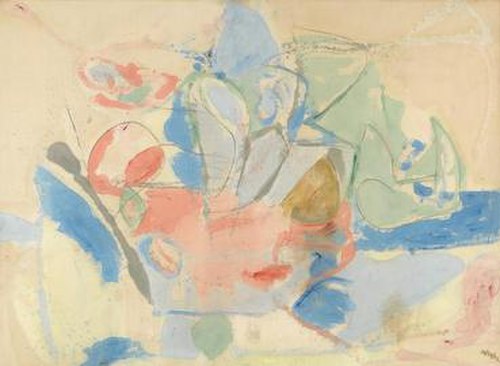
The single most consequential thing any woman did in this movement may be the most consequential thing anyone did for what came after it. In 1952, at the age of twenty-three, Helen Frankenthaler (1928–2011) made Mountains and Sea by pouring thinned-down paint directly onto raw, unprimed canvas, so the color soaked into the weave like a stain on cloth rather than sitting on top of it as a brushed skin. The result was soft, luminous veils of color, suggesting a landscape without depicting one. She had invented the soak-stain, and it became the literal bridge from Abstract Expressionism to the next movement.
There were more. Joan Mitchell (1925–1992) made lush, slashing gestural abstractions that turn memories of landscape into storms of color, working much of her life in France. Elaine de Kooning (1918–1989) was a painter and a sharp, widely read art critic at once, writing the reviews that shaped opinion in the very scene that overlooked her own canvases. Grace Hartigan (1922–2008) was among the most respected painters of the younger New York generation in the 1950s. Each was a central New York School artist; each was, for decades, treated as a minor character in a story about men.
The injustice sharpens here: two younger painters, Morris Louis and Kenneth Noland, saw Mountains and Sea, picked up Frankenthaler’s soak-stain, and built it into Color Field painting, and it was those two men, not the woman who invented the method, who collected most of the founding credit for the movement that grew straight out of her experiment. A young woman worked out how paint should meet cloth, and two men walked through the door she opened and got their names on it.