MODERN · MOVEMENT · 9 OF 10

Abstract Expressionism

1943–1960 · ~17 years
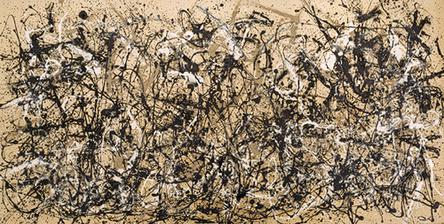
Jackson Pollock, Autumn Rhythm (Number 30), 1950 · The Metropolitan Museum of Art · in copyright, shown small under fair use

For the first time an American movement led the world, or so the standard account goes, and Paris handed the avant-garde to New York. A loose group later called the New York School made the canvas, in one critic’s phrase, “an arena in which to act,” big enough to swallow the viewer and built to record the body, the gesture and the unconscious directly. The single idea split into two wings that look nothing alike: the gesture painters who put the act of painting on the wall, and the color-field painters who built vast glowing fields aimed at the sublime. Almost none of the actual paintings can be shown here, because the whole movement is still under copyright, so the words have to carry the pictures.

Read the Abstract Expressionism story6 chapters · 1943–1960
No manifesto

Surrealism got a manifesto and a pope. Abstract Expressionism got neither. It was never a club with a rulebook; it was a loose set of New York painters who mostly distrusted programs, plus two critics who fought over what they were doing. There is no founding document that names the movement and lays down its rules. The nearest thing is a letter two of them sent the New York Times in 1943, and after that the key texts arrive one at a time, by individual hands, often years apart.

Adolph Gottlieb and Mark Rothko wrote that letter (with Barnett Newman a co-editor), published on 13 June 1943 in reply to a critic, Edward Alden Jewell, who had dismissed their work. Its most-quoted line draws the whole future of the movement in one sentence: “There is no such thing as good painting about nothing.” The subject, they insisted, is everything, and only the tragic and timeless will do. Note the attribution: it is Gottlieb and Rothko’s, with Newman, and it is a letter, not a manifesto.

After that, four voices and no chorus. Pollock published a short statement, “My Painting” (in the journal Possibilities, which Robert Motherwell co-edited, winter 1947–48), describing how he worked on the floor so he could “literally be in the painting.” Newman published “The Sublime Is Now” (1948), the color-field wing’s credo. And the critic Harold Rosenberg published “The American Action Painters” (1952), the essay that coined “action painting” and called the canvas “an arena in which to act.” Two painters’ statements, two critics’ framings, and no manifesto.
Read about the 1943 Gottlieb-Rothko letter
How the influence flowed
Grew out of
Surrealist automatism
gave: marks straight from the unconscious
Arshile Gorky
gave: the hinge from automatism to abstraction
Hans Hofmann
gave: “push and pull,” the émigré teacher
The WPA
gave: the survival and the New York milieu
Abstract Expressionism1943–1960
Led to
Color Field
took: the soak-stain and the pure field
Pop Art
took (by reaction): cool mass-culture surfaces
Minimalism
took (by reaction): the scale, minus the gesture
The NY art world
took: the scale, the market, the critic machine
Abstract Expressionism took Surrealist automatism, Hofmann’s classroom and the survival the WPA had bought, pushed abstraction to its largest and most ambitious scale, and in doing so moved the center of world art from Paris to New York for good.
The details
~17 yrs
Span
New York
Centered on
vs
gesture
The gesture wing (“action”)
Pollock · de Kooning · Kline · Gorky
The painting as the record of an event: the artist’s body and unconscious moving across the canvas, edge to edge, no focal point. “Action painting” is the critic Harold Rosenberg’s 1952 term, and it means THIS wing only.
field
The color-field wing
Rothko · Newman · Still · Frankenthaler
The opposite move: a vast, enveloping field of color built for stillness and scale, meant to deliver something like the sublime. The names listed are the core, not the full roster (Frankenthaler’s soak-stain is the bridge into Color Field). Never call these painters “action painters.”
Meanwhile, elsewhere
Other movements in the same years
1947 · Washington & Moscow
The early Cold War
The Marshall Plan, NATO, McCarthyism, the bomb. The documented CIA covert promotion of this art abroad made it a showcase of “American freedom” against Soviet socialist realism. But the CIA did not create the movement, the painters had invented it years earlier, and most of them never knew their work was being used this way.
1945 · New York
New York takes the crown
The war broke Europe and emptied Paris of its avant-garde, many of them to New York; American money, a booming gallery and museum scene, and a confident superpower culture shifted the center of art across the Atlantic for the first time.
1950 · Paris & New York
Existentialism
Sartre, Camus, the bomb, a culture of anxiety and individual authenticity, running in parallel with Rosenberg’s idea of the canvas as an existential “act,” the painting as the record of a self facing the void.
9 featured works
Canonical works · 17
1948Onement INewman
1950ChiefKline
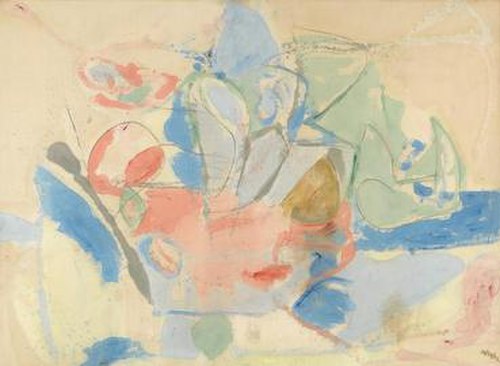
1952Mountains and SeaFrankenthaler
1952Woman Ide Kooning
19571957-D No. 1Still
1957Blast, IGottlieb
1957The SeasonsKrasner
1960No. 14, 1960Rothko