From nonsense to fury
When Richard Huelsenbeck carried Dada from Zurich back to Berlin, it landed in a completely different country and turned into a completely different thing. Zurich Dada had been nonsense as an end in itself, refusal made in a safe neutral bubble. Berlin in 1918 was no bubble: Germany had lost the war, the Kaiser had fled, the streets were full of demobilized soldiers and revolutionaries, people were genuinely starving, and a fragile new republic (later called the Weimar Republic) was being born in chaos. Dada here could not afford to be a private joke. It got savagely political, pointed squarely at the militarists who had run the war and the new establishment papering over the wreckage. The Berlin circle constituted itself as “Club Dada” and ran hard left: Raoul Hausmann, the self-styled “Dadasoph”; Hannah Höch; John Heartfield, who had anglicized his German name as a protest against wartime nationalism and would become the great anti-Nazi photomontagist; the savage caricaturist George Grosz; and others.
Scissors and the daily paper
Their weapon was photomontage. A collage(a technique Cubism had developed a few years earlier) is any picture assembled by gluing found materials onto a surface. Photomontage is the special case where the found materials are photographs, cut out of newspapers and magazines and reassembled into a new, jarring, satirical image: a general’s head on a baby’s body, a machine where a brain should be. Berlin Dada used scissors and the daily paper to make pictures that attacked the people in the daily paper. (Hedge the famous claim: both Grosz and Heartfield, and separately Hausmann and Höch, said they invented photomontage, but cut-and-pasted photographs went back to the 1850s. Nobody in Dada invented it. What Berlin Dada did was seize the technique and turn it into a political weapon, an art made from the same mass media it was attacking.)
Hausmann made the same indictment in three dimensions. His Mechanical Head, subtitled The Spirit of Our Time, is a wig-maker’s wooden dummy head with objects screwed to it: a folding ruler, a tape measure curled over one ear, a tin cup, the works of a pocket watch. The head has no thoughts of its own. Its only contents are the measuring and counting instruments bolted to the outside of it. That, Hausmann is saying, is what the war-machine society has produced: a person who is nothing but the gadgets done to him.

The whole republic, cut up
The masterpiece of the form has one of the longest titles in art: Cut with the Kitchen Knife Dada through the Last Weimar Beer-Belly Cultural Epoch of Germany, made by Hannah Höchin 1919–20. The title is itself a sneer at the comfortable respectability of the new republic, the well-fed politicians and generals who had survived the war and now ran things as if nothing had happened. Stand in front of it (it is large, nearly four feet tall) and it is overwhelming on purpose: a teeming field of hundreds of cut-out fragments from the illustrated press, generals’ heads and dancers’ legs and machine cogs, the whole republic shredded and reassembled, with the words “the great dada world” and “anti-dada” scattered to sort the figures into camps. And down in one corner, easy to miss, she pasted a little map of the European countries where women had won the vote, a quiet flag planted by one of the very few women the movement let near its center.
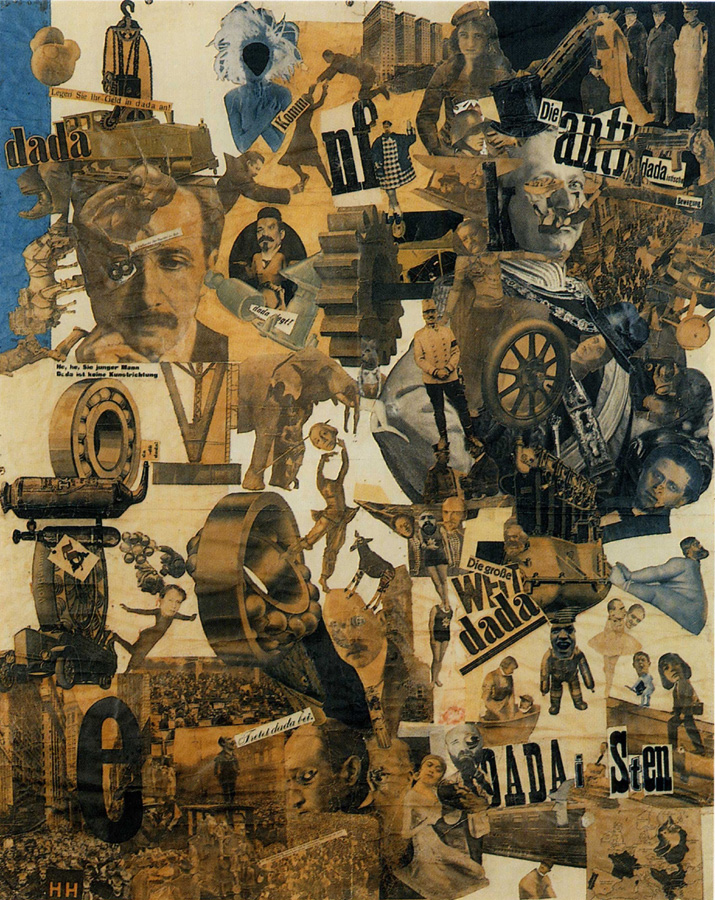
The Fair, and the women shoved aside
In the summer of 1920 the Berlin group staged its great spectacle, the First International Dada Fair: around two hundred works, slogans on every wall, and a stuffed dummy in a German officer’s uniform with a papier-mache pig’s head hanging from the ceiling, a gesture so contemptuous of the military it later drew prosecution. But the Fair is also where one of Dada’s ugliest truths shows clearly. Hannah Höch, who made the work that became the emblem of the whole movement, was nearly left out entirely. Grosz and Heartfield wanted her excluded; she got in only after Hausmann, her partner, threatened to withdraw his own work. Years later the Dadaist Hans Richter summed up Höch’s contribution to the group as “the sandwiches, beer and coffee she managed somehow to conjure up despite the shortage of money.” The line was both contemptuous and false: Höch held a paying day job at the Ullstein publishing house and was a working artist the whole time, not the group’s hostess. She wrote that the men “continued, into their old age, to look on us women artists as charming and gifted amateurs, denying us any real professional status.”
She was not alone in being written out. In Zurich, Sophie Taeuber-Arp was a serious abstract artist usually filed under her husband’s name; Emmy Hennings co-founded the entire Cabaret Voltaire and is remembered mostly as a singer; and in New York the Baroness Elsa von Freytag-Loringhoven turned her own body and apartment into art years before the men got around to it, and is now best remembered for a urinal that may be hers and is credited to a man. The movement that wanted to tear up every hierarchy kept one of them carefully intact. Name them, because their own colleagues mostly did not.