An island in the war
In February 1916, while the armies of Europe were settling into the second year of grinding each other to paste, two German refugees opened a nightclub in Zurich. One was the writer and theater director Hugo Ball. The other was the poet, singer and performer Emmy Hennings, a published author in her own right before any of this began and the equal co-founder of what they were about to make, not a hired act. (She tends to get filed under “Ball’s partner who sang,” which is the first small injustice in a story that has several.) Both had seen enough of the war’s logic up close to conclude that the whole civilization producing it had gone insane. Switzerland was neutral, an island of peace in a continent at war, which is exactly why the artists, the deserters, the pacifists and the exiles had all washed up there.
So on 5 February 1916 the two of them opened the Cabaret Voltaire(a cabaret being a small nightclub with a stage), tucked into a back room of a tavern at Spiegelgasse 1. They named it after Voltaire, the eighteenth-century French writer who had spent his life mocking the powerful, which tells you the program before the curtain even goes up. A press notice invited “young Zurich artists of all tendencies” to come and contribute. What turned up was stranger than anyone advertised.
Verses without words
A circle gathered fast: the Romanian poet Tristan Tzara, who would become the movement’s loudest mouth and tireless impresario; the Romanian painter Marcel Janco; the Alsatian artist Hans Arp(he also went by the French “Jean”); the German writer Richard Huelsenbeck; and the Swiss artist Sophie Taeuber, later Taeuber-Arp, who was making some of the most formally rigorous work in the room. What they did on the little stage had no precedent and was meant to have none. Poems were shouted in three languages at once, deliberately drowning each other out. There were chants and drumming, Hennings singing her cabaret songs, Janco’s jagged cardboard masks, and Ball’s sound poems, which he called “verses without words”: strings of invented syllables that meant nothing and were arranged purely for their noise. If that sounds like a child banging pots, that was rather the idea. Sense, they had decided, was what had built the trenches. Nonsense was the cure.
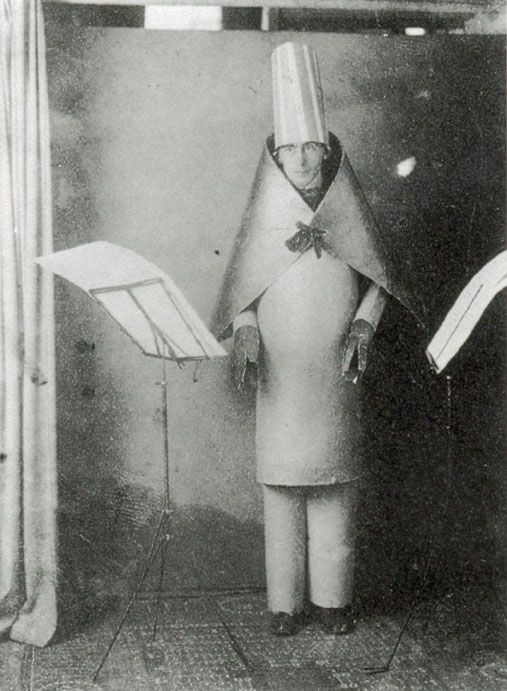
The most famous night came in June 1916, when Ball performed his sound poem “Karawane” dressed in a costume of stiff blue cardboard tubes for legs and a huge gold cardboard collar he flapped like wings. He could not walk in it. He had to be carried onto the stage and off again, intoning his made-up syllables like a priest of a religion that did not exist. It is the founding image of Dada: total seriousness and total absurdity wearing the same costume, and you genuinely cannot tell which one is the joke.
There was a verbal version of the nonsense too, and it became one of Dada’s most quoted recipes. Tzara’s instruction for making a Dada poem was, roughly: take a newspaper, cut out every word of an article, shake the words up in a bag, then draw them out one by one and copy them down in the order they come. The poem is whatever chance hands you. Remove the author’s taste and judgment from the work and let accident write it instead. Off to one side, quietly, Sophie Taeuber-Arp was making the most disciplined objects in the whole circle, spare geometric abstractions that were the opposite of the cabaret’s chaos, and the fact that she is most often remembered under her husband’s name is the same injustice the movement kept running, one we will hit again.
A word born no one knows how
At some point that spring the group needed a name, and they chose the word Dada. Where it came from is the most-disputed fact in the whole movement, and the honest thing is to tell the famous story as a legend rather than a fact. The legend goes that someone stabbed a paper-knife blindly into a French-German dictionary and hit “dada,” which in French is a child’s word for a hobby-horse. It is a wonderful story. It may even be true. But Tzara later claimed he invented the name himself, which set off a lifelong feud over who “owned” Dada, and the most reputable accounts simply shrug. What is not in doubt is that the word was chosen because it means nothing, or rather because its meanings are all trivial: a child’s toy in French, a brush-off in German, “yes, yes” in Romanian. A movement that had decided sense was the enemy could hardly march under a sensible banner. On Bastille Day, 14 July 1916, at the first public Dada soirée, Ball read the first Dada manifesto, which announced “Dada is a new tendency in art” and then gleefully explained that the whole point was that it meant nothing. A manifesto that argues itself out of existence. It would not be the last.