Surrealism takes the inheritance
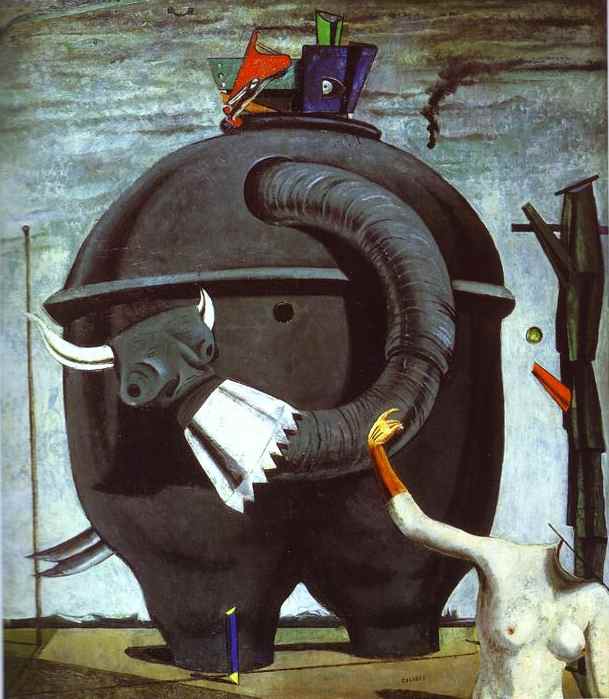
Dada did not so much die as get reorganized by the man who had broken it. Having driven Tzara out, André Breton took Dada’s best tools, its love of chance, its collage, its appetite for provocation, and pointed them somewhere new: at the unconscious mind and the dream. In 1924 he published the Surrealist Manifesto and Surrealismwas born, a movement that kept Dada’s methods but gave them a purpose Dada had refused to have. The Paris Dada circle simply walked across the bridge: Ernst, Arp, Man Ray, Éluard, Aragon, Breton himself all became Surrealists. Ernst’s strange Cologne pictures had been pointing this way all along. Look at his 1921 Celebes: a vast, rounded, dark body like a cast-iron boiler on legs, a ribbed tube curling up like a trunk ending in a blunt mechanical head, a small headless mannequin beside it, an empty sky behind. It is part machine, part beast, part nightmare, and it makes no rational sense at all, which is the point. This is Dada’s nonsense turning into the Surrealist dream, and it is often called the first masterpiece of Surrealist painting. Dada had hatched the movement that ate it.
The three things that outlived the joke
Strip away the clowning and three of Dada’s inventions ran forward and changed everything downstream. The readymade, Duchamp’s claim that choosing can be art, became the foundation of Conceptual art and of Pop Art, and is, in a real sense, the seed of much of the art made after 1950. Photomontage, the political cut-and-paste, found its full power in the 1930s when John Heartfield (Berlin Dada’s own) used it for savage anti-Nazi covers on a mass-circulation weekly, the same cut-up-the-daily-press weapon turned on fascism in the daily press itself, and from there the line runs straight to the protest poster and the punk record sleeve. And chancefed Surrealist automatism, the music of John Cage, the events of Fluxus and the whole idea of art as a procedure rather than a craft. There is a clean way to measure how far the joke traveled: in 2004 a poll of five hundred art-world professionals, asked to name the single most influential artwork of the twentieth century, did not choose a Picasso. They chose Duchamp’s urinal.
The gag and the earthquake
It is tempting to tidy Dada up into one thing or the other, to call it either a silly prank or a profound revolution, but it was emphatically both, and the refusal to choose is the point. The Dadaists genuinely meant the horse-laugh. They genuinely believed that after the trenches, reason and beauty and seriousness were a fraud, and that the only honest art was an art that attacked art. And it really was the seedbed of everything that came after. Hold both halves at once, the prank that felt like an ending and the idea that turned out to be a beginning, because that double nature is exactly what Dada built and exactly what it left behind. A movement whose name means nothing turned out to mean almost everything.