Not a club, and not two men
It is easy to shrink Fauvism to Matisse and Derain at Collioure, but the band that filled Room VII was real and various, and the lazy labels (the angry one, the quiet one) do them a disservice. What held them together was not a creed, there wasn’t one, but a shared permission: color chosen for effect. What they did with that permission ran from violent to decorative to almost shy.
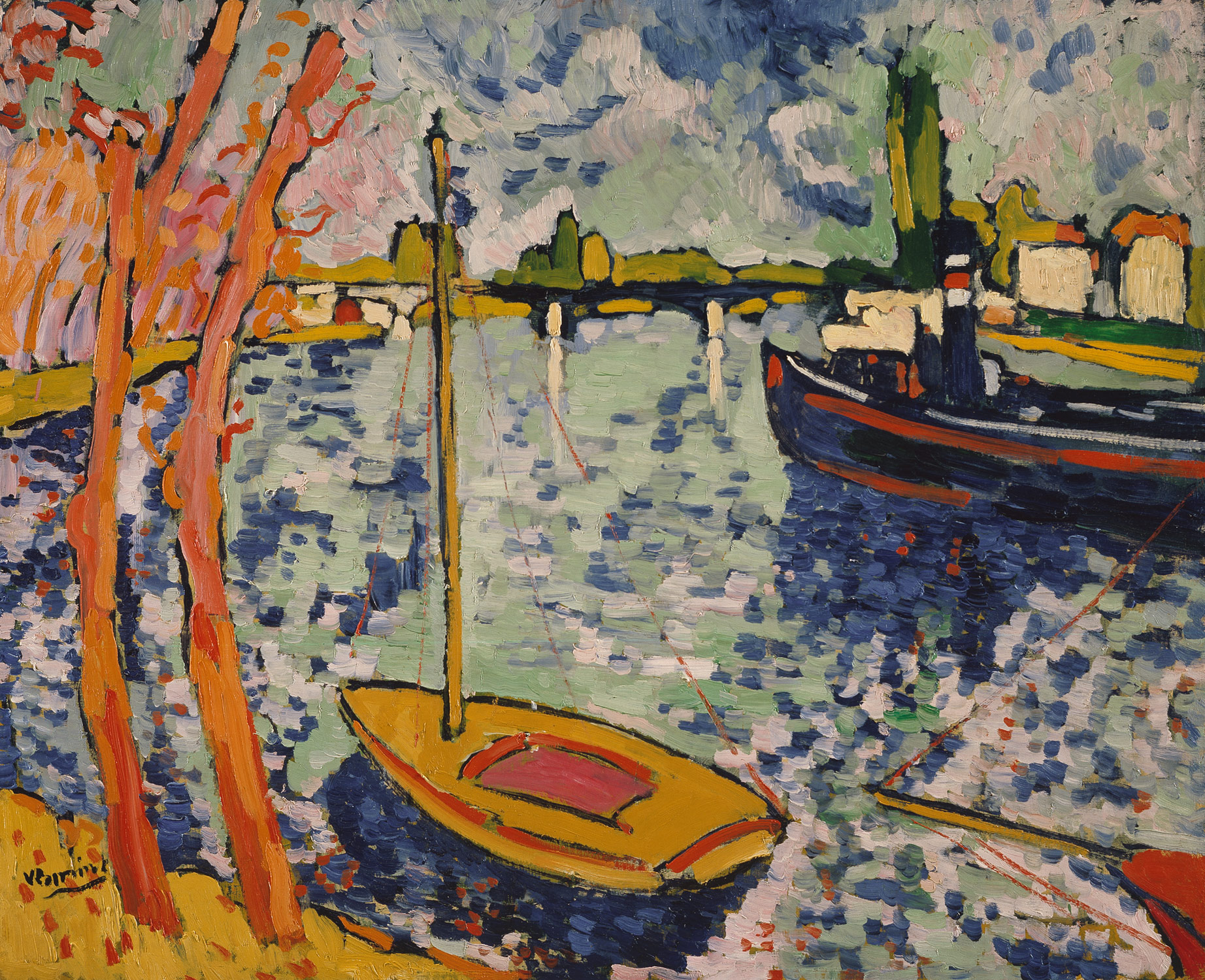
Maurice de Vlaminck pushed the color hardest of anyone. He squeezed cobalt, vermilion and chrome onto the canvas barely tamed, in thick, rhythmic, almost aggressive strokes, painting the riverside towns west of Paris as if the landscape were on fire from inside. At the other end stood Albert Marquet, who carried the bright Fauve key for only a season and then quietly stepped back into calm, tonal, gray-blue harbor and river views that he painted serenely for the rest of his life, the Fauve who tried the wildness on, found it wasn’t him, and folded it away.
From the port, and from the stage
The label kept pulling in more. From the port city of Le Havre came two friends, Raoul Dufy and Othon Friesz, both swept up after seeing Matisse’s work. Dufy became the most purely joyful of the Fauves: his Street Decked with Flags, Le Havre (1906) takes an ordinary street strung with French tricolor flags on a holiday and dissolves the whole thing into a confetti of bright Fauve patches, color as sheer celebration. His friend Othon Friesz, drilled in the dull browns of the academy, said the hot Fauve color came to him as a release, and for a few years he painted his home coast of Normandy in the same bright key before the pull of Cézanne’s structure drew him back toward weighed planes and quieter tones.

Then there was Kees van Dongen, a Dutchman in Paris who took Fauve color somewhere none of the others did, into the world of glamour. He aimed the wild palette at fashionable society portraits, dancers and cabaret performers, hot greens and acid pinks on the faces of singers under stage light. (He was, for a time, even a member of the German Die Brücke group, a living bridge between the French and German strands of the same impulse.)
Derain’s burning Thames
Monet had already painted the Thames, famously, a few years before: bridges and water dissolved into soft gray and lilac fog, the very breath of London weather. Then Derain went to London and painted the same river flaming. The dealer Ambroise Vollard, sensing a market, had sent him over in 1906, and he came back with around thirty canvases, Charing Cross Bridge, the Pool of London, Big Ben, in colors London simply does not wear: the Thames in orange and pink and green, the sky a pure rose. It is one of the cleanest demonstrations of the whole point. The same city, the same bridge, two painters, and the only difference is that one let the place choose the colors and the other let the picture choose them.

The high-water mark
The biggest single statement came from Matisse, at the spring 1906 Salon des Indépendants (the no-jury exhibition where anyone could show). Le Bonheur de vivre, “The Joy of Life,” is enormous, nearly six feet by eight, and it is the movement at full volume: a dreamy clearing full of nude figures lounging, dancing, embracing, the bodies drawn in flowing simplified outlines and the whole scene flooded with flat, saturated, clashing color, grass that goes orange and pink, trees that curl like ribbons, no shadow doing any honest work anywhere. It was the grandest thing Fauvism produced, an entire imaginary arcadia built out of the new freedom. It is also worth seeing clearly what that arcadia is: a European fantasy of a golden age outside civilization, the kind of “natural” paradise the period routinely imagined through non-Western bodies and landscapes. The art-historical name for that habit is primitivism, and it is part of the colonial picture (the same one Gauguin sits inside) that Fauvism’s “freedom” has had to be reckoned with against, not waved away.

It also became a turning point in a rivalry, though here the story has to be told carefully. Le Bonheur de vivre was the sensation of 1906, and the following year Picasso unveiled Les Demoiselles d’Avignon (covered in depth in this era’s Cubism reads). Many people, then and since, have read the Demoiselles as Picasso’s answer to Matisse’s arcadia, his attempt to outdo the reigning shock-picture of Paris. The rivalry was real and the chronology fits, but no one can show that Picasso set out to beat Matisse; it is a reading the pictures invite, not a plan anyone recorded. And the picture that supposedly provoked the Demoiselles points, by the same stroke, at the thing about to kill Fauvism, because the Demoiselles belongs to what came next.