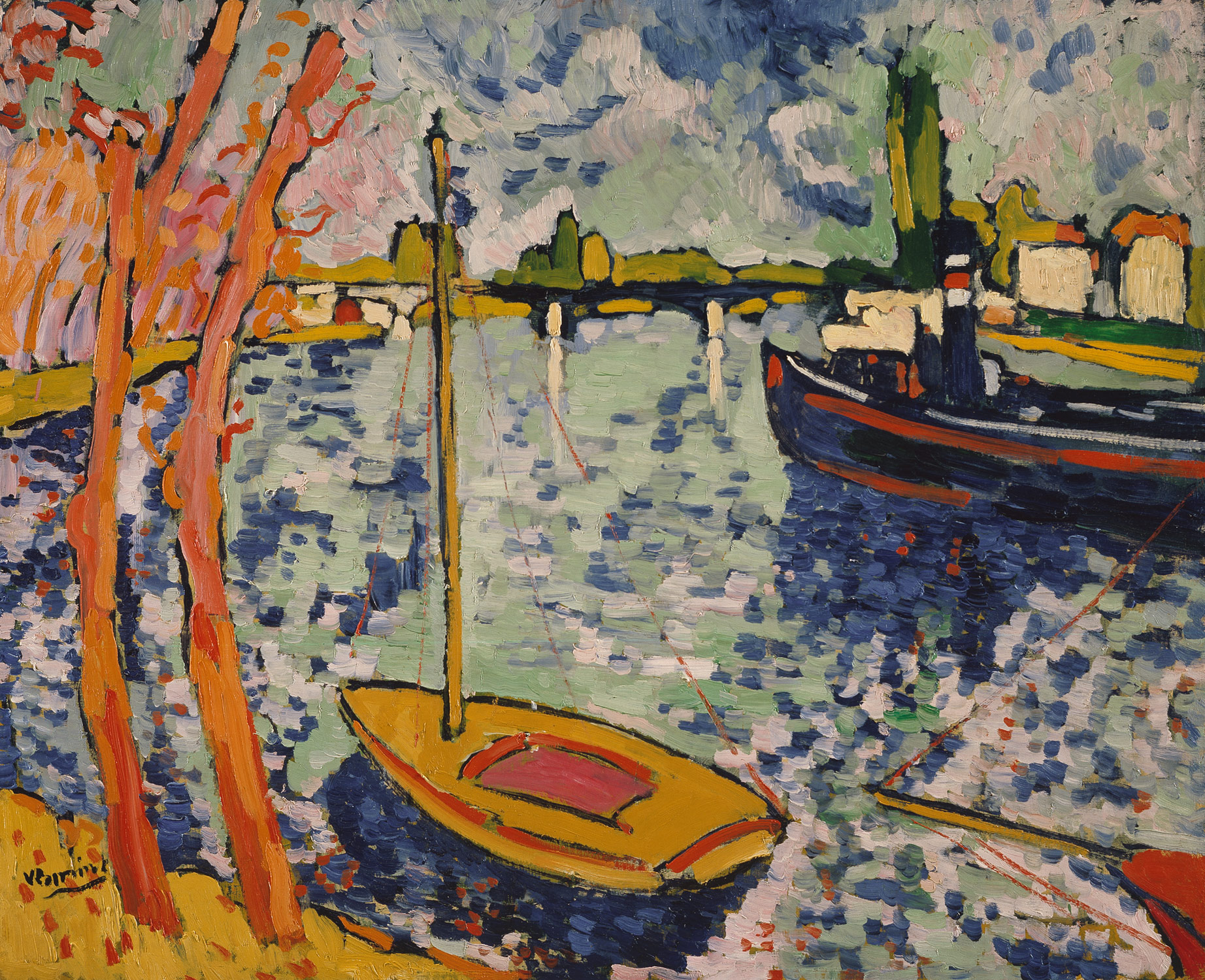
For roughly four hundred years in European painting, color had a job: tell you the dress is blue, the apple red, the shadow cool. For about three years after 1905, a loose band in France fired color from that job. A face could carry a green stripe, a road could run orange, a harbor could be pink and turquoise, not because anything was that color but because the picture wanted it. A hostile critic called them les fauves, the wild beasts. They never chose the name and never quite shook it, and the freedom it mocked outlasted everyone who laughed.
For something like four hundred years, color in European painting had one assignment: describe. It told you the local color of things (the flesh is pink, the sea is blue-green) and it modeled light and shadow so a flat cloth read as a round, solid world. Even the Impressionists, who shattered color into thousands of bright separate touches, were still chasing the same prize, the real light falling on real things. Monet’s regatta is color at its most liberated and still completely loyal: every dab of blue and white is reporting on actual water and actual sky.
The Green Stripe fires color from that job. Matisse paints his wife Amélie with a band of pure green running down the middle of her face, one cheek cool, one cheek warm, the background slammed in as slabs of orange and pink. Nobody’s face is green. The stripe is not a shadow, not a reflection, not anything you could photograph. It is there because the composition needed a cool axis to push the warm flesh against. Three moves are doing the work: color chosen for effect, not accuracy; pure unmixed color laid on straight (no blending toward “realistic” hues); and flatness, the shading that used to fake roundness simply dropped, so the canvas reads as a bright patterned surface instead of a window.
That is why Fauvism counts as a new movement and not just a louder palette (a painter’s palette being the range of colors they work in). It did not improve how color described the world. It cut the cord between color and description entirely. After 1905, in the Western tradition this story maps, a painter no longer owed the world its real colors, and every later use of arbitrary, expressive, or purely decorative color is spending the permission the Fauves bought.
Fauvism is the movement with nothing to quote. There was no founding manifesto (a manifesto being a public declaration of a movement’s program and principles), no founding meeting, no program, no membership list, not even a name the painters chose for themselves. A hostile critic named them, as an insult, and they kept the insult because it was the only label anyone could agree on. A movement defined entirely from the outside has no statement of its own, and that absence is the honest record.
The closest thing to a creed is a single essay, and it is Matisse speaking only for himself. “Notes of a Painter” (Notes d’un peintre) appeared in the Paris journal La Grande Revue on 25 December 1908, written as a reply to critics of the new painting. It is a personal account of one man’s aims, not a platform spoken for a group, and its timing gives the game away: by December 1908 the 1907 Cézanne retrospective and Braque’s Cubist summer had already pulled the band apart. The essay reads less as Fauvism’s flag than as Matisse-the-individual, published just as the thing it might have spoken for was breaking up.
Two lines carry the whole of his thinking. The first is almost a slogan: “What I am after, above all, is expression.” The second tells you what expression meant to him, that a picture is built, not transcribed: “Composition is the art of arranging in a decorative manner the diverse elements at the painter’s command to express his feelings.” A creed for one painter, arriving too late to be a flag for the rest.