Grey island, glossy dream
Start with the thing almost everybody gets wrong. Pop Art did not start in America with Andy Warhol. It started in Britain, years earlier, and for a very British reason: envy. In the late 1940s and early 1950s Britain was still digging out of the Second World War. Food was rationed (some of it until 1954), cities were bombed flat, money was tight, and everything was, by every account, grey. Across the Atlantic sat America, fat and bright and undamaged, pumping out a flood of glossy mass culture that washed up in British magazines and movies: Hollywood stars, enormous chrome cars, full-color advertising, pulp sci-fi, comics, supermarket packaging in colors Britain had not seen on its own shelves in years. To a young British artist, all that abundance was a fantasy, half-loved and half-suspicious, beamed in from a richer planet. That mixture, hunger plus a cool analytical distance, is where Pop was born.

The people who first turned it into art were a loose circle of young artists, critics and architects who met at the Institute of Contemporary Arts in London. They called themselves the Independent Group (an informal discussion club, not a school or a gallery), first convening in the winter of 1952. Two of them carry the story here: the sculptor and collagist Eduardo Paolozzi, who had the eye, and the painter Richard Hamilton, who supplied the theory. Around them sat photographers, designers and critics, including Lawrence Alloway, usually credited with first attaching the phrase “Pop art” to all this. What bound them was a refusal to sneer. The respectable view was that American mass culture was junk, beneath serious art. The Independent Group looked at the junk and got fascinated, studying car styling and ad layouts with the seriousness others gave old masters, and asked the question that became Pop: why is this not art?
A toy gun that fires the word “POP”
The first to act on it was Paolozzi, a Scottish-Italian sculptor who had hoarded American magazines for years. As early as 1947, a full decade before anyone used the term, he was cutting up that hoard into collage (an image built by pasting found scraps of printed paper onto a surface, a technique inherited from Dada). The one to picture is I was a Rich Man’s Plaything: a dense sheet of cuttings, a pulp-romance cover, a Coca-Cola ad, a cherry-pie ad, a pin-up, an Army recruiting hand, and in the corner, cut from the packaging of a toy gun, a pistol firing a little puff of smoke with one word printed inside it, “POP!” That puff is often called the first appearance of the very word in this art, a comic-book gunshot that happens to spell out the name of a movement that did not yet exist.

The whole consumer dream in one room
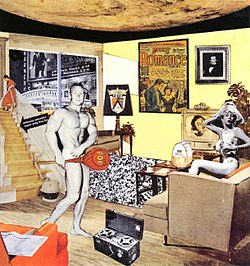
The picture usually called the first iconic Pop work came nine years later, from Hamilton, the most deliberate thinker in the group. For the 1956 London exhibition This Is Tomorrow he made a tiny collage, about ten inches square, with a title as long as a sentence: Just what is it that makes today’s homes so different, so appealing? It is a single modern living room pasted from magazine cuttings and stuffed with every shiny promise of 1950s life at once: a bodybuilder flexing in the center, holding a giant Tootsie Pop the size of a tennis racket with the word “POP” up its wrapper (there it is again); a pin-up in a lampshade hat; a television, a tape recorder, a vacuum cleaner, a tinned ham on the coffee table like a centerpiece, a comic-book cover framed on the wall as if it were a painting. The entire dream of postwar abundance, deadpan, in one room, assembled from the ads, a piece of consumer culture made of consumer culture.
The year after, Hamilton wrote the nearest thing Pop ever had to a creed, and it was a private letter, not a manifesto: a 1957 note to the architects Alison and Peter Smithson listing the “characteristics of pop art.” The list reads exactly like the advertising it describes, popular, transient, expendable, low cost, mass produced, young, witty, sexy, gimmicky, glamorous, big business. Nothing about the soul, beauty or genius. A product spec sheet for a movement, and that flatness is the message. British Pop kept going (Peter Blake, who would later design the Sgt. Pepper sleeve; the young Hockney; and one woman, Pauline Boty, whom a later chapter will not let the story forget), but by the late 1950s the center of gravity was shifting west. The British had the idea first. The Americans were about to make it loud.