MODERN · MOVEMENT · 10 OF 10

Pop Art

1956–1970 · ~14 years
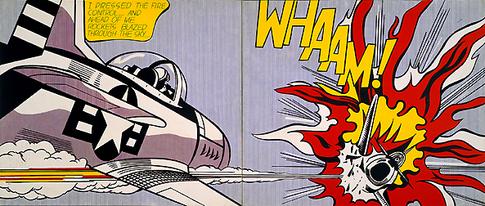
Roy Lichtenstein, Whaam!, 1963 · Tate, London · in copyright, shown small under fair use

Pop Art took the cheapest, most public images anybody saw every day, soup labels, comic strips, advertising, movie stars, supermarket packaging, and made them the content of serious art, done cold. It was the cool, flat, mechanical answer to Abstract Expressionism’s hot, gestural, soul-baring painting, and it started in Britain first, not America: a London discussion club called the Independent Group got obsessed with glossy American mass culture in grey, rationed postwar Britain years before Warhol picked up a silkscreen. Then America made it enormous, Warhol’s grids of soup cans and silkscreened Marilyns, Lichtenstein’s giant comic panels, Oldenburg’s saggy soft hamburgers. The deepest question Pop poses it never answers on purpose: is this a love letter to consumer abundance or a deadpan burial under it, and the same deadpan also hid, for decades, the women it wrote out, the near-total whiteness of its canon, and the uncredited people whose designs and labor the machine ran on.

Read the Pop Art story6 chapters · 1956–1970
The manifesto

“Pop Art is: Popular (designed for a mass audience), Transient (short-term solution), Expendable (easily forgotten), Low cost, Mass produced, Young (aimed at youth), Witty, Sexy, Gimmicky, Glamorous, Big business.”

“The reason I’m painting this way is that I want to be a machine. (Andy Warhol, 1963)”

— The “characteristics of pop art” (Hamilton’s 1957 letter), Richard Hamilton · 1957 · a private letter to the architects Alison and Peter Smithson, fellow members of the Independent Group; later reprinted so often it became the de-facto definition of the movement

Pop never got a manifesto. It got a letter. Most movements announce themselves with a public declaration nailed to the door of the art world. Pop had no founding document and no signatures, which fits a movement that was deadpan and noncommittal on principle. What it had instead was a private letter: in 1957 Richard Hamilton wrote to his friends Alison and Peter Smithson, two architects in the Independent Group, and listed what “pop art” should be.

The list is the closest thing the movement ever had to a creed, and it reads exactly like the advertising it was about: popular, transient, expendable, low cost, mass produced, young, witty, sexy, gimmicky, glamorous, big business. That is not a call to arms. It is a product description, and that flatness is the message. There is nothing in it about the soul, beauty, or genius.

Andy Warhol gave the movement its other famous lines, but they are color, not a creed. “I want to be a machine,” he told an interviewer in 1963, and meant it as a compliment. (A line about everyone being world-famous for fifteen minutes is also attached to him, but it was first printed in 1968 and he may never actually have said it, two facts worth keeping straight.)
Read Hamilton’s list on Tate’s Pop art page (1957)
How the influence flowed
Grew out of
Abstract Expressionism
gave: the foil, inverted on every axis
Neo-Dada (Johns, Rauschenberg)
gave: the door, the everyday object back in
Dada & the readymade
gave: collage, appropriation, the readymade
Mass culture
gave: the raw material and the subject
Pop Art1956–1970
Led to
Conceptual art
took: the idea, not the object, is the art
The Pictures Generation
took: appropriation as a critical weapon
Neo-Pop (Koons)
took: consumer kitsch and branding as fine art
Today’s image world
took: the high/low wall, gone for good
Pop took Abstract Expressionism’s scale and Dada’s readymade, turned art outward to the cheapest, most public mass imagery and rendered it cool and mechanical, and handed appropriation and mechanical reproduction forward as legitimate art, dissolving the wall between fine art and the commercial image so completely that the museum and the supermarket now speak the same visual language.
The details
~14 yrs
Span
Britain → USA
Born in
vs
british
British Pop (the Independent Group)
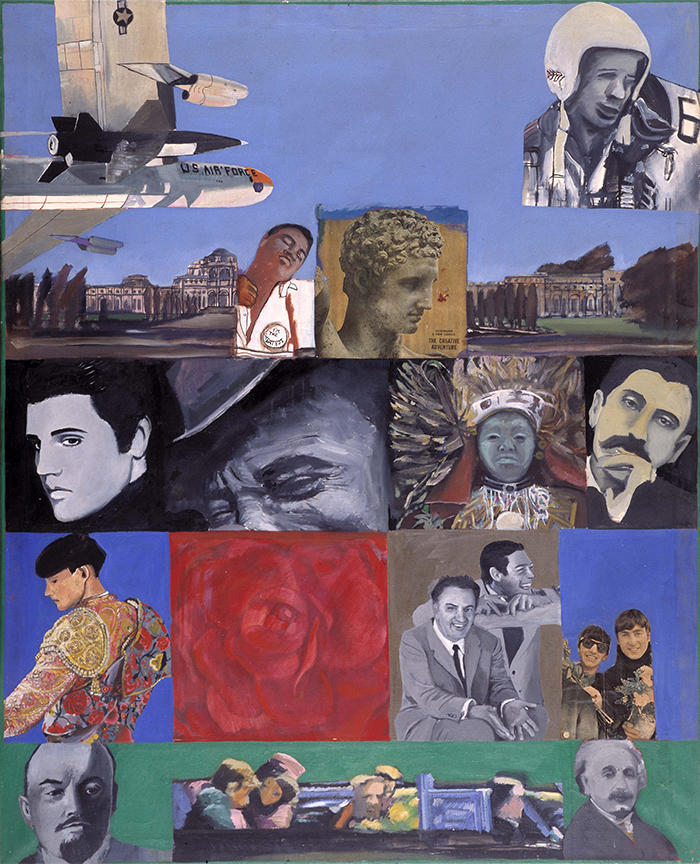
Hamilton · Paolozzi · Blake · Boty
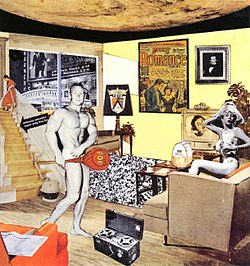
It started here, in grey postwar London. A circle of young artists, critics and architects (the Independent Group) at the ICA got hypnotized by the glossy American abundance flooding in from across the Atlantic, and built art out of it. Paolozzi’s 1947 magazine collages, Hamilton’s tiny 1956 living-room collage, and the 1957 letter that defined Pop like an ad slogan. Cooler and more analytical than the American wave, and years earlier.
american
American Pop
Warhol · Lichtenstein · Oldenburg · Rosenquist
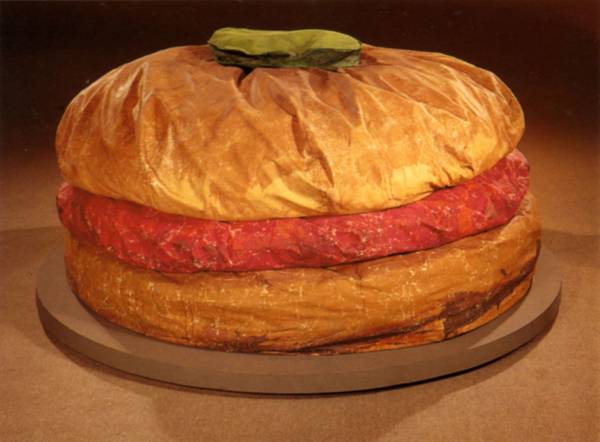
The second wave, and the bigger one. America took the British idea and made it huge, brash and unmissable: Warhol’s soup-can grids and silkscreened Marilyns out of the Factory, Lichtenstein’s comic panels at billboard size, Oldenburg’s giant soft hamburgers, Rosenquist’s room-length splices. Where the British circle studied mass culture, the Americans matched its scale and gloss head-on.
Meanwhile, elsewhere
Other movements in the same years
1957 · USA / UK
The consumer boom
Pop is inseparable from the supermarket, the suburb, the TV set and Madison Avenue. Postwar prosperity flooded America with branded goods and ads; the British fascination was sharper because Britain was still grey and rationed while American abundance glittered from across the Atlantic.
1952 · New York
Abstract Expressionism’s reign
While Pop was being born, AbEx (Pollock, Rothko, de Kooning) was the establishment avant-garde, the hot lone genius baring his soul. Pop’s rise is the story of AbEx being dethroned by the cool machine.
1962 · the West
The celebrity machine
Television, glossy magazines and Hollywood’s star machine peaked in these years, manufacturing fame as a product. Warhol’s Marilyns (made the month she died) ride that wave: fame, repetition, image-as-merchandise.
9 featured works
Canonical works · 18
1954FlagJohns
1955BedRauschenberg
1961The StoreOldenburg
1962Floor BurgerOldenburg
1962Marilyn DiptychWarhol
1963Drowning GirlLichtenstein
1963Whaam!Lichtenstein
1964Brillo BoxesWarhol
1964Marisol’s carved-wood Pop figuresMarisol
1965F-111Rosenquist