Built from cigar-box sketches
Start with the size, because everything else answers to it. Bathers at Asnières is about 6 feet 7 inches tall and 9 feet 10 inches wide. That is Salon scale, the acreage the official exhibition spent on history’s great moments. Seurat spent it on an afternoon by the river.
He did not improvise a thing that big. He built it the patient, academic way. Out on the actual riverbank in 1883 he made roughly fourteen small oil studies he called croquetons (kro-keh-TOHN, “little sketches”), some of them painted on the lids of cigar boxes and other scraps of panel, plus a set of careful drawings in conté crayon (a hard drawing stick of compressed chalk and graphite). Then he carried all of it back to the studio and assembled the giant canvas from the parts, finishing it in the spring of 1884. The on-the-spot freshness and the studio control are both in the final picture at once.
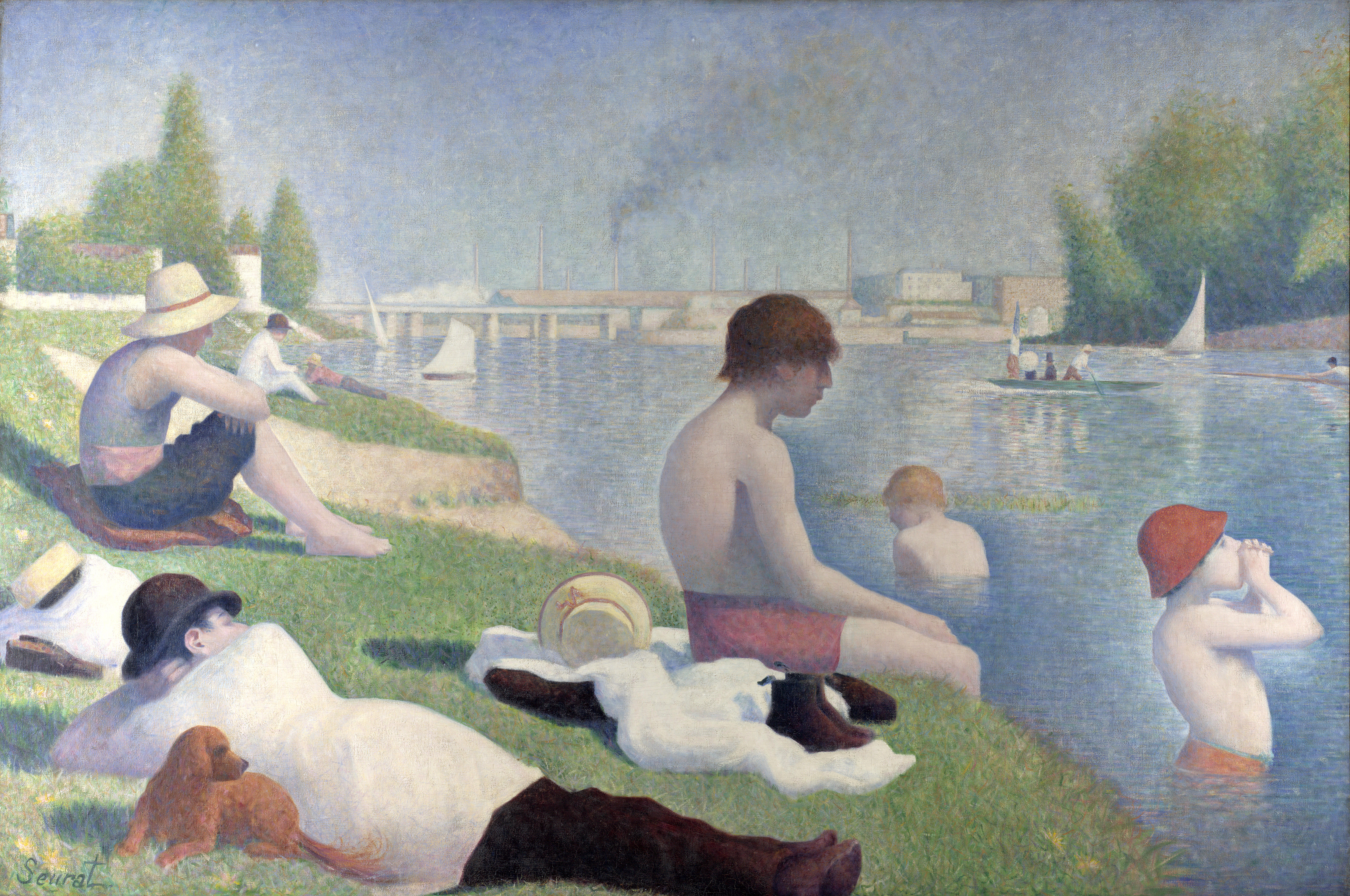
Balayé: swept, not dotted
Look closely at the grass and the water and you will see Seurat’s technique here was not yet the famous dot. He laid the paint in long, controlled, criss-crossing strokes he called balayé (bah-lah-YAY, “swept”), a woven, disciplined hatching. That is where the painting’s strange calm comes from: the surface is even and brushed, the figures are smooth and frieze-like, everyone is still. This is a picture about order, built stroke by careful stroke.
Two methods on one canvas
Here is the part people get wrong, so it is worth getting right. A few years after he finished the Bathers, around 1886 to 1887, Seurat had worked out a new method on his next big canvas, and he went back into this one and added small pointillist dots in a few places, most visibly around the orange-red hat of the boy out in the water. (Quick definitions, because the words get muddled: Pointillism is the popular name for painting in separate small dots; Divisionism is the more precise name for the underlying idea, placing separate touches of unmixed color so the eye, not the palette, does the blending. Seurat himself preferred “Divisionism” for the method. The two are not interchangeable: pointillism describes the dots, divisionism the color theory behind them.)
But do not let anyone tell you he repainted the Bathers in dots. He did not. This was localized retouching, a hat here, an edge there, dropped into an already-finished canvas, not a conversion. What it leaves you with is rare and lovely: a single picture where you can see both of Seurat’s techniques at once, the early woven sweep across most of it and the later separate dots in a few small patches, the artist’s whole evolution caught on one wall.