A frozen Sunday, seven by ten feet
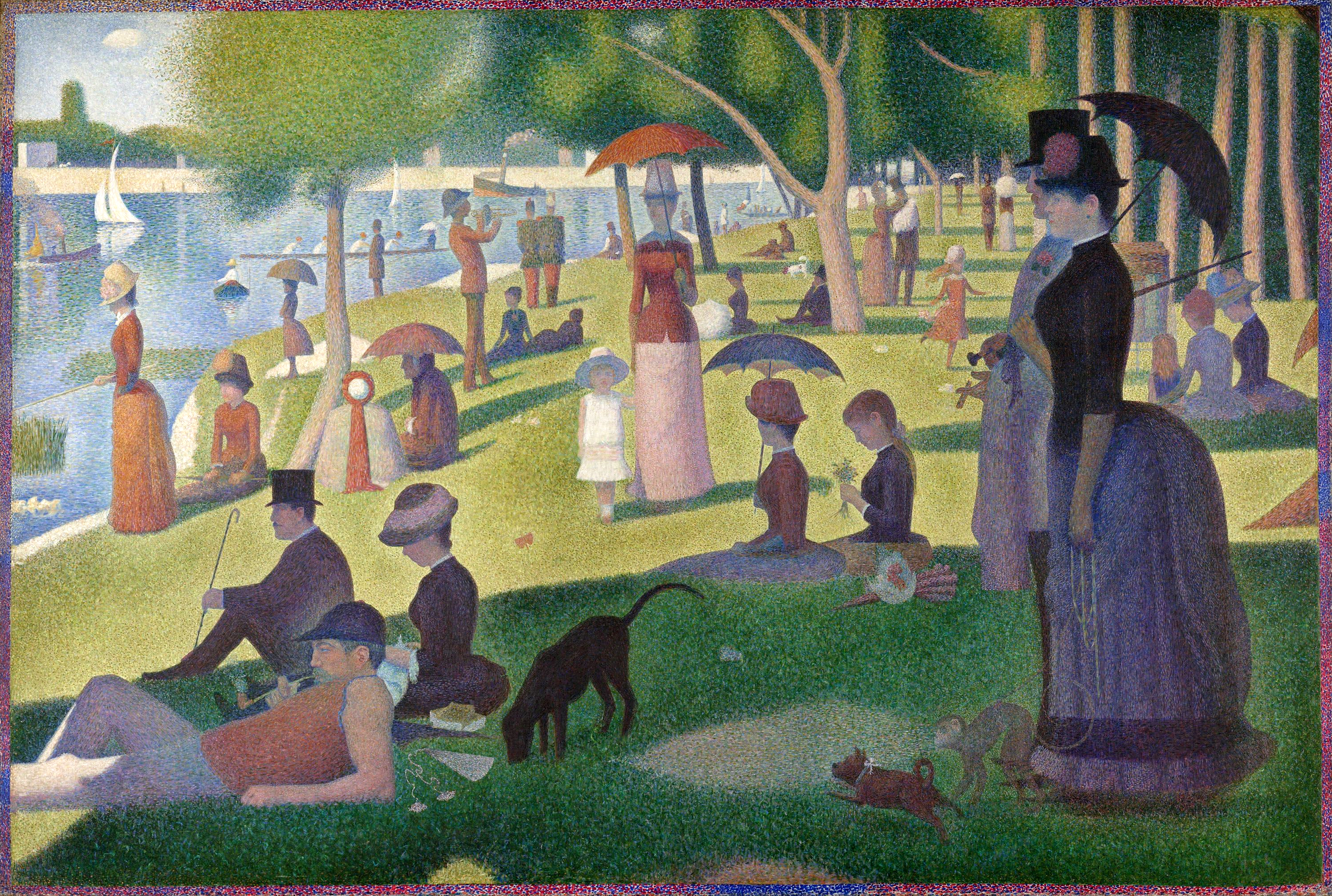
First, the scale, because it is part of the shock. The Grande Jatte is enormous: about 6 feet 9¾ inches tall and 10 feet 1¼ inches wide (207.5 by 308.1 centimeters), call it roughly seven feet by ten. It fills a wall. And what fills that wall is, strangely, the calmest, most frozen crowd in art. Roughly forty-eight people(the commonly cited count, so call it “about forty-eight,” not a hard official number) stand and sit across a sunlit lawn, and almost none of them move. Look at how they are posed: nearly every figure stands bolt upright or sits perfectly straight, faces turned in profile or dead away from us, and not one of them is touching, gesturing to, or even looking at another. A real park on a Sunday is full of slouch and motion and people leaning in to talk; here the bodies are spaced out like chess pieces and held in place, each sealed in its own column of air. People in 1886 found that stillness unsettling, and it is still the first thing you feel: a holiday crowd rendered as motionless as a row of statues.
The monkey, the girl, the fisher
Now hunt for the details. Foreground right: an elegant couple, and at the woman’s feet, on a leash, a small pet monkey, the thing nearly everyone misses. Some scholars read the monkey as a sly social note (the French singe carried a pun about loose morals), but treat that as interpretation; the animal itself is verifiably there. Among the figures are several dogs, people fishing, a man playing a horn. At the left waterline, a standing woman holds a fishing rod, and some make a pun of that too, since the French for “to fish” sounds like “to sin,” but again, that is a reading, not a fact. And near the center stands a little girl in white, painted almost without dots, brightly lit, the one clear, still point the eye rests on in all the shimmer.
Optical mixing, and a darkened lawn
Get close and the whole picture falls apart into separate dots of pure color; step back and they fuse into solid, glowing form. That is optical mixing in action, and the broad sunlit lawn is the best place to test it: up close it is a confetti of green, yellow, orange, and blue, and from across the room it reads as one luminous field of grass. But a warning about that grass: look for dull brownish patches in it. Those are not what Seurat intended. He used a zinc yellow pigment that has chemically darkened to brown over the decades, so the lawn was meant to be much brighter and more golden than it now appears. What you are looking at is, in part, a faded picture, a real conservation fact, not the original effect.