The too-clear nightmare
The automatists let the picture happen. The other half of Surrealism did the reverse. The dream-image painters (their other name is the veristic stream, from the same root as “verity”; veristic means truth-to-appearance) planned and executed impossible scenes with the slow, exact, photographic finish of an old master, precisely so the irrational would look undeniable. A melting clock painted as a smear is just a smear; a melting clock painted with every reflection in place, on a real-looking table on a real-looking shore, forces your eye to believe a thing your mind knows is impossible.
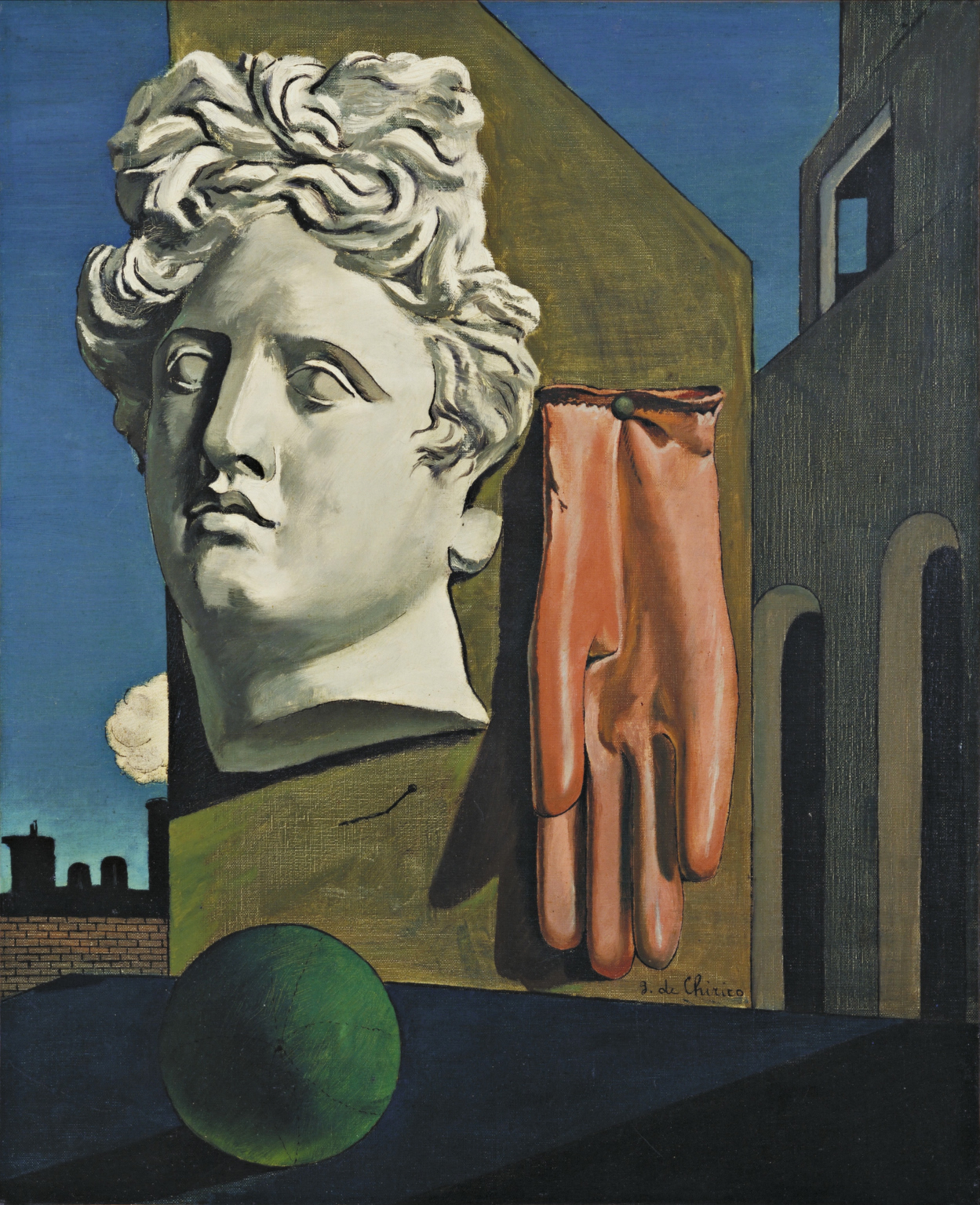
The visual grandfather of this stream had been working a decade before Surrealism had a name. The Italian painter Giorgio de Chirico, in his Metaphysical painting (in Italian pittura metafisica, his term for an art of dream-logic and dread built from ordinary things), painted empty Italian squares with long raking shadows, classical statues, distant trains and faceless tailor’s dummies. The Song of Love (1914) nails a Greek head and a red surgeon’s rubber glove side by side to a wall, a green ball below, a train on the horizon, an utterly calm picture of an utterly impossible arrangement. Nothing melts and nothing screams; the dread comes from the silence and the wrongness of the light. Ernst, Tanguy, Dalí and Magritte all drank from de Chirico. He is the literal visual DNA of the movement, which is why his earlier pictures, not the more famous later ones, are the ones in public collections.
The clocks, and the man who would not stop talking
The showman of the stream was the Spaniard Salvador Dalí, who joined around 1929 and painted the single most famous Surrealist image. There is a catch: the picture cannot be shown, because The Persistence of Memory (1931) is still under copyright. So take it in words, and it is worth the slow look. The light is hard and clear, a deserted luminous shoreline running back to the gold cliffs of Dalí’s own Catalan coast. At the left edge stands a plain table, its hard corner jutting forward. Now the watches, one at a time. One pocket watch drapes limp over the table edge, drooping like something left too long in the sun. A second hangs off the dead branch of a leafless olive tree, melted soft and folded over the wood like wax. A third slumps across a strange pale shape on the sand, an eyeless, sleeping-face creature, half a face and half a slug. The fourth, the only firm one, is a closed orange watch crawling with black ants. Take in the whole: hard light, hard ground, and time itself gone soft, the scene held in a dream-stillness. And it is tiny, about nine inches by thirteen, painted with a jeweler’s precision, the impossible softness sitting inside a world rendered exact.
Dalí had a name for his method: the paranoiac-critical method. The idea was to deliberately induce in himself a paranoid, hallucinatory way of seeing, the kind of mind that reads a hidden second image into everything, and then paint both images at once so the canvas flickers between them. As for the watches, Dalí said they came to him contemplating a runny Camembert cheese at the end of a meal. File that exactly where it belongs, as Dalí’s own story; he was a relentless self-mythologizer who never let a fact get in the way of a better line about himself. Before the clocks, he had already proved the dream image would work in any medium. With the filmmaker Luis Buñuel he made Un Chien Andalou (1929), a short film of pure dream-logic whose opening shot, a straight razor drawn across a woman’s eye, still lands like an assault. The dream image, now moving on a wall.

The pipe that is not a pipe
Where Dalí performed, the Belgian René Magritte sat perfectly still. His paintings are flat, sober and as plainly painted as a shop sign, which is exactly what makes them unsettling: he renders the impossible in the bland, reasonable voice of an instruction manual. His most quoted picture is a lesson in one image. The Treachery of Images (1929) shows a single brown pipe, carefully painted, and beneath it, in tidy cursive, “Ceci n’est pas une pipe,” this is not a pipe. The first reaction is to object: of course it is. But Magritte is right and you are wrong. It is not a pipe. It is a picture of a pipe. You cannot pack it with tobacco; the word, the painted image, and an actual pipe you could hold are three different things, and we go through life cheerfully confusing them. He delivers the cleanest one-line lesson in modern art with the straightest face imaginable. (He kept worrying the same theme for decades; his later The Son of Man (1964) shows a man in a bowler hat whose face is blocked by a hovering green apple, a self-portrait that hides the self.)

A desert of stones
The third dream-image painter worth knowing is the Frenchman Yves Tanguy, entirely self-taught, who decided to become a painter on the spot in 1923 after glimpsing a de Chirico in the window of a Paris gallery from a passing bus and leaping off to look. He never trained and he never strayed: Tanguy invented a single landscape and painted it for the rest of his life, a vast, evenly lit plain receding to a far low horizon, the ground littered with smooth pale shapes like bones or pebbles worn round by some invisible sea. Nothing in it is nameable and nothing is alive, but the light is so consistent and the space so deep that you believe in the place completely. Breton thought him the most faithful of all of them to Surrealist principles. His mature work is all from the 1930s and 1940s.