Woman everywhere, women nowhere
Surrealism had a problem it never solved and mostly never noticed. The Surrealists were obsessed with “woman.” She was their great subject and symbol: the muse, the gateway to the marvelous, the embodiment of desire and the irrational. They had a special idol, the femme-enfant, the “woman-child,” an ideal of a young woman supposedly closer to the unconscious precisely because she was naive and unschooled. On canvas and in the manifestos, woman was everywhere and exalted. In the studio and on the membership lists, real women were mostly somewhere else, welcomed as lovers, models and muses, and slow to be treated as serious artists. That is the contradiction: a movement that put woman at the dead center of its art while keeping actual women out of the room where the art was discussed.
Name them
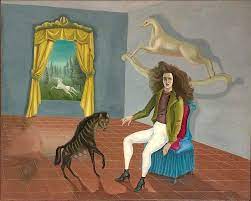
And yet the women were there, they were good, and several made work that outlasted the men’s. Leonora Carrington came into the orbit through a relationship with Max Ernst, twenty-six years her senior, and was treated as the femme-enfant ideal made flesh. She was also a painter and writer of ferocious originality who built an entire private mythology of alchemy, animals and dream. Her Self-Portrait (Inn of the Dawn Horse) (c.1937–38) shows her seated in jodhpurs with a lactating hyena beside her, a white rocking-horse floating behind her head, and a real horse galloping free out the window, a woman painting her own dream-world rather than posing inside a man’s. She left Europe, settled in Mexico, and worked for another seventy years.
Meret Oppenheim, Swiss-German, made the single most famous Surrealist object of them all, and she made it at twenty-two. The men around her tended to condescend to her as a pretty young protégée; the object answered them. Object (1936), often called Breakfast in Fur, is a teacup, saucer and spoon entirely covered in gazelle fur. It started as a café joke in Paris with Picasso and the photographer Dora Maar about covering anything in fur, and it turns the most genteel ritual imaginable, taking tea, into something animal and faintly revolting: a cup you cannot drink from without putting fur to your lips. It was the very first work by a woman artist the Museum of Modern Art ever acquired, and its sudden total fame so overwhelmed Oppenheim that she walked away from the Paris scene for years.

The list runs on, and each deserves better than a name. Dorothea Tanning painted her own arrival: her Birthday (1942) is a self-portrait staged like a dream, the artist bare-breasted in a narrow corridor where door after door swings open into a receding infinity of rooms, her skirt dissolving into a tangle of writhing roots, a small winged lemur-like creature at her feet. Remedios Varo, the Spanish-Mexican painter, worked in a wholly different key: meticulous, jewel-like interiors that look like pages from an alchemist’s manual, hooded figures in narrow towers spinning thread out of moonlight, every panel painted with the patience of a Renaissance miniature. Claude Cahun, the French photographer, turned the self-portrait into a laboratory of identity decades before the vocabulary existed, shaving the head bald, posing as a weightlifter, a doll, a masked androgyne, insisting the self was a costume you could change. Leonor Fini painted commanding sphinx-women and pointedly refused to formally join Breton’s group, keeping the imagery and declining the membership; Kay Sage painted austere architectural dreamscapes stranded in empty light.
The artist who refused the label
And then there is Frida Kahlo, the Mexican painter, whom Breton met and promptly tried to claim for Surrealism, declaring her work surrealist as if that settled it. Kahlo declined flatly. “I never painted dreams,” she said. “I painted my own reality.” It is the cleanest rebuke the movement ever got: the most famous painter Breton tried to absorb looked at the label and refused it, on the grounds that her work was not fantasy at all but the literal facts of her own broken body and divided life. Include her here not as a Surrealist but as the artist who saw the label clearly and walked away. The summary is the one the men of the movement could never quite make: Surrealism worshipped woman and sidelined women, and the women it sidelined were, several of them, the equals or betters of the men idolizing them.