The painter becomes a politician
When the French Revolution came in 1789, David did not merely cheer it from the studio. He climbed inside it. He is the rare case of a great painter who became, for a few violent years, an actual revolutionary official, and the facts of it are worth stating plainly, neither softened nor sensationalized, because they are how the severe Roman style became the literal look of the new French state.
David was elected a deputy to the National Convention (the revolutionary assembly that governed France and abolished the monarchy). He sat with the Montagnards, the most radical faction, and when the deposed king Louis XVI was put on trial, David voted for his execution, making himself a regicide (a killer of a king); his royalist wife divorced him over the vote. He joined the Jacobin Club, the engine room of the radical Revolution, became an ally of its leader Maximilien Robespierre, sat on the feared Committee of General Security that hunted the Revolution’s enemies, and for a stretch served as President of the Convention itself. Contemporaries called him “the Robespierre of the brush.” And he ran the Revolution’s images: he designed and staged its great public festivals and funerals as vast open-air Neoclassical theater, antiquity brought to life in the streets of Paris, the most famous being the Festival of the Supreme Being in June 1794 (a vast open-air pageant staged to swap out Christian worship for a new state religion of reason and civic virtue).
A murdered man painted as a saint
Out of all that came the strangest and greatest picture of his career, and one of the strangest in all of European art: a piece of government propaganda that is also a masterpiece. Jean-Paul Marat was a radical journalist and a fellow Montagnard deputy, a friend of David’s, who suffered from a painful skin disease that forced him to spend hours soaking in a medicinal bath, where he also worked. On 13 July 1793 a young woman named Charlotte Corday, who blamed him for the Revolution’s bloodshed, talked her way into his rooms and stabbed him to death in that bath. The Convention asked David, Marat’s friend and the Revolution’s image-maker, to paint him. What he produced was The Death of Marat (1793).
It shows almost nothing, and that is its power. Marat lies slumped sideways in the bath, dead, the wound under his collarbone the only violence visible, a white turban around his head, his face calm and almost tender. One bare arm hangs down out of the bath and across a plain wooden packing box, the pen still loose in the fingers; the other hand still holds the letter Corday used to get in. A spreading bloodstain darkens the water. And above all of it, taking up the entire top half of the canvas, is nothing: a great dim empty void of brown wall. Anyone raised on Christian painting recognizes the shape instantly. The slumped body, the fallen arm, the bare skin, the somber emptiness, this is the composition of a pietà or a deposition (the standard image of Christ’s dead body taken down from the cross and mourned), the holiest image in Western art. David has lifted that sacred shape and emptied the God out of it. A murdered revolutionary is laid out as a secular martyr, scripture without heaven, propaganda raised to the pitch of a holy relic. It is, at once, a thing made to whip up a faction and a genuinely great painting, and it does not stop being either by being the other.

The same brush, a new master
The radical Revolution devoured itself. When Robespierre fell in the coup of July 1794 (the Thermidor, named for the month in the Revolution’s new calendar), David, his ally, was arrested and jailed, and was lucky to be released under an amnesty the next year. He had backed the losing side of a terror, and he needed a new patron. He found one in the soldier who rose out of the Revolution’s wreckage to make himself emperor: Napoleon Bonaparte. David rallied to him completely and became his official painter, the image-maker of the Empire as he had been of the Republic.
His grandest piece of Napoleonic myth-making is Napoleon Crossing the Alps (painted 1801–05). Bonaparte sits a rearing white horse on a mountain pass, his cloak streaming straight out in a gold-and-red banner, one gauntleted hand thrown up to point the way over the mountains, his face cool and certain in the middle of a storm. In the rock beneath the horse’s hooves are carved three names: Bonaparte, and below him Hannibal and Charlemagne, the two earlier conquerors who had crossed the same Alps, so that the picture quietly enrolls Napoleon in a line of legends. It is heroic myth, not reporting. The real Napoleon made the crossing days after his army, in fair weather, on the back of a sure-footed mule led by a guide, which is sensible and unpaintable. David gave the legend the horse. There are five versions of the picture; the first, commissioned by Charles IV of Spain, hangs at the Château de Malmaison.
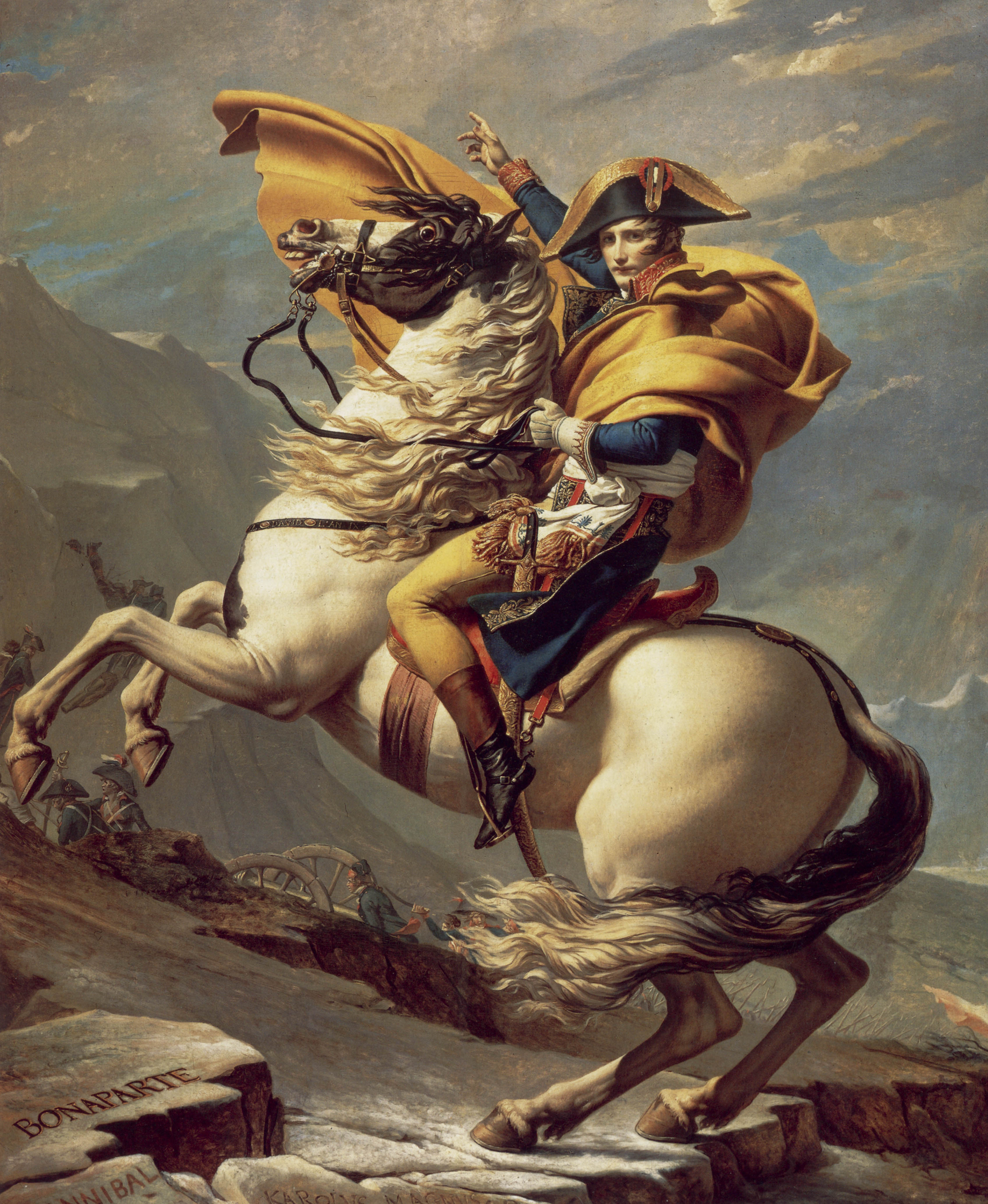
So the same severe style, born to preach Roman civic virtue, served first a Republic that killed its king and then an Empire that crowned a general. The look did not change. The owner did. Neoclassicism is the rare case in the history of art of a style that became, for a generation, a government’s official propaganda machine, with its greatest painter sitting inside the government running it.
The royalist who painted the Queen
While David was bending the official art world toward the Republic, the most sought-after portrait painter in France was at work on the woman that Republic would behead. Élisabeth Vigée Le Brun (1755–1842) became Marie Antoinette’s favored portraitist around 1778, painting the Queen and her family more than thirty times, and she was one of the most successful painters of the whole age, of either sex, with something near six hundred and sixty portraits to her name by the end. In 1783 she was admitted to the Académie royale (France’s official art establishment, the body that trained painters, ran the Salon, and decided what the public was allowed to see), one of a tiny handful of women ever let in.
The Revolution that handed David his power made her a fugitive. A committed royalist bound to the doomed court, she fled Paris at midnight on 5 October 1789, the night the crowd set out to march on Versailles, and spent the next twelve years working her way across Italy, Austria, Russia, and Germany, painting aristocrats in one capital after another until an amnesty let her come home. Late in life she set the whole journey down in three volumes of memoirs that shaped how the age would be remembered. The same upheaval runs through both careers from opposite ends: David stayed and voted to kill the king, and Vigée Le Brun packed in the dark and ran. The same Académie, the same decade, opposite sides of the same blade.
