NEOCLASSICAL & ROMANTIC · MOVEMENT · 1 OF 2

Neoclassicism

c.1750–c.1830 · about 80 years
David, The Death of Socrates, 1787 · 4 ft 3 in × 6 ft 5¼ in · The Metropolitan Museum of Art, New York · public domain worldwide

Mid-century Europe was tired of Rococo prettiness, and the buried Roman cities were coming up out of the ground. A German scholar told painters to imitate the Greeks and chase a noble simplicity and quiet grandeur, and in Jacques-Louis David they found a master who painted civic duty with a draughtsman’s hardness. The same severe style then became the official look of the French Revolution and of Napoleon.

Read the Neoclassicism story5 chapters · c.1750–c.1830
Why it was a break
vs
Before · Fragonard, The Swing (1767)
What painting had been for the Rococo: a private pleasure for a rich world. A girl on a swing kicks off a slipper toward a hidden lover peering up her skirts, pastel, feathery, weightless, about nothing but delight.
After · David, Oath of the Horatii (1784)
What David did instead: a stripped, severe stage, hard contour over soft color, sculptural figures, and a stoic civic subject. Pleasure replaced by duty, the swing replaced by an oath.

Before David, elite painting was Rococo (the light, ornamental, aristocratic style made for private pleasure). The palette was pastel, the brushwork feathery and visible, the composition swung on soft curves, and the subjects were flirtation and mythological play. Fragonard’s Swing is the textbook case: pretty, weightless, and about nothing more than delight.

Neoclassicism strips all of that out. The palette goes severe and local (stone, steel, blood-red), the brushwork goes smooth and nearly invisible so the figures read as carved marble, the stage goes shallow and frieze-like with the action pressed forward, and the subject becomes stoic duty from Greek and Roman history. Above all, clear LINE replaces soft color as the thing carrying the picture, you could trace every figure with a pencil.

That is why this is a new movement and not a new fashion. The canvas stops being a decoration on a salon wall and becomes an argument: art as a public lesson in virtue. Within a decade that same severe style would be drafted as the official image of the French Revolution.

No manifesto

The Neoclassical painters never wrote a manifesto. Their creed was written for them, by a man who could not paint. In 1755 a German scholar named Johann Joachim Winckelmann published a slim essay (the first edition was a run of about fifty copies) telling artists to stop inventing and start imitating the Greeks, whose supreme quality he named in a phrase that became the movement’s motto: a noble simplicity and quiet grandeur.

Anton Raphael Mengs, Winckelmann’s friend, tried to paint the doctrine in his Parnassus ceiling of 1761, often called the first programmatic Neoclassical picture. David, thirty years later, actually did. So the founding document of an art of severe, drawn, moral pictures is a piece of art criticism.

One honest footnote on the famous line. The first English translator, Henry Fuseli, rendered stille Größe in 1765 as sedate grandeur, not quiet grandeur. The smoother quiet grandeur is the modern standard wording everyone quotes now. The open source below lets the reader check Fuseli’s own words.

Read Fuseli’s 1765 translation of Winckelmann
How the influence flowed
Grew out of
Rococo
gave: a target to revolt against
Antiquity
gave: subjects, figures, the frieze stage
Pompeii excavated
gave: real Roman rooms and design
The Enlightenment
gave: reason and civic virtue
Neoclassicismc.1750–c.1830
Led to
Romanticism
took: the line-vs-color fight, as its opposite
Academic art
took: drawing-first training
Realism
took: the rules it would break
Neoclassicism took antiquity, the dug-up Roman cities, and Winckelmann’s creed, made line and moral seriousness the center of painting, and set the drawing-first academic rules that every later movement would define itself against.
The details
c.80 yrs
Span
Paris · Rome
Centered on
vs
reason
Line and the antique
David · Ingres · Mengs · Canova
Clear contour over color, the Greeks and republican Rome as the model, the canvas as a moral lesson. David made it the State’s style; Ingres defended the primacy of line for forty years.
rococo
The Rococo it buried
Boucher · Fragonard
Pastel goddesses, flirtation, gardens of idle pleasure, art as a private delight for a small rich world. Exactly what the new severity set out to replace.
Meanwhile, elsewhere
Other movements in the same years
1751 · Paris
The Encyclopédie
Diderot and d’Alembert begin the Encyclopédie. Neoclassicism is the visual arm of the same Enlightenment cult of reason and civic virtue.
1789 · Paris
The French Revolution
The Revolution makes David its image-maker, a Convention deputy and regicide who staged its festivals. The style becomes a government’s official propaganda.
1748 · Rome · Pompeii
The Grand Tour
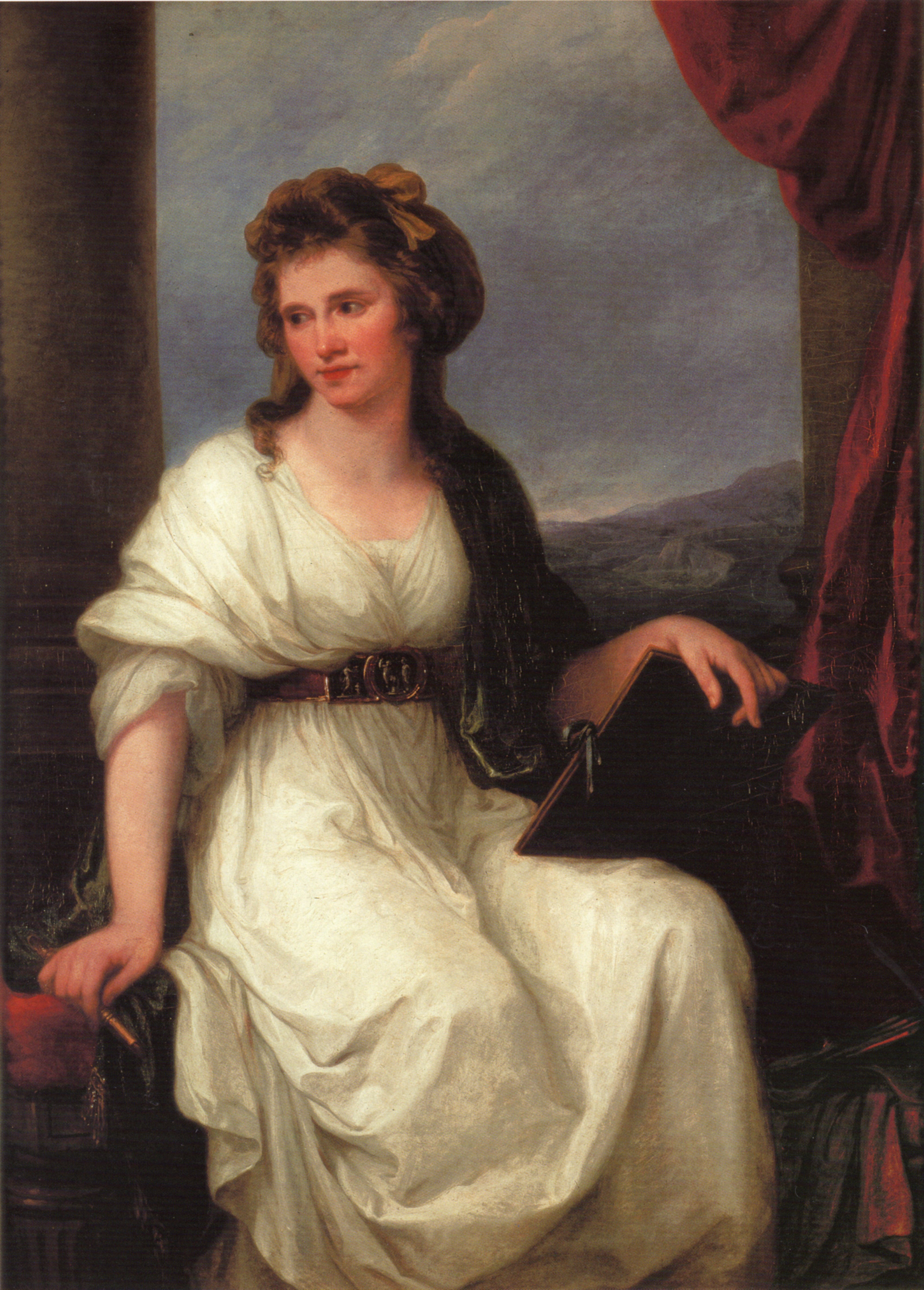
With Pompeii newly under excavation, Rome is Europe’s finishing school; Winckelmann, Mengs, Canova, Kauffman, and West all pass through the same ruins.
7 featured works
1784
David
Oath of the Horatii
Oath of the Horatii
David · Paris
Three brothers swear on their father’s outstretched swords to die for Rome, taut male resolve at left, the women collapsing in grief at right. A royal commission painted five years before 1789, later read as a summons to put country above self.
David, Oath of the Horatii, 1784–85 · 10 ft 10 in × 13 ft 11 in · Louvre, Paris
1787
David
The Death of Socrates
David · Paris
Condemned by Athens, Socrates reaches for the cup of hemlock mid-argument, finger raised, still teaching as he dies. Reason facing death without a tremor.
David, The Death of Socrates, 1787 · 4 ft 3 in × 6 ft 5¼ in · The Metropolitan Museum of Art, New York
1793
David
The Death of Marat
The Death of Marat
David · Brussels
The murdered radical journalist Jean-Paul Marat slumped dead in his medicinal bath, pen still in hand, painted by his friend David as a secular martyr. Propaganda and great painting at once.
David, The Death of Marat, 1793 · 5 ft 5 in × 4 ft 2⅜ in · Royal Museums of Fine Arts of Belgium, Brussels
1801
David
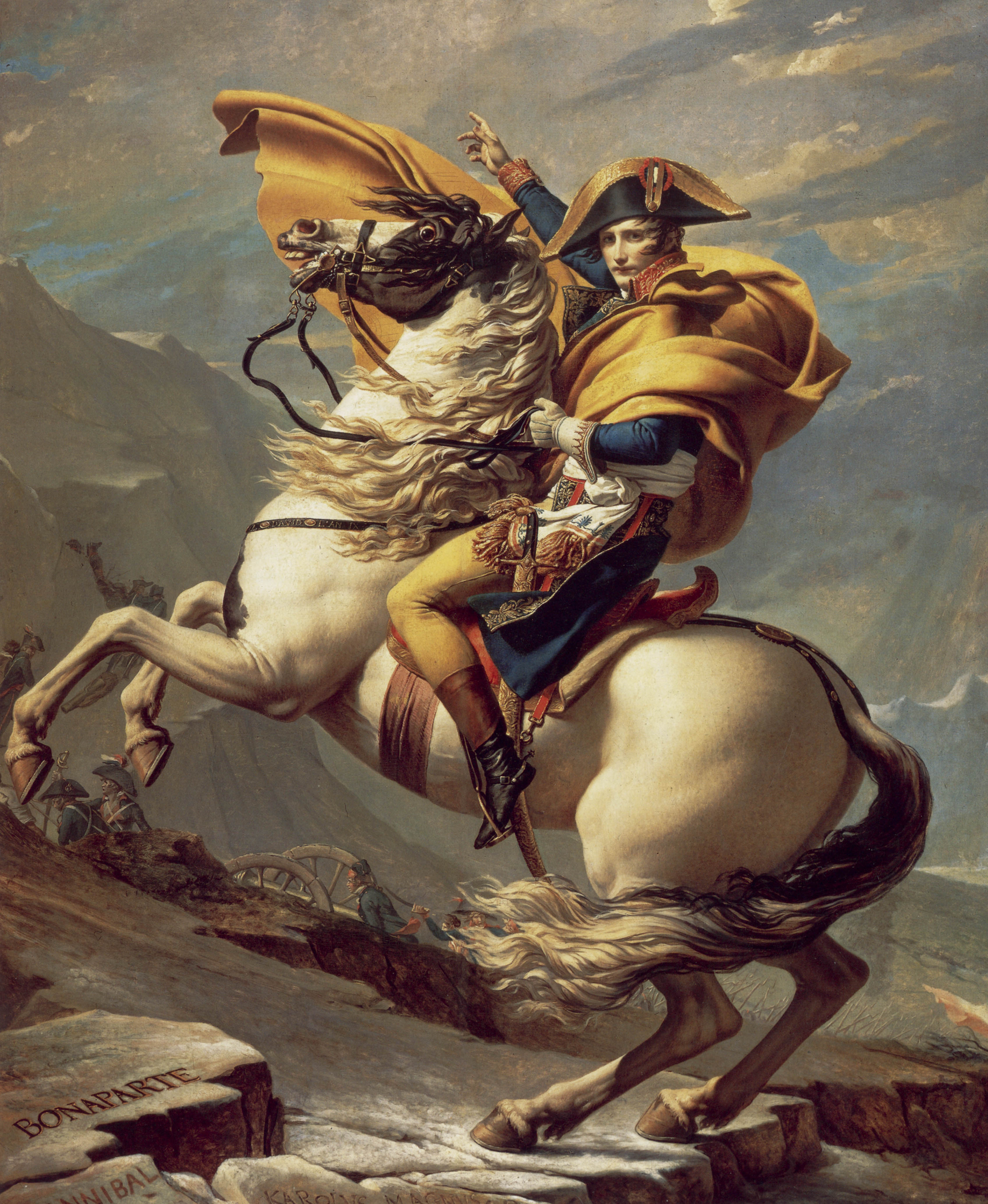
Napoleon Crossing the Alps
David · Paris
Bonaparte on a rearing white horse, cloak streaming, pointing over the pass, the names of Hannibal and Charlemagne carved in the rock below. Heroic myth, not reportage (he actually crossed on a mule).
David, Napoleon Crossing the Alps, 1801–05 · 8 ft 6⅜ in × 7 ft 3 in · Château de Malmaison, Rueil-Malmaison
1814
Ingres
La Grande Odalisque
La Grande Odalisque
Ingres · Paris
A reclining harem nude seen from behind, her cool back drawn impossibly long and smooth, line bent past anatomy for the sake of the curve. Critics at the 1819 Salon said it had two or three vertebrae too many.
Ingres, La Grande Odalisque, 1814 · 3 ft × 5 ft 4 in · Louvre, Paris
1806
Ingres
Napoleon I on his Imperial Throne
Ingres · Paris
Napoleon enthroned head-on as a frozen Byzantine icon, ivory, gold, and ermine, hieratic and cold. Ingres’s line pushed all the way into ritual stiffness; the Salon of 1806 disliked it.
Ingres, Napoleon I on his Imperial Throne, 1806 · 8 ft 6 in × 5 ft 3¾ in · Musée de l’Armée, Paris
1827
Ingres
The Apotheosis of Homer
Ingres · Paris
Homer enthroned and crowned by Victory before a Greek temple, the great writers and artists of all ages ranged below in symmetrical homage. Late Neoclassicism as a closed pantheon of genius.
Ingres, The Apotheosis of Homer, 1827 · 12 ft 8 in × 16 ft 9½ in · Louvre, Paris
Canonical works · 10
1761Parnassus (ceiling)Mengs
1770The Death of General WolfeBenjamin West
1784Oath of the HoratiiDavid
1787The Death of SocratesDavid
1793Psyche Revived by Cupid’s KissCanova
1793The Death of MaratDavid
1801Napoleon Crossing the AlpsDavid
1806Napoleon I on his Imperial ThroneIngres
1814La Grande OdalisqueIngres
1827The Apotheosis of HomerIngres