Géricault's heir
Eugène Delacroix (1798–1863) became the public face of French Romanticism and the champion of its central technical claim: that color, not line, is the soul of a picture. That put him at war with the Neoclassical camp and its captain, Ingres, who defended the supremacy of the drawn line for decades. The two snarled at each other across the Salon like the two halves of one argument, which is exactly what they were. Ingres said a painting was a perfect drawing, colored in. Delacroix said the color was the painting, and the drawing could look after itself.
The fanaticism of ugliness
His first great provocation came straight out of a poem. Lord Byron, the Romantic poet whose work fed half the painters of the age, had written a play about Sardanapalus, a last Assyrian king who, with his city falling and defeat certain, has everything he owns destroyed before it can be taken from him. Delacroix painted the moment in 1827, nearly thirteen feet tall and over sixteen feet wide.

The king lies on an enormous blood-red bed, propped on one elbow, watching with terrible calm while his concubines are stabbed, his slaves cut down, and his horses dragged shrieking to the slaughter around him. The whole canvas tilts and writhes; there is no level line anywhere, no still surface, no cool gray to rest the eye. Everything is heat and motion and gleaming flesh, the diagonal pushed until the picture seems to be sliding off its own bottom corner. The Salon of 1827 was appalled. One critic called it the “fanaticism of ugliness,” which Delacroix could have stitched on a banner. It is the anti-David: where the Oath of the Horatii stands its figures in a calm stone row, Sardanapalus drowns its figures in a flood of red.
July 1830, not 1789
Three years later he painted the picture everyone half-remembers, and almost everyone dates wrong. Liberty Leading the People does not show the French Revolution of 1789. It commemorates a second, smaller revolution: the three days of July 1830 (the French call them the Trois Glorieuses, the Three Glorious Days) when the people of Paris rose and toppled the restored king Charles X. Delacroix watched it from the sidelines and painted his response within months.
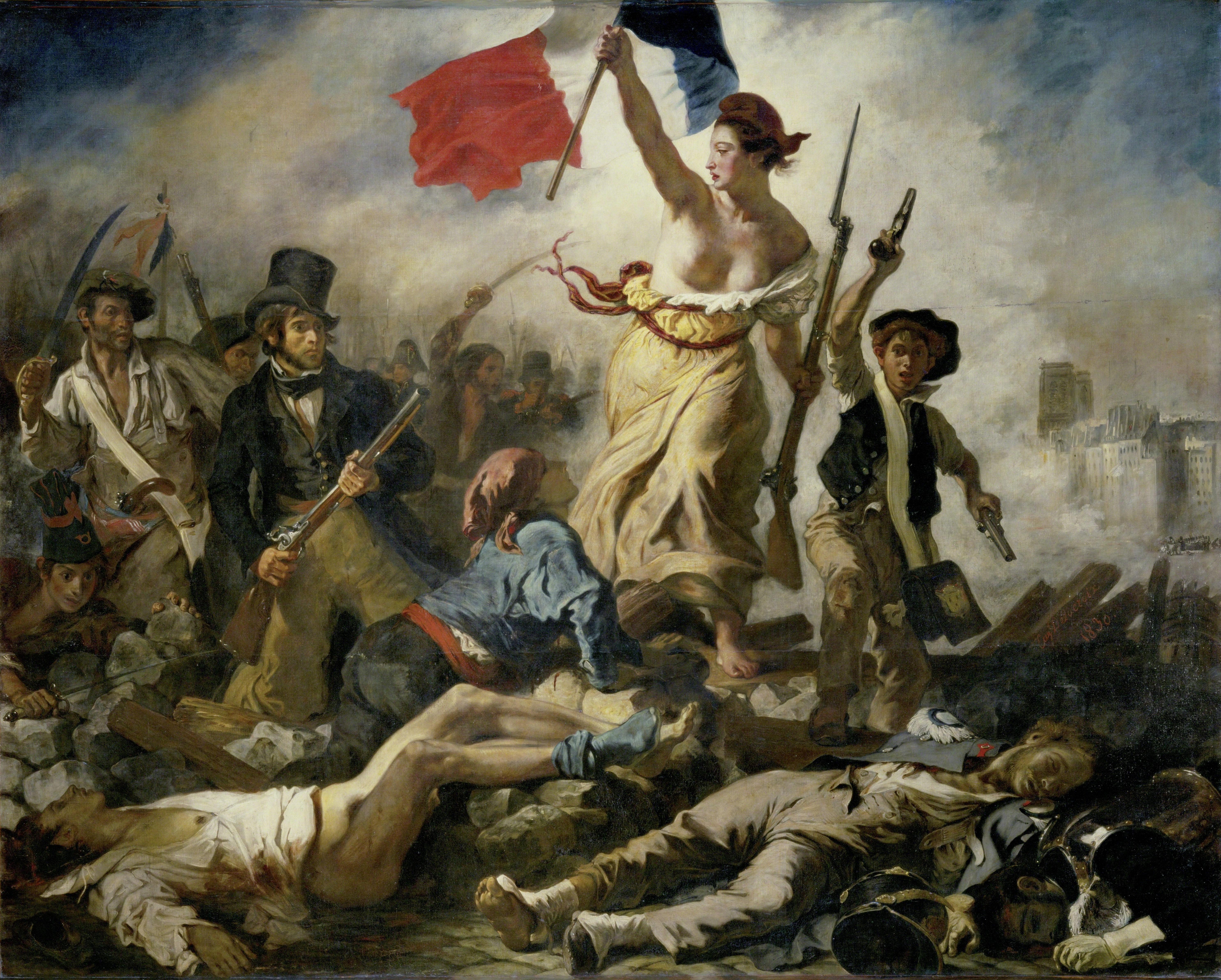
The bare-breasted woman at the center, striding over the bodies on the barricade with the tricolor in one hand and a musket in the other, is not a real woman and not a portrait of anyone. She is an allegory (a figure who stands for an idea), Liberty herself, or France, the figure the French call Marianne. The soft cloth cap she wears, the Phrygian cap, was the ancient Roman badge of a freed slave and became the symbol of the Revolution, so a viewer in 1830 read her at a glance. Around her, real Parisians: a top-hatted gentleman with a hunting gun, a boy with two pistols, a worker in a smock, the rich and the poor at the same barricade. (The legend that the top-hatted man is Delacroix himself is just that, a legend; he did not fight.) Liberty does not stand still and pose like a Neoclassical goddess. She walks toward you, out of the gunsmoke, off the front of the canvas. It made Delacroix the official voice of French Romanticism.
The East as a screen
In 1832 Delacroix sailed for North Africa, attached to a French diplomatic mission to Morocco, and the trip lit a lifelong fascination. Out of it came Women of Algiers (1834) and a string of harem and hunt and street scenes that fed a whole nineteenth-century European fashion called Orientalism: the “Orient,” meaning North Africa and the Middle East, painted by Western artists as a place of erotic languor, exotic color, and timeless mystery. The pictures are real and often beautiful, and they are also a projection. The people in them are mostly props for a Western daydream, an East imagined more than observed, the harem as a fantasy a European man could never actually have entered. It is one of the strands Romanticism handed forward, beauty and a blind spot wound together in the same canvas.