NEOCLASSICAL & ROMANTIC · MOVEMENT · 2 OF 2

Romanticism

c.1780–c.1850 · about 70 years
Géricault, The Raft of the Medusa, 1818–19 · 16 ft 1 in × 23 ft 6 in · Louvre, Paris · public domain worldwide

Romanticism is not a style but a temperament, the revolt of feeling against Neoclassical reason. It has no leader and no manifesto, just painters in Madrid, Paris, London, and Dresden who mostly never met and shared a mood: color over line, emotion over restraint, and nature too vast and terrifying to master. It is the Revolutionary age seen from the other side, disillusion, the horror of war, and national feeling.

Read the Romanticism story9 chapters · c.1780–c.1850
Why it was a break
vs
Before · David, Oath of the Horatii (1784)
The Neoclassical picture: built like a Roman frieze, clear contour, sculptural figures lit evenly, every edge finished, the brushwork hidden, the mood austere and morally controlled. Reason and order rule.
After · Géricault, The Raft of the Medusa (1818–19)
The Romantic picture: a place of feeling and force. Edges dissolve, the brushwork shows, color carries the emotion, and the composition heaves on the diagonal, ordinary suffering piled into a straining pyramid.

Neoclassicism, above all David, built a painting like a Roman frieze: clear contour, sculptural figures lit evenly, every edge finished, the brushwork hidden, the mood austere and morally controlled. The Oath of the Horatii lines its heroes up like statues swearing on cue. Reason and order rule, and the cool classical line is the thing that carries the picture.

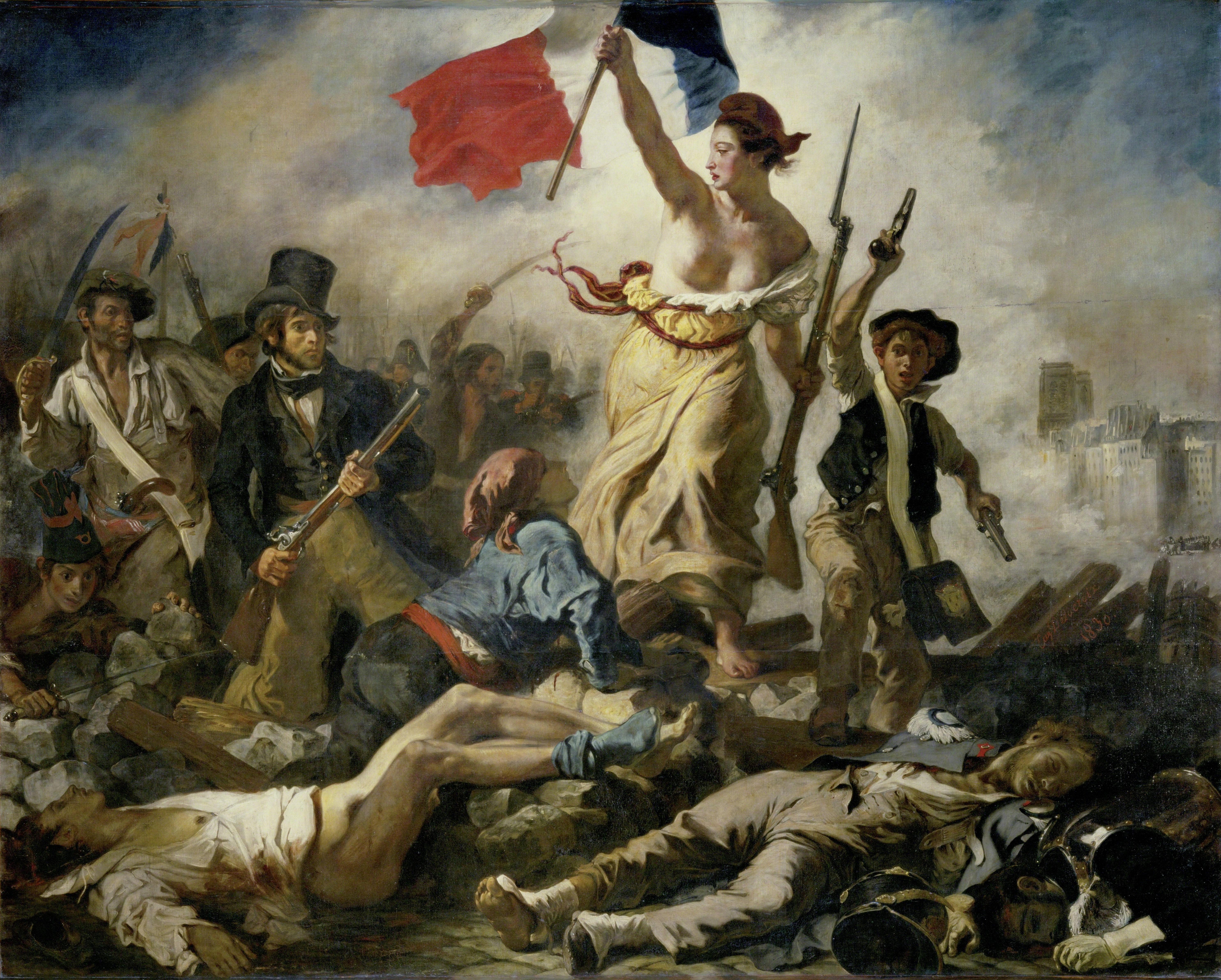
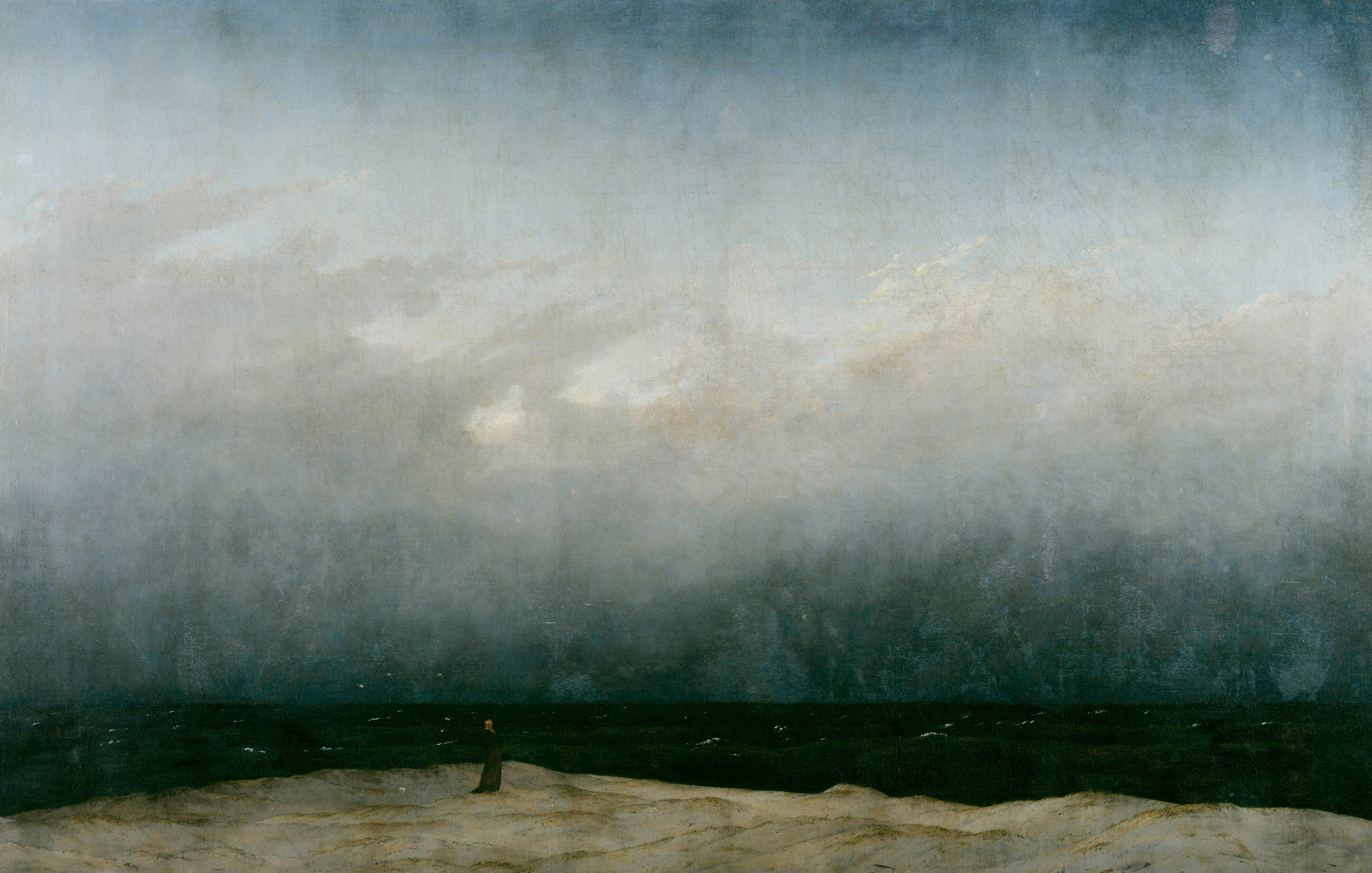
Romanticism throws the rulebook out. The picture stops being a controlled diagram and becomes a place of feeling and force. Edges dissolve, the brushwork shows, color carries the emotion, and the composition heaves on the diagonal. Géricault piles the dead into a straining pyramid on a raft; Delacroix lets hot color and motion run riot; Goya goes dark; Friedrich shrinks a single figure under an enormous sky; Turner dissolves a ship into light.

That is why this is a temperament and not a tidy style. The subject is no longer civic virtue calmly depicted but emotion, the sublime (nature as terrifyingly grand), the individual, the nation, and the nightmare, painted with visible heat. There is no manifesto and no single look, because there was no movement to issue one.

No manifesto

There was no Romantic manifesto, because there was no Romantic movement to sign one, just painters in Madrid, Paris, London, and Dresden who mostly never met and shared a mood instead of a program. No club, no rulebook, no pope.

The nearest thing to a creed came from the writers and critics. Wordsworth, in the Preface to Lyrical Ballads (added in 1800, expanded 1802), defined poetry as the spontaneous overflow of powerful feelings. Friedrich told painters to shut the bodily eye and paint what they saw within. Delacroix argued for color and imagination in the privacy of his Journal. And Baudelaire pinned it down a generation later: Romanticism lives not in choice of subjects but in a way of feeling.

So the surrogate manifesto is a handful of poems, diaries, and reviews. Friedrich’s lines reach English only as a circulated translation, not a primary document, so treat them as such. No manifesto. A temperament.

Read Wordsworth’s 1800 Preface to Lyrical Ballads
How the influence flowed
Grew out of
Neoclassicism
gave: the foil it revolted against
The sublime (Burke)
gave: terror and vastness as a subject
Romantic literature
gave: feeling, the Byronic hero, the nation
Baroque color
gave: the loose colorist tradition
Romanticismc.1780–c.1850
Led to
Barbizon & Realism
took: loose, weather-true landscape
Impressionism
took: dissolved light, color over line
Orientalism
took: the exotic, from Delacroix’s Morocco
Romanticism took David’s grand history-painting scale and filled it with disaster, took Burke’s sublime and the cult of feeling, and handed loose weather-driven landscape, color over line, and feeling-as-subject on to Realism, Impressionism, and modern painting itself.
The details
c.70 yrs
Span
Spain · France · Britain · Germany
Spread across
vs
feeling
Color and the sublime
Goya · Géricault · Delacroix · Turner · Friedrich · Constable
Emotion as the real subject, visible agitated brushwork, and nature as terrifyingly grand. A shared mood crossing borders with no central command.
reason
The Neoclassical foil
David · Ingres
Cool line, finished surface, classical calm, civic virtue. The order the Romantics revolted against; Delacroix and Ingres snarled at each other across the Salon for decades.
Meanwhile, elsewhere
Other movements in the same years
1789 · Paris
Revolution to 1830
Romanticism’s whole life runs through the political earthquake. Where Neoclassicism painted the Revolution’s optimism, Romanticism paints its hangover, disillusion, the horror of war, and revolt (Delacroix’s Liberty).
1798 · England · Germany
Romantic literature
The same decades produced Wordsworth and Coleridge’s Lyrical Ballads, Byron (whose Sardanapalus Delacroix paints), Goethe, and the German Sturm und Drang. Painting and poetry shared one temperament.
1830 · Britain
The machine age
As the railway and steamship remade Britain, Turner painted them dissolving into light and weather. The same age that built the railways produced the painting that most distrusts cold reason.
14 featured works
1814
Goya
The Third of May 1808
Goya · Madrid
A faceless French firing squad guns down Madrid civilians at night; the central victim flings up his arms in a glaring white shirt, lit like a martyr before the muzzles. No order, no glory, just modern slaughter.
Goya, The Third of May 1808, 1814 · 8 ft 9½ in × 11 ft 4½ in · Museo del Prado, Madrid
1820
Goya
Saturn Devouring His Son
Goya · Madrid
The Titan Saturn, eyes wild, crams a small headless body into his mouth, painted on Goya’s own dining-room wall, never titled by him, never meant to be seen. The blackest of the Black Paintings.
Goya, Saturn Devouring His Son, c.1819–23 · 4 ft 8½ in × 2 ft 8 in · mural transferred to canvas · Museo del Prado, Madrid
1801
Goya
The Family of Charles IV
Goya · Madrid
The Spanish royal family lined up in gold and medals, Goya himself half-shadowed at his easel behind them in homage to Velázquez’s Las Meninas. The famous grotesque reading is later interpretation, not documented intent.
Goya, The Family of Charles IV, 1800–01 · 9 ft 2¼ in × 11 ft ¼ in · Museo del Prado, Madrid
1799
Goya
The Sleep of Reason Produces Monsters
Goya · Madrid
A sleeping artist slumped over his desk while owls and bats swarm out of the dark, plate 43 of the Caprichos. The Spanish sueño means both sleep and dream, so the title also reads The Dream of Reason.
Goya, Los Caprichos plate 43, 1799 · etching and aquatint · The Metropolitan Museum of Art, New York
1819
Géricault
The Raft of the Medusa
Géricault · Paris
Survivors of the 1816 Méduse wreck heaped on a makeshift raft, a pyramid of the dead and the barely-living straining toward a speck of a rescue ship. A fresh national scandal painted at the scale once reserved for gods and kings.
Géricault, The Raft of the Medusa, 1818–19 · 16 ft 1 in × 23 ft 6 in · Louvre, Paris
1830
Delacroix
Liberty Leading the People
Delacroix · Paris
Liberty, bare-breasted with the tricolor in hand and a Phrygian cap on her head, strides over the barricade dead leading an armed crowd. The July 1830 Revolution (not 1789), and an allegory, not a real woman.
Delacroix, Liberty Leading the People, 1830 · 8 ft 6 in × 10 ft 8 in · Louvre, Paris
1827
Delacroix
The Death of Sardanapalus
Delacroix · Paris
The Assyrian king reclines on his red bed watching his concubines, slaves, and horses slaughtered as his city falls, a Byronic orgy of hot color and writhing diagonals reviled at the Salon of 1827 as the fanaticism of ugliness.
Delacroix, The Death of Sardanapalus, 1827 · 12 ft 10 in × 16 ft 3 in · Louvre, Paris
1840
Turner
The Slave Ship
The Slave Ship
Turner · London
A blood-and-gold sunset over a heaving sea, shackled limbs and fish in the bloody foreground, Turner’s response to the 1781 Zong massacre, exhibited in 1840 as the abolition movement met in London.
Turner, The Slave Ship, 1840 · 2 ft 11¾ in × 4 ft ¼ in · Museum of Fine Arts, Boston
1844
Turner
Rain, Steam and Speed
Turner · London
A Great Western Railway locomotive bursts out of a storm of golden mist across Brunel’s Maidenhead bridge, the modern machine dissolving into Turner’s light, the railway age painted as weather.
Turner, Rain, Steam and Speed — The Great Western Railway, 1844 · 2 ft 11¾ in × 4 ft ⅛ in · The National Gallery, London
1839
Turner
The Fighting Temeraire
Turner · London
The ghostly white HMS Temeraire, a Trafalgar veteran, towed by a squat dark steam tug up a sunset Thames to be broken up, the age of sail handed to the age of steam.
Turner, The Fighting Temeraire, 1839 · 2 ft 11¾ in × 3 ft 11⅞ in · The National Gallery, London
1842
Turner
Snow Storm — Steam-Boat off a Harbour’s Mouth
Turner · London
A steamer swallowed in a vortex of snow and spray, the whole canvas a spinning storm, the painting around which Turner told the almost certainly apocryphal story that he had himself lashed to the mast for four hours.
Turner, Snow Storm — Steam-Boat off a Harbour’s Mouth, 1842 · 3 ft × 4 ft · Tate, London
1818
Friedrich
Wanderer above the Sea of Fog
Friedrich · Dresden
A man in a dark coat seen from behind, alone on a crag above a sea of fog and jagged peaks, the icon of the Romantic individual facing the sublime. Possibly a self-portrait; the identity is unconfirmed.
Friedrich, Wanderer above the Sea of Fog, c.1818 · 3 ft 1⅜ in × 2 ft 5½ in · Hamburger Kunsthalle, Hamburg
1810
Friedrich
The Monk by the Sea
The Monk by the Sea
Friedrich · Dresden
A tiny lone monk on a sliver of dune beneath an enormous, almost empty sky and sea, one of the emptiest and most radical landscapes of its century, the sublime as near-nothingness.
Friedrich, The Monk by the Sea, 1808–10 · 3 ft 7¼ in × 5 ft 7½ in · Alte Nationalgalerie, Berlin
1821
Constable
The Hay Wain
The Hay Wain
Constable · London
A hay wain (horse-drawn cart) crossing the River Stour at Flatford under a big moving English sky, quiet rural England with weather as the real subject. It won a gold medal at the 1824 Paris Salon and impressed Delacroix.
Constable, The Hay Wain, 1821 · 4 ft 3¼ in × 6 ft ¾ in · The National Gallery, London
Canonical works · 14
1799The Sleep of Reason Produces MonstersGoya
1801The Family of Charles IVGoya
1810The Monk by the SeaFriedrich
1814The Third of May 1808Goya
1818Wanderer above the Sea of FogFriedrich
1819The Raft of the MedusaGéricault
1820Saturn Devouring His SonGoya
1821The Hay WainConstable
1827The Death of SardanapalusDelacroix
1830Liberty Leading the PeopleDelacroix
1839The Fighting TemeraireTurner
1840The Slave ShipTurner
1842Snow Storm — Steam-Boat off a Harbour’s MouthTurner
1844Rain, Steam and SpeedTurner