Landscape as religion
In Germany the temperament turned inward and went quiet. Caspar David Friedrich (1774–1840) painted lonely, God-haunted landscapes that feel less like views than like prayers. His great invention is a small one and you cannot unsee it once you have it: the Rückenfigur (German for “back figure”), a person seen from behind, standing at the edge of the picture and gazing into the vast space beyond. We do not see the figure’s face. We stand where they stand and look where they look, out into an enormous, silent nature. It is the sublime made personal and devotional: not nature as spectacle, but nature as the place a soul goes to feel its own smallness.
Almost nothing at all
He pushed it furthest early, in The Monk by the Sea (1808–10), one of the most radical landscapes anyone had painted.
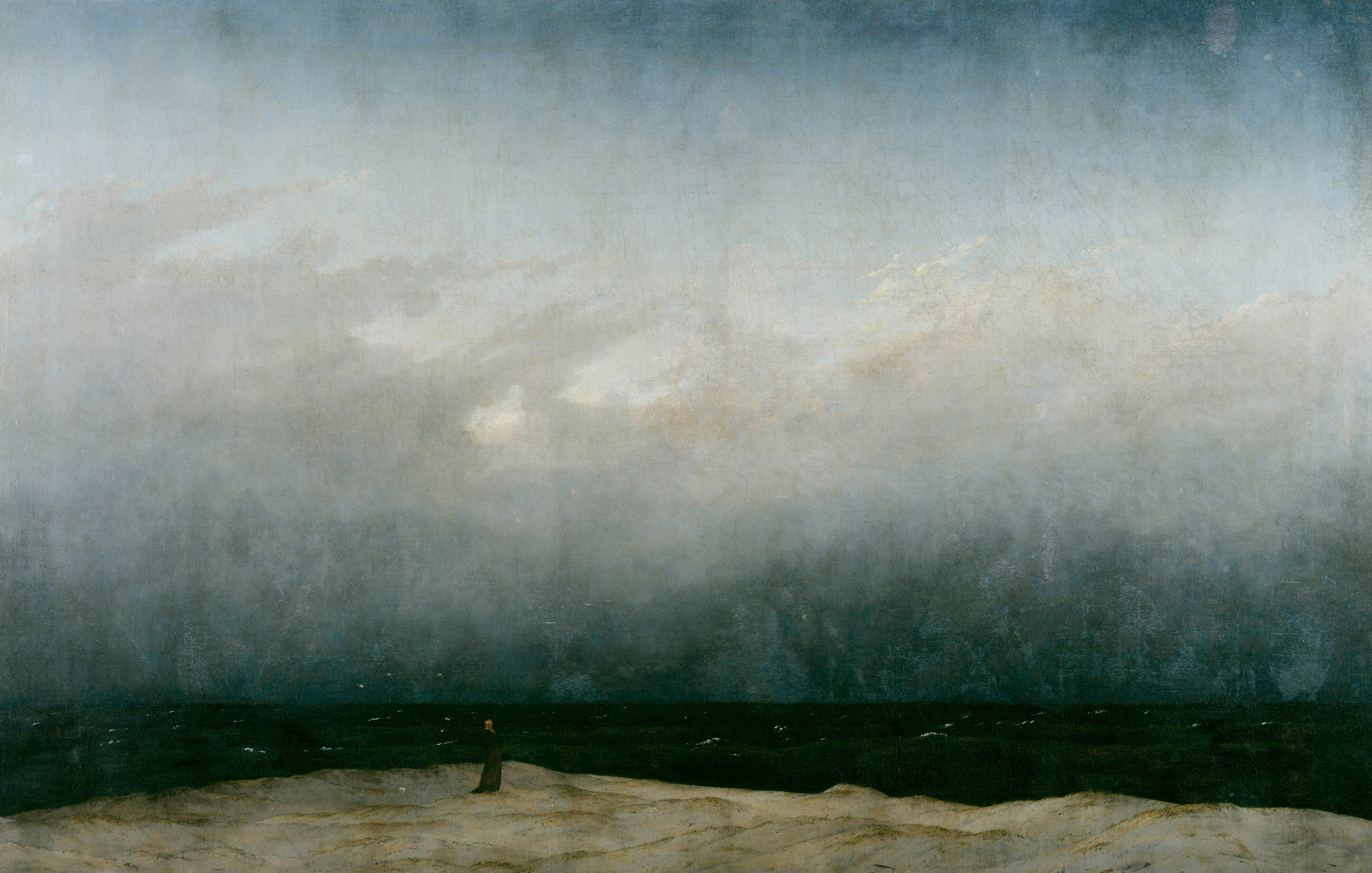
There is almost nothing in it. A thin strip of pale dune at the bottom, a single tiny monk standing on it, and above him a wall of sea and sky, nearly empty, taking up the whole rest of the canvas. No trees, no ship, no framing, none of the props a landscape was supposed to lean on. Just one small human and an enormous, indifferent expanse of nothing. The writer Heinrich von Kleist said standing in front of it felt as if your eyelids had been cut off, there was nothing to stop the looking. It is the sublime stripped down to its bones: a figure dwarfed to a speck before the infinite, which is either God or the void, and Friedrich leaves you to decide which.
The icon of the lone soul
His most famous picture is the one image that has become shorthand for the whole movement. In Wanderer above the Sea of Fog (about 1818) a man in a dark green coat stands on a rocky crag, his back to us, looking out over a sea of fog from which jagged peaks rise like islands.

We never see his face, only the back of a solitary man at the top of the world, master of nothing, contemplating a view that has no bottom. Who he is stays uncertain. The reddish hair has made some think it a self-portrait; another reading says the figure is a particular army officer, which would make the picture a patriotic memorial. Friedrich is not telling, and the not-telling is the point. The figure is anyone, is you, is the Romantic individual alone with the infinite. It is the exact inverse of a David hero. David’s men face us and command the scene; Friedrich’s man turns away and is swallowed by it. The whole revolt of feeling fits in that one turned back.