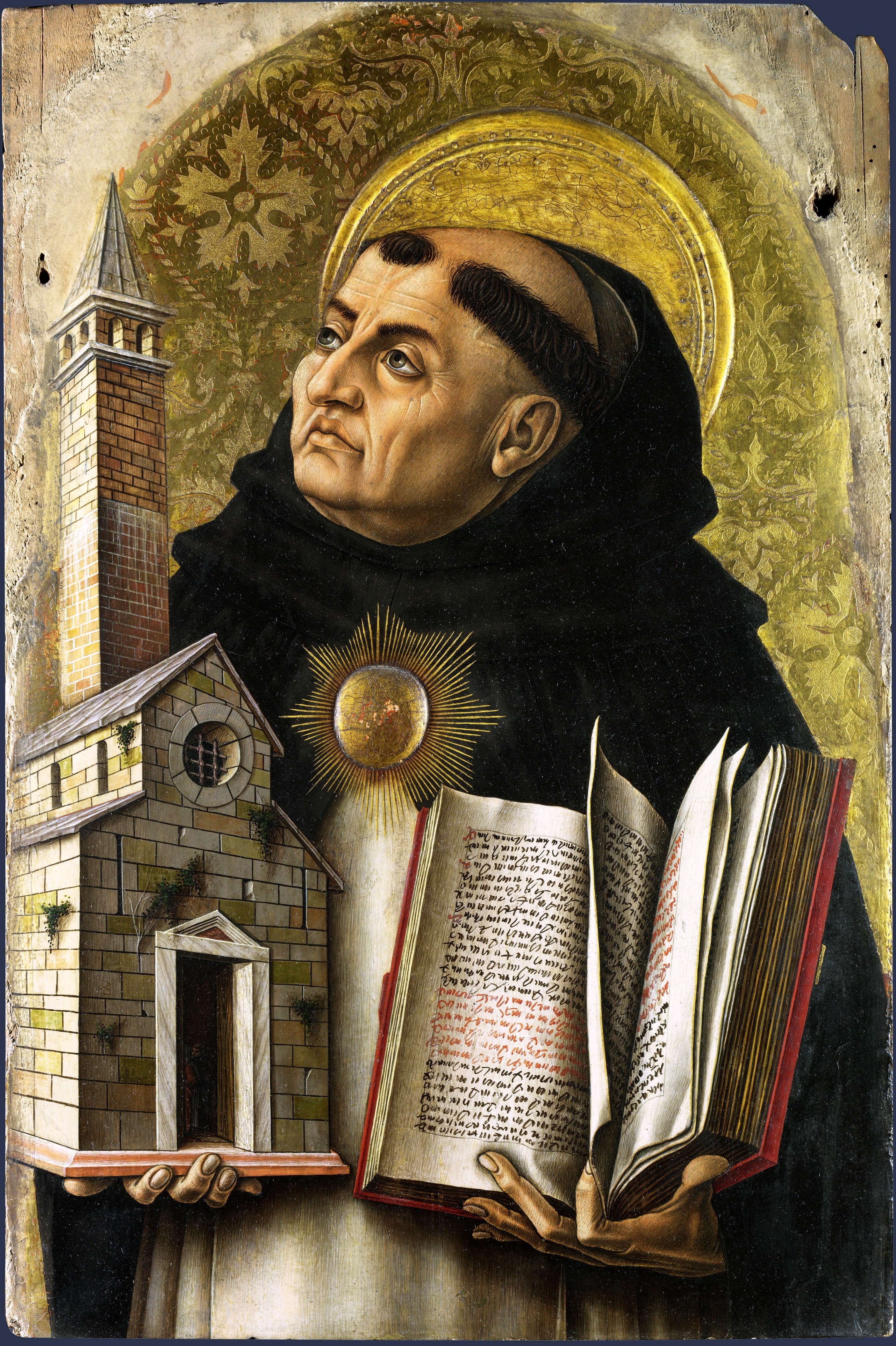
Two things arrived in 13th-century Europe at almost the same moment, and the second nearly destroyed the first. The first was a huge, silent young man from a noble Italian family, so quiet and so heavily built that his fellow students at Cologne nicknamed him "the dumb ox." The second was Aristotle: the complete works of the greatest mind of pagan antiquity, lost to the Latin West for five hundred years and now flooding back into the universities through Arabic translation, carrying conclusions that seemed to blow Christian theology apart at the seams.
Aristotle came bundled with his Arabic interpreters, and what they had drawn out of him was alarming. That the world is eternal, with no creation. That the intellect is a single faculty shared by all humanity, which would mean no individual immortal soul. That philosophy's job is to follow reason wherever it leads, even off the edge of the faith. To a Church that had built its theology on a Platonized Augustine, suspicious of pagan reason, this looked less like a gift than a bomb.
The dumb ox absorbed the bomb. Rather than condemning Aristotle or quarantining him, Thomas Aquinas spent his life showing that "the Philosopher," properly read, is the friend of Christian theology and not its enemy: the apparent contradictions dissolve the moment the distinctions are drawn carefully enough. He cited Aristotle thousands of times, corrected him where he thought him wrong, and built out of the wreckage the most systematic theology in the history of Latin Christianity.
His teacher saw it coming. As his canonization biographer told the story decades later, Albert the Great heard the other students mocking the silent giant and answered: "We call this young man a dumb ox, but in his teaching he will one day produce such a bellowing that it will be heard throughout the world." That is a saint's-life flourish, written some seventy years after the fact, and the frame stays visible. But the bellowing was real. It is still resounding, and it is built, from end to end, on one wager: that reason and faith could be pushed to their absolute limits and would never, finally, contradict each other.
The break
Before Aquinas, the Christian default ran through Augustine, and Augustine had absorbed his philosophy from the Platonists (era 2, chapter 1). That meant a deeply Platonic cast of mind: the soul as the real person and the body as a kind of prison or burden, knowledge as the mind's ascent away from the messy material world toward eternal truths, the visible world as a fallen copy of a higher spiritual order. Reason had its place, but pagan philosophy was something to be borrowed from cautiously and watched closely. Then the Arabic transmission delivered the whole of Aristotle into the universities, and Aristotle was not a safe Platonist who pointed the soul heavenward. He was an empiricist who started from the physical world, and in the hands of his Muslim commentator Averroes he came carrying theses that seemed to contradict the faith head-on.
Both sides of the alarm deserve their strongest case, because the suspicion was not stupid. On one side stood the theologians who wanted Aristotle reined in: here was a pagan system teaching that the universe never began (no Genesis), that the active intellect might be one shared thing rather than each person's own immortal soul, and that reason, run to its conclusions, simply landed where it landed. Letting that loose in the schools looked like inviting heresy through the front door. On the other side stood the so-called "Latin Averroists" in the Paris arts faculty (Siger of Brabant and others), who seemed to be saying something even more unsettling: that one could follow the philosophy to its conclusions as a philosopher, and hold the opposite as a believer, as though there were two separate truth-tracks running in parallel. A bishop would later brand this the doctrine of "double truth" (true in philosophy, false in faith). Modern scholars doubt anyone actually held it so baldly (the real Averroes certainly did not; era 2, chapter 4). But the fear it named was real: that reason and faith were drifting into two unconnected worlds.
Aquinas's break is to refuse both the quarantine and the divorce. There are not two truths; there is one. Reason and revelation are two non-competing routes to it, and since both come from the one God who is their author, they cannot ultimately conflict. Where they seem to, the reasoning is faulty or the scripture has been misread, and the work is to go back and find the mistake. The concrete move that makes this work is a single sentence he draws from his theology of grace: "grace does not destroy nature but perfects it." Faith does not cancel reason, override it, or compete with it; it completes it, the way a second and higher light lets the eye see further into the very same room the daylight already lit. The easy misreading runs the wrong way: "perfects" does not mean faith replaces what reason found with something better, scrapping the natural for the supernatural. It means faith builds on what reason got right and carries it further, the way a telescope does not cover the eye but extends the very seeing the eye was already doing. Reason's findings are kept, not overwritten. Aristotle, then, is not a threat to be managed but an instrument to be used: the most powerful tool reason has ever forged, now turned to the service of a faith it cannot contradict. The break is not from faith to reason (that is the caricature). It is from a theology suspicious of Aristotle to one that made Aristotle its engine, and in doing so claimed for unaided reason a far longer reach than any earlier Christian account had dared allow.
Chapter 1
The dumb ox
"We call this young man a dumb ox, but in his teaching he will one day produce such a bellowing that it will be heard throughout the world."
He was born around 1225 (the sources split, and the safest thing to say is "around 1225") at the family castle of Roccasecca, in the hills between Rome and Naples, in what was then the Kingdom of Sicily. The family was noble, prominent, and ambitious; Thomas was the youngest of at least nine children, and they had a career mapped out for him. He would enter Monte Cassino, the wealthy and prestigious Benedictine monastery nearby, and in time rise to lead it. It was the respectable path for a clever younger son of good blood: power, property, and a great house behind him.
Thomas had other plans, and they horrified his family. At about nineteen he decided to join the Order of Preachers (the Dominicans), a new kind of order entirely. The Dominicans were mendicants: friars who took a vow of poverty and begged for their living rather than holding land and property the way the old monastic orders did. To a family that had imagined their son enthroned at the head of a rich abbey, the choice of a barefoot begging order looked like throwing his birthright in the gutter, and they were not subtle in their response. His brothers seized him on the road and brought him home, where the family held him captive (at the family castles of Monte San Giovanni and Roccasecca) to break his resolve. How long is uncertain; the sources disagree, one saying about a year and another nearly two, probably because he was moved between locations. A year is the safe estimate, possibly longer.
One famous detail from the confinement belongs to the saint's-life tradition rather than the documentary record. The story goes that the family, trying to shake his vow of chastity, sent a woman into his room to seduce him, and that Thomas snatched a burning brand from the fire and drove her out, then scorched a cross into the door. That comes from the Life written by William of Tocco for his canonization case, roughly seventy years after the events; it reads as the tradition's fond memory of its saint, the kind of scene the genre loves, not as a documented event. What is solid is the core: the family seized him, held him to break his will, and eventually gave up. Thomas got his way. He remained a Dominican.
Freed, he went north to study, and the teacher he found shaped everything. Albert the Great (Albertus Magnus, around 1200 to 1280, later called the "Universal Doctor") was a Dominican polymath with an appetite for the whole of knowledge, including the new and dangerous Aristotle, and from 1248 Thomas studied under him at Cologne. Here the most famous story of his student years attaches, and it is the source of the chapter's epigraph. Thomas was large and habitually silent, and his fellow students, mistaking quiet for dullness, took to calling him "the dumb ox." Albert, the story runs, heard the mockery and shut it down: we call him a dumb ox, but his bellowing in doctrine will one day be heard throughout the world. The wording varies between the tellings (one has "we call," another "you call him"), all of them reporting the same William of Tocco Life written for the sainthood case about seventy years on. The honest label is: "as his canonization biographer told it." But the biographical bones underneath are solid: Albert taught him, thought enormously well of him, and after Thomas died would personally travel to defend his former student's orthodoxy. The fondness, at least, is real.
From there the career runs the standard track of a brilliant medieval academic, with one striking exception. He went to Paris in 1252 and obtained his Dominican chair as a master of theology in the late 1250s; he taught for years at the papal court in Italy (Anagni, Orvieto, Rome, Viterbo) through the 1260s; and then, unusually, he was sent back to Paris for a second term as regent master from 1268 to 1272. That second term was exceptional. The convention was one term and done; almost nobody returned for a second. He was called back because Paris was on fire over the Latin Averroist crisis, the alarm over how far Aristotle could be pushed, and the Paris condemnations of 1270 that came out of it. The Dominicans wanted their heaviest mind in the room. The dumb ox was sent to do the bellowing where it was most needed.
Chapter 2
Two routes to one truth
"Since therefore grace does not destroy nature but perfects it, natural reason should minister to faith as the natural bent of the will ministers to charity."
Everything Aquinas built rests on the architecture in that epigraph, and it is constantly mis-stated in both directions. The claim is not that reason can prove all of Christianity (the rationalist's fantasy). It is also not that faith and reason occupy separate, walled-off rooms that never speak (the fideist's retreat). It is something more demanding than either: that faith and reason are two routes to one truth, and that since both ultimately come from the one God who authors both, they cannot finally contradict each other. "Grace does not destroy nature but perfects it." Reason is nature's own light; faith is a second, higher light added on top of it, not painting over what reason shows, but letting the eye see further into the very same room.
The crucial distinction, the one that keeps Aquinas honest and that most summaries flatten, is this. He divides the truths about God into two kinds. There are the preambles of faith (praeambula fidei): truths that unaided reason can in principle reach on its own steam, that God exists, that God is one, that God is the creator. These are philosophy's to demonstrate; no scripture is needed to get there. And then there are the mysteries of faith (mysteria fidei): truths that reason cannot reach by any argument and that revelation alone supplies. The Trinity (that God is three distinct persons who are nonetheless one God), the Incarnation (that God became a particular human being), the Resurrection: these are not conclusions anyone could ever deduce. They are above reason, not against it. No argument ever demonstrated the Trinity, and Aquinas never pretended one could. The familiar claim that "Aquinas proved Christianity by reason" is precisely, flatly not his position. Reason reaches the door of the faith; it does not get inside. That is why the work divides in two.
The division shows up in his books themselves, which confirms that this is structure and not slogan. He wrote two great systematic works, and they are built on opposite premises. The Summa Theologiae (his huge, unfinished textbook of theology, written from 1267) argues from revelation: it takes scripture as a starting premise and reasons within the faith. But the earlier Summa contra Gentiles (around 1259 to 1265) was aimed at a reader who does not share the faith (the tradition holds it was written to equip Dominican missionaries arguing with Muslims and Jews in Spain), and so it argues as far as reason alone can carry, holding revelation back until reason has gone as far as it can. Two books, two methods, the same architecture: here is what reason can establish on its own, and here, beyond it, is what only revelation supplies. The faith/reason map is not something Aquinas talks about. It is the floor plan he wrote on.
This is the architecture that answers the Latin Averroists Aquinas was sent to Paris to confront. The position he opposed seemed to treat philosophical conclusions as binding as philosophy even where they clashed with revelation, as if reason ran one truth-track and faith ran another, and a thinker could ride both at once. (A Paris bishop would caricature this as "double truth"; the real Averroes never taught it, and the Paris masters probably did not hold it so crudely either; era 2, chapter 4 has the full story.) Aquinas's answer cuts the knot. There are not two truths to ride. There is one. Reason helps toward it and can reach real and important parts of it; revelation carries further and corrects reason's mistakes on the matters that exceed its reach. Where a sound philosophical argument seems to contradict the faith, one of two things has gone wrong (the argument is not actually sound, or the scripture has been misread), and the work is to go find which. He could be so calm about Aristotle precisely because he was certain, in advance, that no genuine truth of reason could ever survive a head-on collision with a genuine truth of faith. They are both true. Truth does not contradict truth.
Chapter 3
The Five Ways
"I answer that, The existence of God can be proved in five ways."
Aquinas's single most famous passage offers five arguments for the existence of God, the Quinque Viae, the "Five Ways," set out near the start of the Summa in one tight article. They are compressed sketches, each one leaning on a whole worked-out the article does not stop to unpack, not five knock-down proofs that settle God in five easy steps. But the first of them, which Aquinas calls "the more manifest," repays a slow and full reading, because almost everyone alive today misreads it, and seeing why it is misread is half of understanding it.
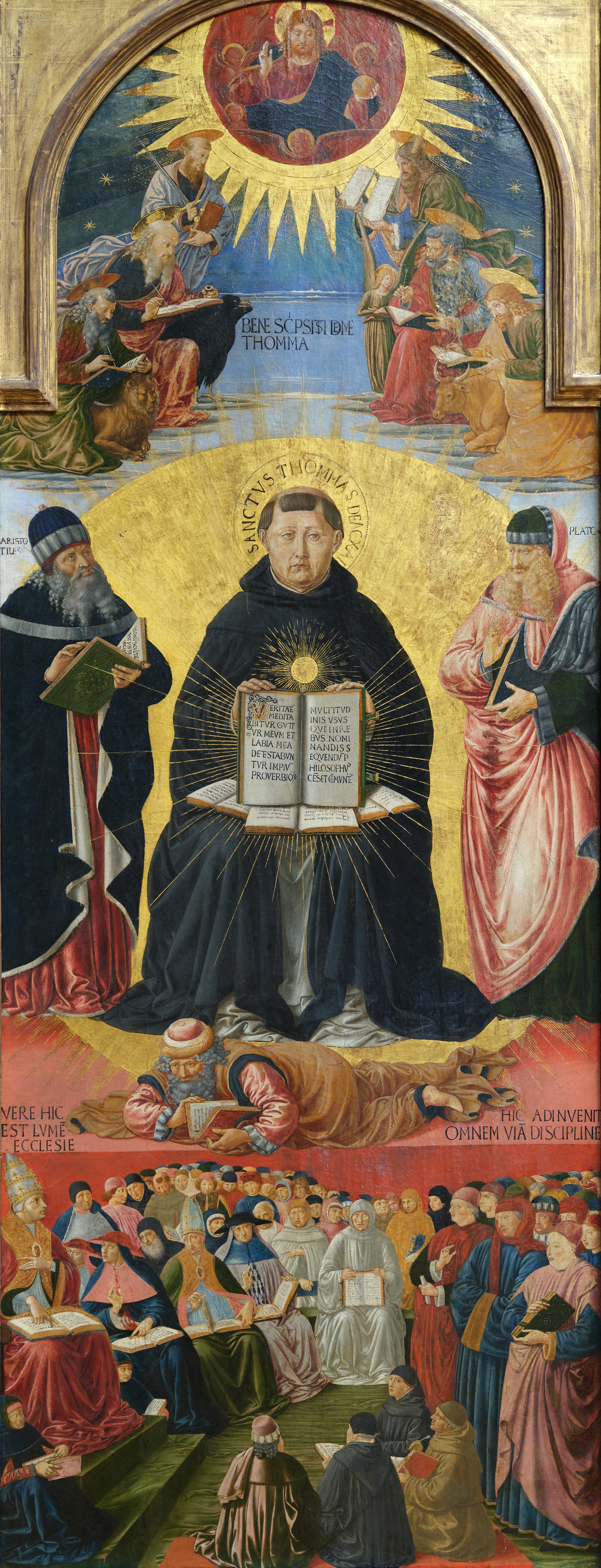
The First Way is the argument from motion, step by step. Aquinas starts from plain observation: "It is certain, and evident to our senses, that in the world some things are in motion." By "motion" he means change of any kind, not just things moving through space but anything passing from one state to another. Next: "whatever is in motion is put in motion by another." A thing doesn't change itself out of nothing; something already actual has to do the changing. His own homely illustration: "the staff moves only because it is put in motion by the hand." Then the engine of the argument: this chain of one-thing-changing-another cannot run back forever, "this cannot go on to infinity," because if every member of the chain is only passing along a motion it received from the member before, with nobody actually originating it, then nothing is doing the moving at all; it is a line of staffs with no hand. "Therefore it is necessary to arrive at a first mover, put in motion by no other; and this everyone understands to be God."
Then comes the part that gets misread, and it is essential, because the standard misreading turns the argument into something Aquinas explicitly rejected. The First Way is not about a temporal first cause, not a cosmic starter-pistol fired long ago that set a chain of dominoes toppling down through time. It is not the "first domino," the Big-Bang figure who got things going at the beginning and then stepped back. The chain Aquinas means is simultaneous. It is what is holding a thing up right now, this instant. The hand moves the staff at this moment; trace the chain of what-is-moving-what at any single frozen instant, and that is the chain that cannot run back forever. The whole series exists all at once, like a chandelier hanging from a chain hanging from a hook: pull out any link this second and the whole thing drops this second. It is a claim about present dependence, not about ancient history.
There is strong reason to read it this way and not the domino way, because Aquinas said so, repeatedly and in the teeth of his own convenience. He held that reason alone cannot prove the world ever had a beginning in time, that for all unaided philosophy can show, the universe might be eternal, with no first moment at all. (That the world did begin is, for him, a truth known only from revelation, not a demonstrated conclusion.) That admission costs him something: it means the First Way cannot possibly be an argument about a temporal first event, because Aquinas denies reason can even establish that there was one. The argument has to be about something else, and it is. It is about act and potency, Aristotle's machinery. "Motion," he writes, "is nothing else than the reduction of something from potentiality to actuality." A cold cup of coffee is potentially hot, and the stove, already actually hot, makes it so. A thing cannot do this to itself, cannot be the source of its own actuality, "for nothing can be reduced from potentiality to actuality, except by something in a state of actuality." So whatever is being actualized is being actualized, right now, by something already actual, and that chain of present dependence must terminate in something that is pure actuality, actualized by nothing, holding the whole structure up this instant. The Unmoved Mover. This is metaphysics (an argument about what it takes for change to be happening at all), not cosmology, not a story about how things got started.
The other four Ways run on the same kind of fuel, and go quickly now that the pattern is clear. The Second Way runs the same move on efficient causation: nothing can be the cause of itself (it would have to exist before it existed), the chain of present causes cannot be infinite, so "it is necessary to admit a first efficient cause, to which everyone gives the name of God." The Third Way, from contingency, is subtler: the things around us are contingent (they can fail to exist, they come and go), and if everything were like that, then there is no reason something rather than nothing should exist at all to ground the whole show; so there must be something that exists necessarily, of itself, and "this all men speak of as God." The Fourth Way, from degrees, notices that things are more or less good, true, noble, and argues that gradations point to a maximum that is the cause of the rest, "something which is to all beings the cause of their being, goodness, and every other perfection; and this we call God." (That fourth argument leans on Aristotle braided with Platonic participation; the influence line back to Plato is real.)
The Fifth Way rewards a full look on its own, because it is the teleological one (the argument from purpose) and it has a clean, vivid shape. "The fifth way is taken from the governance of the world," Aquinas writes. "We see that things which lack intelligence, such as natural bodies, act for an end, and this is evident from their acting always, or nearly always, in the same way, so as to obtain the best result." An acorn reliably becomes an oak, not a fish or a puddle; unthinking natural things behave as if aimed at a goal, consistently, in a way that produces the best result. "Hence it is plain that not fortuitously, but designedly, do they achieve their end." But a thing without intelligence cannot aim itself at a goal it knows nothing of, "as the arrow is shot to its mark by the archer." The arrow flies true not because it intends the target but because an archer aimed it. So the consistent goal-directedness of mindless nature points to a mind directing it: "some intelligent being exists by whom all natural things are directed to their end; and this being we call God."
The honesty that makes Aquinas a great philosopher rather than merely a great believer sits in the very same article. Before he gives a single one of the Five Ways, he lays out the two strongest objections to God's existence (the best case against his own conclusion) and they are not soft. The first is the problem of evil: "If, therefore, God existed, there would be no evil discoverable; but there is evil in the world. Therefore God does not exist." The second is a principle of economy that is genuinely arresting, because it is a razor pointed straight at God: "it is superfluous to suppose that what can be accounted for by a few principles has been produced by many. But it seems that everything we see in the world can be accounted for by other principles, supposing God did not exist." That is Ockham's razor aimed at theism, stated by Aquinas himself around 1270 (sixty years before William of Ockham was famous for it) raised against his own case and then answered. A mind that arms its own enemies that well, inside the very article where it argues the opposite, is not running propaganda.
What the Five Ways do and do not deliver is worth stating precisely, because Aquinas was precise about it. Even if every one of them lands, there is an honest seam in that recurring last clause: "this everyone understands to be God," "to which everyone gives the name of God." The arguments, at most, reach a first mover, a first cause, a necessary being, a designer, not yet the God of any particular scripture, the God who is a Trinity or who became incarnate. Aquinas knew this perfectly well; it is exactly his point. The Five Ways are preambles of faith, reason walking as far up the road as reason can go. They reach the door. They do not, and were never meant to, open it. What is on the far side (the specifically Christian God) is mystery, and mystery is revelation's to supply, not reason's to deduce. The Five Ways are the longest stride unaided reason takes in the whole medieval story, and they stop, deliberately, exactly where reason's reach gives out.
Chapter 4
The law and the soul
"The participation of the eternal law in the rational creature is called the natural law."
If the Five Ways are Aquinas's most famous proof, his theory of natural law is his most influential idea, the one that ran straight out of theology into Western law and politics and never left. The structure is a nested hierarchy of four kinds of law, each grounded in the one above it, and together they form a single consistent order rather than four competing rulebooks. They run from the top down.
At the summit is the eternal law (lex aeterna): God's own providential ordering of all creation, the rational plan by which the universe is governed, "the very Idea of the government of things in God the Ruler of the universe." Every creature participates in it whether it knows so or not; a rock obeys it by falling, blindly. Below that comes the law this chapter is named for, the natural law (lex naturalis), and the move that makes the whole system humane: "the participation of the eternal law in the rational creature is called the natural law." Rational creatures (human beings) don't just blindly obey the eternal law the way the rock does; they share in it through reason, by being able to grasp their own natural inclinations toward their proper ends and reason about them. Its first and most basic precept, the one everything else unfolds from, is: "good is to be done and pursued, and evil is to be avoided." By itself that sounds like a tautology, but Aquinas makes it do real work. He reads the good off the natural inclinations built into the kind of thing a human being is, and the precepts of the natural law track those inclinations one by one. A human is a living thing, inclined to preserve its own life, and the natural law directs it to protect that life, not throw it away. A human is an animal that reproduces and rears its young, so the law directs it to care for its children, not abandon them. A human is a rational animal who can only flourish among others, so the law directs it to live in society, to tell the truth, to not wrong a neighbor. None of those conclusions needs a scripture or a lawbook; they follow from reading what a human being is and asking what such a creature is for. And because it is built into rational nature as such, the natural law is universal: the same for every rational being, in every culture, regardless of tradition or revelation. A pagan who never heard scripture can know it, because it is written into what a human being is.
The bottom two tiers add the particulars. Human law (lex humana) is what legislatures actually pass ("these particular determinations, devised by human reason"), the specific rules a given community draws down from the general principles of natural law and applies to its own circumstances. (Natural law says don't kill recklessly; human law sets the speed limit at fifty-five.) And because human law derives its authority from the natural law above it, a human law that contradicts natural law is defective as law: the thought later condensed into the tag "an unjust law is no law at all" is Aquinas's, though that exact Latin slogan is a later compression of what he actually argued. Finally, divine law (lex divina): the revealed law of the Old and New Testaments. Why is it needed, if natural law is already written in every rational heart? Because reason reaches only so far. Divine law directs the believer toward a supernatural end (eternal happiness, which no merely natural reasoning could chart) and governs the interior life (motives, the secret movements of the heart) that no human law could ever reach. "Besides the natural and the human law," Aquinas writes, "it was necessary for the directing of human conduct to have a Divine law." Four tiers, perfectly consistent, the higher always grounding the lower, and this is the faith/reason architecture of Chapter 2, now poured into a theory of law: reason gives the natural law, revelation adds the divine law on top, and neither cancels the other.
Two pieces of Aquinas's metaphysics need to be on the table before the soul, because the arguments still to come lean on them and because they are, on their own, among his deepest moves. The first is the distinction between essence and existence, between what a thing is and that it is. Consider a horse, or a person. There is what it is (a human being, with a certain nature, a list of properties that would still be true in a storybook where that person never existed at all). And then there is the sheer brute that it is, the fact of being actually here, present in flesh, rather than a mere possibility. Aquinas's point is that in every created thing these two come apart: a thing's essence does not include its existence. Nothing about what a human is guarantees that any human is. Existence is something added to the essence, borrowed, handed to it from outside; the creature did not have to be, and one day it will stop being. In God alone, Aquinas argues, the two coincide: God's very essence is to exist. God does not have existence the way a creature has it, on loan; God is his own act of existing, ipsum esse subsistens, "subsistent Being itself." That is the deep engine under the Third Way (Chapter 3): a thing whose essence does not include its existence must get that existence from something else, and the chain has to end in the one being whose essence simply is existence.
The second move answers a problem the first one creates. If God is so utterly unlike everything else (not a being among beings but Being itself) then how can anything be said about him at all? Every word we own was learned from creatures. Call God "good" or "wise," and the word means either exactly what it means when applied to a good person (which drags God down to creature-size, the error Aquinas calls speaking univocally, in one single sense), or something totally unrelated (which empties the word out, so "God is good" says nothing at all, speaking equivocally, in two unconnected senses). Aquinas threads between them with the analogy of being (analogia entis): we speak of God analogically, by proportion. "Good" said of a person and "good" said of God are neither the same nor unrelated; they are related the way "healthy" is related when it is said of both a morning run and a person's body, not identical, not accidental, but proportioned, the one pointing up toward the other. So our God-talk is real but always stretching, true, and never adequate, always reaching with creaturely words toward a perfection that exceeds them. It is exactly the move Duns Scotus will reject in the closing chapter, and the whole "and this everyone understands to be God" clause of the Five Ways quietly depends on it.
From the law, turn to the soul, where Aquinas makes his sharpest break with the inherited Augustinian-Platonic default, and the break is, once again, Aristotle. The Platonic picture of the soul (as in the Plato chapter) is dualist and dramatic: the soul is the real person, a spiritual thing temporarily imprisoned in a body, which is a tomb, a cage, or at best a vehicle it drives around for a while. Aquinas rejects this. Following Aristotle, he holds that the soul is the substantial form of the body, and the force of that only lands once the soul is no longer pictured as a ghost living inside a body. The soul is not a tenant occupying the body like a driver in a car. It is what makes the body a living human body in the first place. A human being is not a soul plus a body; a human being is a single thing, a hylomorphic compound, matter (the body) organized by form (the soul). Remove the soul and the result is not a body sitting empty, waiting for a new occupant. It is a corpse, a different kind of thing entirely, no longer a human body at all, just matter that used to be one.
That position has an obvious problem, and Aquinas, characteristically, does not dodge it. If the soul is just the form of the body, the way a sphere is the shape of a ball, then it looks like personal immortality should be impossible: destroy the body and the form should vanish with it, the way the shape goes when the ball is flattened. A pure Aristotelian has real trouble explaining how a person could survive death. Aquinas threads the needle. The human soul, he argues, is unusual among forms: it is also immaterial, because the intellect performs operations (grasping universal concepts, abstract thought) that no bodily organ does (thinking is not the brain's activity the way digestion is the stomach's), and so the soul can survive the body's death. The deep consequence of having made the soul the body's form rather than its prisoner is that the separated soul, after death, is not the full human person. It is a fragment, a human soul deprived of the body it is the form of, in an unnatural and incomplete state. The complete person (body and soul together) can only be restored by the resurrection of the body. And this is why, for Aquinas, bodily resurrection is not a pious add-on, a sweetener tacked onto the real prize of an immortal soul. It is a metaphysical necessity of his whole anthropology: because the human being just is the union of soul and body, there is no whole person again until the body is back. Plato could float the soul off to its reward and never miss the body. Aquinas cannot, and does not want to: for him the material world, the body included, is genuinely good, and the human person is not complete without it.
Chapter 5
The Summa as a machine
"On the contrary…"
The Summa Theologiae is the largest, most systematic theological text in the history of Latin Christianity (roughly three thousand articles, something like ten thousand objections raised and answered), and the first surprising thing about it is who it was for. Aquinas wrote it explicitly as a textbook for beginners in theology, students just starting out, not advanced disputants. That this colossus, the most demanding feat of medieval system-building, was conceived as a teaching primer for novices is itself a fact about the man and the method. But the deepest thing about the Summa is not its size. It is its shape, because the shape is a thinking-engine, and to read it is to watch a mind work.
Every one of those three thousand articles runs through the exact same five-part machine, and once it is seen it cannot be unseen. First, the question, always posed as a yes-or-no: "Whether God exists?", "Whether the soul is immortal?" Second, and this is the move that defines the whole method, the objections: the strongest arguments against the position Aquinas is going to defend, numbered, one after another. He leads with the best case against himself, stated as forcefully as any opponent could state it (recall the problem of evil and the proto-razor he raised against his own proof of God). Third, the sed contra, "on the contrary," a single counter-authority, usually a line of scripture or a Church father, pointing the other way, the pivot of the article. Fourth, the respondeo, "I answer that," Aquinas's own position, argued out in full. And fifth, the replies: he goes back through every numbered objection from the start and answers it one by one, dismantling the best case against himself piece by piece. Objection, counter-authority, answer, rebuttal. Every single time.
This is not an arbitrary house style; it is the institutionalization of a method (era 2, chapters 4–5). It descends from Abelard's Sic et Non ("yes and no"), the technique of setting the authorities against each other on a question. But Abelard mostly posed the contradictions; the Summa's article structure demands that they also be resolved, giving the answer and defeating every objection to it. Read the right way, the machine is a model of intellectual honesty that a great many later philosophers never matched. Aquinas arms his own critics, inside his own book, with the sharpest weapons against each of his positions, before he defends them. The man who put the strongest argument against God's existence into the very article that proves God exists was not afraid of the objections. He sought them out and printed them first.
The single most famous slur ever thrown at this whole enterprise is one almost everyone has heard: how many angels can dance on the head of a pin? It is the perfect image of medieval thought as sterile hair-splitting, solemn men in robes burning their lives on a question of cosmic pointlessness. And the precise truth is that the debate is a fake. It is not in Aquinas. It is not a medieval debate at all. No medieval source poses it; as one scholar puts it, "evidence that the question was widely debated in medieval scholarship is lacking." It is a 17th-century Protestant jibe, manufactured to make Catholic scholastic theology look ridiculous. The earliest known versions are English and polemical: William Sclater in 1619 mocking scholastics for debating whether angels "did occupy a place… and how many might sit on a Needle's point," and William Chillingworth in 1637 sneering at "whether a Million of Angels may not fit upon a Needle's point." The standard modern phrasing was then propagated by 18th-century rationalist satire. The angels-on-a-pin debate is not a specimen of medieval thought. It is a piece of anti-medieval propaganda that has been so successful that most people take the parody for the thing itself.
The genuinely interesting part is the one the slur was engineered to hide: there is a real question underneath, and it is not stupid. Aquinas does ask, in the Summa (I, q. 52, a. 3), whether several angels can be in the same place at once, and he answers no. But the question is a serious metaphysical puzzle, not word-chopping: how does a being with no body "occupy" a location at all? An angel, for Aquinas, is an incorporeal intellect with no extension in space, so what could it even mean for it to be "here" rather than "there"? His answer works through power and contact rather than physical occupation: an angel is "present" where it acts. That is a real and live question about the nature of place, materiality, and what it is for something non-physical to relate to the physical world, the kind of question philosophers of mind still wrestle with in other clothes. The fake question (how many fit on a pin?) was built by stripping the real question (how does an incorporeal being relate to location?) of everything that made it serious and dressing the residue up as absurdity. The fake is genuinely fascinating as a case study in how one era's polemic becomes another era's received history. It just says nothing whatever about Aquinas.
The caricature has had five hundred years and the truth deserves a paragraph. The whole "medieval philosophy equals sterile -chopping" picture is itself a construction of the same 17th- and 18th-century moment that invented the pin-debate. Scholasticism at its best (Anselm's argument, Aquinas's synthesis, Ockham's nominalism) is rigorous, historically self-aware, genuinely original philosophy, and the Summa's article structure, leading always with the best objections and stating them more clearly than an opponent would, is a standing rebuke to obscurantism, not an example of it. There is an honest version of the critique, and Aquinas's own successors voiced it: the institutional machinery (endless obligatory commentary on set texts, university disputation as performance, the prestige of the approved answer over the interesting question) did, over time, breed defensive and repetitive argumentation, and part of what drove Ockham (chapter 6) was a reaction against exactly that sclerosis. But that is a story about an institution hardening, not about the method itself. The method itself, the machine that arms its own critics first, is one of the finest instruments of disciplined thought the West ever built.
Chapter 6
The straw, and after
"Reginald, I cannot, because all that I have written seems like straw to me."
On the morning of December 6, 1273, Thomas Aquinas celebrated Mass, and afterward something happened to him that his contemporaries described as an extended ecstasy or mystical experience, and that he never explained. And then he simply stopped. He put down his pen and would not pick it back up. The Summa Theologiae (the great machine, three thousand articles deep) was left unfinished, breaking off in the third part among the sacraments; the treatise on the Eucharist had apparently just been completed, and the rest was never written. His secretary, Reginald of Piperno, who had worked at his side for years, begged him to go on. The reported answer is the line in the epigraph: "Reginald, I cannot, because all that I have written seems like straw to me." The greatest system-builder of the Middle Ages looked at his life's work and called it chaff.
That line is famous, but it carries a long chain of testimony: canonization testimony, three removes from Aquinas. Reginald told it to a man named John del Giudice, who told it to Bartholomew of Capua, who swore to it at the canonization inquiry at Avignon in 1319, forty-six years after the morning it supposedly happened. It is sworn testimony, but it is third-hand and very late, and the same testimony comes down in more than one wording (a longer version runs "such secrets have been revealed to me that all I have written now appears to be of little value"). What is not in doubt, what every major source agrees on independently, is the hard biographical fact underneath: on December 6, 1273, Aquinas stopped writing, and the Summa was never finished. The exact words are tradition. The silence was real.
He did not have long. In poor health, he was summoned by Pope Gregory X to the Second Council of Lyon, and he set out on the road despite his condition. He never arrived. He fell ill on the journey and died on March 7, 1274, at the Cistercian abbey of Fossanova, around forty-nine years old. (Dante would later repeat a rumor that he had been poisoned on the orders of Charles of Anjou, in Purgatorio XX, but modern historians dismiss it, and it stands only as a rumor Dante repeated.) He was canonized by Pope John XXII at Avignon on July 18, 1323, almost exactly fifty years after his death, and is known by the honorific that gradually attached to him, Doctor Angelicus, the "Angelic Doctor."
Aquinas argued, in the Summa (II-II, q. 11, a. 3), that obstinate heretics should be put to death. His reasoning runs by analogy: forgers of money are rightly executed by the secular authority, and corrupting the faith (which sustains the soul's eternal life) is graver than corrupting the money supply, so "much more reason is there for heretics, as soon as they are convicted of heresy, to be not only excommunicated but even put to death." He builds in a mercy procedure (the Church admonishes once, then twice; only if the heretic stays obstinate does it give up, excommunicate him, and hand him to the secular arm), but the conclusion is capital punishment for obstinate heresy, and the position substantially shaped medieval inquisitorial practice. The Second Vatican Council's Dignitatis Humanae (1965) represents a decisive shift, and modern Catholic teaching has explicitly moved away from this position. The text is named and sourced; the reader can weigh it.
Aquinas was not crowned the official philosopher of the Church in his own lifetime, or anywhere near it; that tidy story is a later legend, and the truth is far rockier. On March 7, 1277 (three years to the day after he died) Étienne Tempier, the bishop of Paris, condemned 219 propositions, and a significant number of them brushed against Aquinas's own teaching, in particular his "one substantial form per body" account of the soul (chapter 4) and his treatment of prime matter. The condemnation "severely damaged Thomas's reputation for many years." His synthesis, barely finished, was under official suspicion within thirty-six months of his death. The canonization of 1323 began the rehabilitation; the Council of Trent later placed the Summa on the altar beside the Bible as a symbol of its authority; and only in 1879, with Pope Leo XIII's encyclical Aeterni Patris, was Thomism made the effectively required framework for Catholic philosophy and seminary teaching, the "official philosopher" outcome that people imagine was there from the start. It was a 19th-century decree, not a 13th-century one, and it came after centuries of argument, not by fiat.
And the argument started immediately, from inside the synthesis, with two Franciscans who pulled at its seams. Duns Scotus (around 1266 to 1308), the "Subtle Doctor," was no Thomist. Where Aquinas had said we can only speak of God by analogy ("being" and "good" said of God and of creatures in a stretched, proportioned, never-identical sense; chapter 4), Scotus answered that this risks making God finally unsayable: if "being" means something genuinely different when said of God, then no reasoning that starts from creaturely being can ever climb to him, and arguments like the Five Ways lose their footing. His fix was the univocity of being: "being" must mean one single thing, the very same sense, whether it is said of God or of a stone, and God simply has infinitely more of it. That pulls God back inside the reach of plain reasoning, but it also flattens the analogical distance Aquinas had worked so hard to keep. Scotus also reversed Aquinas's order of the soul's powers, making the will, not the intellect, the primary faculty: where Aquinas held that one wills what the intellect shows to be good, so understanding leads, Scotus made the will free to choose regardless, so love and choice run out ahead of understanding. Scotus is the hinge to William of Ockham (around 1287 to 1347) and the via moderna, "the modern way" (era 2, chapter 7). Ockham's nominalism (from the Latin nomen, "name") dissolves the shared natures, the universals, that Aquinas's whole metaphysics is built on: there is no real "horse-ness" standing out in the world that every horse shares, only a herd of individual horses and the name "horse" thrown over them. And he pressed the principle now called Ockham's razor (do not multiply explanatory entities beyond necessity) to shave away exactly the kind of unseen metaphysical furniture (universal natures, the real distinction of essence and existence) that Aquinas had built the cathedral out of. If only bare individuals exist, then the analogy of being and the essence/existence architecture look radically different, and reason's confident reach into how the world must be begins to shorten toward what observation merely finds. This was not crude rejection; Ockham is in deep argument with the Summa, and the Summa is the text he is arguing against. The two roads Aquinas had run side by side begin, in his successors' hands, to file for separation.
But the cathedral he built did not fall. Thomism survived the 1277 condemnation, the rise of the via moderna, and the long swing of intellectual fashion, and kept finding new life: re-enthroned by Leo XIII in 1879, carried into the 20th century by thinkers like Étienne Gilson and Jacques Maritain, still a living tradition of philosophy today, seven hundred years on. That is a strange afterlife for a man who, in his last months, looked at the whole soaring structure and called it straw. Perhaps both things are true at once, which would be very much in his spirit: the synthesis really is one of the supreme achievements of the Western mind, the most complete attempt anyone has made to show that the most rigorous reason and the deepest faith can be held together without either swallowing the other, and it seemed, to the man who built it, like nothing at all beside whatever he glimpsed that December morning. The dumb ox's bellowing did resound throughout the world, exactly as his teacher said it would. He just stopped believing, at the very end, that the noise had been the point.