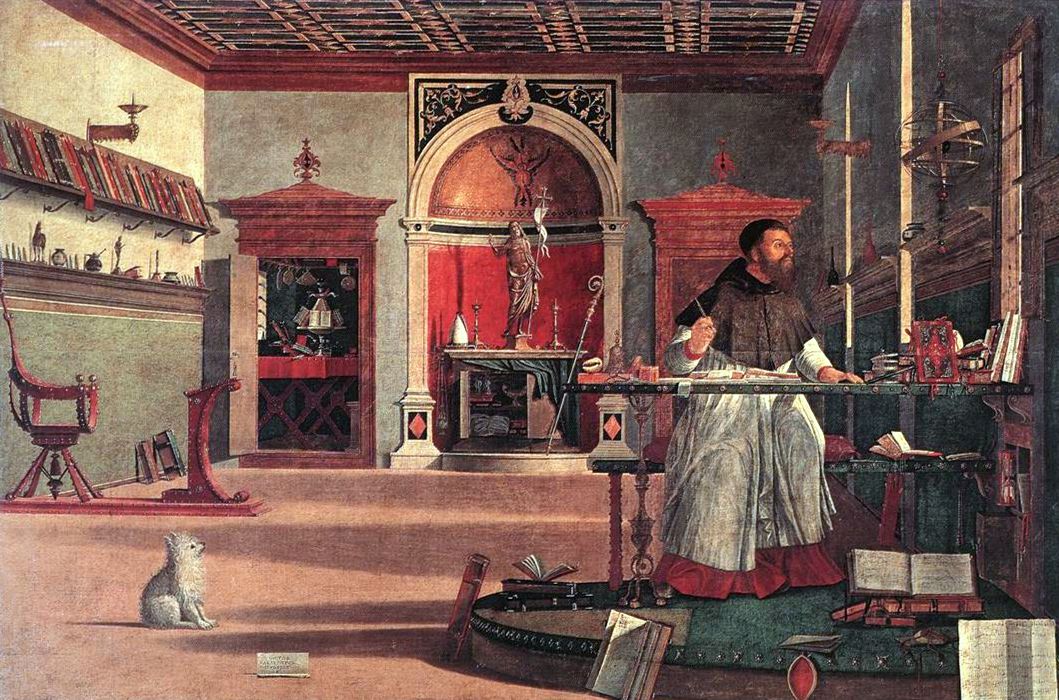
It begins with the young man, because everything Augustine became is a reaction against who he was. In his twenties he was a star: a brilliant, ferociously ambitious provincial from a small town in Roman North Africa, climbing the one ladder a clever poor boy could climb in the late empire, which was rhetoric, the art of speaking, the skill that won lawsuits and imperial appointments and made a teacher rich. He was good enough at it to teach it in Carthage, then to be handed the rhetoric chair in Milan, where the emperor's court actually sat. He had a long-term partner he never married and a son he loved. And he was sure, the way only a clever young man can be sure, that Christianity was a religion for simpletons: crude stories, a crude God, a book whose prose embarrassed a man with taste.
He spent nine years in a fashionable alternative instead, a dualist religion called Manichaeism that flattered the intellect and answered the one question gnawing at him: where does evil come from? And he spent those same years, by his own later account, in a state he could only call restless: wanting things he got and finding they didn't fill him, wanting to be good and watching himself choose worse, praying, in the most quoted line he ever wrote about himself, "Give me chastity and continency, only not yet."
Then, in his early thirties, in a garden in Milan, he broke, and went looking for what had happened to him in the only place no philosopher had thought to look exhaustively before: inside. The book he wrote about it, the Confessions, is the most intimate document the ancient world produced, and it is not a memoir in our sense. It is thirteen books of prayer, addressed straight to God, in which a master of persuasion turns his entire trained skill on the hardest possible subject, his own self, and discovers that the self is far stranger, far more divided, far deeper than anyone had said.
That is the throughline, and it is one move repeated at every level: the inward turn. Where the Platonists he loved looked up and out toward the changeless Forms, Augustine looked in, and reported back that the inner life is a real country, with its own geography of memory and will and time, and that this is where, if anywhere, a person meets the truth. The whole modern idea that a person has an inner self worth examining starts, more than anywhere else, here.
One frame to hold the whole way. Almost everything we know about the young Augustine, we know from the old Augustine, from a book he wrote around 397, a decade after the events, as a bishop with a thesis to argue and the finest literary technique in the Latin world. "As Augustine tells it" is the honest phrase to keep in mind. He is both the only witness and an interested one. That is not a flaw in the story; for a book about how a self looks from the inside, it may be the only honest way to write it.
The break
The tradition that came before deserves its strongest case, because Augustine loved it and owed it everything. Ancient philosophy was, overwhelmingly, an outward search. The pre-Socratics asked what the cosmos was made of. Plato sent the mind climbing up, out of the cave, toward Forms that hang (so to speak) above the visible world: eternal, public, impersonal, the same for everyone who reaches them. The Stoics studied the rational order running through all of nature and tried to fall in line with it. Even the inwardness the Platonists did have (Plotinus, the third-century thinker whose books would crack Augustine open, taught a turn inward and an ascent to the One) was a turn inward in order to climb out of the self toward something impersonal and universal, a One that is nobody, that waits for no one, reached by intellect and discipline if one has them. The good life was a public project of the reasoning mind, pointed at an order out there in the structure of things. This is a serious, beautiful tradition, and nothing here is a strawman: it gave Augustine his and very nearly his soul.
Augustine's break is to take that inward turn and stop it at the self, and find, when he gets there, not an impersonal One but a person, and not a clean ascent but a war. The move has a slogan, from one of his early works: noli foras ire, do not go abroad, return into yourself, for in the inward man dwells truth. (We give it as paraphrase; no public-domain English of the line is pinned down, but the sense is exact and the move is his.) Set against Plato, it turns the floor over. Plato says: look away from yourself, up at the changeless. Augustine says: look into yourself, because the self is where the image of God is stamped, and so the self is the one place in all of creation where, going deeper, leads closer to the truth instead of further from it. The road in is the road up.
And what he finds in there is the second half of the break, the part that is genuinely new. He finds that knowing the good is not enough to do it. The Platonists, he says, showed him the destination perfectly and could not make him take a single step toward it, because the problem was never in his intellect, which saw the good clearly, but in his will, which was split against itself, wanting and not-wanting the same thing in the same breath. Ancient had largely assumed that to know the good is to do it, that vice is a kind of ignorance. Augustine, watching himself from the inside, reports that this is false, that a person can see the better and choose the worse, with open eyes, and that this divided will is the central fact of the inner life. The interior self, the first-person depths, the will at war with itself, knowledge that cannot move the heart: these are the things the inward turn discovers, and they are the furniture of every examined inner life since. The chapters that follow are him finding them.
Chapter 1
The restless heart
"Thou madest us for Thyself, and our heart is restless, until it repose in Thee."
That is the first sentence of the Confessions, spoken to God before a word of the life story has begun, and it states the whole book's thesis before the argument starts, the same trick Plato pulls with the deathbed scene, the conclusion smuggled into the opening. The claim is enormous: a person is made for something, and until they reach it they will be restless, and nothing short of it will hold them. Augustine spends the next twelve books proving the restlessness on the only specimen he can fully examine: himself. So the story starts where he starts: with the brilliant, divided, dissatisfied young man, and the question that drove him into a heresy for nine years.
The vitals first, because for once they are firm and not legend. Augustine was born on 13 November 354 (he records his own birthday, an unusual fact for the period) in Thagaste, a small Roman city in Numidia, North Africa (modern Souk Ahras, in Algeria). His mother Monica (around 331 to 387) was a devout Christian and is the second protagonist of the Confessions, her prayers running under the whole book like rain that finally soaks a reluctant field. His father Patricius was a pagan small landowner, baptized only on his deathbed, and gets few lines. The family was not rich, but they spent what they had on the one investment that could lift a clever son: education. He was schooled in Thagaste and the nearby town of Madauros, then sent across to Carthage (North Africa's great metropolis, on the coast of what is now Tunisia) around 370, for advanced training in rhetoric, the art of persuasive public speaking that was the gateway to a career in law or imperial service.

In Carthage, around 372 to 373, the spark struck. Reading for his rhetoric studies, Augustine came across a now-lost work by Cicero (the great Roman orator and philosophical popularizer) called the Hortensius, an exhortation to take up philosophy, to stop chasing fame and money and turn the mind toward wisdom itself. It detonated. He says it changed the whole direction of his desires; for the rest of his life he treats it as the moment the search began. The shape of that recurs: Augustine is a man converted by books, again and again (the Hortensius now, the Platonists later, Paul's letter in the garden at the end). He reads his way into every turn of his life.
Then the part the pious editions used to skip, and that the honest story cannot. Around the age of seventeen, in Carthage, Augustine took a concubine (a socially recognized union, short of marriage, between a man and a woman of lower status) and he lived with her, faithfully, for some fourteen or fifteen years. They had a son. And here is a fact that is itself part of the story: she is never named. Not in the Confessions, not in any ancient source, not in any modern scholarship. Augustine, who names his mother and his friends and his teachers and his cat-quick adolescent sins, gives the woman he loved and lived with for a third of his life no name at all. No one should supply one; the silence is the fact, and it is the first crack in the saint. He writes movingly of the grief when she was eventually torn from him, and he never once lets us know who she was.
Their son he does name, and tenderly: Adeodatus, which is Latin for "given by God," born around 372 to 373. The boy was sharp; Augustine later wrote a philosophical dialogue, On the Teacher, as a conversation with him, putting the real arguments of his teenage son on the page, which is a startling paternal monument. Adeodatus was baptized alongside his father and died young, around 389 to 390, aged perhaps seventeen or eighteen. He matters for how much it cost when the family was broken up.
It was broken up, and the breaking is the central wart of the early life. When Augustine's career took off, his mother arranged a respectable marriage to an heiress (a step up he wanted) and the marriage required getting rid of the concubine. So she was sent away, back to Africa, and Augustine describes the wound in a line that does not flinch: "my heart, which clave to her, was racked, and wounded, and bleeding." And then, in the same passage, he records what he did next: unable to wait the two years until his young fiancée came of age, he took a second, temporary concubine to tide him over. And then, at his conversion, he abandoned the engagement too. The sequence stands at full strength before any halo gets near it. The future theologian of the divided will dismissed a faithful partner of fifteen years to climb, grieved sincerely, and immediately replaced her, and the woman who paid for all of it vanishes from his book without a name. He is not hiding this. He is putting it in evidence, against himself, which is the whole method of the Confessions: the prosecution and the defendant are the same man.
Then the nine years that made him a philosopher by giving him something to escape. After the Hortensius lit the search, Augustine went looking for a system that could carry the weight, and he found the Manichees, followers of a third-century Persian prophet named Mani, who taught a stark : the universe is a battlefield between two eternal, co-equal powers, Light (good) and Darkness (evil), forever at war. Augustine joined as a hearer, the lower of the two Manichee ranks, and stayed about nine years (roughly 373 to 382). And why it gripped him matters, because the whole rest of his thought is built to answer the question Manichaeism answered for him first.
The question was evil, the oldest knife in religion. If there is one good God who made everything, where did evil come from? Did the good God make it (then he is not good)? Did something else make it (then he is not the maker of everything)? Augustine, troubled by the evil he saw in the world and, more sharply, the evil he saw in himself, found the Manichee answer a relief: evil is not God's fault at all, because evil is a rival power, a dark substance, an anti-God locked in eternal combat with the light. On this view a person's own bad impulses are not really his own; they are particles of the foreign Dark caught inside, struggling against the trapped Light. It let a guilty, ambitious young man off a hook he could feel in his own chest. That relief is the reason he stayed nine years, and the reason he later spent so much of his life dismantling it: he knew its pull from the inside.
What broke the spell was disappointment in a man. The Manichees kept promising Augustine that all his hard questions would be answered when their great teacher Faustus came to Carthage. Faustus came: smooth, eloquent, and, Augustine found, intellectually empty, unable to answer the very questions Augustine had been told to save for him. The let-down (he narrates it in Book V of the Confessions) was the beginning of the end of his Manichee years. But disillusionment is not a solution. He left the Manichees not because he had a better answer to the problem of evil but because their answer had a hollow spokesman. He was now adrift: a rising rhetorician with a lit-up mind, no faith he could respect, and the oldest question in the world still open. To close it, he had to leave Africa.
Chapter 2
The garden
"a voice, as of boy or girl, I know not, chanting, and oft repeating, 'Take up and read; Take up and read.'"
The road to the garden runs through two cities and two men. In 383 Augustine left Carthage for Rome, partly for career, partly (he admits) to get out from under his mother's relentless surveillance; she followed him anyway. A year later, in 384, he won a real prize: the chair of rhetoric in Milan, where the imperial court then sat, the most prestigious teaching post in the Western empire and a plausible launch pad to a governorship. He was thirty, successful, and intellectually homeless. Two things he found in Milan changed that, and neither was a feeling. Both were arguments.
The first was a man: Ambrose, the formidable bishop of Milan (around 339 to 397). Augustine went to hear him at first purely as a professional, to study the technique of a famous speaker, and got ambushed by the content. Ambrose preached scripture allegorically: where the young Augustine had sneered at the Bible's crude stories and clumsy prose, Ambrose read the hard passages as figures, layered meanings, the surface a shell over a kernel. This dissolved Augustine's chief intellectual objection at a stroke. He had rejected Christianity partly because its book embarrassed his literary taste; Ambrose showed him a way to read that book that a man of taste could respect. The door he had bolted on aesthetic grounds came open.

The second thing was a stack of books, the intellectual hinge of his whole life. Sometime around 386 a Milanese acquaintance gave Augustine, in his words, "certain books of the Platonists, translated from Greek into Latin," almost certainly the Enneads of Plotinus, the great Neoplatonist, in Latin translation. (Augustine's own phrasing is barbed: God procured them for him, he says, "by means of one puffed up with most unnatural pride"; the man who lent the books was insufferable, and the gift saved him anyway.) From the Platonists Augustine learned the two things he could not get past on his own. First, that God need not be a body, that there can be a reality that is real and supreme without being made of any stuff, taking up no space, which the materialist young Manichee had literally been unable to imagine. Second (the larger of the two) that evil need not be a thing either. Without Plotinus, Augustine could not have escaped Manichaeism. The Platonists handed him the metaphysics; what they could not hand him was the will to move.
Because that was the wall. He now believed, intellectually, almost everything. He saw the good clearly. And he could not take the last step, could not actually let go of the ambition and the sex and the life he had, could not will the change his mind already endorsed. He diagnoses the paralysis in the most honest sentence anyone had yet written about wanting to be good: long before, he says, he had prayed for chastity, and added a clause. "Give me chastity and continency," he prayed, "only not yet." It is usually quoted as a wink and it is not one. It is a man catching himself praying for a cure while privately hoping the prayer won't be answered too soon, because he is not done enjoying the disease. He wanted to want the good. He did not yet want it. That gap, between the will that approves and the will that acts, is the thing he had discovered by looking inward, and it had him pinned in the summer of 386.
Then, the garden. As Augustine tells it (and we keep that frame, because he is writing eleven years later, a trained rhetorician with a literary model in mind: the conversion of the desert monk Anthony, which had moved him) he was in a garden in Milan, in an agony of indecision, weeping under a fig tree, when he heard a child's voice from a neighboring house, "as of boy or girl, I know not" (the ambiguity is his own) chanting and repeating: Take up and read; take up and read. He took it as a command from God, went to where he had left a book of Paul's letters, and opened it at random, to Romans 13, which told him to stop living in indulgence and "put on the Lord Jesus Christ." And then, in his words: "No further would I read; nor needed I: for instantly at the end of this sentence, by a light as it were of serenity infused into my heart, all the darkness of doubt vanished away."
That scene wants care in both directions. It is the most famous conversion narrative in Western literature, and it is also a constructed one, shaped, years on, by a master of the craft, patterned on an earlier saint's story, written for an audience of one (God) and millions (us). The honest claim is not "this is what happened in the garden" but "this is how Augustine, a decade later, chose to tell what happened in the garden," and the choice is itself revealing. He could have narrated a slow change of mind. He narrated a voice and a lightning bolt, because the thing he most wanted to say about his conversion was that he did not do it. Something outside his divided, paralyzed will reached in and turned it. That conviction (that the will cannot save itself, that it has to be moved from outside by grace) is the seed of the harshest doctrine of his old age (Chapter 5). The garden is where he first felt it, or first decided he had.
He was baptized by Ambrose at Easter 387, his son Adeodatus baptized at his side. On the journey home to Africa his mother Monica died, at the port of Ostia, after a shared moment of near-mystical vision the Confessions records as the book's emotional summit. Augustine went back to North Africa, founded a small community, and meant to live a quiet contemplative life. The Church had other plans: ordained priest at Hippo Regius (modern Annaba, Algeria) around 391, more or less by popular acclamation and against his own wishes, and consecrated bishop there around 395 to 396, he would spend the rest of his life, almost forty years, as a working bishop in a provincial African town, preaching, judging disputes, and writing the books that built the Latin mind. The first thing he does with his new metaphysics is solve the problem that drove him to the Manichees in the first place.
Chapter 3
Where evil comes from
"That evil then which I sought, whence it is, is not any substance."
This chapter carries the single idea most needed to actually get Augustine, and it is a genuinely beautiful piece of reasoning. It is his answer to the problem of evil (the answer that broke the Manichee dualism he had carried for nine years) and it is called the doctrine of privation. Taken move by move it clicks; skimmed, it sounds like a word trick, which is exactly what its critics say it is. They get their say at the end. The thing comes first, at full strength.
The trap, again. One good God, maker of everything, and yet there is evil. Two exits, both fatal: either God made evil (so he is not good), or someone else did (so he is not the only maker). The Manichee took the second exit (a second, evil power, co-eternal with God) and Augustine had followed him out that door. The cost of that door, he came to see, is that such a God is no longer supreme; there is a rival he is fighting and might not beat. So Augustine needs a third exit, one that keeps God both wholly good and wholly in charge. Plotinus showed him where it was. The move runs in five steps, slow.
One. Everything that exists was made by God. Two. Everything God made is good; Augustine takes this from the opening of Genesis, where God looks at each made thing and "saw that it was good." Three. Therefore everything that exists, just insofar as it exists at all, is good in some degree; being and goodness run together, so that to be a thing (a real, existing thing with a nature) is already to be good as far as it goes. Four. So evil cannot be one of the things that exist. It is not an ingredient, not a substance, not a stuff, not a power, not anything God made or anyone made, because everything made is good, and evil is precisely not good. Five. Then what is it? Evil is a privation: a lack, a missing-ness, a good that should be present and isn't. It is not a thing; it is a hole in a thing. And here the famous images do the work: blindness is not some dark substance poured into an eye, it is sight missing from an eye that should have it; darkness is not stuff pumped into a room, it is light absent; a hole in a sock is not made of anything, it is wool that should be there and isn't. Evil is like that. It has no positive existence of its own. It is the dent, not the car.
That one move is what makes the theory load-bearing and not just clever. Take the killer question back up (where did evil come from?) and it dissolves. On the privation view, that question is malformed, like asking "where does darkness come from?" Darkness doesn't come from anywhere; it isn't a something that gets manufactured and shipped. It is just what remains wherever light is absent. So too with evil: God did not make it (it isn't a thing that can be made), and no rival made it (same reason), so there is no second power to posit and no stain on God's goodness. Evil enters the world not as a creation but as a corruption, a good thing falling away from the goodness it was made with. Above all it enters through a will: a rational creature's will turning away from a higher good (God) toward a lower good (itself, a body, a peach). The thing chosen is always good (that is the point) but it is chosen in the wrong order, loved more than it should be and more than the higher good it crowds out. Evil is disordered love, a real good grasped in a corrupt way. The wickedness is not in the peach; it is in the turning.
Put plainly: God didn't make evil, because evil isn't a thing that can be made. It's a lack, not a substance: the missing good, the wrong order, the turn away. The Manichee had to choose between a God who isn't good and a God who isn't in charge. Augustine doesn't have to choose: everything that exists is good, evil is the good gone missing or gone crooked, and there is no dark second kingdom to explain because there was never a dark thing to begin with. With one distinction (substance versus privation) the wall he'd been stuck behind for a decade simply isn't there. That is what it felt like, he says, to read the Platonists and finally be able to think about evil without two gods.
And the move that earns him real respect is that he names where it's weak. The privation theory has a famous, hard objection, and Augustine's heirs argue about it to this day, so it deserves full force. Take a torturer, someone who delights in another's agony, who is good at cruelty, inventive, attentive, fully engaged. Is that monstrousness really just an absence, a hole, a nothing? It feels like the most present, most positive thing in the room. Saying "the torturer's cruelty is merely the lack of the love that should be there" can sound like a bookkeeping trick played on something that is obviously, actively real. Augustine's answer (and whether it satisfies is a matter readers still divide on) is to hold the line: yes, the energy, the cleverness, the attention are all real goods, gifts of a good nature, and they are real precisely because they exist; what makes the act evil is not any of that positive equipment but the thing that is missing from it, the love and justice that ought to be steering it and aren't. The cruelty is the privation made active, good capacities harnessed to a corrupt order of loves. Whether that fully accounts for the felt positivity of malice is one of the live arguments in the philosophy of religion, and it has been since he wrote. But the mark of a real philosopher is in what he does next: he hands over the sharpest knife pointed at his own theory rather than hiding it. He found the crack and showed it. (Plato did exactly this to his own Forms; the move is the mark.)
Privation is the engine under everything that follows. The divided will (Chapters 3–4) is a will whose loves are disordered, turned to lower goods over higher ones. The whole drama of grace is the drama of a will that cannot reorder its own loves and has to be reordered from outside. Even the two cities at the end are sorted by what they love, and in what order. Augustine's entire system is a theory of love gone right or wrong, and it rests on this floor: evil is never a thing, only a good corrupted, a love misaimed. Privation is the key to the rest of him.
Chapter 4
Time, memory, and the self inside
"What then is time? If no one asks me, I know: if I wish to explain it to one that asketh, I know not."
The first nine books of the Confessions tell the life story and end with Monica's death. Then the book does something no autobiography would do: it keeps going for four more books that are pure philosophy, on memory, on time, on creation. Augustine has turned the inward gaze from his history to the structure of the inner life itself, and what he finds there is the most original philosophy in the book. This is the chapter where the throughline pays off completely: the inward turn discovers an interior that is a real country, with its own physics. Two of the strangest things he finds in it (the nature of time, and the bedrock of the self) come next, and then the line that runs twelve centuries forward to Descartes.
The epigraph is the most honest sentence in the philosophy of time. What is time? If nobody asks me, I know; if I have to explain it, I don't. Everyone has lived inside time their whole life; nobody can say what it is. Augustine takes the puzzle by the throat with a worry that is easy to feel and hard to escape. Where does time even exist? The past is gone; it doesn't exist anymore. The future hasn't happened; it doesn't exist yet. And the present, the only part that does exist, has no duration at all: the instant anyone tries to grab "now" and measure it, it has already slid into the gone-past. So all three parts of time seem to have no existence: a no-longer, a not-yet, and a vanishing knife-edge. How can we measure something (say one note is longer than another) when none of the thing we're measuring is ever actually there to measure?
His answer is the inward turn applied to time, and it is dazzling: time exists in the mind. Not out there in the world as a kind of cosmic river one floats on, but in here, as a stretching of the soul. The past exists, but as memory, present now in the mind. The future exists, but as expectation, present now in the mind. The present exists as attention, the mind's focus on the passing instant. There are not really three times; there is a present-of-things-past (memory), a present-of-things-present (attention), and a present-of-things-future (expectation), all of them happening now, in a soul that is stretched out (his word is distentio, a distension, a being-pulled-taut) across what it remembers and what it awaits.
His own example makes it concrete, the one that proves the case: measuring a sound. Say this note lasted longer than that one. But while the note is sounding, it isn't over, so its whole length can't yet be measured; and the instant it's over, it's gone, so there's nothing left to measure. So where does the measuring happen? It happens in the mind, which holds the just-finished sound in memory while the next is sounding, and compares the impression of the one against the impression of the other. The sound out in the air is not what gets measured; by the time it is grasped, it's nowhere. What gets measured is an impression the sound left in the mind. Time, for Augustine, is that mental stretch, the soul holding past and future together in a present act of attention. It is the first time anyone made time psychological rather than cosmological, a fact about minds rather than about the heavens, and it is one of the deepest things in the book.
One level further down lies the bedrock. While he's in there mapping the inner country, Augustine hits a floor that cannot be doubted, and it is one of the most famous moves in philosophy precisely because someone else would make it again, alone, twelve hundred years later. In the City of God he poses the skeptic's challenge: what if I am wrong about everything, deceived in all my beliefs? And he answers (this ships as paraphrase, because no public-domain English of the line is pinned, though the Latin is his and exact, si fallor, sum) that even total deception cannot reach all the way down, because to be deceived, one has to exist. If I am fooled, then there is an I that is being fooled. The very act of erring proves an existing one who errs. One can doubt the whole world and every belief in one's head, and the doubting itself hands back the one thing that cannot be doubted: that the doubter is.
That rings a bell, and it has to be rung precisely, as a parallel, not a debt. Twelve centuries later, René Descartes would shut himself in a warm room, try to doubt everything, and arrive at cogito, ergo sum (I think, therefore I am) the same bedrock reached by nearly the same road: whatever I doubt, I cannot doubt that I, doubting, exist. The structure is strikingly alike, and the two are worth setting side by side. But it would be wrong to say Descartes "got it from Augustine." There is no good evidence he was answering this passage; when the parallel was pointed out to him he acknowledged the resemblance and claimed he'd reached it on his own, and the purposes differ: Augustine is defending the soul's immateriality, Descartes is laying a foundation for all knowledge. The exact shape of it is this: the argument Descartes would reach by a different road, for a different reason, twelve hundred years on. What the parallel really shows is how powerful Augustine's inward turn was, that the deepest discovery of seventeenth-century philosophy was already sitting in a fifth-century bishop's book, found by the same method of looking in.
There is one more thing the inward turn finds, and it closes the gap in the whole system. When the mind grasps a truth that is eternal (that seven and three make ten, that justice is better than cruelty, truths that do not change and were not invented by anyone) where does it see them? Not in the shifting world of the senses, and not, Augustine thinks, generated by the small flickering mind on its own. He answers with a theory called divine illumination: the mind sees these unchanging truths by a light cast on them from God, the way the eye sees colors only because an outside light falls on them. In an early dialogue, On the Teacher, written with his son Adeodatus, he draws the conclusion that no human teacher really puts knowledge into another mind; the teacher only points, and the learner sees the truth by consulting an inner teacher, the light of God within. It is the inward turn at its most epistemological: even the most public, impersonal truths (the ones Plato sent the mind out and up to reach) are met, for Augustine, by going in, because the light that makes them visible is already shining in the inner room.
By turning the trained rhetorician's whole attention inward (onto memory, onto time, onto the indubitable doubting self, onto the very light by which the mind sees what is true) Augustine mapped an interior with real structure: a self that holds time together inside it, a self that survives even total deception, a self with depths the ancient outward-facing tradition had never charted. This is the new kind of self of the throughline, and it is his lasting gift to philosophy quite apart from anything theological. But the inner country has a darker region too, the one the garden already showed, the will that will not obey itself, and that region is where Augustine's thought turns hardest, and most troubling.
Chapter 5
Grace, the will, and Pelagius
"Give me chastity and continency, only not yet."
This is the chapter where many readers part company with Augustine, and the honest course is to follow them all the way to the place where they want to get off, pulling no punches on the way. It is about the will (the faculty he discovered was divided against itself) and about what he came to think the will can and cannot do on its own. He started, as a young convert, fairly generous about human freedom. He ended, as an old bishop, with a doctrine so severe that it has unsettled Christians for sixteen hundred years. The hardening happens on the page, and he knew it was happening.
The early position comes first, because he later had to walk it back. In a work called On Free Choice of the Will, begun around 388 just after his conversion, Augustine is still fighting the Manichees, and his weapon is free will. Where does evil come from, if not from a dark rival power? From the free will of rational creatures, he says, from us, freely turning from the higher good to the lower. This is the privation theory of Chapter 3 with a culprit named: evil is disordered love, and the disordering is a free act of a will that could have done otherwise. It is a humane, recognizable view: we sin freely, and so we are justly blamed. The later Augustine will take most of it away.
What changed him was a fight with a serious opponent, one who deserves his strongest case stated before Augustine answers him. The opponent was Pelagius, a British monk (active around 390 to 418), and his position was not stupid or lax; it was, on its face, the more morally serious one. Pelagius reasoned: God commands us to be good; God is just; and a just God cannot command the impossible. Therefore, if we are commanded not to sin, we must actually be able not to sin; human nature must retain real, working free will, uncorrupted at the root, capable of choosing the good. Grace, for Pelagius, is real and helpful (God gives us the law, the example of Christ, the forgiveness of past sins) but the decisive step is ours; we must make the effort, and grace, in part, rewards it. His follower Julian of Eclanum sharpened the edge into a direct accusation: Augustine's idea that we inherit guilt and corruption from Adam makes God a monster, punishing newborns for a crime committed before they existed. That is not a cheap shot. It is the hardest question anyone can put to Augustine, and Pelagius and Julian forced him to his least comfortable answers.
What Augustine answered is severe, and it bears stating plainly. He held that Adam's first sin did not merely set a bad example; it introduced a corruption into human nature itself, passed down to every descendant the way (his metaphor) a disease in the root spreads to every branch. This is original sin in its hard form, and a precise note is owed: Augustine did not invent the idea (it has roots in Paul and earlier writers) but he gave it the definitive Western shape, the heritable, biological transmission of a guilt and a damage we are all born into. And the consequence is the part that stops readers cold: after the Fall, the human will is no longer free to choose the good on its own. It is in bondage, able to sin freely, but not able to turn to God by its own power. The will must be liberated by grace; it is not inherently free. Knowing the good is not enough (the garden taught him that); the divided will cannot reorder its own loves; only grace, reaching in from outside, can do it. And grace, he concluded, God gives to some and withholds from others.
It runs to an end, and Augustine followed it there without flinching. If the will cannot save itself and grace is what saves, and grace is given to some and not others, then who is saved is finally up to God's free choice, not ours: predestination, the teaching that God decided in advance, before anyone was born, who would be saved. Before the world began, Augustine taught, God chose the elect who would be saved; the rest are justly left to the damnation that, he insists, all of us equally deserve, so that no injustice is done to anyone: the saved get unmerited mercy, the rest get merited justice, and none gets wronged. The whole of humanity, on this view, is a massa perditionis, a lump of perdition, out of which God mercifully rescues some. There is no softening this, and Augustine did not try. This is the conclusion many readers find genuinely disturbing, a God who chooses, from a justly condemned mass, whom to save and whom to pass over, and it was his settled, documented position, edges and all.
And the wart that is his own, the one he was honest enough to record, is that he knew he had hardened. The generous free-will Augustine of On Free Choice of the Will and the predestinarian Augustine of the anti-Pelagian years are not the same, and late in life he wrote a remarkable book, the Retractations, going back through his own works in order and correcting what he no longer believed, including walking back the early work's more hopeful view of the will. He did not pretend he'd always thought this. He showed his own change of mind on the page, which is rare in any age. Both things hold at once: the late doctrine is harsh to the point that much of later Christianity could not finally accept it, and the man who held it was unusually honest about how he'd gotten there.
The doctrine did not sweep the field. Pelagianism was condemned at the Council of Carthage in 418, and Augustine's side won the official argument. But his full predestinarian severity was a harder sell even among his allies. A later generation of monks in southern Gaul (the so-called Semipelagians) tried to find a middle path, granting human corruption but insisting we can at least begin to reach for God on our own. That long quarrel was settled only at the Second Council of Orange in 529, a full century after Augustine's death, broadly in his favor but with the sharpest predestinarian edges left unaffirmed. The Church kept Augustine's grace and quietly declined his hardest conclusion, until, a thousand years on, the Reformation would dig that conclusion back up and build on it (Chapter 6).
Chapter 6
The two cities, and what came after
"Accordingly, two cities have been formed by two loves: the earthly by the love of self, even to the contempt of God; the heavenly by the love of God, even to the contempt of self."
The last great work was written against the clock of a falling world. In 410 the unthinkable happened: Rome (the eternal city, unsacked for eight hundred years) was taken and plundered by the Visigoths under Alaric. The pagan reaction was immediate and pointed: this is the Christians' fault. Rome conquered the world under its old gods; Rome abandoned those gods for Christ; now Rome is sacked. The gods took their revenge. Augustine, bishop in his African town, answered that charge across twenty-two books written between 412 and 426, and the answer became the most influential philosophy of history the Latin West ever had: the City of God.
Its central idea is in the epigraph, and it is misread constantly. All of human history, Augustine says, is the intertwined story of two cities, and the cities are defined not by walls or borders but by love, by what their members ultimately love and in what order. The earthly city is built by "the love of self, even to the contempt of God"; the heavenly city by "the love of God, even to the contempt of self." That's it: two loves, two orientations of the heart, and every human being belongs to one or the other by what they finally love most. This is the privation theory of Chapter 3 written across all of history: it is a story about ordered and disordered love at the scale of the human race.
The misreading has to be killed, because almost everyone gets it wrong and the wrong version matters. The two cities are not the Church versus the Roman state, religion versus politics, good institution versus bad institution. Augustine is explicit that the two cities are intermixed throughout earthly history and cannot be sorted out by anyone but God at the end of time. The visible Church contains members of the earthly city: hypocrites, the lukewarm, the self-loving in clerical robes. The pagan empire contains, here and there, members of the heavenly city, drawn by a grace they may not even name. No one can point at any institution and say "there is the City of God." The division runs through every institution and every human heart, invisible until the Last Judgment sorts it. Read as church-versus-state, as a blueprint for the Church to rule the world, it becomes the opposite of what it says. It is a doctrine about the secret orientation of loves, not a map of powers.
And the darkest wart, named plainly and then left, because it earned its place in his story and a sermon would only soften it. For most of his career Augustine opposed using force in religion. His long fight was with the Donatists, a rigorist North African sect that had split off and formed a rival church, and at first he argued they should be won by persuasion, never compelled. Then he changed his mind, and reached for a parable to justify it. In Jesus's story of a great banquet (Luke 14), a host whose invited guests don't come sends his servants out to bring in strangers, with the line "compel them to come in." Augustine turned that phrase into a doctrine: the state may use coercion against heretics and schismatics, because forcing someone back toward the truth can be an act of love, the way a father forces a straying child. He wrote it to the Donatist bishop Vincentius in so many words, granting that Vincentius held no one should be compelled to follow righteousness, "and yet you read that the householder said to his servants, 'Whomsoever ye shall find, compel them to come in.'" Augustine himself argued for exile and fines, not death; he did not run torture chambers. But the argument, that coercing belief can be Christian love, outlived its careful author, and later centuries cited it to underwrite inquisitions and forced conversions he never imagined. That is the honest shape of it: a good man, in a local fight, built a key that worse men would use on doors he never meant to open.
Against that stands, in fairness, the line of his that is most loved and most mangled. Preaching on the first letter of John, Augustine said: "Love, and do what you will," and the popular world has run off with it as a permission slip, love God and do as one pleases, act on any impulse. The full passage says nearly the reverse. "Love, and do what you will: whether you hold your peace, through love hold your peace; whether you cry out, through love cry out; whether you correct, through love correct... let the root of love be within, of this root can nothing spring but what is good." It is not a license; it is a claim that real love, properly rooted, will of its own accord do only good, that the act can be trusted if the love behind it can. The misquote keeps the freedom and throws away the root. The man who wrote it is the diagnostician of disordered love from Chapter 3, not its excuser.
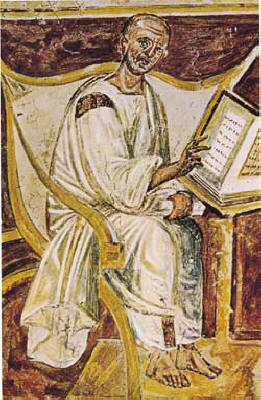
Augustine died on 28 August 430 in Hippo, an old man, while the city was under siege by the Vandals, a Germanic people who had crossed from Spain into North Africa and were eating their way along the coast. He died of illness in his city's last hours; Hippo fell soon after. The Roman world he had lived his whole life inside was visibly ending around his deathbed, which makes it all the more striking that the books he left would outlive that world by a margin he could not have guessed, and effectively build the mind of the next one.
And the size of him, at the right scope: Augustine is the single most influential thinker in the Latin Christian tradition before the modern age. The scope is exact, the Latin West; the Greek-speaking Eastern Church, which had its own giants, never leaned on him the way the West did. For a thousand years he was the most-quoted authority after scripture itself, and the major moves of Western thought keep turning out to be footnotes to him. Anselm, three centuries later, made Augustine's "faith seeking understanding" into a program. Aquinas built on his grace and his two cities, while gently correcting his pessimism about reason. And then the inheritance turns explosive. Martin Luther was, literally, an Augustinian friar (a member of a religious order founded on Augustine's name and rule) and he read the late Augustine, the Augustine of the enslaved will and unmerited grace, and used him to break the Western Church in two: salvation by grace alone, by faith alone, the human will unable to earn its own rescue, is Augustine's anti-Pelagian doctrine turned into a hammer. John Calvin took the very hardest thing Augustine taught (predestination) and followed it to its most consistent end, double predestination, with Augustine cited on nearly every page. The conclusion the medieval Church had quietly declined to affirm, the Reformation dug up and built a civilization on.
And one last thread. René Descartes, opening modern philosophy in the seventeenth century, reached the bedrock self that nothing can doubt (I think, therefore I am) by the same inward road Augustine had walked twelve hundred years earlier to si fallor, sum, if I am deceived, I exist (Chapter 4). The parallel is real; the influence is not claimed. What it shows is the reach of the inward turn. Augustine took the inward turn, found inside the self a personal God, a divided will, the structure of time, and an indubitable first person (a whole interior country) and the next thousand years of Western thought, religious and then secular, kept going back in through the door he opened. The rhetorician who turned philosophy inward did not just win an argument about evil or grace. He found the modern self, restless, divided, and deep, and the rest of us have been living in it since.