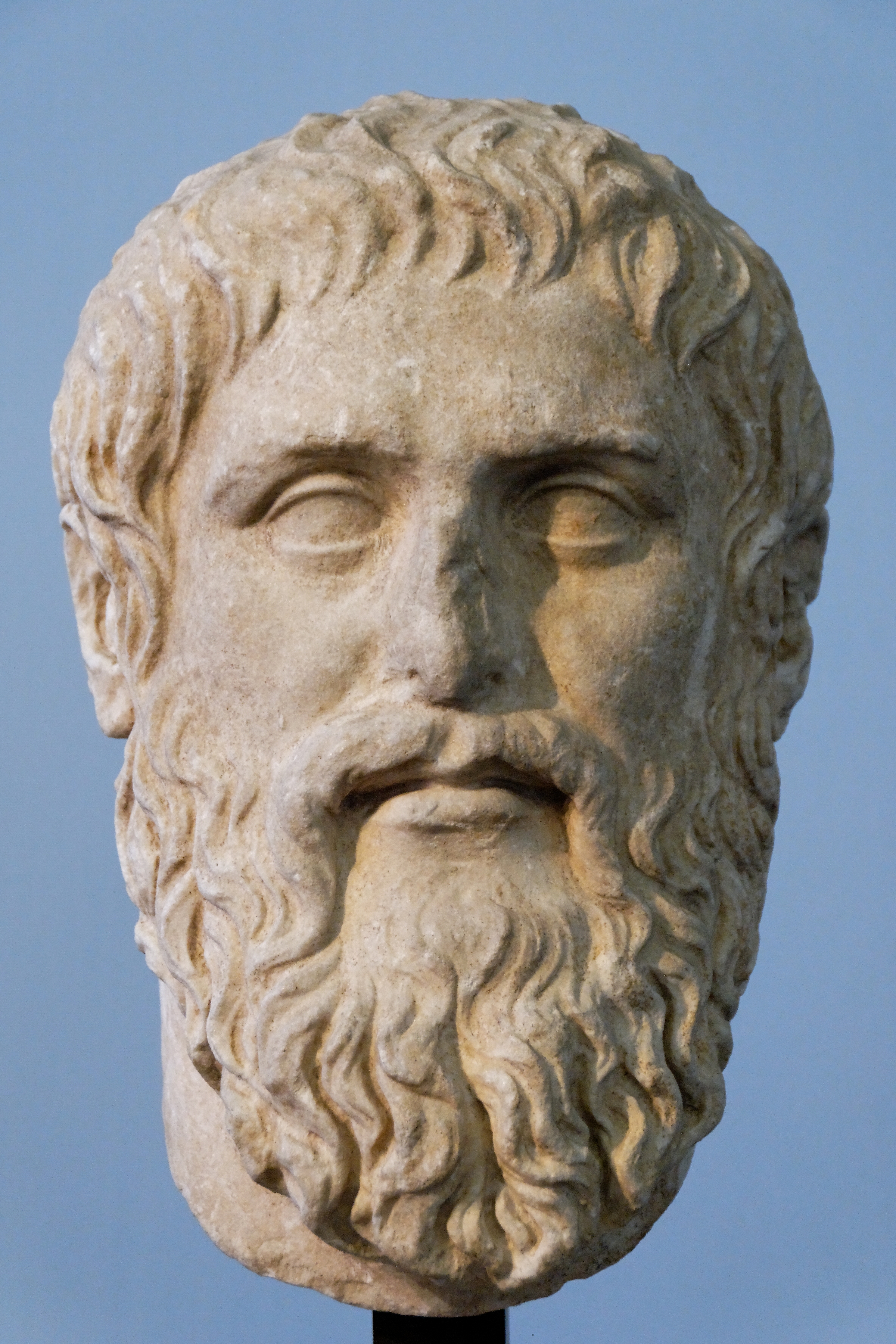
By the time Plato was a young man, Greek philosophy had argued itself into a corner (the Greeks chapter). Heraclitus had said everything is always changing, which meant there was nothing stable to know. Parmenides had said real change is impossible, which meant the whole visible world was a deception. Both had arguments nobody could quite break, and the lesson the Sophists drew was that since real knowledge is out of reach, wisdom is just persuasion, and the smart man learns rhetoric. Then his teacher Socrates was executed by Athens for asking too many questions, having taught (at least by Plato's rendering) a method for tearing down bad answers but no good answer of his own.
That is the wreckage Plato walked into. His one move out of it is the most influential idea in Western thought: split reality in two. Heraclitus is right about one level, Parmenides about the other, and the philosopher's job is to get from the lower to the higher. Everything else is detail.
The break
Before Plato, every serious answer about what is real pointed at stuff. Thales said water, Anaximenes said air, the atomists said tiny uncuttable bodies in the void (the Greeks chapter). Whatever the answer, the really real was some ingredient of the physical world, the thing the senses were ultimately reporting on. And that is exactly where the trouble lived, because the physical world will not hold still. Heraclitus had shown that everything in it is sliding (the river is never the same river), and if the object of knowledge keeps changing underneath, knowledge of it is impossible. Knowledge needs something that stays put.
Plato's break is to say: then the really real is not stuff at all. It is not in the visible world, and it is not the kind of thing eyes can see. There are perfect, changeless originals (the Beautiful itself, the Equal itself, Justice itself) that the mind can grasp by reasoning and the senses can never reach, and the beautiful, equal, just things one actually runs into are only shadowy, shifting copies of those originals. This is the theory of Forms, and it flips the floor completely. Common sense says the solid table in the room is more real than some abstract idea of a table. Plato says it is the other way around: the abstract original is the real thing, and the table one can knock on is the copy that fades. Heraclitus was right, but only about the copies. The originals never move. One move, and the whole map of what counts as real turns over.
Plato wrote dialogues, little stage plays in which characters argue, and he never once steps on stage himself. The character who carries the argument is almost always Socrates. So "Plato argues" really means, on the page, "Socrates says," and scholars genuinely divide on where the real Socrates ends and Plato's own ventriloquism begins. That seam stays visible throughout. It is half of what makes Plato Plato.
Chapter 1
The problem Plato walked into
"Plato, if I am not mistaken, was ill."
That is one of the strangest opening lines in philosophy, and it is doing something sly. The Phaedo is Plato's account of the last hours of Socrates, the deathbed scene, the most emotionally loaded thing he ever wrote. A man named Phaedo is listing who was in the prison cell when Socrates drank the poison, and he gets to Plato and says: Plato was ill, so far as he knew, and was not there. Plato writes himself out of his own master's death. Even his most intimate, most literary record of the event he cared about most is, by his own deliberate construction, secondhand. That instinct (never quite speak in the first person, always put the words in someone else's mouth, always keep a frame between the author and the claim) is the single most important thing to understand about him before any of the ideas. The chapters start there, with the man he is writing about, the problem that man left behind, and the older deadlock both of them were trying to escape.
Plato was born in Athens in the late 420s BC, into a prominent family, and died in 347 BC, around eighty. (One sometimes reads that his real name was "Aristocles" and that "Plato," meaning "broad," was a wrestling-coach's nickname for his build, or his forehead, or his prose style. That story comes from Diogenes Laertius, a biographer writing roughly six hundred years later, who offers three different versions of it in the same breath. It is a late tale, not a fact. "Plato" was a perfectly ordinary Athenian name on its own.) What matters is not the biography but the teacher. Plato was about twenty-eight when Athens, in 399 BC, put Socrates on trial for impiety and corrupting the young and voted to kill him (the Greeks chapter). That execution is the wound the entire Platonic project grows out of. Plato spent the next half-century making sure Socrates was never forgotten, and making sure the city that killed him never lived it down.
What did Socrates actually leave him? A method and a hole. The method was the elenchus (cross-examination): corner someone into defining a big word (justice, courage, piety), then ask follow-up questions until their confident definition falls apart, and leave them stuck, knowing less than they thought they knew but at least knowing that. It is a magnificent tool for demolition. It is useless for construction. Socrates, at least the Socrates of Plato's early plays, never says what justice is; he only proves that his interlocutor doesn't know either. He died having taught the city how to take an answer apart and having refused, or been unable, to put one together. That hole is the job Plato sets himself: keep the method, but reach an answer it can stand on.
The dialogue problem controls everything that follows. Scholars sort Plato's dialogues into three rough piles. The early ones (the Apology, Euthyphro, and a handful of others) are pure elenchus, no big positive doctrine, and most scholars think their Socrates is the closest thing we have to the historical man. The middle ones (the Phaedo, the Symposium, the Republic, the Phaedrus) are where the famous machinery shows up: the Forms, the immortal soul, recollection, the philosopher-king, and the tripartite soul (the idea that the soul is split into three parts that are often at war with each other). Here the consensus is that "Socrates" has quietly become Plato's mouthpiece, saying things the real Socrates probably never said. The late ones (the Parmenides, the Theaetetus, and others) get technical, and remarkably, the Forms come under attack, sometimes from Socrates' own side. So the rule is this: the theory of Forms, the tripartite soul, and the just city all belong to Plato's middle-period Socrates, dramatized through a character, in dialogues scholars read as Plato's own thinking. That hedge is a fact about the kind of thing Plato chose to write, and he chose it on purpose, because (as he has Socrates argue elsewhere) a written claim can't defend itself under questioning, and the living back-and-forth of two minds is where philosophy actually happens. He made the form match the conviction.
Now the older deadlock, the one the Forms are built to break, because Plato did not invent his problem from scratch. He inherited two arguments that could not both be true and could not separately be dropped (the Greeks chapter, run quickly here so we can go past it). Heraclitus: everything in the world is in flux, always becoming something else, never simply being anything, like a river that stays a river only by never being the same water twice. If that is the whole story, knowledge is doomed, because the moment a thing is known it has already changed into something unknown. Parmenides, from the opposite side: change is literally unthinkable, because for something to change it would have to become what it is not, and "what is not" cannot even be spoken of, so reality must be one single changeless thing and the moving world the eyes report is a fraud. Two strong arguments, flatly opposed, and between them they seem to prove that either nothing can be known or nothing really moves.
A third inheritance points the way out. The Pythagoreans (the secretive number-mystics of southern Italy, the Greeks chapter) had taught that the deepest truths about the world are not the messy objects the eye sees but the numbers underneath them, the whole-number ratios that turn out to govern musical harmony and the motions of the heavens. A perfect triangle, the kind geometry proves theorems about, is not any triangle anyone could ever draw; every drawn triangle is a little crooked, yet the mathematical truths hold perfectly of the perfect one nobody has seen. The Pythagorean voice in Plato's ear says: maybe the really real is something the mind grasps and the eye never does. That is the seed. Plato is about to plant a whole universe in it.
(One more thing Aristotle would later report and Plato never wrote down: the so-called unwritten doctrines, oral lectures at the Academy on ultimate principles that supposedly lay under even the Forms. Scholars disagree sharply about whether they amount to a hidden system or are mostly Aristotle's own reading, and the safest position is that it might be real, it might be a reconstruction, and nothing in the main story depends on them.)
Chapter 2
The Forms
"the good is not only the author of knowledge to all things known, but of their being and essence, and yet the good is not essence, but far exceeds essence in dignity and power."
The argument that forces the Forms into existence is usually called the one-over-many, and once its is clear the rest follows.

The argument, step by step. Take any collection of beautiful things: a face, a melody, a clean mathematical proof, a sunset. They have almost nothing physically in common (one is a sound, one is a pattern of light), and yet all of them get called by the one word, beautiful, and that is no mistake. So there is something the same about them. What is it? It cannot be any physical feature, because they share no physical feature (the melody has no color, the face has no key signature). It cannot be that each is beautiful "because of" the others, because that just passes the question along. So it must be some one thing they all have in common that is not any of them, something they all "have a share in." Plato's name for that one thing is the Form of Beauty, or the Beautiful itself: not a beautiful object, but Beauty as such, the single source from which every beautiful thing borrows whatever beauty it has.
Now push on why that source can't be an ordinary object. Every beautiful thing one can point to is beautiful only sort of, only for now, only from here. The face ages. The melody is gorgeous to one listener and grating to another. A hand is beautiful but clumsy next to a statue's. Beautiful things are always beautiful-and-also-not, depending on when, compared to what, in whose eyes. But the thing that makes them beautiful, Beauty itself, cannot be like that, or it could not do its job. It must be beautiful period, not beautiful-from-one-angle, must never fade, never have an off-day, never be out-beautied. Which means it cannot be a physical thing at all, because physical things are exactly the things that fade and shift and depend on viewpoint. The Form of Beauty is eternal, changeless, and not available to the senses. The mind reaches it or nothing does.
The steelman, the idea at full strength before the objections. This is not a mystical flourish; it is the only known answer at the time to a real and pressing question. If knowledge is possible at all (and the Sophists were busy arguing it wasn't), it has to be knowledge of something, and that something has to stay still long enough to be known. The flux world can't supply it. The one-over-many argument locates the only candidate that fits: a changeless object the intellect can grasp. Mathematics already behaves exactly this way (the truths of geometry are perfect, eternal, and about no physical triangle), so the move isn't even exotic. Plato is saying: whatever makes mathematical knowledge possible, do that for beauty, for justice, for goodness, for everything we claim to really know. The Forms are the price of admission for knowledge being real.
This is also where Plato's split heals the old deadlock. There are now two levels of reality, and the words for them are technical, not the ordinary English they look like. There is the world of becoming: the visible, physical, sensory world, where everything is always sliding from one state to another, and here Heraclitus was simply right, this world really is pure flux. And there is the world of being: the invisible, intelligible world of the Forms, eternal and changeless, and here Parmenides was right, this reality really is one unchanging order. "Being" here does not just mean "existing" and "becoming" does not just mean "changing"; they name two different grades of reality, one stable and self-sufficient, one always dependent and in motion. The two great opponents were each describing a real level; their mistake was each thinking his level was the whole of reality. Knowledge is possible after all, but it is knowledge of the upper level, the Forms; about the lower, sliding world there can be only opinion (the Greek doxa, which for Plato is a belief that can be perfectly correct but isn't tied down by understanding why it is correct), never genuine knowledge.
The technical word for how the two levels connect is participation (in Greek, methexis). A beautiful thing is beautiful by participating in, having a share of, the Form of Beauty. Think of the Form as the master recipe and the beautiful things as the individual dinners. Every dinner is the recipe made real in flour and heat, every dinner comes out a little different, some are burnt and some are perfect, and yet they are all that-recipe because they all share in it. The recipe itself never gets eaten, never burns, never changes; it is what the dinners are copies of. That is participation, and it lets Plato say both halves at once: the beautiful things are real (they are genuinely beautiful, genuinely participating) and they are second-rate (they are copies, always falling short of the original they share in).
Two misreadings get pinned on Plato constantly, and both are wrong. The first: that the Forms are "perfect copies floating in heaven." They are not in a place at all. A place is part of the physical world, and the Forms are not physical; they are non-spatial and non-temporal, which is a weird thing to be but not a thing that has an address. When the Phaedrus talks poetically about a "place beyond the heavens" where the soul glimpses the Forms, that is a myth, a picture, and the surrounding text makes clear it is a picture. "The realm of the Forms" is a way of talking about a kind of reality, not a location anyone could fly to. The second misreading: that Plato thought the physical world is an illusion, a dream, the Matrix. Also wrong. A copy is not an illusion. The dinner really exists; it is just not the recipe. Plato's lower world is genuinely real, genuinely there, just real at a lower grade, dependent on the Forms the way a shadow depends on the thing casting it. The problem he is pointing at is not "nothing is real" but "the things one can touch are not the things one can truly know."
Now the move that earns Plato a place among the very greatest philosophers, and it is not a strength of the theory but an attack on it, staged by Plato himself. Late in his life he wrote a dialogue called the Parmenides, in which old Parmenides cross-examines a young Socrates about the theory of Forms and lands a blow that has worried defenders of the Forms ever since. It is now called the Third Man argument (Aristotle's later nickname for it; in Plato's own text the example is greatness, so it is really a "third greatness"). It is a beautiful piece of self-sabotage. The whole theory says: many great things are great by sharing in one Form, Greatness itself. Fine. The result is: the many great things, plus Greatness itself. The twist that makes the whole thing run: Greatness itself is also, in some sense, great (it is, after all, Greatness, the most great thing there is), so it now counts as one more member of the collection of great things, right alongside the great rocks and great men it was supposed to explain. So now there is a new collection of great things: the originals and the Form. And by the theory's own rule, whenever there are many great things they must all be great by sharing in some one Form of Greatness over and above them. So a third Greatness is needed to explain the shared greatness of the first group plus the first Form. And that third one is also great, so it joins the pile, and a fourth is needed, and so on forever. In Plato's own words, through Parmenides: "another idea of greatness now comes into view over and above absolute greatness, and the individuals which partake of it; and then another, over and above all these, by virtue of which they will all be great, and so each idea instead of being one will be infinitely multiplied." That bolded-out clause, "by virtue of which they will all be great," is the engine: each new collection of great things shares some greatness, and that shared greatness demands yet another Form to explain it, which then joins the next collection, forever. The theory of one master Form behind the many copies threatens to explode into infinitely many Forms.
Plato wrote this. Plato, the inventor of the Forms, sat down and composed the sharpest objection to the Forms anyone has ever made, put it in the mouth of the philosopher he most respected, and let his own young hero fail to answer it cleanly. He did not bury the problem; he staged it, in public, in writing. That is the mark of a real philosopher, the willingness to arm one's own critics and let the argument go where it goes. (Aquinas would do exactly the same thing, opening the case against God's existence with the two strongest arguments against it before answering them. Honest minds arm their enemies.) What Plato does not do is conclude that the Forms are dead; the later dialogues keep working with them in modified forms. He has found a crack in his own foundation and shows it rather than papering over it. And the crack does not stay private: the same worry, that if the Forms are kept separate from things it is unclear how they do anything to things, is the exact objection Aristotle, who would study at Plato's Academy for twenty years, makes the center of his own break with his teacher (Chapter 7). The flaw Plato found in his own foundation is the one his greatest student widens.
One Form sits above all the others. It is the Form of the Good, and Plato's claim about it is the most extreme thing in his whole . The Good is not just the highest Form; it is, he says, the source of the being of all the other Forms and of our ability to know them, and it is itself "beyond" being, in his words "not essence, but far exceeds essence in dignity and power." That is a strange and important sentence. It says the Good is not one more item in the catalogue of what exists, even the top item; it is what makes the catalogue possible, the source that lets the other Forms be at all and lets the mind reach them, the way (as he is about to argue) the sun is not one more visible thing but the thing that lets all visible things be seen. That claim gets its full shape in the three great images of the Republic (Chapter 4). First, though, comes the soul that does the climbing, and the argument that it existed before the body.
Chapter 3
Knowledge and the immortal soul
"And I am certain that no one ever did teach him."
There is a paradox that should stop learning before it starts, and Plato takes it seriously enough to build a whole theory answering it. It comes up in the Meno, posed by Meno himself, and it goes like this: a person can never learn anything. Either one already knows the thing, in which case there's nothing to learn, or one doesn't know it, in which case one wouldn't recognize it if one found it, so there's no way to go looking. Search is impossible. One can only find what one can already identify, and only identify what one already knows. So how does anybody ever come to know anything new?
Plato's answer, through Socrates, is one of the boldest moves in philosophy: nobody learns anything new. Learning is recollection. The knowledge was already there, from before birth, and what looks like learning is really remembering something the soul once knew and forgot. The Greek word is anamnesis, and to prove it Socrates does something no other ancient philosopher does. He runs an experiment, on stage, in front of the witness who doubts him.
The demonstration is the argument. Meno has a slave boy who has had no mathematical education. Socrates draws a square in the dirt, two feet on each side, so four square feet of area, and asks the boy a question any of us might get wrong: how long must the sides be to make a square with double the area, eight square feet? The boy answers confidently and wrongly. Double the sides, he says, four feet each. Socrates doesn't tell him he's wrong; he just draws that square and asks the boy to count, and the boy sees that doubling the sides gave him not double the area but four times it, sixteen square feet, way too big. The boy tries again: maybe three feet a side? They draw it, count it, nine square feet, still wrong, but the boy now sees he's overshooting and undershooting and is, in Socrates' famous phrase, properly stuck (which is better than being confidently wrong, because now he wants the answer). Then Socrates, asking only questions, never asserting, leads him to draw the diagonal of the original square and build a new square on that. The boy counts it out: eight square feet, exactly double. He's solved it. The correct side length for a square of double area is the diagonal of the original. Socrates turns to Meno and says: I never told him a single answer. "I am certain that no one ever did teach him." I only asked questions; every right answer came out of the boy himself. So where did the knowledge come from? It was already in him. He recovered it. And that is exactly what dissolves the paradox: the reason the boy can recognize the right answer when he reaches it is that some part of him already had it, latent, all along. He didn't need someone to install new content from outside; he only needed to be led back to what was already there, which is recovery, not teaching. And since nobody taught it to him in this life, he must have had it from some other time, before he was born. The soul, therefore, pre-exists the body. It knew, it forgot, and good questioning helps it remember.
The steelman, the argument at its strongest. Setting aside the talk of past lives, there is something genuinely strange about mathematical knowledge that Plato put his finger on. The moment one finally sees why the diagonal works, it doesn't feel like swallowing a fact someone fed over; it feels like recognizing something, like a thing one sort of always knew clicking into place. The truth seems to come from inside, drawn out by the right question, rather than poured in from outside. Plato's theory is an explanation of that feeling: the reason mathematical insight feels like remembering is that it is remembering. The past-life frame is optional; the puzzle underneath it is not, which is: where do necessary truths, the ones grasped as having-to-be-so rather than just happening to be observed, come from, if not from experience? Experience shows a person this square; where does knowledge of every possible square come from? Plato's answer is wrong, most philosophers think, but the question is one of the deepest in the subject, and a version of it is still live.
The Phaedo, the deathbed dialogue, takes the recollection idea and turns it into a full argument that the soul is immortal. The reasoning runs through equality. Two sticks look equal, but no two physical things are perfectly equal; look close enough and one is always a hair longer. Yet the mind has a grip on perfect equality, Equality itself (a Form, exactly like the Form of Beauty from Chapter 2, but now for the mathematical case), and it's by holding that perfect standard in mind that the sticks can be judged "almost equal" or "equal-ish." So where did the perfect standard come from? Not from the sticks, which are never perfectly equal; they could only recall a perfection already known. As Plato puts it: "before we began to see or hear or perceive in any way, we must have had a knowledge of absolute equality," and not only of equality but "of beauty, goodness, justice, holiness." The soul knew the Forms before it entered the body, which means the soul existed before the body, which (Plato argues) is good evidence it will outlast the body too. In plain terms: a person keeps measuring the world against perfect standards that the world itself never gave them, so those standards must have come from somewhere the world isn't.
This is also why Plato has Socrates call philosophy "the practice of death." It sounds morbid and it isn't. The body, with its hungers and sensations and distractions, keeps dragging the mind down into the flux world of becoming. The philosopher spends his life trying to think past the body, to reach the changeless Forms with pure reason, which is exactly what the soul will do permanently once death frees it from the body for good. So a life of philosophy is a rehearsal for the soul's release. "The true philosophers," Socrates says in his last hours, "are always occupied in the practice of dying." A man about to be executed is explaining to his weeping friends why he, of all of them, has the least reason to be afraid.
There's a quieter idea in here that matters for everything later, the difference between knowledge and true opinion (in the Greek, episteme versus doxa, the doxa met in Chapter 2), and Plato draws it with a wonderful image. Suppose someone gives a stranger correct directions to a town they've never been to, having got them right by luck or hearsay. The stranger arrives. He had a true opinion, and it worked, it got him there. But a true opinion that can't be backed up is unstable; tomorrow the same person might just as easily believe the wrong directions, never having known why the right ones were right. Plato's image for this is the legendary craftsman Daedalus, whose statues were so lifelike they would run away unless tied down. True opinions, he says, "are beautiful and fruitful, but they run away out of the human soul, and do not remain long" unless they are fastened. What fastens a true opinion into knowledge is grasping the reason it's true, the cause, the "why." Knowledge is true opinion tied down by understanding, or so the Meno has it: Plato would spend the rest of his career discovering that the "understanding" piece is harder to pin down than it looks, and his late dialogue the Theaetetus (Chapter 7) ends up unable to say cleanly what that extra ingredient is at all. But the picture is clear enough here to do the chapter's work. This is why the slave boy isn't done when he guesses the answer; he's done when he sees, through the diagonal, why it has to be that answer. Chapter 4's whole climb is from running-away true opinion up toward tied-down knowledge of the Good.
One piece of background matters not just as fact but as disappointment. In the Phaedo, Socrates describes once hearing that the philosopher Anaxagoras (the Greeks chapter) had said Mind governs everything, and being thrilled, because surely now things would be explained by what's best, by purpose, by what each thing is for. And then the crushing letdown: Anaxagoras brought in Mind and immediately dropped it, explaining everything by "air, and ether, and water, and other eccentricities," mechanical pushes and pulls with no purpose in sight. "What expectations I had formed," Socrates says, "and how grievously was I disappointed." That gap, a universe explained by mechanism with no answer to why it's good that things are this way, is precisely the gap the Form of the Good is built to fill. The next chapter is the answer to Anaxagoras's failure.
Chapter 4
The Sun, the Line, and the Cave
"Behold! human beings living in a underground den, which has a mouth open towards the light and reaching all along the den; here they have been from their childhood, and have their legs and necks chained so that they cannot move, and can only see before them, being prevented by the chains from turning round their heads."
(A note on that quote before we go in: "living in a underground den" is exactly what Jowett wrote. The grammar is archaic, modern editors usually fix it to "an underground," but the real 1871 text says "a underground," and the quotation above keeps the real text.)
People usually meet the Cave as a stand-alone party trick, and it isn't one. It's the last of three images Plato lays out within about fifteen pages of each other in the Republic, and they're a single connected ascent. The Sun, the Divided Line, and the Cave are three ways of drawing the same staircase, from the dimmest shadows up to the Good itself. Walk them in order and the famous Cave stops being a spooky riddle and becomes the payoff of an argument.
The Sun. The Form of the Good is supposed to be the source of both the being of the other Forms and our knowledge of them, and that's a hard thing to picture. So Plato draws an analogy with the most obvious source we know. Seeing requires three pieces: the thing, the eye, and a third element people forget, light. In the dark the object is right there and the eye works fine, and still nothing is seen; what's missing is the light that lets the eye and the object meet. The sun is the source of that light: it gives visible things the power to be seen, and (Plato adds) it gives them their growth and life, their power to be. The analogy then lifts one level up, from the visible world to the intelligible world of the Forms. The Good is to the world of the Forms what the sun is to the world of sights. The Good is the "light" that lets the mind's eye and the Forms meet, that makes the Forms knowable; and it is also the source that lets the Forms be at all. The Good is the author of both knowledge and being, and is itself beyond being. The sun isn't one of the things it lets the eye see; the Good isn't one of the things it lets the mind know. It's the condition for the whole field.
The Divided Line. Now Plato gets precise about the levels in between, with a geometry exercise. Take a line and cut it into two unequal parts, one for the visible world and one for the intelligible world. Then cut each of those parts again, in the same ratio. That gives four segments, and they stand for four grades of mental state, from the foggiest to the clearest: 1. At the bottom, imagining (eikasia): dealing only with shadows and reflections, images of images. Mistaking a reflection in a puddle for the thing itself. 2. Next up, belief (pistis): turning to the actual physical objects, the real tree instead of its shadow. This is ordinary perception of the everyday world. Better, but still only the lower, sliding world of becoming. 3. Cross into the intelligible world. Mathematical thinking (dianoia): the geometer reasoning about triangles. She's not talking about any drawn triangle (she uses the drawing only as a crutch), she's reasoning about Triangle itself, and she starts from assumptions she takes for granted and reasons down to conclusions. Real abstract thought, but still leaning on images and unexamined starting points. 4. At the top, pure understanding (noesis): the mind grasping the Forms directly, by reason alone, with no images at all, and reasoning all the way up to the Good, the one thing that needs no prior assumption to justify it. That last point is what makes level four categorically different from level three: the mathematician starts from premises she just takes for granted (the axioms), but the philosopher climbs past all borrowed assumptions to a foundation that rests on nothing beneath it, the foundation everything else hangs from.
The Line is the staircase drawn as a ruler. Each step is a clearer way of knowing, and each lower one is a copy or shadow of the one above it (physical things shadow the Forms, the way literal shadows shadow physical things). The journey of education is the journey up the line, from puddle-reflections to the Good.
The Cave. The same staircase as a story, the most famous one Plato told, and the previous two images supply what it means. People have been chained since childhood deep in a cave, facing a wall, unable even to turn their heads. Behind and above them burns a fire. Between the fire and the prisoners' backs runs a low walkway, and along it people carry objects, statues of things, so that the fire throws the shadows of those objects onto the wall the prisoners face. Those shadows, shifting on the wall, are the only things the prisoners have ever seen. So naturally they take the shadows for reality. They name them, they notice which shadow tends to follow which, they get clever about predicting the sequence, they hand out honors to whoever's best at the shadow-game. (That is level one of the Line, eikasia, living among images of images and calling it the world.)
Now free one prisoner. Turn him around. The firelight stabs his eyes; the carried objects look less convincing to him than the familiar shadows did, and he wants to turn back to what he knows. (He's been shoved from level one to level two, from shadows to physical things, and it hurts, the first lesson is that ascent is painful and the truth at first looks less real than the comfortable error.) Drag him further, up the rough slope and out of the cave entirely, into the sunlight, and it's worse: he's blinded, dazzled, sure he was better off below. But slowly his eyes adjust. First he can look at shadows and reflections in the outer world, then the objects themselves, then the night sky, and at last (this is levels three and four, and the climax) he can look at the sun itself, and understand that the sun is the source of everything he can now see. The sun, of course, is the Good. The prisoner has made the whole climb, from shadows on a wall to the Form of the Good, and now he knows what's real.
The Cave is not a story about reality being an illusion. The shadows are real shadows of real statues lit by a real fire moved by real people; nobody's hallucinating, nothing's fake. (This is not the Matrix; Plato is not the world's first paranoiac doubting whether anything exists.) Nor, and this is the other half of the trap, is it Descartes' worry two thousand years later that some deceiver might be feeding a mind false impressions of a world that isn't there. Plato never doubts the world exists. He is not asking "how do I know I'm not dreaming, or plugged into a machine?" The prisoners are not deceived about whether there is a world; they are stuck at the wrong end of a scale of reality and knowing, mistaking the lowest grade of things (shadows) for the highest. The problem is not foundational doubt; it's bad access, and the cure is not proof that the world is real but education: the slow, forced, painful turning of the whole soul away from the sensory world up toward the Forms and the Good. That's what the climb is.
Then comes the turn the pop versions always cut. The freed prisoner has to go back down. Having seen daylight, he's obligated to return into the cave, into the dark, to the people still chained there, and try to free them. And it goes badly. His eyes, used to the sun, can't make out the shadows anymore, so he fumbles at the very shadow-game the prisoners prize, and they laugh at him; he seems to have gone up and ruined his eyesight. And if he tries to unchain them and drag them up the way he was dragged, they would, Plato says, kill him if they could get their hands on him. That line is written by the man whose teacher was executed by Athens for exactly this offense. The philosopher who escapes the cave, sees the Good, and comes back to govern and free his city is mocked, resented, and at the limit killed by the very people he's trying to save. That is the death of Socrates, written into the structure of the universe. The Cave is not a feel-good allegory about enlightenment. It's an argument that the person best fit to rule is the one who least wants the job and is most likely to be destroyed for taking it, because seeing the truth makes a person useless at the shadow-games the cave rewards and dangerous to the people who love their chains. That sets up the most famous and most contested claim Plato ever made: that the philosopher, this returning, blinking, endangered figure, should be king.
Chapter 5
The just soul and the just city
"Let us suppose that the just and unjust have two rings, like that of Gyges in the well-known story, which make them invisible, and then no difference will appear in them, for every one will do evil if he can."
The Republic opens with a challenge that the whole rest of the book is trying to answer, and it is one of the most searching challenges in all of moral philosophy. A young man named Glaucon (Plato's own brother) isn't satisfied with easy praise of justice. He wants to know whether being just is actually good for the just person, or whether it's just a con everyone agrees to because they're too weak to get away with injustice. And he tells a story to sharpen the knife.
This is the Ring of Gyges. A shepherd named Gyges, in the story, finds a chasm opened by an earthquake, climbs down, and finds among other wonders a golden ring on a corpse. He discovers that turning the ring inward makes him invisible. So he uses it: he gets himself sent to the palace, seduces the queen, murders the king, and takes the throne. Glaucon's challenge is this. Imagine two such rings, one given to a just man and one to an unjust man. Once a man can't be seen, once there are no consequences and no reputation at stake, will the just one really behave any differently from the unjust one? Glaucon bets he won't: "every one will do evil if he can." Strip away the fear of getting caught, and (says Glaucon) the just man and the unjust man will do exactly the same things, which means justice was never something people wanted for its own sake. It was just a fear of punishment wearing a nice coat. So, Socrates: prove me wrong. Show me that justice is good for the just man's soul, that he's better off being just even if nobody ever knows and he never gets a thing for it, even if he's invisible.
That is a genuinely hard challenge (it's still the hardest challenge in moral philosophy, the "why be moral when one could get away with it?" question, and it has never had a universally accepted answer), and Plato's answer takes the rest of the book and runs through a theory of the soul. To show that justice is good for the just person, he first has to say what justice, in a single person, even is. And his move is to look at the soul's parts.
Plato argues, through Socrates, that the soul has three parts, and the proof is the plain fact of inner conflict. A person can want two opposite things at once. A thirsty man might want to drink and also, at the same moment, refuse to drink (the water's foul, or it's poisoned, or he's fasting). One and the same thing can't both push and pull in the same respect at the same time, so the pushing and the pulling must come from different parts of him. So: Appetite (the largest part): hunger, thirst, lust, the craving for money and comfort. The part that just wants what it wants. Reason (the part that should rule): the part that calculates, that knows the water is poisoned, that can hold a long-term good against a short-term craving. Spirit (in Greek, thumos, the in-between part): the seat of anger, pride, indignation, the love of honor and the hatred of shame. Crucially, spirit naturally allies with reason against appetite, when it's working right; it's the part that gets angry at oneself for giving in to a craving known to be wrong. This alliance is the whole hinge of the justice argument: reason alone often can't overpower appetite (the man who knows the water is poisoned still feels the thirst), but reason backed by spirit can. Spirit is the inside ally that gives reason a fighting chance. Without it, knowing what's right and being able to do it would come apart completely, and a just life would be impossible from the start.
The concrete case Plato builds the theory on. A man named Leontius passes a place of execution and sees corpses lying there. He feels a disgusting urge to look, and he's ashamed of the urge and tries to resist it, and finally he can't, and he runs over and stares, and as he gives in he rounds on his own eyes, snarling at them: "Take your fill of the fair sight." Three things are happening in one man: appetite wants to look, reason says don't, and spirit, that self-disgust, that snarl at his own weakness, takes reason's side against the appetite, even though it loses. Three parts in one scene.
The Phaedrus gives the same three-part soul a far more vivid form, the one people remember, and Plato clearly enjoyed writing it. The soul is a chariot. The charioteer is reason. He drives two winged horses. One is a good horse, "upright and cleanly made... a lover of honour and modesty and temperance," who "needs no touch of the whip, but is guided by word and admonition only", that's spirit. The other is a nightmare, "a crooked lumbering animal, put together anyhow," "flat-faced and of a dark colour," "shag-eared and deaf, hardly yielding to whip and spur", that's appetite. When the charioteer sees a beautiful person, the dark horse bolts straight for them and the charioteer has to haul back on the reins, and the drama of self-control is the drama of a man trying to drive a team where one horse won't obey. It's the same psychology as the diagram (reason should rule, spirit helps, appetite resists), but rendered as a physical sensation: the lurch, the strain on the reins, the bad horse that can never quite be trusted.
So what is justice in a soul? It's each part doing its own job and not grabbing another part's. Reason rules, spirit backs reason up and enforces its decisions, appetite obeys and gets its needs met without taking over. When that order holds, the person is just, and Plato's word for the result is health: a just soul is an organized soul, a soul where the parts aren't at war. Injustice is the opposite, it's usurpation, a part seizing power it shouldn't have. The tyrant's soul is one where appetite has overthrown reason and runs the whole show; it looks like freedom (do whatever one wants!) and it's actually slavery, a person dragged around by whichever craving is loudest. And that's the answer to Glaucon. The reason it's good to be just, even invisibly, even with the ring, is that justice isn't mainly about how a person treats other people; it's about whether one's own soul is in order or in chaos. The unjust man with the ring gets the throne and the queen and the gold, and what he is, on the inside, is a riot, a man enslaved to his own appetites with no one at the wheel. He's won everything and become a mess. The just man, even penniless and unseen, has the one thing actually worth having: a self that isn't at war with itself. The dinner-table version: the wages of injustice aren't paid out in prison, they're paid out in what kind of person one has to become to do it.
Now Plato does the move the whole book is named for. He scales the soul up into a city. If justice in a soul is three parts each doing its own work, then justice in a city should be three classes each doing its own work. The scaling is not just a chosen metaphor: a city is made of people, and every person has all three parts of the soul, so a city is built out of the very same material. Plato's move is to say that people sort by which part tends to rule in them. Some are governed mostly by appetite, some mostly by spirit, some mostly by reason, and those three human types become the city's three classes. The city has the same shape as the soul because the city is, in his phrase, the soul "writ large," the same structure made big enough to see clearly. So the just city has: a producing class (farmers, craftsmen, merchants), the appetite of the city, who feed and supply it; a class of soldiers or "guardians-as-warriors," the spirit of the city, who defend it and enforce its order; and a small ruling class of philosopher-rulers, the reason of the city, who actually know the Good and so know how the city should be steered. Justice in the city, exactly like justice in the soul, is each class doing its own work and not meddling in another's, the rulers ruling, the soldiers fighting, the producers producing, "the quality, I mean, of every one doing his own work, and not being a busybody."
Which brings us, at last, to the most famous and most explosive sentence Plato ever wrote. If only the person who has climbed out of the cave and seen the Good actually knows what's good for a city, then it follows, ruthlessly, that only that person should rule. Hence: "Until philosophers are kings, or the kings and princes of this world have the spirit and power of philosophy... cities will never have rest from their evils." The philosopher-king. Not a politician who reads philosophy on the side, but a ruler whose whole authority comes from having seen the Form of the Good and therefore actually knowing what justice is, rather than merely having opinions about it like everyone in the shadow-game below. This is the Cave's returning prisoner: the one who got out, saw daylight, and is dragged back down to govern, the one who least wants the job and is most likely to be destroyed for it. Plato's claim isn't "wouldn't it be nice if smart people ran things." It's the logical end of the whole system: knowledge of the Good is the only thing that could possibly qualify someone to rule, almost nobody has it, so almost nobody is qualified, and a city has no rest until it's governed by the rare few who do.
The Republic also contains proposals that are genuinely alarming, and flinching past them is its own kind of dishonesty. They need to be named straight: The "royal lie." (The standard textbook name is the "noble lie", but Jowett's actual translation of the dialogue says "royal lie", basilikon pseudos in the Greek.) It's a founding myth the rulers tell everyone: that citizens were born from the earth itself, and that the god who made them mixed metals into their souls, gold in the rulers, silver in the soldiers, bronze and iron in the producers, and that one's metal fixes one's proper place. A useful fiction to make people accept the class structure as natural and god-given. A lie, told by the state, for the state's stability. Plato proposes it with open eyes. Censorship of poetry. Homer and Hesiod show the gods lying, fighting, behaving badly, and poetry in general works on the lower, emotional parts of the soul rather than reason. So in the just city the poets get censored, and some get expelled. Plato, who writes some of the most beautiful prose in Greek, wants to police the stories the city tells. Abolition of the family, for the guardians. The ruling and soldier classes have no private families: wives and children are held in common, mating is arranged by the state for good breeding, and children are raised communally not knowing their own parents, so that a guardian's loyalty is to the whole city and never to a private clan. (This applies only to the guardian class, not to the producers, but it's radical enough.)
Sitting right next to those proposals, one that was startling for the opposite reason: women guardians. Plato argues that women of the guardian class can serve as full guardians, rulers and soldiers both, and should get the same education as the men, because the relevant differences between people are differences of soul and aptitude, not of sex. In a society that gave free women almost no public role at all, that was a genuinely radical claim, and Plato makes it as part of the same cold-eyed logic: if what qualifies a person to rule is knowing the Good, and a woman can know the Good, then her sex is as irrelevant as her height. But the same passage carries a caveat Plato states just as plainly: he holds that women share the same range of natural capacities as men only in a weaker, diminished form across the board, weaker at each thing men do. The proposal is role-equality (a guardian woman does everything a guardian man does) resting on an assumption of unequal capability, which is a real and ambivalent position, not the modern claim that the sexes are simply equal. It marks how far even the most progressive ancient view falls short of what equality would later come to mean.
All of which sets up the twentieth century's most famous attack on Plato, one that runs in both directions. In 1945, the philosopher Karl Popper (an Austrian who had fled Nazi Europe and watched fascism rise) published The Open Society and Its Enemies, whose first volume, "The Spell of Plato," argued that Plato was the original enemy of the free society, "the philosophical champion of the closed society," and that the Republic's politics were, in Popper's word, "purely totalitarian" (meaning a state that leaves no part of life, private, cultural, or political, outside its control, and uses whatever it takes to keep that control). The philosopher-king, on this reading, is unchecked authoritarian power dressed up as wisdom.
Steelman Popper first, because his reading is not stupid and pretending it is would be cheating. Look back at the list. The Republic really does propose a ruling class with unchecked power, censorship of art, a state-told lie to keep the population in their assigned places, the abolition of the family to manufacture loyalty to the state, and eugenic breeding controlled from above. Those are real features of the text, not Popper's inventions, and every one of them rhymes with things twentieth-century totalitarian states actually did. A reader in 1945, watching where rule-by-an-elite-who-know-best had just led Europe, was not crazy to read the Republic with a chill.
Now the defense, given fairly, because the steelman is not the last word. Several strong objections cut against Popper. First, anachronism: reading 1940s totalitarianism backward onto a text built out of Pythagorean number-mysticism and a Socratic quest for the just soul risks seeing one's own nightmares in a 2,300-year-old mirror. Second, and most important, many scholars read the Republic as not really a blueprint for an actual state at all. The whole construction of the city was introduced as an analogy, a way to see justice "writ large" so we could read it back down into the individual soul, which is what Glaucon's challenge was actually about. And the text supports that reading from the inside: the imaginary city is never named, never given a location or a founding date or a population, and every time the argument threatens to wander off into real politics Plato hauls it back to the question it started from, which was always "what is justice in a single human soul?" On that reading, the ideal city is a thought-experiment about inner order, not a policy proposal Plato wanted Athens to adopt. Third, Plato's elite is selected by merit, not blood or race; the royal lie itself explicitly says a gold-souled parent can have a bronze-souled child who must be demoted, so it is the opposite of a hereditary master race. Fourth, the Republic's own later books describe the ideal city decaying, sliding through worse and worse constitutions down into tyranny, driven by exactly the corruptions Popper treats as Plato's goal; Plato seems to know the perfect city can't and maybe shouldn't last.
The fair conclusion is to hold both and flatten neither. The Republic is at once the most profound sustained argument about justice ever written and a text containing political proposals that should genuinely disturb a reader. The scholarly consensus since 1945 has largely rejected the "purely totalitarian" verdict, not because the Republic's alarming proposals dissolve under scrutiny but because "totalitarian" carries intentions and machinery a fourth-century Athenian text could not have had; what Popper forced, and what stuck, was the refusal to romanticize the philosopher-king. His attack made every Plato scholar after him reckon with the text's hard edges, and that was a service even if the verdict was too harsh. Both things are true at once, and a reader who can only see one of them isn't reading Plato, they're reading a team jersey.
Chapter 6
"Platonic love"
"He who has been instructed thus far in the things of love, and who has learned to see the beautiful in due order and succession, when he comes toward the end will suddenly perceive a nature of wondrous beauty (and this, Socrates, is the final cause of all our former toils) — a nature which in the first place is everlasting, not growing and decaying, or waxing and waning."
"Platonic love" in ordinary speech means affection with the sex removed, friendship that's "just friends." What Plato actually meant is nearly the opposite: a kind of love that starts with physical desire and uses it as the first rung of a ladder that climbs all the way up to the Form of Beauty itself. The desire isn't suppressed; it's the engine.
The teaching comes in the Symposium, a dialogue set at a drinking party where each guest gives a speech in praise of love (eros). When Socrates' turn comes, he says he's just repeating what he once learned from a wise woman named Diotima, of Mantinea. Her teaching is the famous ladder of love, and the point of a ladder is that it is climbed one rung at a time without skipping.
Rung one: one beautiful body. The climb begins, Diotima says, in youth, with being drawn to a single beautiful person. Physical attraction, the ordinary kind, the kind everybody starts with. Plato doesn't sneer at it; it's the foot of the ladder, and a ladder can't be climbed without stepping onto it. "He who would proceed aright in this matter should begin in youth to visit beautiful forms; and first... to love one such form only."
Rung two: all beautiful bodies. The next move, Diotima says, is to see that the beauty in this one person is the same beauty that appears in other beautiful bodies too. It isn't unique to the beloved; it's something they share. And once that is grasped, she says, it would be "foolish" to obsess over one body when the beauty in all of them "is one and the same." From loving a particular to loving a quality that runs across many particulars. (This is the one-over-many move from Chapter 2, now happening inside a love affair.)
Rung three: beautiful souls. Next comes the recognition that the beauty of a soul, a fine character, a good mind, is worth more than the beauty of a body, so the lover comes to love a person for who they are even if their looks are ordinary, and begins to care about the kind of talk and ideas that make people better. Love has climbed from bodies to character.
Rung four: beautiful laws and institutions. From admiring fine souls comes admiration for the fine practices and laws that shape good souls, the customs and structures that make a whole society more beautiful. Love has climbed from individuals to the common goods that form them.
Rung five: the beauty of knowledge. Higher still comes love for the beauty of the sciences, of knowledge itself, the vast ordered beauty of understanding, no longer tied to any one person or thing at all.
The top rung: Beauty itself. And then, Diotima says, after all that climbing, "suddenly" something opens up. The climber perceives a single thing that has been what every earlier rung was a partial glimpse of: Beauty itself, the Form, "everlasting, not growing and decaying," not beautiful in one way and ugly in another, not beautiful here and not there, but "beauty absolute, separate, simple, and everlasting." Every beautiful thing ever loved, the body, the soul, the law, the science, was beautiful by borrowing from this, and now the source itself is in view. That, says Diotima, is "the final cause of all our former toils," the thing the whole climb was secretly for.
That is the key to the whole misunderstanding. Plato's eros is not a feeling to be suppressed; it's the most powerful upward force in the soul, the longing for beauty and for the eternal, and the Symposium's whole argument is that this longing, the same longing that pulls a person toward a beautiful face, is exactly the force that, properly trained, pulls a person all the way up to the changeless Form and to a kind of contact with the eternal. "Platonic love," correctly understood, is not love with the heat turned off. It's love with the heat redirected upward, desire pointed past its first object toward the thing all beautiful objects are copies of. The chaste-friendship meaning is a folk-usage that arrived centuries later and threw away the only part that mattered.
The wise woman whose ladder this is deserves a close look. Was Diotima a real person? Almost certainly not; most scholars think Plato invented her. Plato routes his single most important account of love, the chapter that the whole Symposium builds toward, through a woman's voice, and she is the only major teacher in the entire Platonic corpus who is a woman. In a culture that shut women out of philosophy almost entirely, he hands the highest teaching in the dialogue to one, and has Socrates, the wisest man in Athens, sit at her feet as the student. So "Diotima says" really means, on the page, "the wise woman Plato has Socrates say he learned this from": a fictional teacher, very probably, but the one Plato chose to make the authority on the climb to Beauty, which says something about how seriously he took her.
This ladder is the same staircase as the Cave and the Divided Line from Chapter 4, climbed by a different route. There the ascent was driven by reason, the mind dragged up from shadows toward the Good. Here it's driven by love, the heart drawn up from a beautiful body toward Beauty itself. Same structure, two engines: one can climb to the Forms by thinking hard, and one can climb to them by loving rightly, and for Plato those turn out to be two paths up one mountain. The philosopher in the Republic and the lover in the Symposium are doing the same thing.
Chapter 7
What it changed, and who answered
"The safest general characterization of the European philosophical tradition is that it consists of a series of footnotes to Plato."
The first and greatest answer to Plato came from inside his own school. A teenager named Aristotle (the Greeks chapter) joined the Academy around seventeen and stayed for twenty years, and then disagreed with the master about the one thing that mattered most: the Forms. Aristotle's objection was blunt and it has never fully gone away. Plato, he said, took everything that makes a thing what it is and parked it in a separate, perfect, far-off realm, and that doubles the problem instead of solving it. Now there are two worlds to account for instead of one, and worse, no clear account of how a far-away Form of the Circle does anything to make this coin in the hand round. Separating the Form from the thing breaks the very link it was needed for. (This is the very crack Plato had already exposed in his own Parmenides, Chapter 2, now widened into a settled objection by the student who knew the theory from the inside.) So Aristotle brought the Forms down into things: the "circle-ness" of the coin isn't off in another realm, it's right here, in the coin, the form that this particular bit of metal has taken. One world, studied in obsessive detail, which is what Aristotle spent his life doing.

There's a famous Latin tag for this disagreement that is itself a trap. People quote "Amicus Plato, sed magis amica veritas", "Plato is my friend, but truth is a greater friend", as if Aristotle said it. He didn't, not in those words. That snappy Latin sentence is a medieval paraphrase: the earliest known Latin version, using Socrates rather than Plato, turns up in the 12th-century writer Berengar of Poitiers, around 1150, and it circulated in various forms afterward (Roger Bacon has a Socrates version around 1267; Newton later wrote the Plato version in a notebook). What Aristotle actually wrote, in his Nicomachean Ethics, is more conflicted and more human: he says it is hard to criticize the theory of Forms because it was put forward by friends, but that both the friends and the truth are dear to us, and that piety (his word, and a pointed one, given that Socrates was killed for impiety) requires us to honour the truth above our friends. Same sentiment, but the difference is plain: the real Aristotle is visibly torn about turning against his teacher's central idea, where the slick Latin tag makes it sound easy and costs him nothing.
The same restless honesty shows up in the late dialogue where Plato turns the question of knowledge over without the Forms standing by to answer it. In the Theaetetus, Plato has Socrates ask flatly "what is knowledge?" and chase three answers in turn. First: knowledge is just perception, what the senses report. That fails, because perception changes person to person and moment to moment, and knowledge is supposed to be stable. Second: knowledge is true belief. That fails too, because a person can hit a true belief by luck or be talked into it by a clever speaker without it being knowledge (the same gap the Daedalus statues marked in Chapter 3). Third, and closest: knowledge is true belief plus an account, true belief that can be explained and backed up. And that one slips through Plato's fingers as well, because every attempt to say what the "account" must add either says too little or quietly assumes the very knowledge it was supposed to define. The dialogue ends in aporia, stuck, with no definition standing. This is the one place Plato interrogates knowledge with the Forms set aside rather than pre-loaded as the answer, and it leaves the question that the middle dialogues had seemed to settle openly, honestly unfinished. The question (what turns true belief into knowledge?) is still the live wire of the subject twenty-four centuries later.
After Aristotle, the strangest thing happened to Plato's school: it turned against Plato. The Academy ran on for centuries, but under a head named Arcesilaus (around the 260s BC) it went Skeptic (the Greeks chapter), embracing the suspension of all judgment, the exact opposite of Plato's confident positive doctrine of the Forms and the Good. The school Plato founded to teach knowledge of the changeless truth became a school devoted to doubting whether we can know anything at all. They claimed they were being faithful to the Socratic Plato, the early one who only ever cross-examined and never asserted, which is a clever and not entirely crazy reading and is also, very likely, exactly the kind of thing Plato would have enjoyed arguing about. The man who staged the attack on his own Forms in the Parmenides would not have been scandalized to find his school taking the other side.
The skeptical phase did not last. The hinge is a first-century-BC philosopher named Antiochus of Ascalon, who broke with the Skeptical Academy, declared that its centuries of suspended judgment had been a wrong turn, and reasserted a positive, doctrinal Plato as the tradition's authentic core. It is his dogmatic Plato, not the skeptics', that the Roman world inherited. Across the early centuries AD, that Plato (blended with Aristotle and the Stoics into a loose synthesis sometimes called Middle Platonism, the default philosophy of the educated Roman world, Plutarch its best-known name) became the air educated people breathed. Out of that grew the last great original system of antiquity, Neoplatonism (a later, transformed version of Platonic thought, not Plato himself; the "neo" flags that it is a new system inspired by Plato, not identical to him), built by Plotinus in the third century AD (the Hellenistic tail of the Greeks chapter). Plotinus took Plato's Form of the Good, the source beyond being, and made it the center of everything: he called it the One, from which all reality overflows in descending levels, and he turned the Forms into the contents of a divine Intellect, and made the philosopher's goal a near-mystical ascent back up toward union with the One. (Plotinus also leaned on Plato's one cosmological dialogue, the Timaeus, where a divine craftsman shapes the visible world using the Forms as his blueprints; that dialogue, which connects the Forms to a story of creation, traveled separately into the Latin Middle Ages and did as much as any single text to make Platonism feel congenial to Christian cosmology.) Plato's two-level reality became a glowing ladder from matter up to God, and that is the version of Plato that crossed into Christianity. When a restless North African named Augustine read "the books of the Platonists" (Plotinus, in Latin translation) in the 380s AD and finally found a way to think of God as something other than a body in the sky, the beam he was leaning on was Plato's, carried by Plotinus (the next era, era 2, chapter 1). The transcendent God beyond being, the soul's ascent toward Him, the whole hierarchy of reality from the material up toward the divine, the grammar of a thousand years of Christian theology, is Platonic grammar. "Footnotes to Plato" is barely a metaphor for that stretch of the story.
What Plato actually changed (for the Western tradition, the only one tracked here) comes into focus when pulled back to the scale of the whole. He took a philosophy that had spent two centuries arguing about what stuff the world is made of and pointed it somewhere stuff could never go: toward changeless, invisible originals that only the mind can reach, and made the deepest question not "what is everything made of?" but "what is really real, and how do we climb toward it?" He gave Western philosophy a stable object for knowledge after the flux-and-being deadlock had seemed to make knowledge impossible. He fused the Pythagorean intuition (the really real is what the mind grasps, not what the eye sees) with the Socratic quest (what is justice, beauty, the good, really?) into a single connected system of metaphysics, knowledge, , and politics, the first time anyone in the West had built all of it at once and made the pieces fit. And he did it in the most self-aware way imaginable, writing not treatises but dialogues, never speaking in his own voice, even staging the demolition of his own central theory rather than hiding it, as if to teach by example that philosophy is an argument to keep having and not a doctrine to nail to a door.
His own measure of all this was characteristically deflating, and it comes in a story he tells in the Phaedrus. The Egyptian god Theuth, the inventor of writing, brings his invention to the king Thamus and presents it as a gift that will make people wiser and improve their memory. Thamus turns it down. Writing, he says, will do the opposite of what Theuth promises: people who rely on marks on a page will stop exercising their memory and lose it, and worse, they will seem to know a great deal while having learned nothing, because a reader mistakes having read a thing for having understood it. The point Plato draws from the myth is that writing is a poor substitute for living thought, because a written sentence can't answer back under questioning, it just repeats itself, and it fools the reader into thinking he's understood when he's only read. Which is a strange thing to find written down by the most prolific philosopher of the ancient world. But it fits him perfectly, and it closes the circle this story opened with: the dialogues aren't meant to hand the reader Plato's answers, they're meant to pull the reader into the arguing, to make the soul do the climbing the slave boy did, up from running-away true opinion toward tied-down knowledge. The form is the argument. Twenty-three centuries later, when Whitehead wanted to sum up the whole European tradition in one sentence, the sentence he reached for was that all of it "consists of a series of footnotes to Plato." He didn't mean everyone agreed with Plato. He meant Plato was the one who first laid out the questions wide enough that the rest of us are still working inside them, and the era 2 chapters, faith trying to keep house with reason for a thousand years, are the very next footnotes in that series.